When your employer classifies you as “exempt,” that single word determines whether you receive overtime pay—or work extra hours for free. According to the U.S. Department of Labor Wage and Hour Division (2024), federal enforcement actions recovered $126,967,097 in overtime back wages for more than 101,000 workers in fiscal year 2024 alone. Many of those workers had been wrongly told they didn’t qualify for overtime.
Understanding the difference between exempt and non-exempt status is essential because misclassification costs workers billions of dollars every year. This article explains what these classifications mean under federal and state law, the tests employers must satisfy, warning signs of misclassification, and what you can do to recover unpaid overtime in New Jersey, Pennsylvania, and federal courts.
What Does Exempt vs Non-Exempt Mean for Your Paycheck?
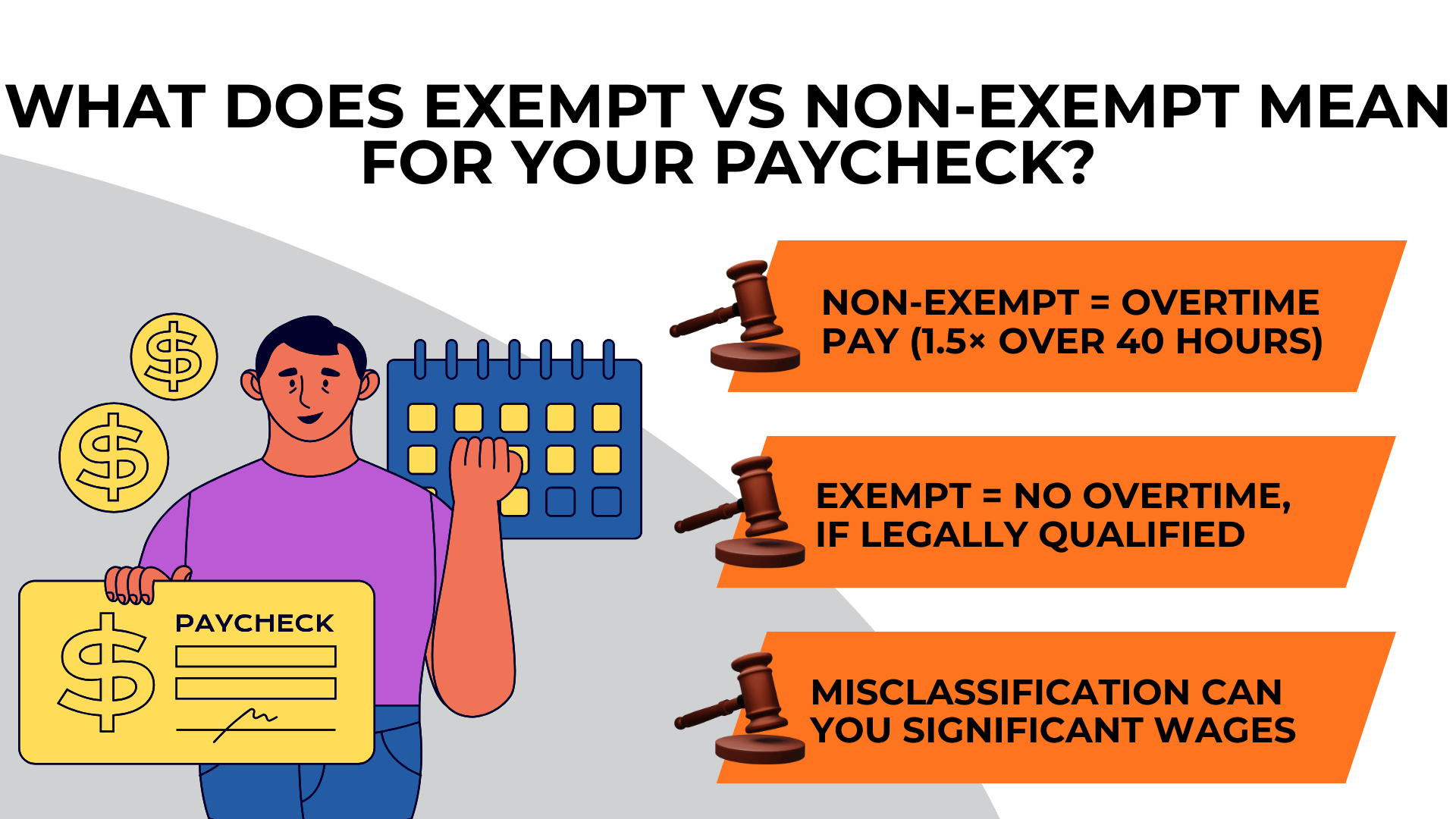
The exempt vs non-exempt distinction answers one fundamental question: must your employer pay you overtime? Under the Fair Labor Standards Act and state wage laws, the answer depends entirely on which category you fall into.
What happens if you’re classified as non-exempt?
Non-exempt employees are entitled to overtime pay at 1.5 times their regular hourly rate for every hour worked beyond 40 in a workweek. This requirement comes from 29 U.S.C. § 207(a)(1), and it applies regardless of whether you’re paid hourly or receive a salary. Your employer cannot waive this requirement, and you cannot agree to give it up.
What does it mean to be classified as exempt?
Exempt employees are excluded from overtime requirements—but only if the employer can prove the exemption legitimately applies. The word “exempt” refers to specific categories of workers that Congress carved out from overtime protection, primarily white-collar employees in executive, administrative, and professional roles. Being called exempt doesn’t make it true.
Why does your classification matter so much?
The financial impact is substantial. According to DOL data (2024), overtime violations represent approximately 85% of all FLSA back wage amounts recovered. When employers misclassify workers as exempt, those workers lose time-and-a-half pay for every overtime hour—losses that accumulate over months and years of employment.
What Tests Must Employers Pass to Classify You as Exempt?
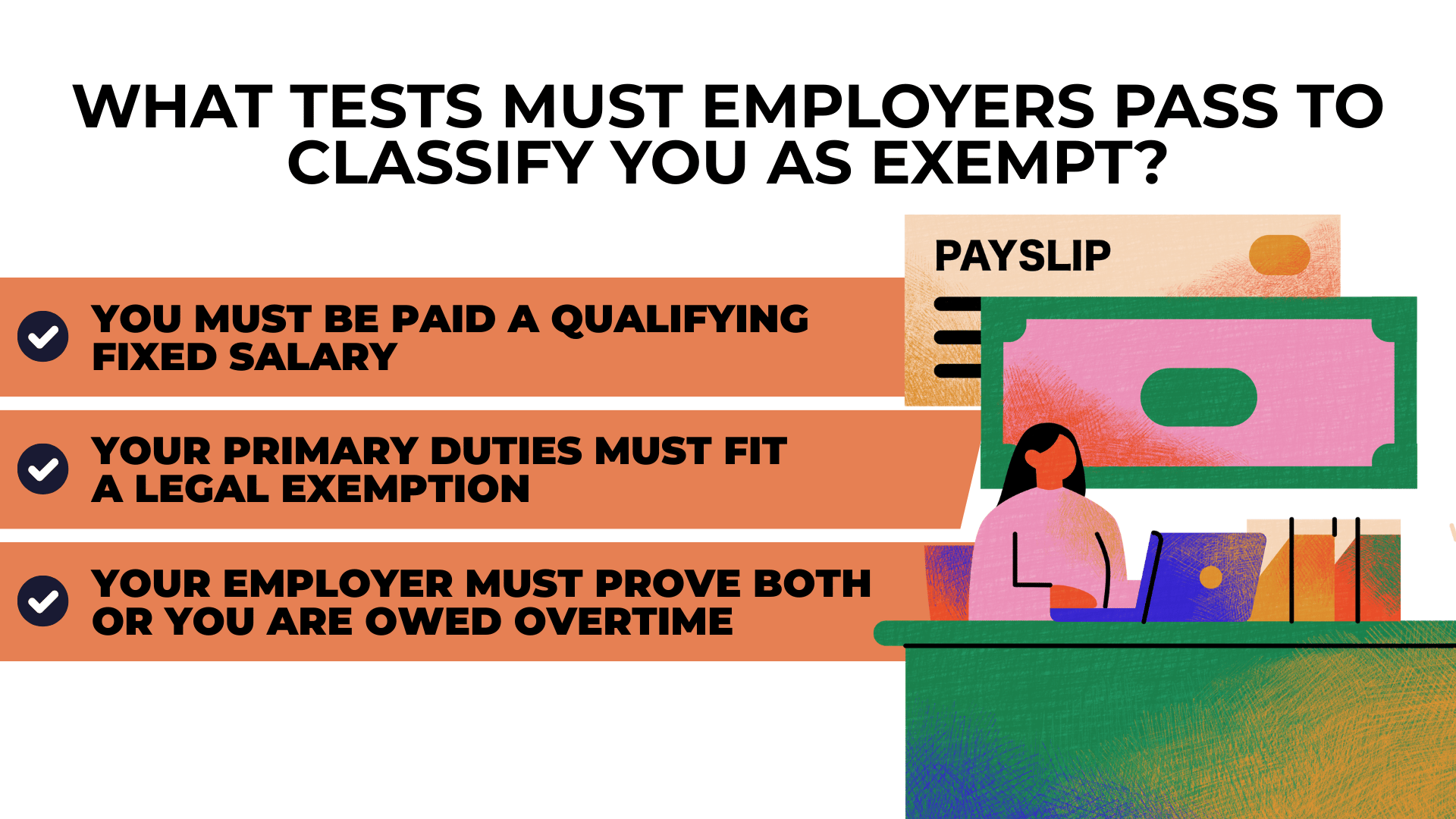
Federal law requires employers to satisfy a two-part test before classifying any employee as exempt from overtime. Under 29 C.F.R. § 541, the employer must prove both the salary basis test and the appropriate duties test. Failing either part means the employee is non-exempt and entitled to overtime.
What is the salary basis test?
The salary basis test requires that exempt employees receive a predetermined, fixed salary that does not vary based on the quality or quantity of work performed. The employee must receive their full salary for any week in which they perform any work, with limited exceptions. The federal salary threshold sets a minimum amount, though this figure has been subject to regulatory changes.
What are the duties tests for white-collar exemptions?
Beyond salary, the employee’s actual job duties must fall within a recognized exemption category. The employer must prove the employee genuinely performs exempt work—not just that they hold an impressive title. The primary white-collar exemptions under federal regulations include:
- Executive exemption: The employee’s primary duty must be managing the enterprise or a recognized department, they must regularly direct the work of at least two full-time employees, and they must have genuine authority to hire, fire, or make recommendations that carry weight.
- Administrative exemption: The employee’s primary duty must involve office or non-manual work directly related to management or business operations, and they must exercise discretion and independent judgment on significant matters.
- Professional exemption: The employee must perform work requiring advanced knowledge in a field of science or learning, customarily acquired through prolonged specialized education.
- Outside sales exemption: The employee’s primary duty must be making sales or obtaining contracts, and they must customarily work away from the employer’s place of business.
- Computer employee exemption: The employee must work as a computer systems analyst, programmer, or software engineer performing specific technical duties, with a salary or hourly rate meeting minimum thresholds.
Does Pennsylvania have different rules than federal law?
Yes. In Chevalier v. General Nutrition Centers, Inc., 656 Pa. 296 (Pa. 2019), the Pennsylvania Supreme Court held that Pennsylvania’s salary threshold test under the PMWA is independent of the federal FLSA threshold and may be more protective of employees. This means workers in Pennsylvania may be non-exempt under state law even if they would be exempt under federal standards.
What if my employer can’t prove both parts of the test?
The burden falls on the employer. As the U.S. Supreme Court clarified in Encino Motorcars, LLC v. Navarro, 584 U.S. 79 (2018), FLSA exemptions should receive a fair reading—but the employer still must demonstrate that the exemption applies. If your employer cannot prove you meet both the salary and duties requirements, you are non-exempt and entitled to overtime for all hours over 40.
How Do You Know If You’ve Been Wrongly Classified as Exempt?
Exempt misclassification often hides behind job titles. According to the National Employment Law Project’s “Broken Laws, Unprotected Workers” survey (2009), 76% of surveyed low-wage workers who worked more than 40 hours per week were not paid legally required overtime. The average worker experiencing an overtime violation had 11 hours of overtime either underpaid or unpaid each week.
Does your job title determine your exempt status?
No. What matters is what you actually do, not what your employer calls your position. An employer cannot transform a non-exempt job into an exempt one simply by changing the title to “manager,” “coordinator,” or “director.” The duties test examines your real day-to-day responsibilities, not the words on your business card or email signature.
What if you have “manager” in your title but don’t supervise anyone?
This is one of the most common misclassification scenarios. The executive exemption requires that you regularly direct the work of at least two full-time employees and have genuine input into hiring and firing decisions. If you’re called a manager but spend your days doing the same work as hourly employees—without supervisory authority—you likely don’t qualify for the executive exemption.
What are the warning signs of misclassification?
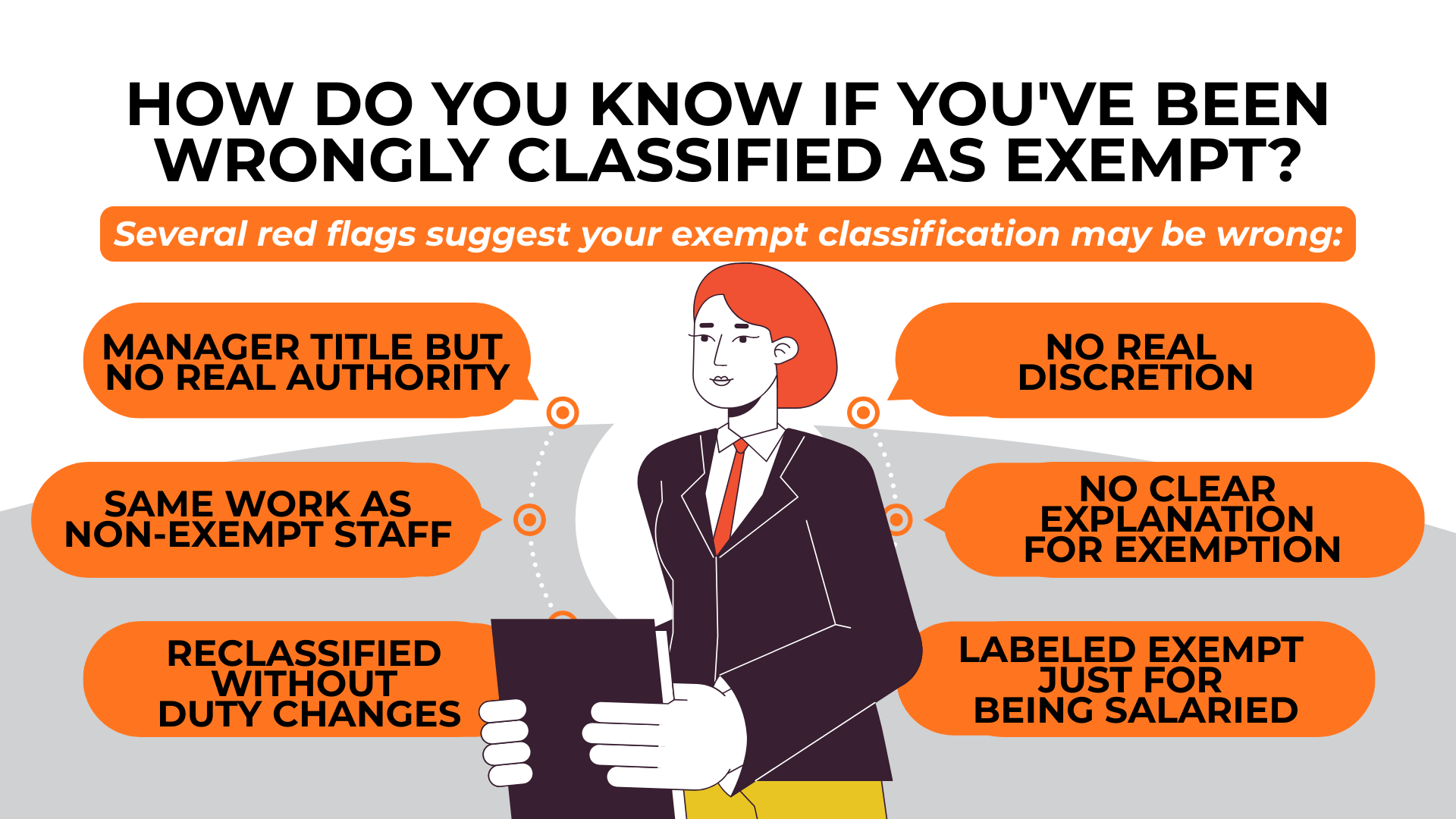
Several red flags suggest your exempt classification may be wrong:
- You have a managerial title but no actual supervisory duties or authority over other employees’ jobs.
- You perform the same tasks as non-exempt coworkers for most of your workday, despite your different classification.
- Your employer changed your classification from non-exempt to exempt without a corresponding change in your actual job duties.
- You have no real discretion or independent judgment—your work follows detailed procedures, scripts, or close supervision.
- Your employer refuses to discuss or explain why you’re classified as exempt when you ask.
- You were told you’re exempt because you receive a salary, with no mention of duties requirements.
If multiple red flags apply to your situation, your classification may not withstand legal scrutiny.
What Damages Can You Recover If Misclassified as Exempt?
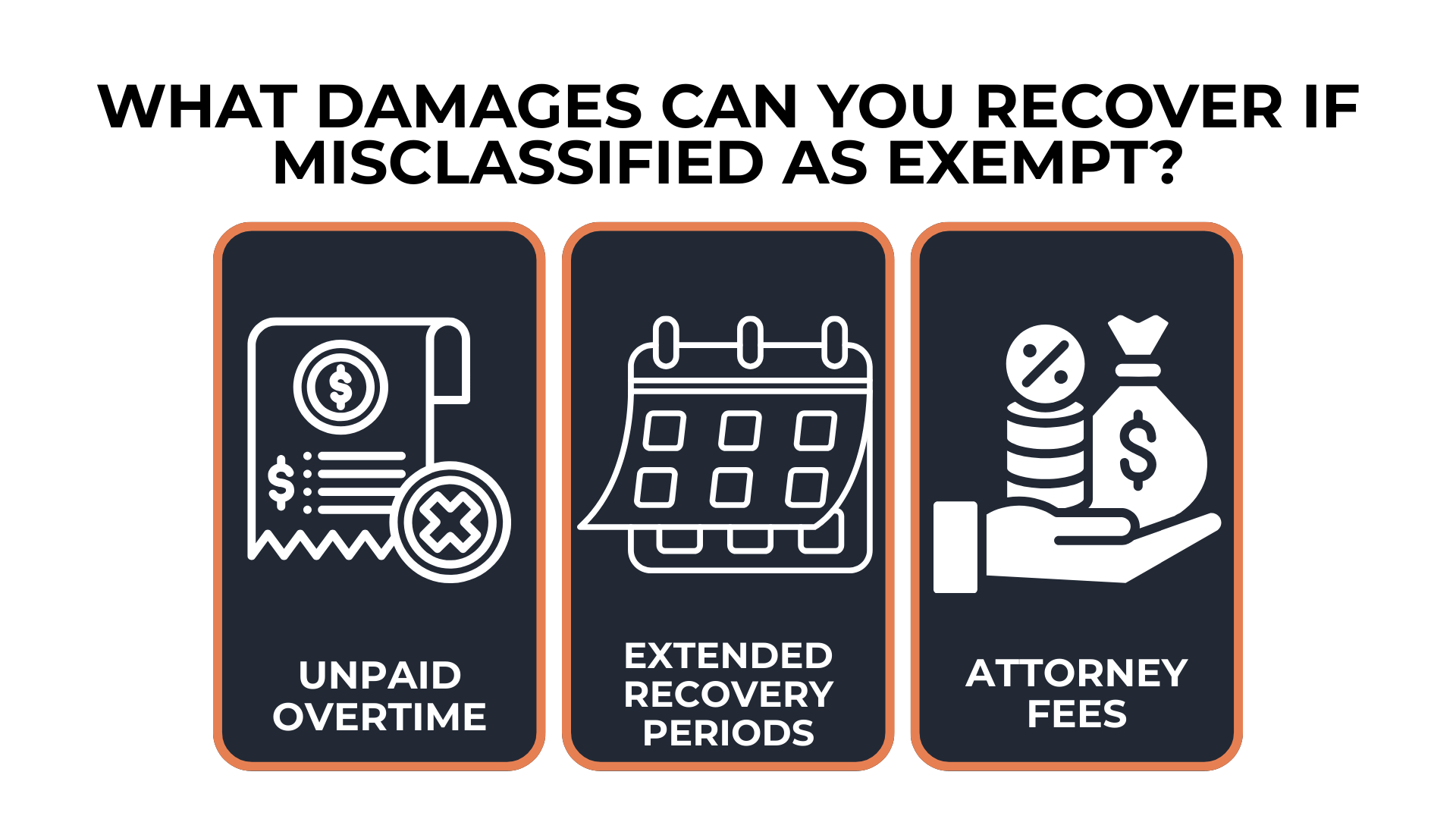
Employees who prove they were wrongly classified as exempt can recover substantial damages under federal and state law. The recovery extends well beyond just the unpaid overtime hours—enhanced damages and attorney fee shifting make these claims economically viable even when individual losses seem modest.
What can you recover under federal law?
Under 29 U.S.C. § 216(b), employees who prove FLSA overtime violations can recover their unpaid overtime wages plus an equal amount in liquidated damages—effectively doubling the recovery. The Third Circuit Court of Appeals made clear in Souryavong v. Lackawanna County, 872 F.3d 122 (3d Cir. 2017), that liquidated damages are the norm rather than the exception. The employer bears the heavy burden of proving both good faith and objectively reasonable grounds to reduce them.
How does New Jersey’s Wage Theft Act increase your recovery?
New Jersey provides even stronger remedies. Under N.J. Stat. Ann. § 34:11-4.10, as amended by the 2019 Wage Theft Act, employees can recover treble damages—three times the amount of unpaid wages. Combined with a six-year statute of limitations, New Jersey offers one of the most worker-protective frameworks in the nation for overtime claims.
What about Pennsylvania’s wage laws?
Pennsylvania’s remedies fall between federal and New Jersey standards. Under the Pennsylvania Wage Payment and Collection Law, 43 Pa. Stat. § 260.10, employees who succeed in wage claims can recover the wages due plus 25% liquidated damages (or $500, whichever is greater), along with reasonable attorney fees and costs.
Do you have to pay your own attorney fees?
No. All three jurisdictions provide mandatory attorney fee shifting to prevailing plaintiffs:
- Federal FLSA: 29 U.S.C. § 216(b) awards reasonable attorney fees and costs to employees who win.
- New Jersey: The Wage Theft Act includes attorney fee provisions for successful claims.
- Pennsylvania: 43 Pa. Stat. § 260.10 provides for recovery of attorney fees by prevailing employees.
This fee-shifting provision means that even workers with relatively small individual claims can find attorneys willing to take their cases.
How Long Do You Have to File an Exempt Misclassification Claim?
Time limits vary significantly depending on which law applies to your claim. Acting promptly preserves your ability to recover the maximum amount of unpaid overtime.
What is the federal statute of limitations?
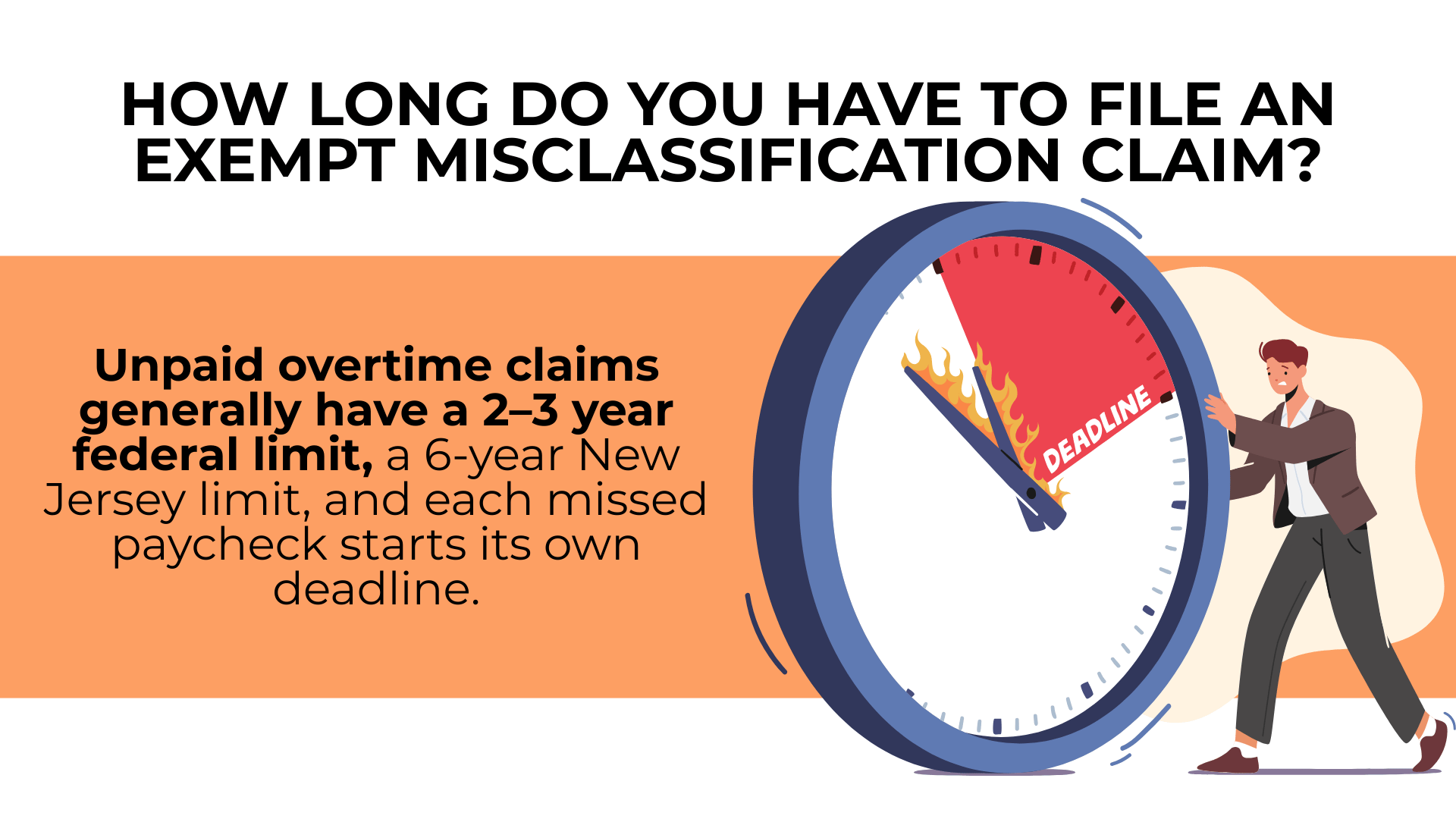
Under 29 U.S.C. § 255(a), FLSA claims must be filed within two years of the violation for non-willful violations or three years for willful violations. A violation is willful when the employer knew or showed reckless disregard for whether its conduct violated the law. The clock runs from each pay period, not from your last day of employment.
How much longer do you have under New Jersey law?
New Jersey’s Wage Theft Act provides a six-year statute of limitations under N.J. Stat. Ann. § 34:11-56a25.1. This extended window allows workers to recover overtime going back much further than federal law permits—a significant advantage for employees who didn’t realize they were misclassified until years into their employment.
Does each missed paycheck start a new deadline?
Yes. The statute of limitations runs from the date each pay period violation occurs, not from the last date of employment. Each paycheck that should have included overtime but didn’t constitutes a separate violation with its own limitations period. This continuing violation principle means you can still recover for recent violations even if earlier ones are time-barred.
How Widespread Is Exempt Misclassification?
Overtime violations, including exempt misclassification, represent the single largest category of wage theft in federal enforcement actions. The numbers reveal both the scope of the problem and the effectiveness of legal remedies.
How much money do workers lose to overtime violations?
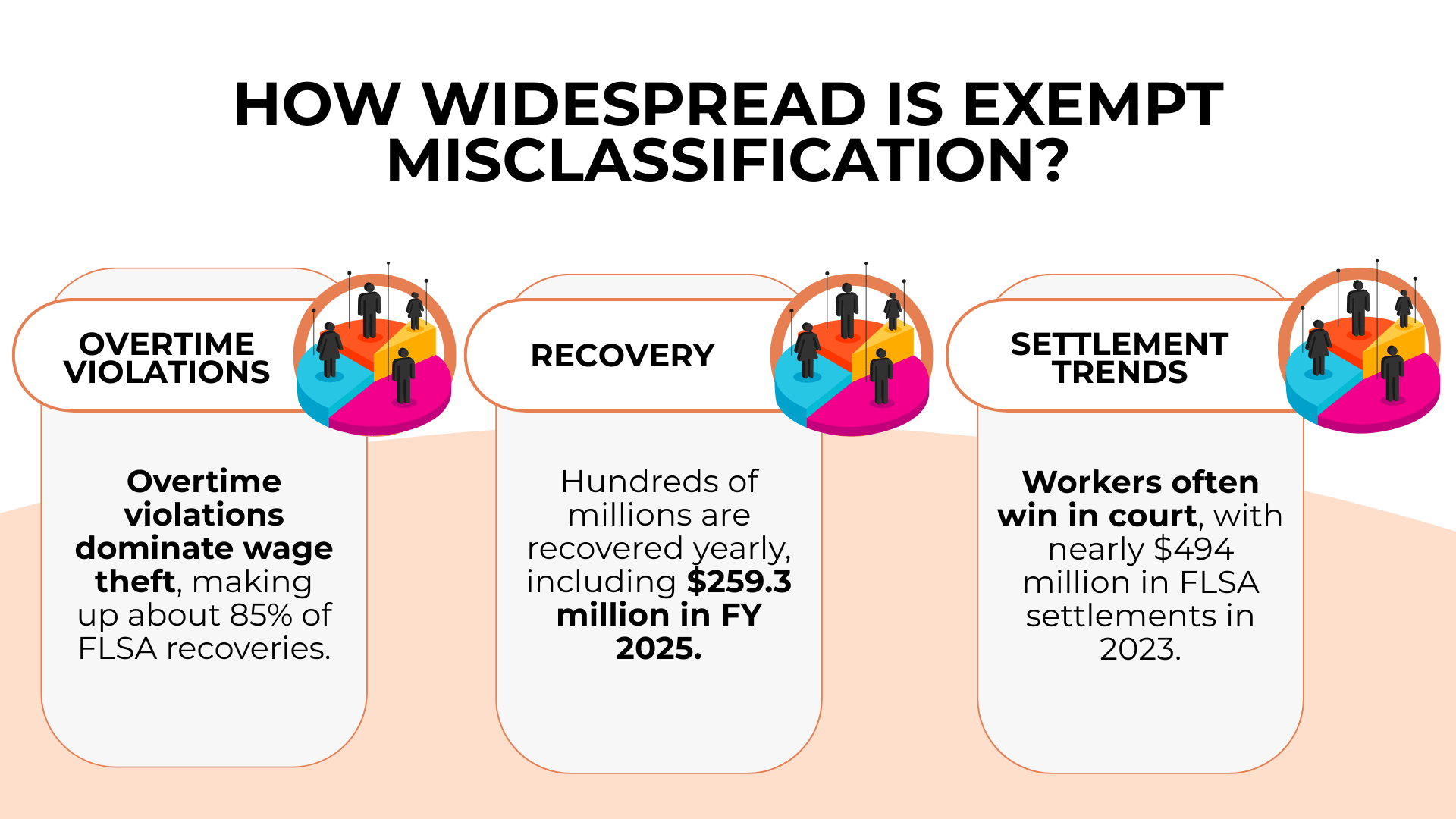
The scale is enormous. According to the U.S. Department of Labor Wage and Hour Division (2025), enforcement actions recovered $259.3 million in total back wages in fiscal year 2025—the highest recovery since 2019 and a 28% increase over the prior year. FLSA-specific enforcement exceeded $184 million in that same period, with the vast majority tied to overtime violations.
How common are overtime violations in enforcement actions?
Overtime violations dominate wage theft enforcement. The DOL’s fiscal year 2024 data shows that overtime back wages totaled $126,967,097 for 101,043 workers—representing roughly 85% of all FLSA recovery. Minimum wage violations, by comparison, accounted for just $15.3 million. This disparity reflects how frequently employers misclassify workers or fail to pay required overtime.
What do settlement trends show about these cases?
Private litigation recovers even more. According to the Seyfarth Shaw 2023 FLSA Litigation Metrics & Trends Report, FLSA collective action settlements totaled $493,571,392 across 423 cases in 2023—an average settlement of approximately $1.17 million per case. Plaintiffs achieved a 75% success rate on conditional certification motions, the first major hurdle in collective action litigation.
What Should You Do If You Think You’re Misclassified?
If the warning signs suggest you’ve been wrongly classified as exempt, taking organized action now protects your ability to recover unpaid overtime later.
What evidence should you gather?
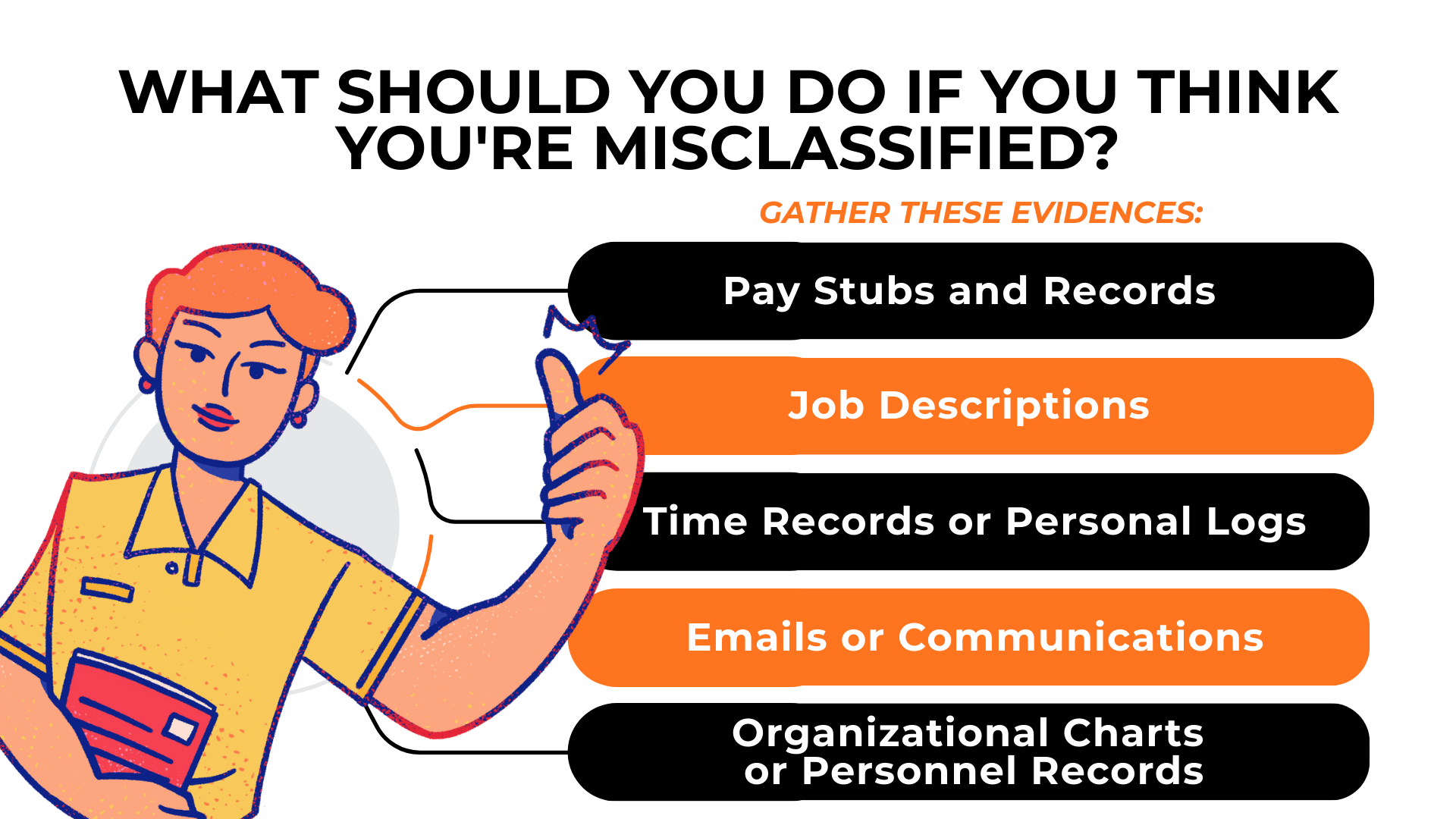
Documentation strengthens any wage claim. Start preserving evidence of your actual job duties and hours worked:
- Pay stubs and records showing your salary, hours, and classification status.
- Job descriptions from when you were hired and any updates since—compare these to your actual duties.
- Time records or personal logs documenting the hours you actually work, including early arrivals, late departures, and work from home.
- Emails or communications showing the tasks you perform, instructions you receive, and the level of supervision involved.
- Organizational charts or personnel records showing whether you actually supervise other employees.
Can you join together with coworkers who were also misclassified?
Yes. The FLSA allows employees to pursue claims as collective actions under 29 U.S.C. § 216(b), where workers who are “similarly situated” can opt in to a single lawsuit. The Supreme Court confirmed in Hoffman-La Roche Inc. v. Sperling, 493 U.S. 165 (1989), that courts may facilitate notice to potential plaintiffs by authorizing discovery of names and addresses of affected employees. State law claims may proceed as class actions under court rules, which use an opt-out rather than opt-in mechanism.
Why is it important to act quickly?
Every paycheck that passes may fall outside the statute of limitations. In states with shorter limitations periods, delay means lost recovery. Consulting with an employment attorney early allows you to understand your classification, evaluate your potential claims, and preserve your rights before deadlines pass.
Frequently Asked Questions
Can my employer make me exempt just by paying me a salary?
No. Salary is only one part of the two-part test for exempt status. Your employer must also prove that your actual job duties fall within a recognized exemption category—executive, administrative, professional, outside sales, or computer employee. Many salaried workers are non-exempt and entitled to overtime because their duties don’t qualify for any exemption.
What if I was exempt at my old job—does that mean I’m exempt now?
Not necessarily. Exempt status depends on the specific duties of each position, not your work history. Under the FLSA’s economic reality approach, as applied in cases like Razak v. Uber Technologies, Inc., 951 F.3d 137 (3d Cir. 2020), classification is a fact-intensive inquiry based on the actual working relationship. A job that qualified as exempt at one company may not qualify at another if the duties differ.
Can I recover overtime for years of misclassification?
It depends on the statute of limitations in your jurisdiction. Federal FLSA claims allow recovery for two years (three if the violation was willful). Pennsylvania provides three years. New Jersey’s Wage Theft Act extends the window to six years, allowing workers to recover significantly more unpaid overtime than under federal law alone.
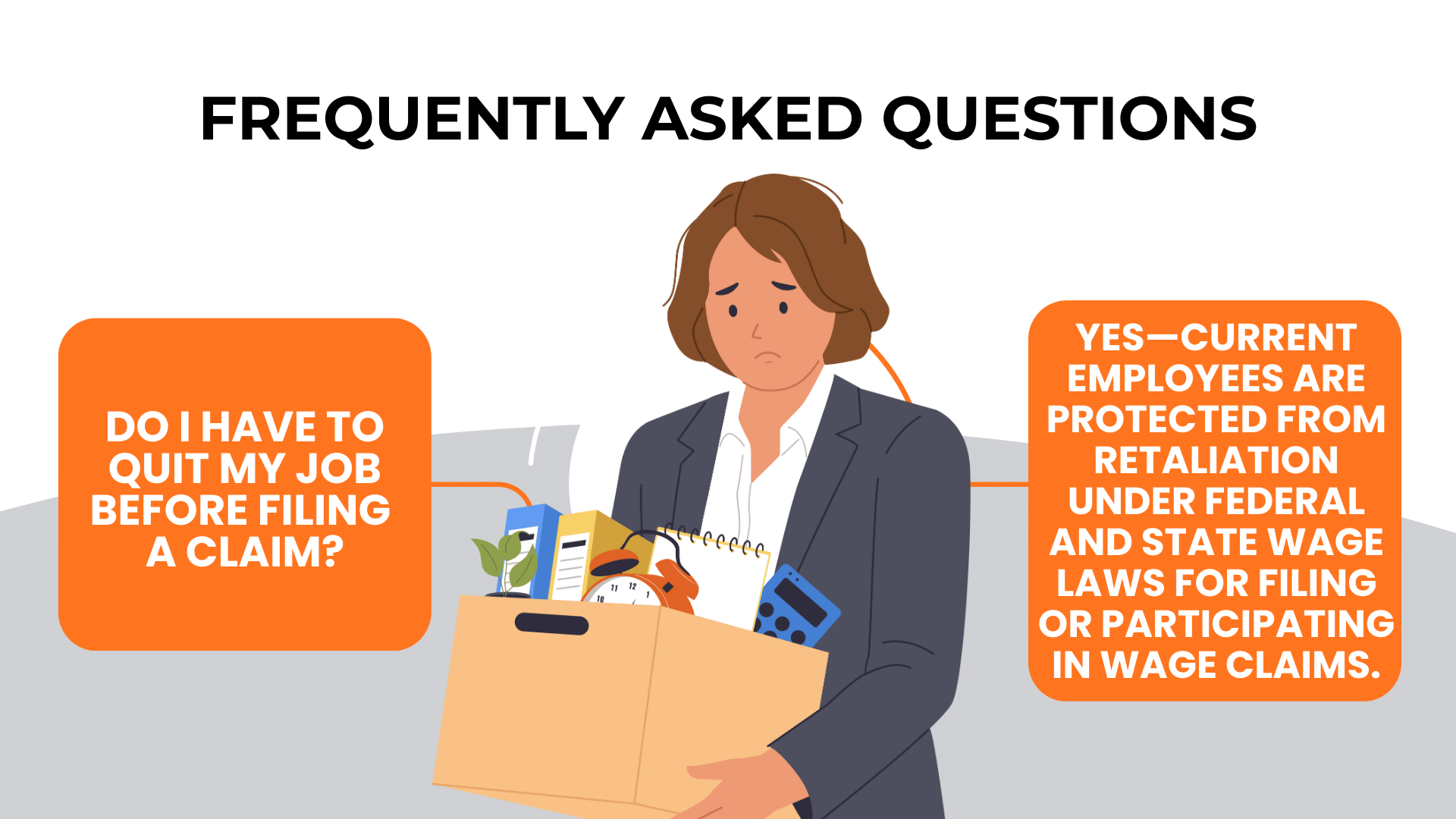
Do I have to quit my job before filing a claim?
No. The FLSA and state wage laws protect current employees who file claims or participate in wage investigations. Many workers pursue overtime claims while still employed, and collective actions often include both current and former employees. Retaliation for exercising wage rights is itself illegal under federal and state law.
What if my employer says the company is too small for overtime laws?
The FLSA applies to enterprises with annual gross sales of at least $500,000 and to individual employees engaged in interstate commerce. However, even if federal coverage is questionable, New Jersey and Pennsylvania state wage laws provide independent coverage that may apply to smaller employers. An employment attorney can evaluate which laws protect you.
Protect Your Right to Overtime Pay
The difference between exempt and non-exempt status determines whether you receive fair pay for your work—or subsidize your employer with unpaid hours. If your job duties don’t match a recognized exemption, you may be entitled to overtime you never received, plus enhanced damages that can double or triple your recovery.
The statute of limitations runs on every paycheck. If you believe you’ve been misclassified as exempt, contact The Lacy Employment Law Firm to discuss your situation.