

Get trusted legal support from experienced Pittsburgh employment lawyers at The Lacy Employment Law Firm. We specialize in employment law, including wrongful termination and discrimination cases, ensuring your rights are protected.
You may have signed a non-compete agreement. This is an agreement that precludes you from seeking employment with another company for a period of time. After signing this agreement, you may feel trapped.
You probably are wondering if there is any way around this agreement. Non-compete lawyers can help guide you.
To get around a non-compete, you need to know that you are breaking a contract. You also need to understand what that means. When you break a contract, your employer can go after you for:
NEW JERSEY PRACTICE AREAS
➤ New Jersey Employment Lawyer
➤ Disability and Reasonable Accommodations
➤ Discrimination Lawyer
➤ Age Discrimination Lawyer
➤ Race Discrimination Lawyer
➤ Pregnancy Discrimination Lawyer
➤ Disability Discrimination Lawyer
➤ Gender Discrimination Lawyer
➤ National Origin Discrimination Lawyer
➤ Religious Discrimination Lawyer
➤ Sexual Orientation Discrimination Lawyer
➤ Harassment Lawyer
➤ Sexual Harassment Lawyer
➤ Retaliation Lawyer
➤ Retaliation for Whistleblower Claims Lawyer
➤ Wage & Hour Lawyer
➤ Failure to Pay Overtime Lawyer
➤ Failure to Pay Wages Lawyer
➤ Employment Contracts Lawyer
➤ Severance Agreement Lawyer
➤ Breach of Contract Lawyer
➤ Wrongful Termination Lawyer
➤ Family Medical Leave Act (FMLA)
➤ Whistleblower Claims Lawyer
➤ Non-Compete Lawyer
Getting out of a non-compete is not easy. Non-compete agreements are clauses in contracts. And contract law differs from other areas of law.
This is because by signing a contract you are agreeing to terms you had a chance to review. When you attempt to get out of this agreement, you are essentially breaking a promise.
The basic definition of a contract is “a promise for a promise with consideration.” That means that one party promises to do something. The other party also promises to do something. And one party is getting something of value for the exchange of promises.
In the cases of non-compete agreements, one party promises not to work in the same field for a period of time. The other party promises work and compensation.
Under contract law, when a party breaks a promise, the other party is entitled to damages. Getting out of a non-compete agreement requires employees to essentially break their promise.
The good news, however, is that contract law is the one area that actually anticipates employees breaking their promises.
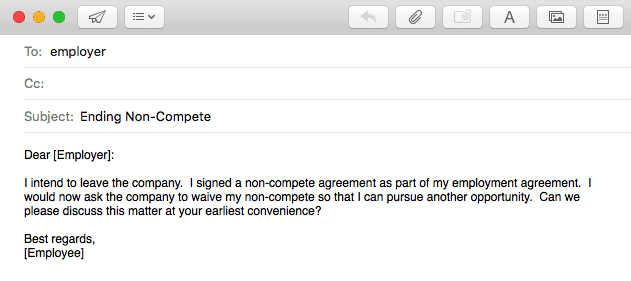
The first potential way out is the easy way. You can always just ask your former employer to waive your non-compete. Under contract law, a party is free to do so.
You may have been a great employee. Sometimes employers do not want to incur ill will,especially if they will not lose anything if you break your non-compete agreement. Keeping an employee that does not want to be at a company is not a great business move.
Also, the company may hope that you will spread goodwill after you leave. Perhaps they do not want to be perceived as unfair.
Of course, there is always the possibility that they will fire you if you suggest breaking your non-compete agreement. Figuring out whether your non-compete clause would remain in place would require legal advice from a non-compete attorney.
The other way out of a non-compete is the hard way. There is a reason for the expression “contracts are meant to be broken.” You can get out of a non-compete agreement by breaching your employment contract.
You can’t break your non-compete agreement without consequences. There is a chance that your former employer might consider it more trouble than it’s worth to enforce the agreement against you. But you should be prepared for the consequences.
Since we are no longer dealing with contract law, your employer can seek greater damages. Under tort trade secret law, you might be on the hook for:
We take many cases on a contingency basis—so you don’t pay unless we win. Reach out and let’s see what’s possible for your situation.