
When a manager or supervisor sexually harasses you at work, the power imbalance makes the situation particularly harmful and difficult to navigate. Your boss controls your schedule, assignments, performance reviews, and future at the company. Manager sexual harassment exploits that authority in ways that can devastate your career and wellbeing.
Pennsylvania and federal law recognize that supervisor harassment is different from harassment by coworkers. When managers harass employees, employers face heightened legal liability because they placed that person in a position of power over you. Understanding these distinctions helps you recognize what happened, document it effectively, and pursue appropriate legal remedies.
If you are experiencing or have experienced manager sexual harassment, you are not alone. According to the EEOC (FY 2023), more than 7,700 sexual harassment charges were filed with the agency that year—a 25% increase from the prior year and the highest level in 12 years. These numbers reflect growing awareness and willingness to hold harassers accountable.
What Behaviors Constitute Manager Sexual Harassment?
Manager sexual harassment encompasses a broad range of unwelcome conduct that occurs because of your sex. The behavior does not need to be explicitly sexual to qualify as harassment. What matters is whether the conduct was unwelcome, occurred because of sex, and was severe or pervasive enough to affect your working conditions.
Verbal conduct and comments
Verbal harassment from a manager may include sexual comments about your body or appearance, repeated requests for dates after you have declined, sexual jokes or innuendos directed at you, questions about your sex life or relationships, and degrading remarks about your gender. Because your manager controls aspects of your job, even subtle comments can create pressure that coworkers cannot exert.
Physical conduct and touching
Physical harassment includes unwanted touching, hugging, kissing, or brushing against you. It also encompasses blocking your movement, standing too close, or cornering you in private spaces. When a manager engages in physical harassment, the authority differential makes it harder to push back or escape the situation.
Visual and written harassment
Managers may also harass through emails, text messages, images, or social media communications. Sharing sexually explicit materials, sending inappropriate messages outside work hours, or displaying offensive images in the workplace all constitute potential harassment. These communications often provide valuable written evidence of the harassment.
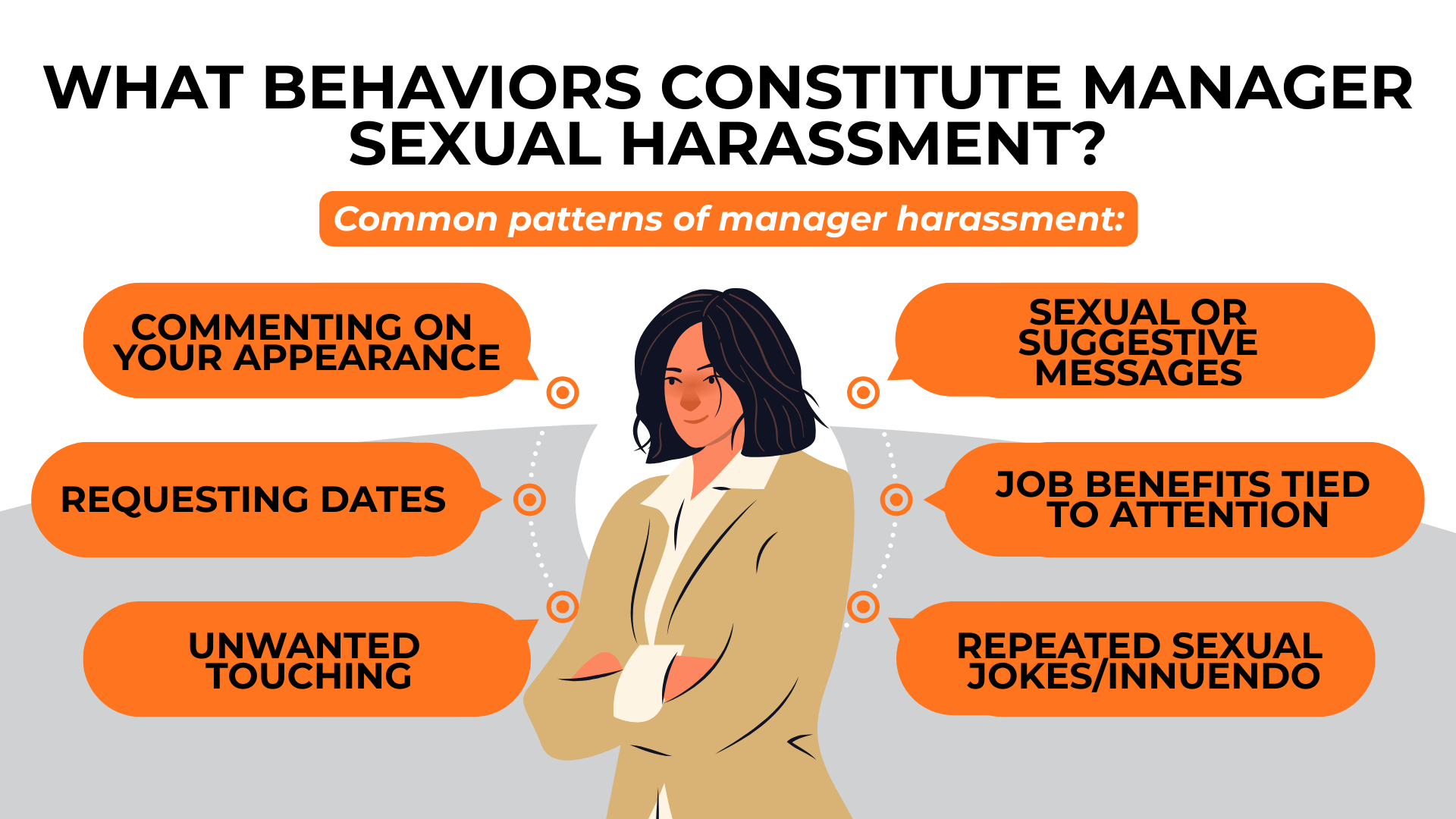
Common patterns of manager harassment
Manager sexual harassment frequently includes combinations of the following behaviors:
- Making comments about your body, clothing, or physical appearance during work conversations or performance discussions
- Requesting dates, sexual contact, or romantic involvement while overseeing your work assignments or schedule
- Touching your shoulders, back, arms, or other body parts without consent under the guise of mentorship or friendliness
- Sending texts, emails, or messages with sexual content, suggestive emojis, or requests to meet privately outside work
- Making job assignments, schedules, or opportunities contingent on your response to personal attention
- Creating a hostile atmosphere through persistent sexual jokes, comments, or innuendos that make you dread coming to work
Why Does Manager Harassment Carry Greater Legal Consequences?
The law treats harassment by supervisors differently than harassment by coworkers because managers exercise authority delegated by the employer. When a manager harasses you, courts hold the employer to a higher standard of accountability.
Who qualifies as a supervisor under the law
Under federal law established in Vance v. Ball State University, 570 U.S. 421 (2013), an employee qualifies as a supervisor only if empowered to take tangible employment actions against you. This includes the authority to hire, fire, promote, demote, transfer, or discipline you. Pennsylvania courts examining PHRA claims look at whether the individual had agency and the power to hire, fire, promote, or discipline the victim, as established in Hoy v. Angelone, 456 Pa. Super. 596 (Pa. Super. Ct. 1997).
When employers face strict liability
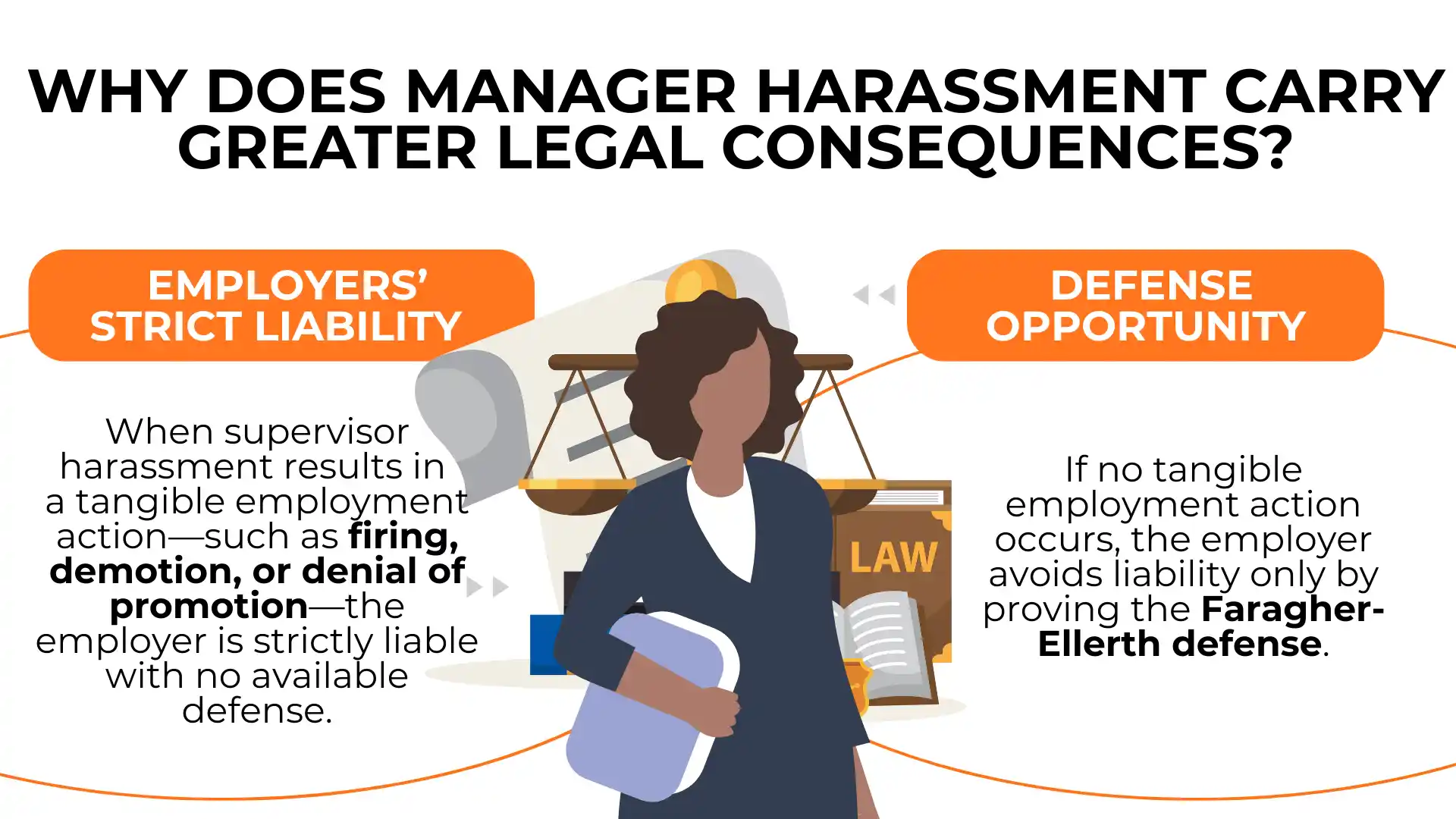
When supervisor harassment results in a tangible employment action—such as firing, demotion, undesirable reassignment, or denial of promotion—the employer is strictly liable. According to Burlington Industries, Inc. v. Ellerth, 524 U.S. 742 (1998), a tangible employment action constitutes “a significant change in employment status, such as hiring, firing, failing to promote, reassignment with significantly different responsibilities, or a decision causing a significant change in benefits.” When this happens, the employer cannot escape liability through any defense.
The employer’s limited defense opportunity
When supervisor harassment does not result in a tangible employment action, the employer may attempt to assert what is known as the Faragher-Ellerth affirmative defense, established in Faragher v. City of Boca Raton, 524 U.S. 775 (1998). To succeed, the employer must prove both that it exercised reasonable care to prevent and correct harassment, and that you unreasonably failed to take advantage of corrective opportunities. If either element fails, the employer remains liable.
How Do You Prove Manager Sexual Harassment?
To establish a hostile work environment claim, you must demonstrate several elements. Pennsylvania courts apply the five-element test from Hoy v. Angelone, 456 Pa. Super. 615 (Pa. Super. Ct. 1997): you suffered intentional discrimination because of your sex; the discrimination was regular and pervasive; the discrimination detrimentally affected you; the discrimination would detrimentally affect a reasonable person in the same position; and the employer knew or reasonably should have known about the harassment.
Meeting the severe or pervasive standard
Courts evaluate whether conduct was severe or pervasive by examining the totality of circumstances. Under Harris v. Forklift Systems, Inc., 510 U.S. 17 (1993), relevant factors include the frequency of the conduct, its severity, whether it was physically threatening or humiliating versus merely offensive, and whether it interfered with your work performance. A single extremely severe incident may suffice, while less severe conduct typically requires a pattern.
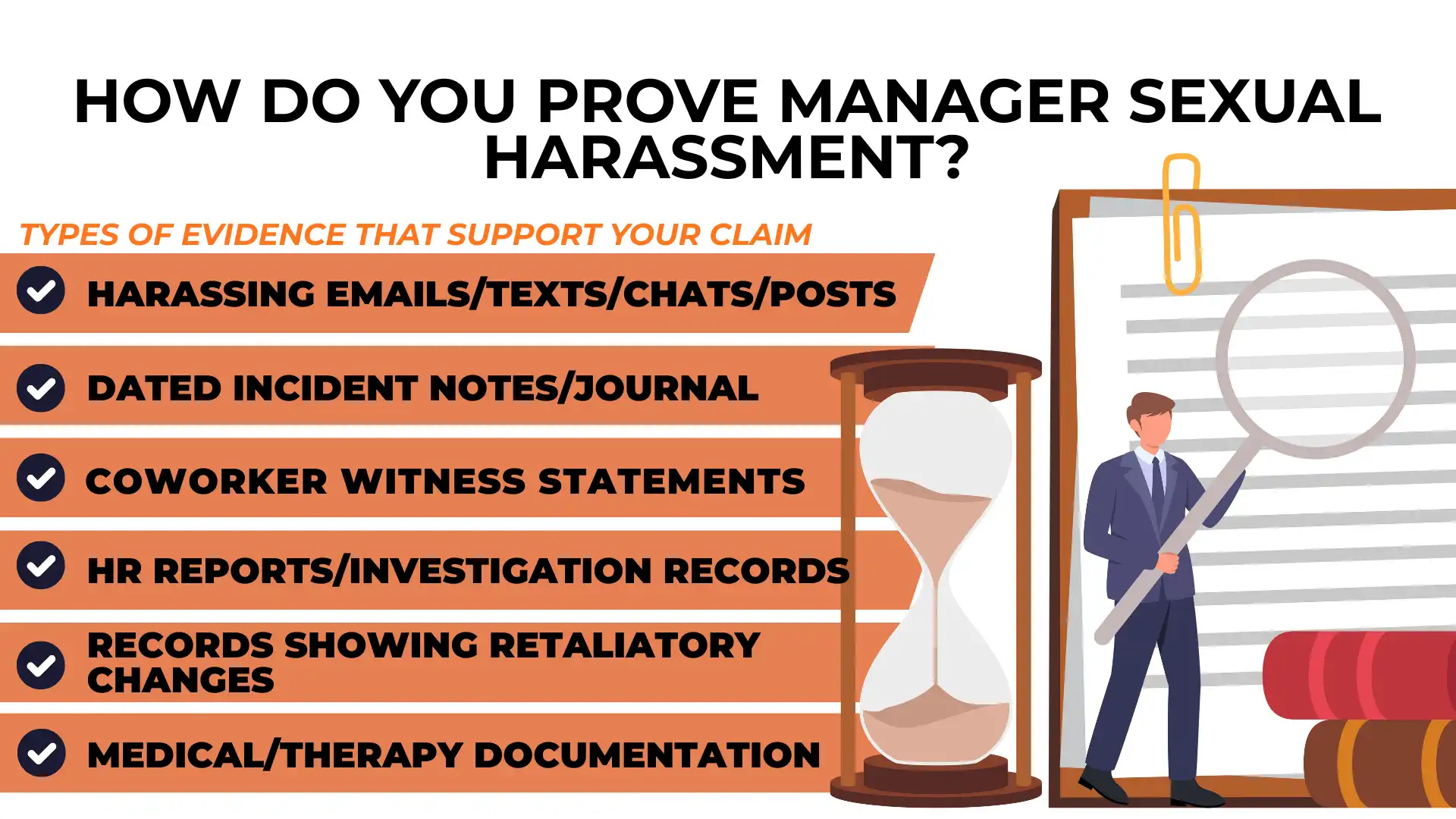
Types of evidence that support your claim
Building a strong harassment case requires gathering multiple types of evidence:
- Written communications including emails, text messages, instant messages, and social media exchanges that document harassing content
- Contemporaneous notes or a personal journal recording incidents with dates, times, locations, witnesses, and specific language used
- Witness statements from coworkers who observed the harassment or to whom you reported incidents at the time
- HR complaints, written reports, or internal investigation records showing you reported the conduct and the employer’s response
- Performance reviews, schedules, or assignment records showing changes that coincided with your rejection of advances or complaints
- Medical or therapy records documenting the psychological impact if you sought treatment for anxiety, depression, or other effects
The dual perspective requirement
Your claim must satisfy both an objective and subjective standard. You must actually perceive the environment as hostile or abusive—the subjective component. Additionally, a reasonable person in your position would need to find the environment hostile—the objective component. Courts do not require proof of psychological injury to meet this standard.
What Protections Exist Under Pennsylvania Law?
Pennsylvania employees have protection under both federal Title VII and the Pennsylvania Human Relations Act (PHRA). Each law offers distinct advantages, and pursuing claims under both statutes typically maximizes your legal options.
Broader employer coverage under Pennsylvania law
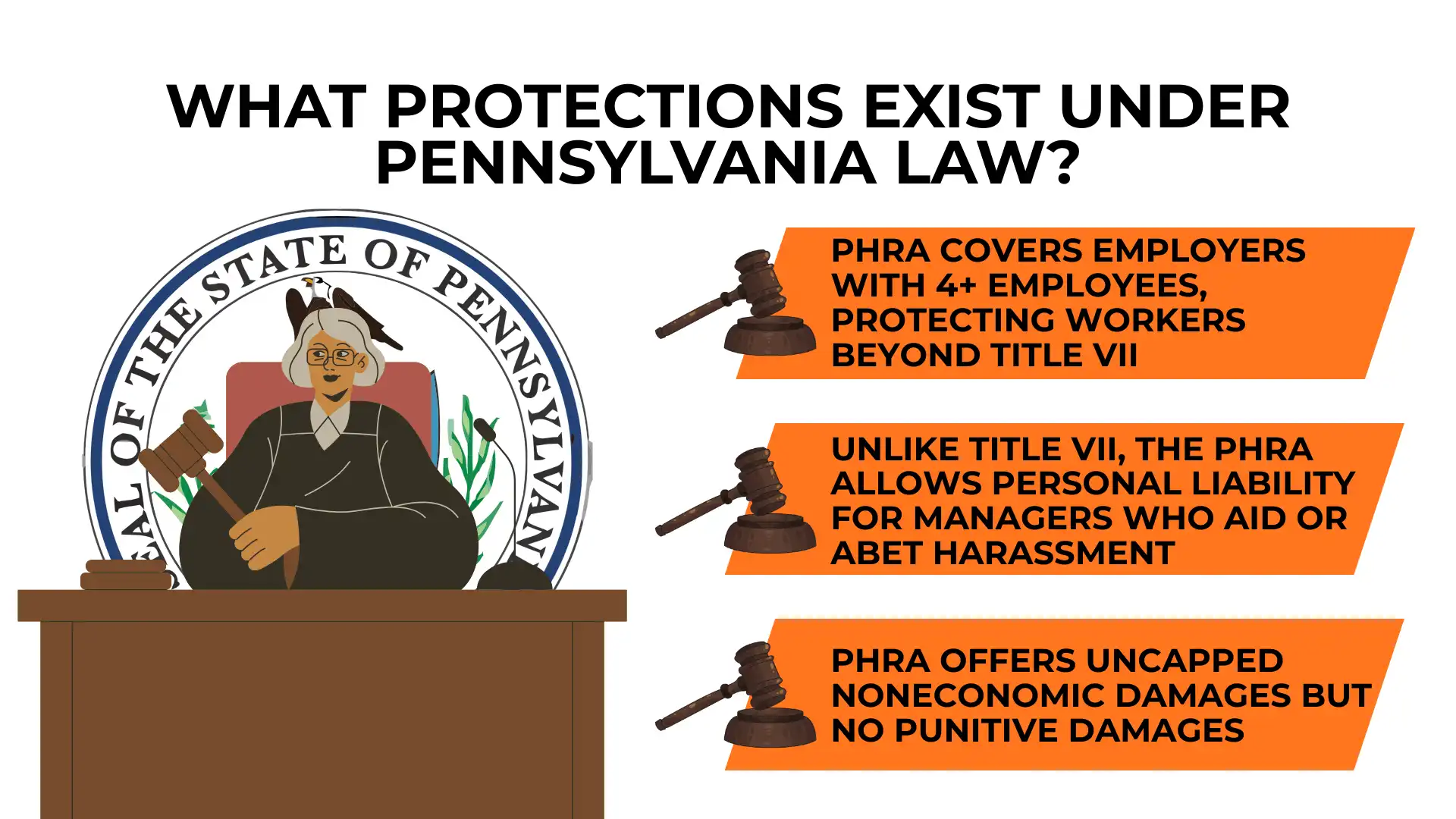
The PHRA covers employers with four or more employees under 43 P.S. § 954(b), significantly broader than Title VII’s 15-employee threshold. This means if you work for a small business that falls below federal coverage, Pennsylvania state law still protects you. This distinction matters considerably for employees at smaller companies.
Personal liability for your harasser
Unlike federal law, the PHRA permits individual liability under 43 P.S. § 955(e) for any person who aids, abets, incites, compels, or coerces unlawful discriminatory conduct. This means your manager can be held personally liable for the harassment—not just the employer. Title VII provides no such individual liability.
Comparing damage remedies
The PHRA offers uncapped compensatory damages for emotional distress, mental anguish, and other noneconomic harm—a significant advantage over federal law. Title VII caps combined compensatory and punitive damages between $50,000 and $300,000 depending on employer size under 42 U.S.C. § 1981a(b)(3). However, punitive damages are not available under the PHRA, as established in Hoy v. Angelone, 554 Pa. 134 (Pa. Sup. Ct. 1998). For particularly egregious conduct warranting punitive damages, Title VII claims become strategically important.
What Are the Filing Deadlines You Must Meet?
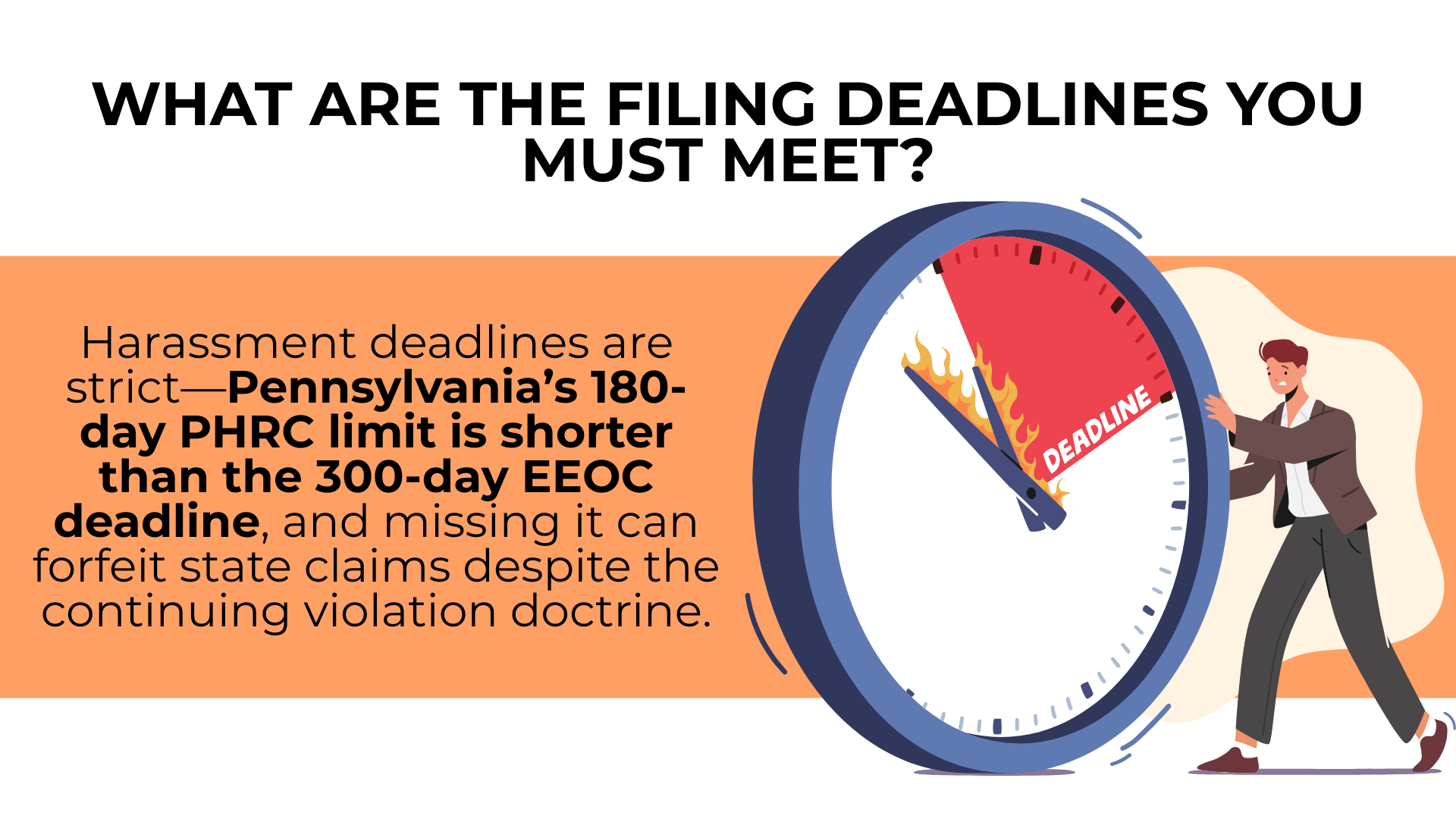
Filing deadlines in harassment cases are strict and missing them can permanently forfeit your legal claims. Pennsylvania’s state deadline is shorter than the federal deadline, creating a critical trap for employees who wait too long to act.
The 180-day Pennsylvania deadline
Under 43 P.S. § 959(h), you must file a complaint with the Pennsylvania Human Relations Commission (PHRC) within 180 days of the discriminatory act. This deadline is significantly shorter than federal timelines and represents one of the most common mistakes employees make. Missing this deadline forfeits your state law claims even if federal claims remain available.
Federal filing requirements
Because Pennsylvania is a deferral state with a local enforcement agency, the federal EEOC filing deadline extends to 300 days from the discriminatory act under 42 U.S.C. § 2000e-5(e)(1). After filing with the EEOC, you must obtain a right-to-sue letter before proceeding to federal court. Once the letter issues, you have only 90 days to file your federal lawsuit.
When earlier incidents remain actionable
Both federal courts and the PHRC recognize the continuing violation doctrine for hostile work environment claims. Under National Railroad Passenger Corp. v. Morgan, 536 U.S. 101 (2002), if at least one act contributing to the hostile environment occurs within the filing period, earlier incidents may also be considered. This doctrine recognizes that harassment often occurs as a pattern rather than isolated events.
What Damages Can You Recover for Manager Harassment?
Sexual harassment victims can recover substantial compensation. According to the EEOC (FY 2018-2021), $299.8 million was recovered for sexual harassment claims during that four-year period—$104 million more than the prior four years. This included $251.8 million from resolved charges and $48 million from litigation, benefiting 8,147 individuals.
Economic losses you can recover
Back pay compensates for wages and benefits lost because of the harassment or resulting termination. Front pay addresses future lost earnings when reinstatement is not feasible. These equitable remedies are authorized under 42 U.S.C. § 2000e-5(g)(1) and are not subject to federal damage caps. You must make reasonable efforts to mitigate damages by seeking comparable employment.
Categories of compensatory damages
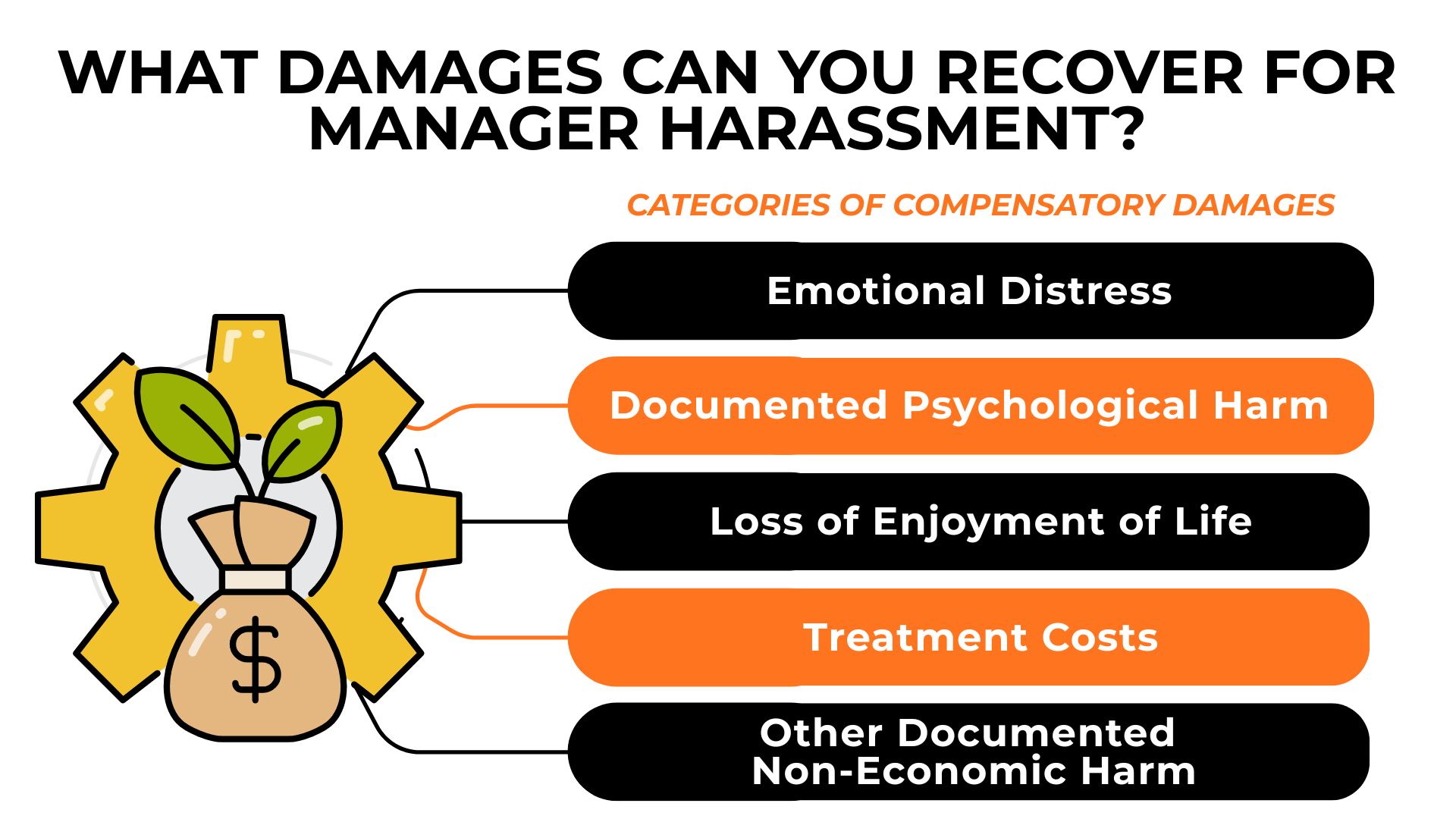
Compensatory damages address the full impact harassment has on your life:
- Emotional pain and suffering including anxiety, depression, humiliation, and loss of self-esteem resulting from the harassment
- Mental anguish and psychological harm documented through therapy records, medical treatment, or expert testimony
- Loss of enjoyment of life where the harassment has affected your relationships, hobbies, or daily activities
- Medical expenses for counseling, therapy, psychiatric treatment, or medication related to harassment effects
- Other nonpecuniary losses that can be documented and connected to the harassing conduct
Understanding case outcomes
When the EEOC takes harassment cases to court, outcomes are overwhelmingly favorable for victims. The EEOC Office of General Counsel (FY 2024) reports a 97% favorable resolution rate in district court litigation, obtaining settlement or favorable judgment in 128 of 132 merits suits resolved. Additionally, the EEOC (FY 2024) recovered nearly $700 million for discrimination victims that year—the highest in EEOC history—benefiting over 21,000 individuals.
What Steps Should You Take After Manager Harassment?
Many harassment victims hesitate to take action. According to the EEOC Select Task Force (2016), approximately 90% of individuals who experience harassment never file a formal charge. Fear of retaliation, uncertainty about legal options, and concerns about career consequences keep people from asserting their rights. However, taking documented action protects both your immediate situation and your legal claims.
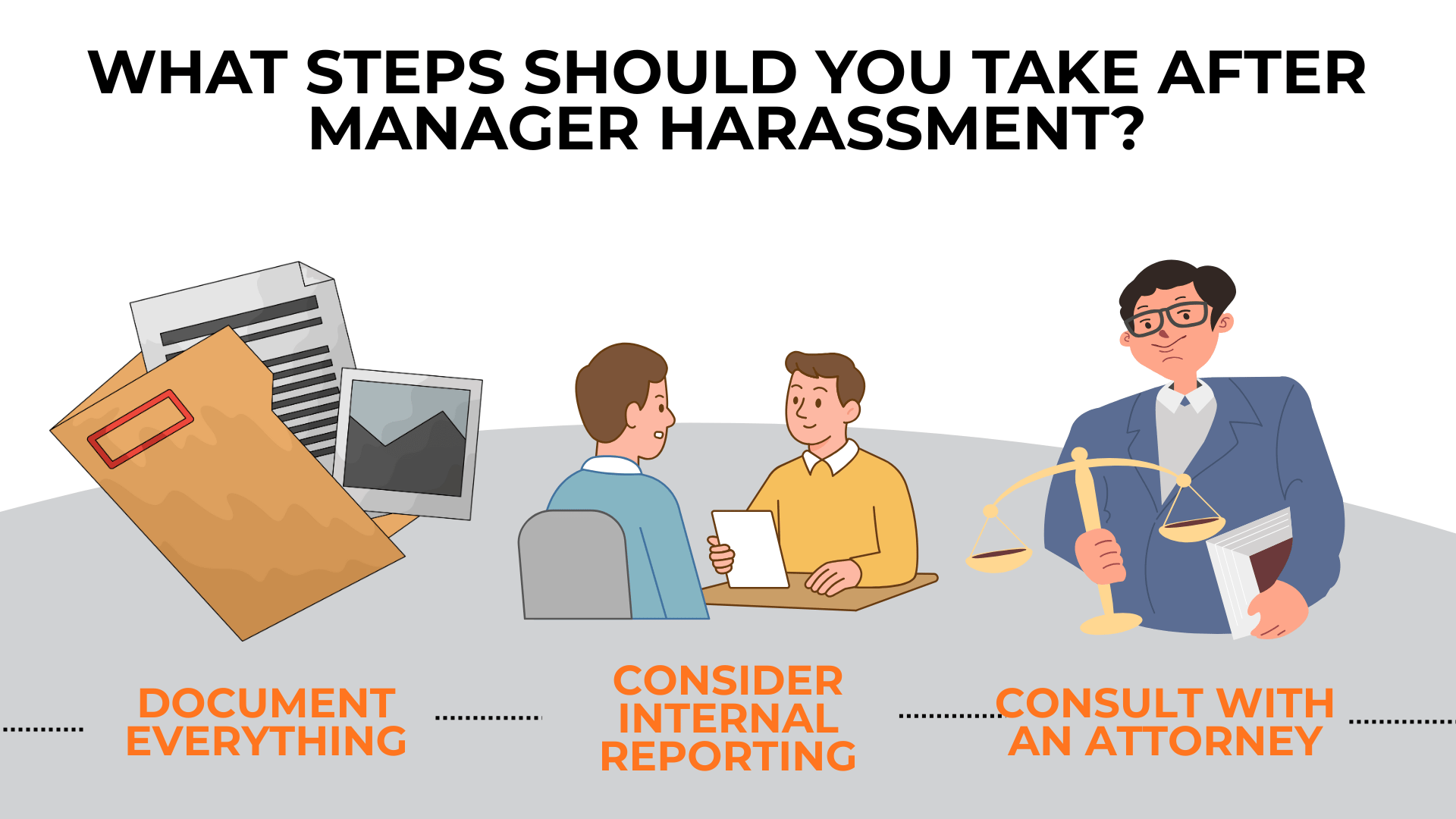
Document everything immediately
Create detailed written records of every incident as soon as possible after it occurs. Include the date, time, location, what was said or done, who witnessed it, and how you responded. Save all text messages, emails, and other communications. These contemporaneous records become critical evidence if you pursue legal action.
Consider internal reporting strategically
Internal reporting can strengthen your legal position by demonstrating that the employer knew about the harassment. However, weigh the risks carefully—reporting may trigger retaliation, and HR often protects the company rather than employees. If you report, do so in writing and keep copies of everything you submit.
Consult with an employment attorney promptly
Given the strict filing deadlines—especially Pennsylvania’s 180-day limit—consulting an attorney quickly protects your options. An experienced employment lawyer can evaluate your situation, advise on the strength of your claims, guide documentation efforts, and ensure deadlines are met. Many employment attorneys offer free initial consultations.
Immediate protective steps
Taking prompt action preserves your rights and strengthens potential claims:
- Write down everything you can remember about past incidents, even if they occurred months ago, including approximate dates and any witnesses
- Forward any harassing texts or emails to a personal email account or take screenshots before they can be deleted
- Identify coworkers who witnessed incidents or to whom you disclosed the harassment at the time
- Obtain copies of your personnel file, performance reviews, and any HR complaint records through a formal request
- Avoid discussing the situation on social media or in workplace chats that could be monitored or discovered
- Calculate the 180-day PHRC filing deadline from the most recent incident and work backward to establish a timeline for action
Frequently Asked Questions About Manager Sexual Harassment
Can I sue my manager personally for sexual harassment in Pennsylvania?
Yes, under the Pennsylvania Human Relations Act. The PHRA’s aiding and abetting provision at 43 P.S. § 955(e) allows individual liability for any person who aids, abets, incites, compels, or coerces unlawful discriminatory conduct. This means your manager can be named as a defendant and held personally responsible for damages. Federal Title VII does not permit individual liability—only the employer entity can be sued under federal law.
What if I did not report the harassment to HR—can I still file a legal claim?
Yes, you can still pursue legal claims even without internal reporting. While internal complaints can strengthen your case, they are not required to file with the EEOC or PHRC. However, if no tangible employment action resulted from the harassment, the employer may try to use your failure to report as part of their affirmative defense. An attorney can help you assess how this affects your particular situation.
How do I know if the harassment was severe enough to be illegal?
Courts examine the totality of circumstances rather than applying a bright-line rule. Factors include how often the conduct occurred, whether it was physically threatening or humiliating, and whether it interfered with your work. A single severe incident—such as physical assault or explicit quid pro quo demand—may suffice. Repeated less-severe incidents that create a pattern can also meet the standard. Consulting with an attorney helps evaluate whether your specific facts meet the legal threshold.
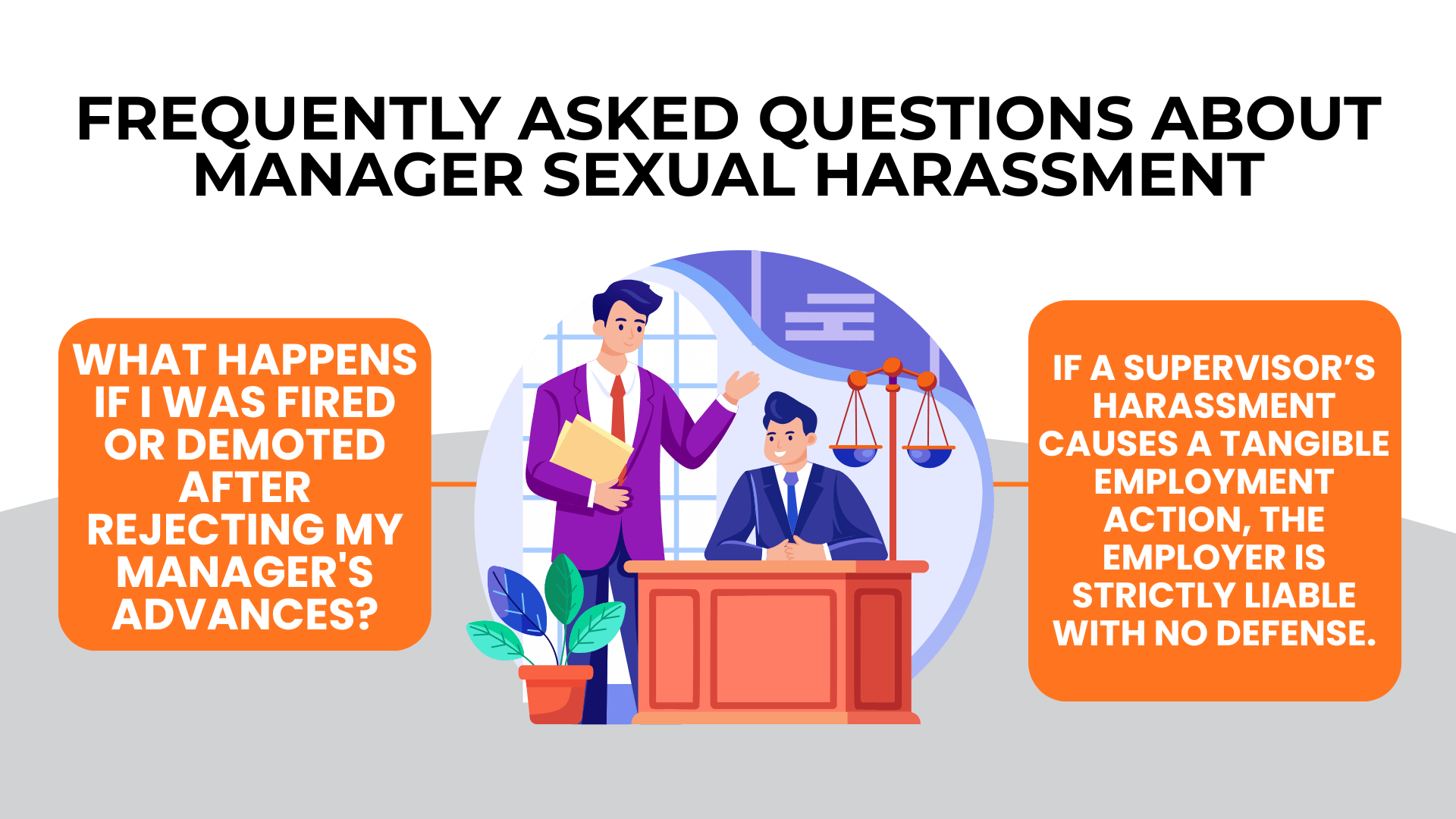
What happens if I was fired or demoted after rejecting my manager’s advances?
When a supervisor’s harassment results in a tangible employment action like termination, demotion, or significant reassignment, your employer faces strict liability with no available defense. This represents the strongest legal position for a harassment victim. The employer cannot argue that it had good policies or that you failed to report—the tangible action itself creates automatic liability.
What is the difference between the 180-day and 300-day filing deadlines?
The 180-day deadline applies to Pennsylvania Human Relations Commission filings under the PHRA. The 300-day deadline applies to federal EEOC charges under Title VII. Because Pennsylvania is a deferral state, federal filers get the extended deadline. However, missing the 180-day deadline forfeits your state law claims and their advantages—including uncapped compensatory damages and individual liability—even if federal claims remain viable. Filing within 180 days preserves both options.
Protecting Your Rights After Manager Sexual Harassment
Manager sexual harassment exploits workplace power dynamics in ways that can devastate your career, finances, and emotional wellbeing. Pennsylvania and federal law provide meaningful remedies for victims, including compensation for lost wages, emotional distress, and other damages. When managers engage in harassment, employers face heightened liability that often results in substantial recoveries for victims.
The most important step is acting before deadlines expire. Pennsylvania’s 180-day PHRC filing deadline is a critical constraint that forfeits valuable state law protections if missed. Documenting incidents, preserving evidence, and consulting with an attorney promptly protects your ability to pursue all available remedies.
Contact The Lacy Employment Law Firm to discuss your manager sexual harassment situation.