

When your employer expects you to arrive early to set up, stay late to clean up, or work through your lunch break without pay, you’re not imagining the problem. Working off the clock is illegal under federal law, and it costs American workers billions of dollars every year. According to the U.S. Department of Labor Wage and Hour Division (2025), federal enforcement actions recovered $259.3 million in back wages for workers in fiscal year 2025 alone—the highest recovery in six years. Much of that money came from employers who required or allowed employees to work without compensation.
If you’ve been working before clocking in, after clocking out, or through breaks that get automatically deducted from your time, you likely have legal options. Federal law and state laws in New Jersey and Pennsylvania provide strong protections for workers, including the ability to recover not just your unpaid wages but additional damages that can double or even triple your recovery.
Is Working Off the Clock Illegal Under Federal Law?
Yes. The Fair Labor Standards Act requires employers to pay non-exempt employees for all hours worked. This isn’t limited to time spent on your primary job duties—it includes any time your employer “suffers or permits” you to work. According to the U.S. Department of Labor (2025), 176,957 workers received back wage awards through federal enforcement actions in FY 2025, averaging approximately $1,465 per worker.
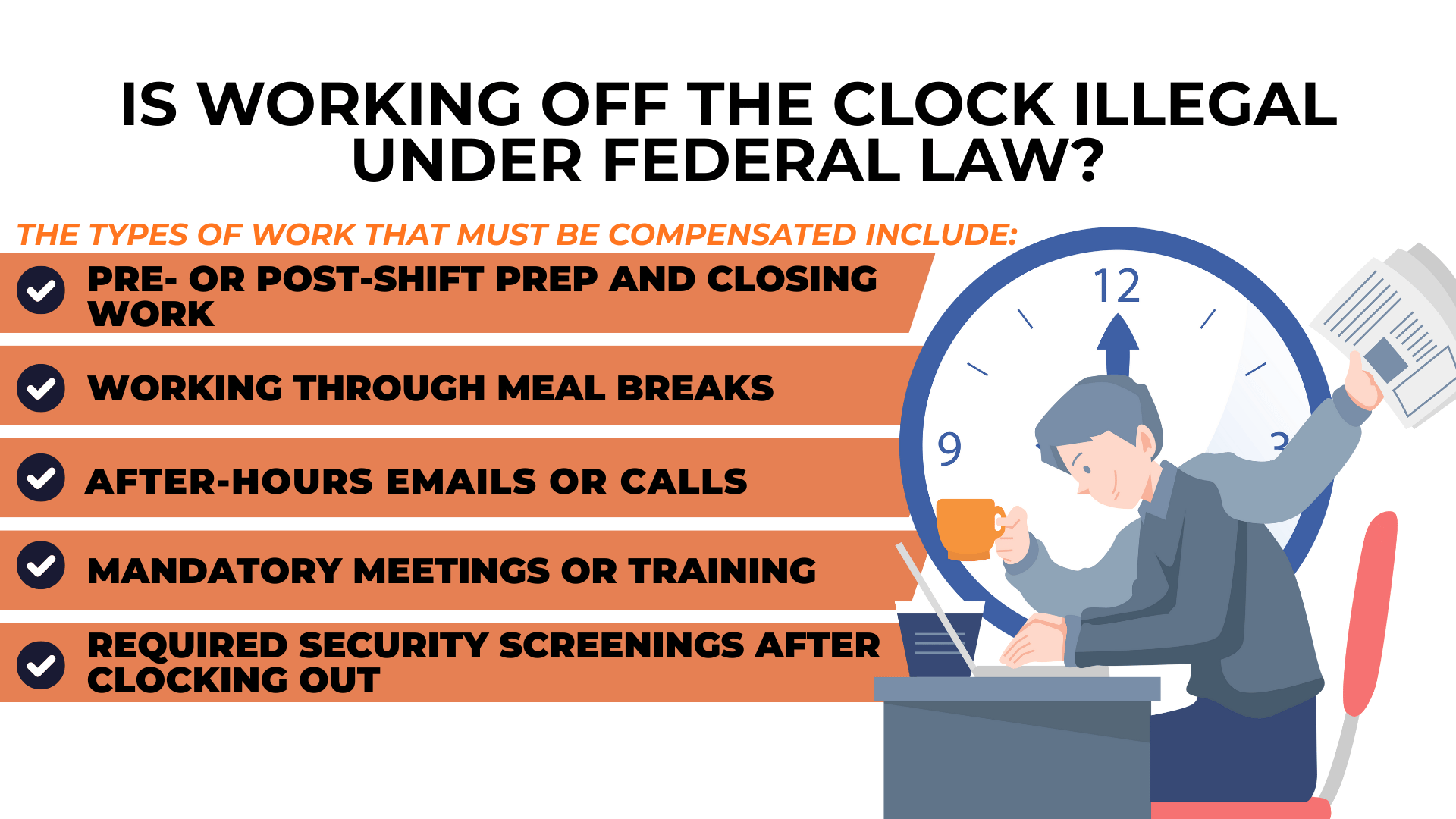
The types of work that must be compensated include:
- Arriving early to boot up computers, gather supplies, or prepare your workspace
- Staying late to complete closing procedures, file paperwork, or secure the building
- Working through meal breaks while remaining on duty
- Responding to work emails or calls outside scheduled hours
- Attending mandatory meetings or training before or after shifts
- Undergoing required security screenings after clocking out
What does “suffered or permitted to work” mean?
Under 29 C.F.R. § 785.11, work that is not requested but “suffered or permitted” is still work time. This means if your employer knows or has reason to know you’re performing work, they must pay you—even if they didn’t explicitly ask you to do it. The regulation places the burden on employers to exercise control over employees’ work time and ensure all hours are properly recorded and compensated.
Does it matter if my employer told me not to work off the clock?
Many employers post policies prohibiting off-the-clock work while simultaneously creating conditions that make unpaid work unavoidable. A written policy doesn’t shield an employer from liability. If management knows employees are working off the clock—whether through direct observation, time records, or common practice—the employer must pay for that time regardless of any policy to the contrary. Employers cannot benefit from work while claiming they never authorized it.
What if I’m a salaried employee?
Being paid a salary doesn’t automatically mean your employer can require unlimited work without overtime compensation. The key distinction is whether you’re classified as exempt or non-exempt under the FLSA. Non-exempt salaried employees must still receive overtime pay for hours exceeding 40 per week. Only employees meeting specific salary and duties tests for executive, administrative, or professional exemptions are exempt from overtime requirements.
What Types of Off-the-Clock Work Are Illegal?
The FLSA’s definition of “hours worked” extends well beyond time spent performing your core job functions. Any time that is integral and indispensable to your principal work activities must be compensated.
According to the National Employment Law Project (2009), 70% of workers who came in early or stayed late did not receive pay for that time. This represents one of the most pervasive forms of wage theft affecting American workers.
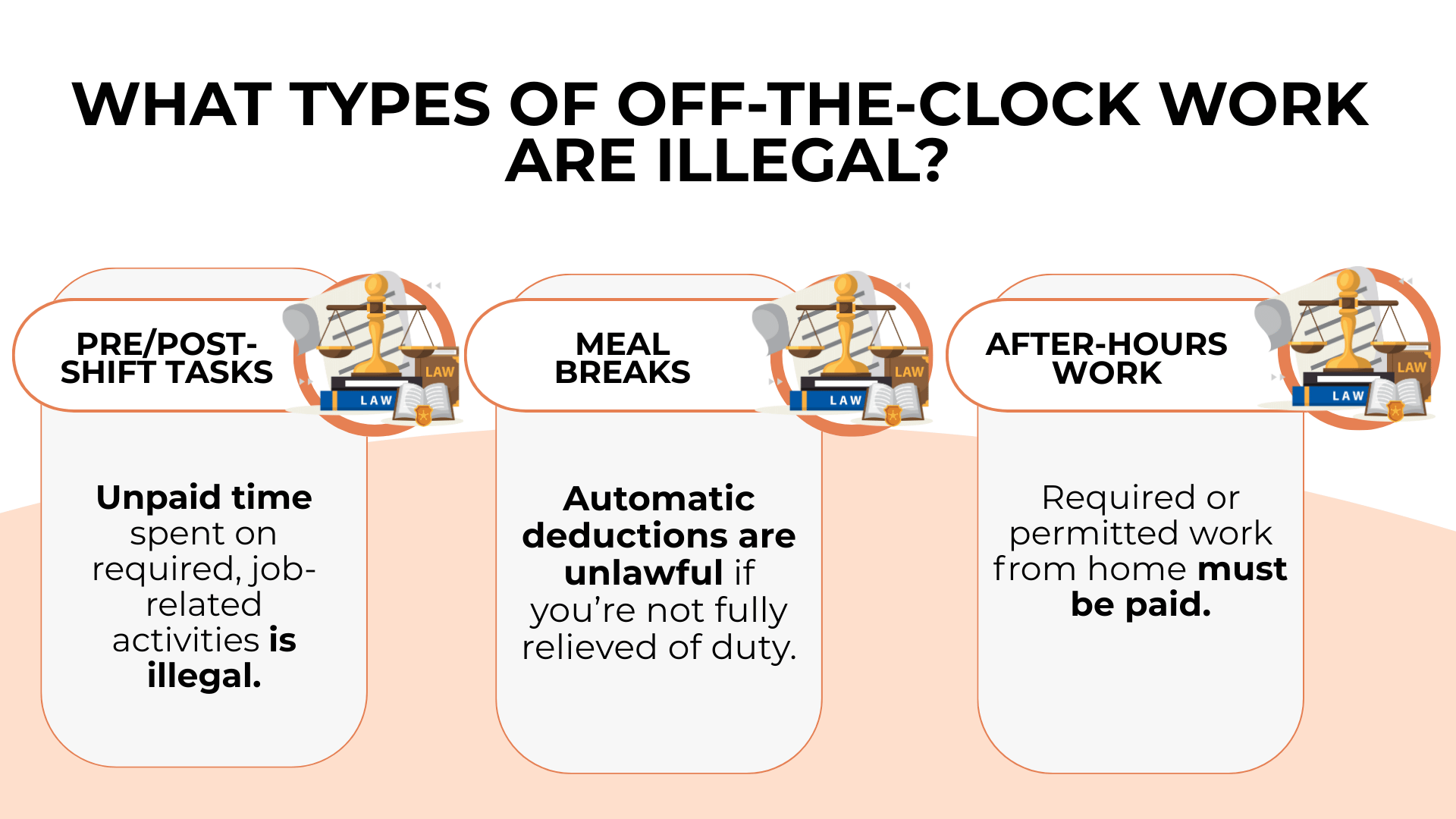
What counts as pre-shift or post-shift work?
Pre-shift and post-shift activities are compensable when they are necessary for you to perform your job. The Supreme Court addressed this directly in IBP, Inc. v. Alvarez, 546 U.S. 21 (2005), holding that time spent walking between donning/doffing areas and production areas is compensable when integral and indispensable to principal work activities.
Compensable pre-shift and post-shift activities typically include:
- Putting on required uniforms, protective gear, or safety equipment
- Gathering tools, equipment, or materials necessary for work
- Undergoing mandatory security screenings or bag checks
- Attending shift briefings or receiving daily assignments
- Logging into computer systems or loading required software
- Completing end-of-shift paperwork or closing procedures
- Counting cash drawers or reconciling daily transactions
- Cleaning workstations or equipment as a job requirement
The Portal-to-Portal Act, 29 U.S.C. §§ 251–262, excludes purely “preliminary and postliminary” activities, but courts interpret this narrowly. In Integrity Staffing Solutions, Inc. v. Busk, 574 U.S. 27 (2014), the Supreme Court held that post-shift security screenings were not compensable only because they were not integral to the employees’ principal warehouse activities—they were imposed for the employer’s benefit in preventing theft, not as part of the job itself.
Are automatic lunch deductions legal?
Many employers automatically deduct 30 minutes or an hour from employee time records for meal periods. This practice is legal only if employees are completely relieved of all duties during that time. Under 29 C.F.R. § 785.19, a bona fide meal period requires that the employee be “completely relieved from duty for the purposes of eating regular meals.”
If you’re expected to remain at your station, answer phones, monitor equipment, or stay available to respond to customers or supervisors during your “break,” you are not completely relieved—and that time must be compensated. The Third Circuit reinforced this principle in Smiley v. E.I. DuPont De Nemours & Co., 839 F.3d 325 (3d Cir. 2016), holding that an employer cannot offset compensation for meal breaks against overtime obligations under the FLSA.
According to the U.S. Department of Labor (2021), 85% of restaurant investigations resulted in violations—with meal break and off-the-clock violations among the most common findings in food service enforcement actions.
What about work I do from home after my shift?
The proliferation of smartphones and remote connectivity has created new opportunities for off-the-clock violations. If your employer expects you to answer emails, take calls, review documents, or complete tasks outside your scheduled hours, that time is compensable under the “suffered or permitted” standard. The same rules apply whether you’re working from a company facility or your living room. Employers who provide work phones or require after-hours availability must track and compensate that time.
How Common Are Off-the-Clock Violations?
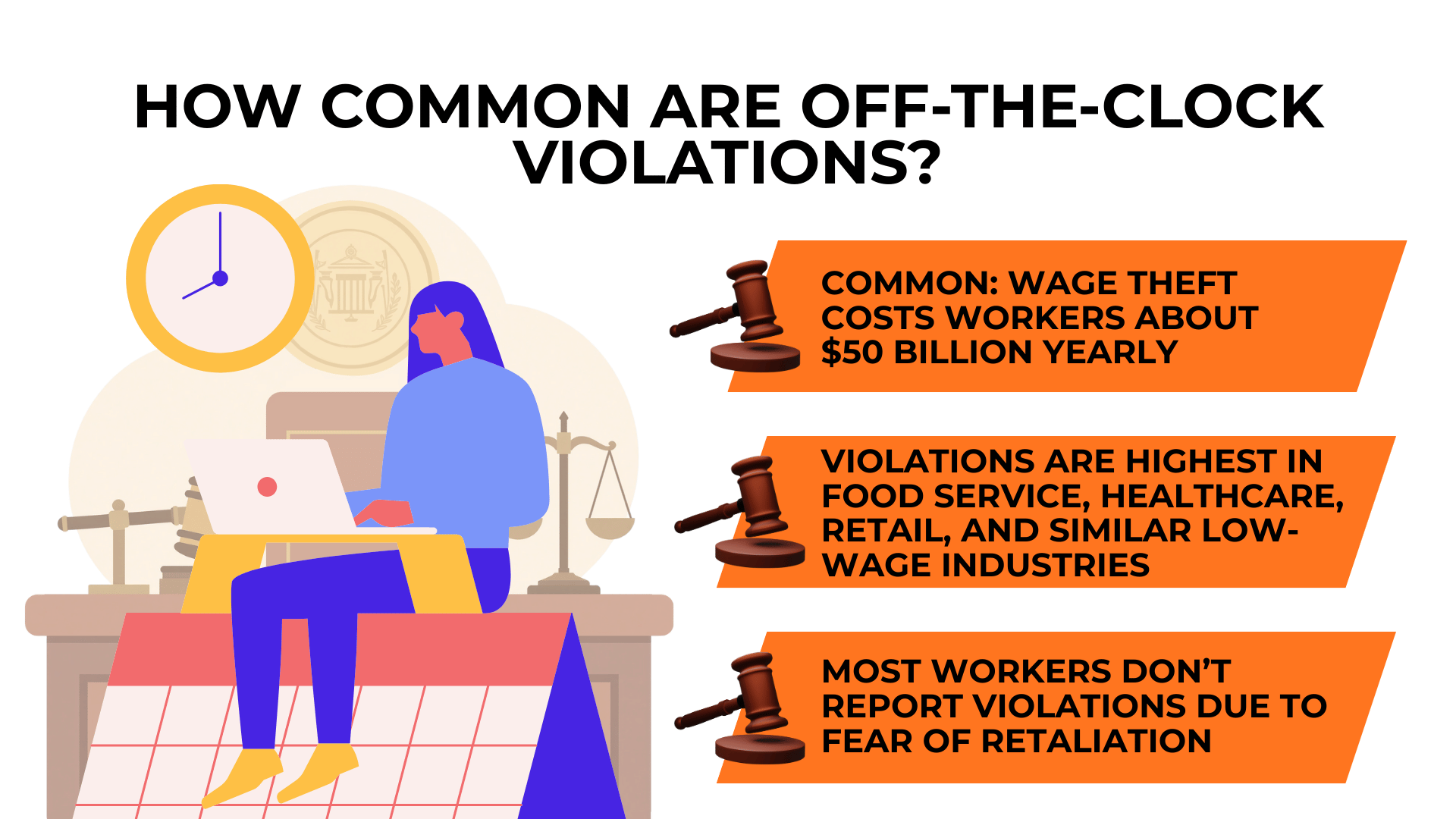
Off-the-clock work isn’t a rare occurrence—it’s one of the most widespread forms of wage theft in the American economy. According to the Economic Policy Institute (2014), employers steal an estimated $50 billion annually from workers through various forms of wage theft, including off-the-clock work, minimum wage violations, and overtime violations.
Which industries have the most violations?
The U.S. Department of Labor designates certain sectors as “low wage, high violation” industries based on enforcement data. According to DOL enforcement statistics (2025), the most violation-prone industries include:
- Food service:4,088 violations resolved with over $42 million in back wages recovered in FY 2025
- Healthcare:2,370 violations resolved with over $53 million in back wages recovered in FY 2025
- Retail and hospitality: Frequent violations involving pre-shift setup, post-shift closing, and unpaid breaks
- Warehousing and logistics: Common issues with donning/doffing time and security screenings
- Home healthcare and nursing: Particularly vulnerable to automatic deduction and gap time violations
The DOL (2021) found violations in 85% of restaurant investigations, recovering $34.7 million in back wages from food service employers in that fiscal year alone.
How much money do employers steal through off-the-clock work?
The scale of wage theft is staggering. According to the Temple University Sheller Center for Social Justice (2024), Pennsylvania workers lose between $19 million and $32 million per week to various forms of wage theft. That translates to roughly $1 billion to $1.7 billion annually stolen from workers in Pennsylvania alone.
Nationally, the Economic Policy Institute (2017) estimates that minimum wage violations alone cost workers $15 billion per year—and that figure doesn’t include overtime violations, off-the-clock work, or other forms of wage theft that would push the total even higher.
Why don’t more workers report violations?
Many workers experiencing off-the-clock violations never file complaints. According to the National Employment Law Project (2019), only about 22% of workers report labor violations to any authority. The primary barrier is fear of retaliation: the same NELP study found that 43% of workers who complained to their employer or attempted to organize experienced illegal retaliation, including termination, reduced hours, threats related to immigration status, and demotion.
What Can I Recover If My Employer Made Me Work Off the Clock?
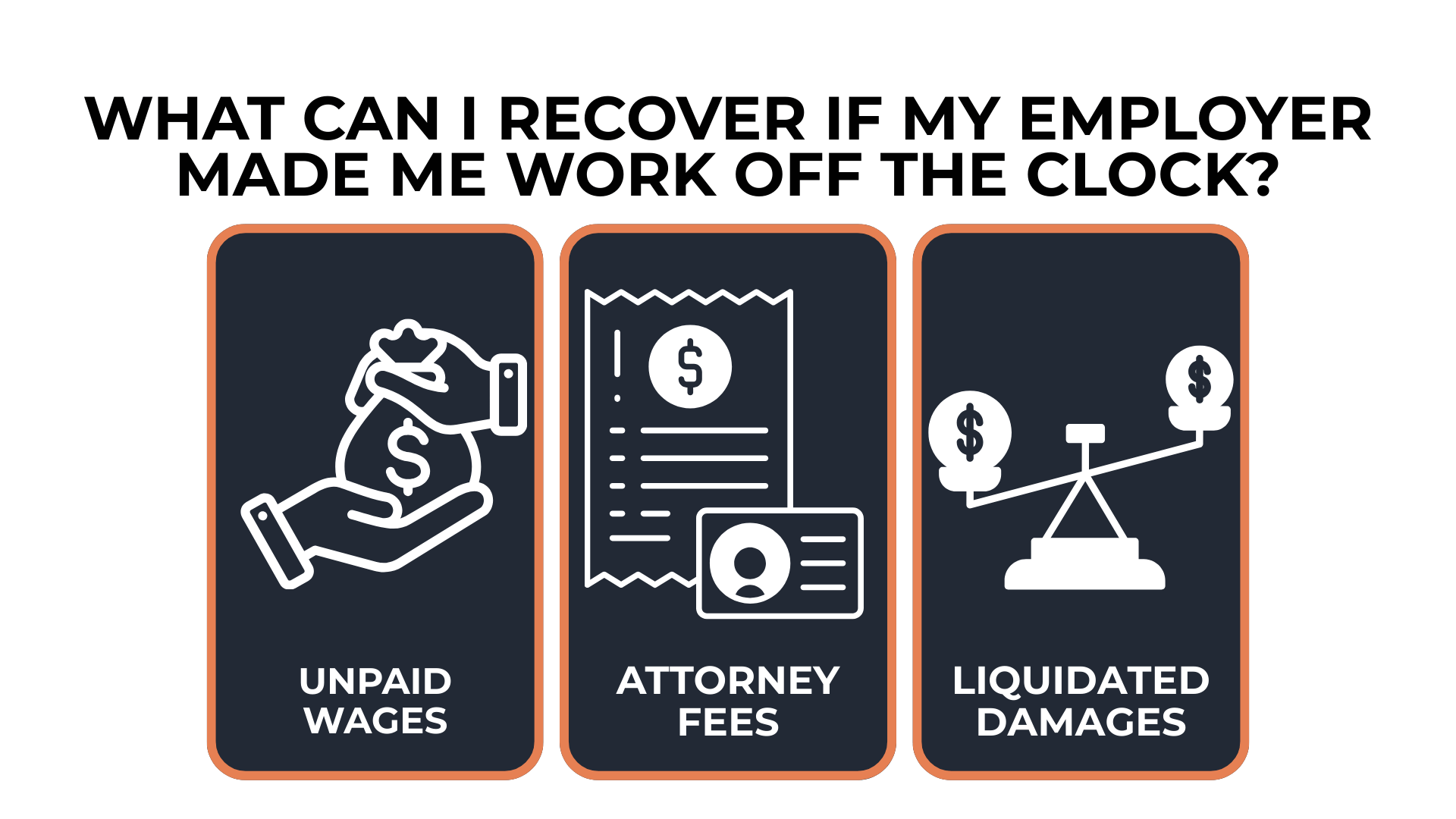
Workers who prove off-the-clock violations can recover more than just their unpaid wages. Federal and state laws provide for enhanced damages designed to compensate workers fully and deter future violations. According to Seyfarth Shaw’s 2023 FLSA Litigation Report, FLSA collective action settlements totaled $493.6 million across 423 cases in 2023, with an average settlement of approximately $1.17 million per case.
What are liquidated damages?
Under the FLSA, workers who prove wage violations are entitled to liquidated damages equal to the amount of unpaid wages—effectively doubling the recovery. This isn’t a penalty that requires additional proof; liquidated damages are the default outcome under 29 U.S.C. § 216(b).
The Third Circuit emphasized this in Souryavong v. Lackawanna County, 872 F.3d 122 (3d Cir. 2017), holding that FLSA liquidated damages are the norm rather than the exception. The employer bears the burden of proving both good faith and objectively reasonable grounds to reduce or eliminate them. Courts do not reduce liquidated damages simply because an employer subjectively believed its pay practices were lawful.
How do damages differ in New Jersey vs. Pennsylvania?
State wage laws provide additional remedies that can be even more favorable than federal law:
- New Jersey Wage Theft Act: Allows recovery of treble damages (three times unpaid wages), a six-year statute of limitations, and mandatory attorney fees. N.J. Stat. Ann. § 34:11-4.10.
- Pennsylvania WPCL: Provides for unpaid wages plus 25% liquidated damages (or $500, whichever is greater) and attorney fees. 43 Pa. Stat. § 260.10.
- Federal FLSA: Provides unpaid wages plus 100% liquidated damages (doubling recovery) and attorney fees. 29 U.S.C. § 216(b).
For a worker owed $10,000 in unpaid wages, the total recovery would be:
- Under FLSA:$20,000 (unpaid wages + equal liquidated damages)
- Under PA WPCL:$12,500 (unpaid wages + 25% liquidated damages)
- Under NJ Wage Theft Act:$30,000 (unpaid wages + 200% liquidated damages)
Plaintiffs can pursue claims under whichever statute provides the greatest recovery, though they cannot obtain duplicative damages for the same wages.
Do I have to pay attorney fees if I lose?
No. All three frameworks—FLSA, NJ Wage Theft Act, and PA WPCL—provide for one-way attorney fee shifting. This means that if you prevail on your claim, the employer must pay your reasonable attorney fees. If you lose, you typically don’t owe the employer’s legal costs. This structure makes it economically viable for workers to pursue even smaller wage claims and allows attorneys to take cases on a contingency basis.
How Long Do I Have to File an Off-the-Clock Claim?
Statutes of limitations vary significantly by jurisdiction, and missing your deadline can permanently bar your claim. Understanding these deadlines is critical to protecting your rights.
What makes a violation “willful”?
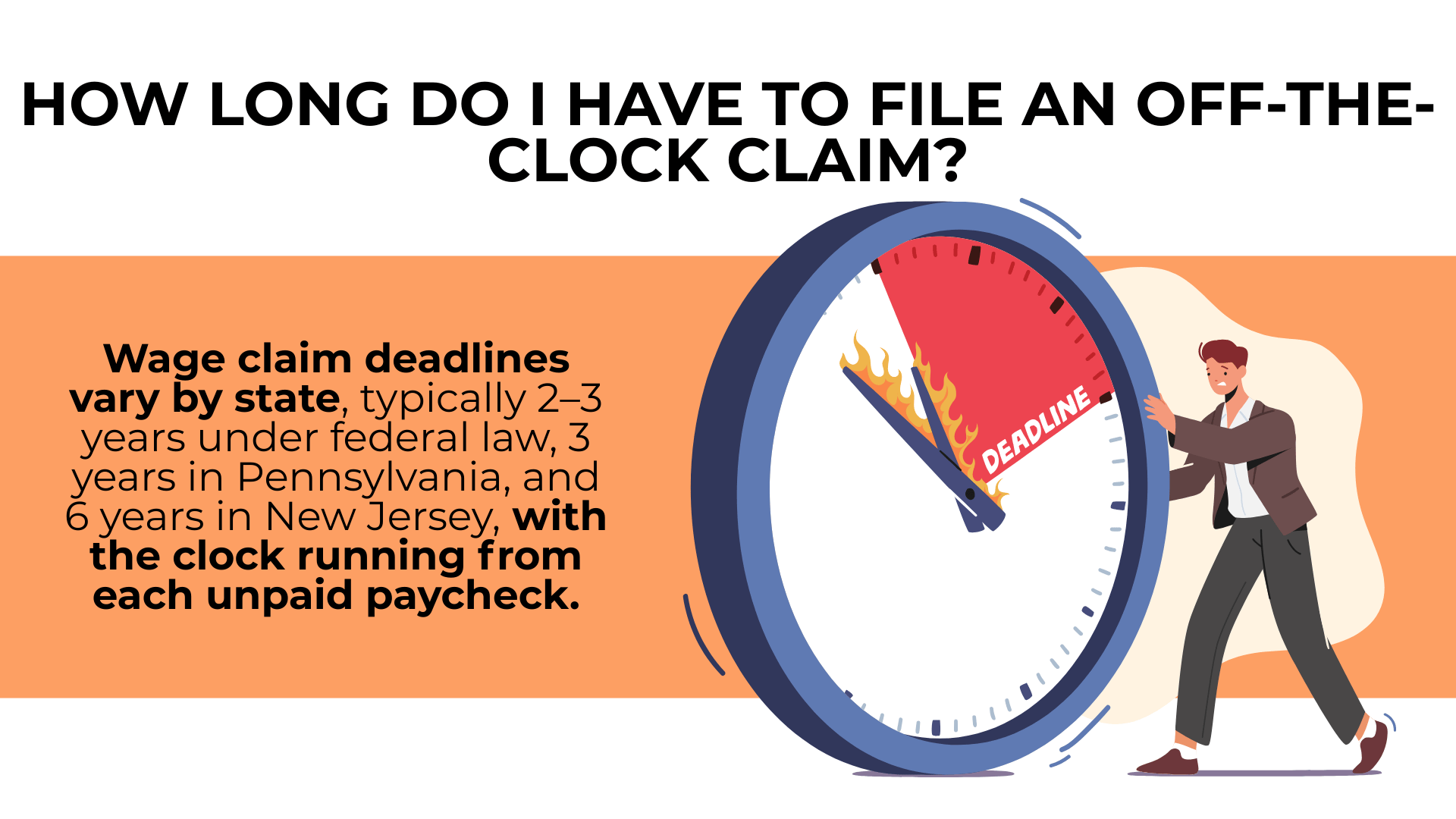
Under the FLSA, the standard limitations period is two years, but this extends to three years if the violation was willful. 29 U.S.C. § 255(a). A violation is willful when the employer knew its conduct violated the FLSA or showed reckless disregard for whether it did. Given that off-the-clock work requirements are well-established violations, many employers face exposure under the three-year willful standard.
Does the clock start from my last day of work?
No. The statute of limitations for wage claims runs from each individual pay period when wages should have been paid, not from your last day of employment. This means:
- Each unpaid paycheck is a separate violation with its own limitations clock
- You can recover wages going back 2-3 years (FLSA), 3 years (PA), or 6 years (NJ) from the date you file
- Violations outside the limitations window are time-barred, but more recent violations remain actionable
Which state’s deadline applies to my claim?
Filing deadline comparison by jurisdiction:
- New Jersey:6 years under the NJ Wage Theft Act, N.J. Stat. Ann. § 34:11-56a25.1
- Pennsylvania:3 years under the PA WPCL, 43 P.S. Labor § 260/8
- Federal FLSA:2 years (3 years if willful), 29 U.S.C. § 255(a)
If your employer operates in New Jersey, the six-year limitations period can substantially increase the wages you’re entitled to recover. Strategic selection of the filing jurisdiction and applicable statute can significantly impact your total recovery.
Can My Employer Retaliate If I Report Off-the-Clock Work?
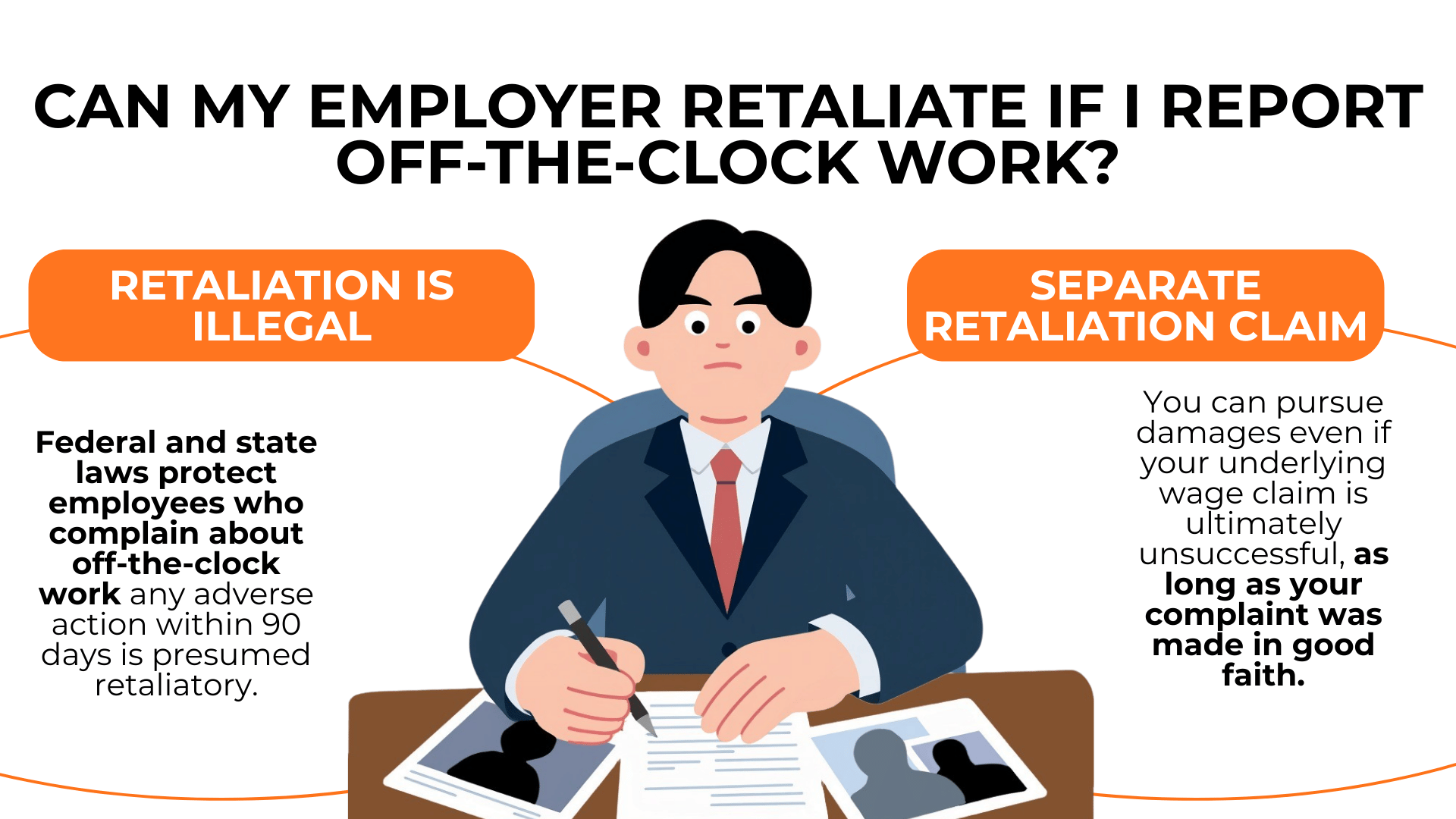
No. Federal and state laws prohibit employers from retaliating against workers who assert their wage rights. Despite these protections, according to the National Employment Law Project (2019), 43% of workers who complained about wage violations experienced some form of illegal retaliation.
What counts as protected activity?
The FLSA’s anti-retaliation provision, 29 U.S.C. § 215(a)(3), protects employees who file complaints, participate in proceedings, or assert wage and hour rights. Importantly, the Supreme Court held in Kasten v. Saint-Gobain Performance Plastics Corp., 563 U.S. 1 (2011), that oral complaints are protected—you don’t need to file a formal written complaint to be covered. An informal complaint to your manager or HR department qualifies as protected activity as long as it’s sufficiently clear to put the employer on notice.
What is New Jersey’s 90-day presumption?
New Jersey’s Wage Theft Act provides one of the strongest retaliation protections in the nation. Under N.J. Stat. Ann. § 34:11-4.10(c), if an employer takes adverse action against an employee within 90 days of protected activity, retaliation is legally presumed. The employer can only defeat this presumption by presenting clear and convincing evidence of a legitimate, non-retaliatory reason for the adverse action—a high evidentiary bar that significantly favors workers.
What should I do if I’m fired after complaining?
If you experience retaliation after complaining about off-the-clock work, you have a separate legal claim against your employer. This claim exists independently of your underlying wage claim. As the Third Circuit held in Brock v. Richardson, 812 F.2d 121 (3d Cir. 1987), an employee need not prevail on the underlying wage claim to maintain a retaliation action—the complaint need only be made in good faith. This means even if your employer convinces a court that no wage violation occurred, you can still recover for retaliatory termination if your complaint was reasonable and made in good faith.
What Should I Do If I’m Working Off the Clock?
If you believe your employer is requiring or permitting off-the-clock work, taking certain steps can strengthen your position and preserve your ability to pursue a claim.
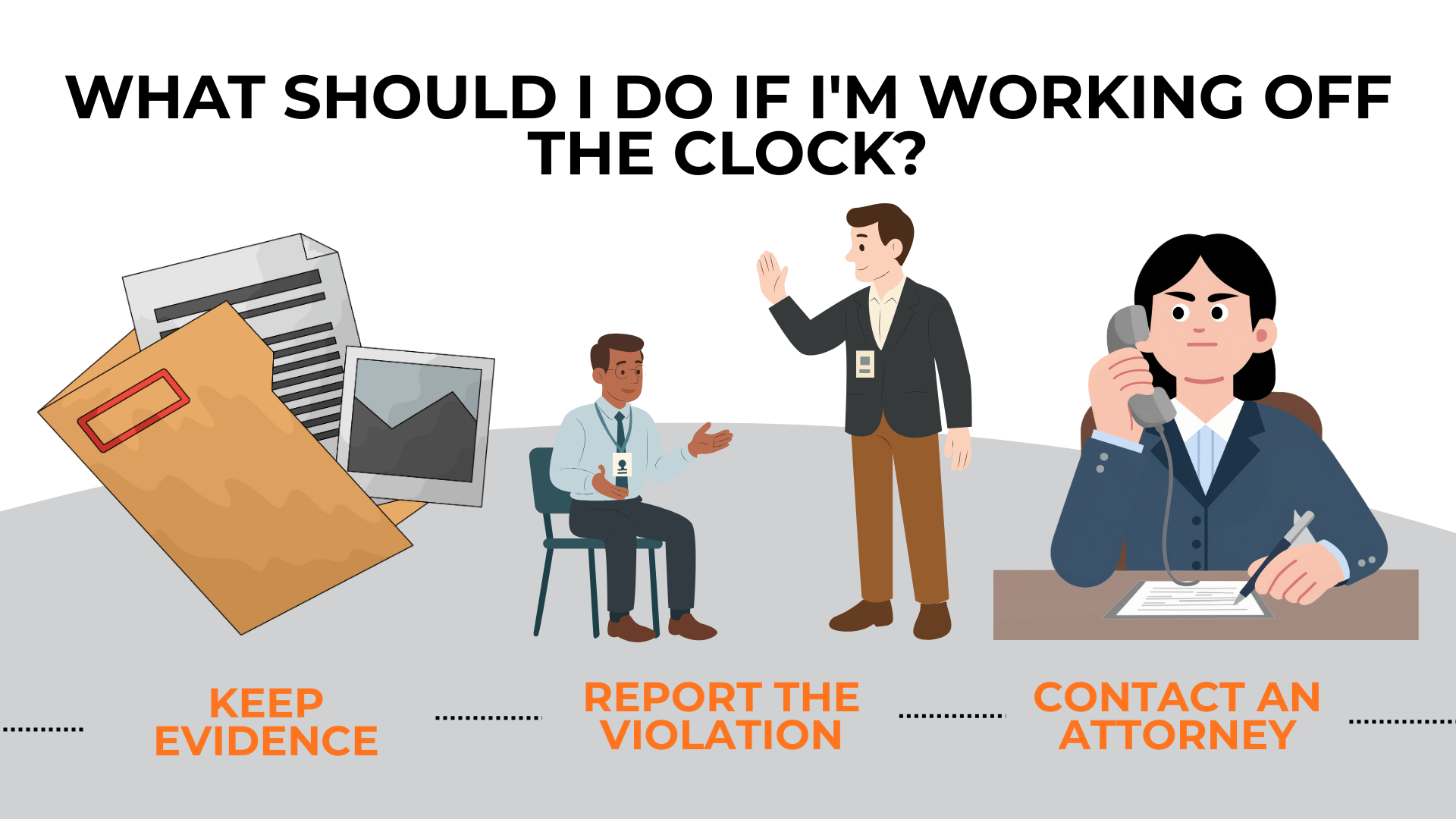
What evidence should I keep?
Building a record of unpaid work is essential. Useful documentation includes:
- Personal log of hours worked, including start and end times each day
- Copies of your official time records or pay stubs showing recorded hours
- Photographs of work schedules, posted policies, or time clocks
- Emails, text messages, or communications showing work performed outside recorded hours
- Names of coworkers who can corroborate unpaid work practices
- Any written policies about off-the-clock work, automatic deductions, or break periods
Keep this documentation in a personal location your employer cannot access—not in work email or on work devices.
Should I report the violation to my employer first?
You are not required to report wage violations to your employer before filing a claim, but doing so may provide advantages. An internal complaint creates documentation that the employer knew of the problem, and it triggers anti-retaliation protections immediately. If you’re comfortable doing so, a written complaint to HR or management—kept in your own records—establishes a clear timeline of protected activity.
When should I contact an attorney?
The sooner you consult with an employment attorney, the better. Because statutes of limitations continue running, waiting can reduce your recoverable damages as older pay periods become time-barred. An attorney can also evaluate whether your case might qualify for collective action treatment under the FLSA, which allows similarly situated employees to join together and potentially increases the resources available to pursue the claim.
Frequently Asked Questions
Can my employer require me to clock out before finishing work tasks?
No. If your employer requires you to complete tasks after clocking out, that time is compensable under the “suffered or permitted” standard. An employer cannot have a policy requiring employees to clock out and then continue working—this is a textbook off-the-clock violation. The fact that a policy exists requiring you to clock out does not change the legal obligation to pay for all hours worked.
Is it off-the-clock work if I answer emails after my shift ends?
It depends on whether your employer knows or should know you’re doing it. If your employer provides a work phone, expects after-hours responses, or creates conditions where answering emails is necessary to perform your job, that time must be compensated. The de minimis doctrine may excuse truly trivial amounts of time, but courts in the Third Circuit apply this exception narrowly. Regular after-hours work, even in small increments, typically requires compensation.
What if my employer automatically deducts 30 minutes for lunch but I work through it?
Automatic deductions are only legal when employees are completely relieved of all duties during the break. If you’re expected to remain available, answer phones, assist customers, or continue any work functions during your designated lunch period, you are not “completely relieved” under 29 C.F.R. § 785.19, and that time must be paid. Systematic automatic deductions that don’t account for interrupted breaks are a common enforcement target.
Can I file a claim if I voluntarily worked off the clock?
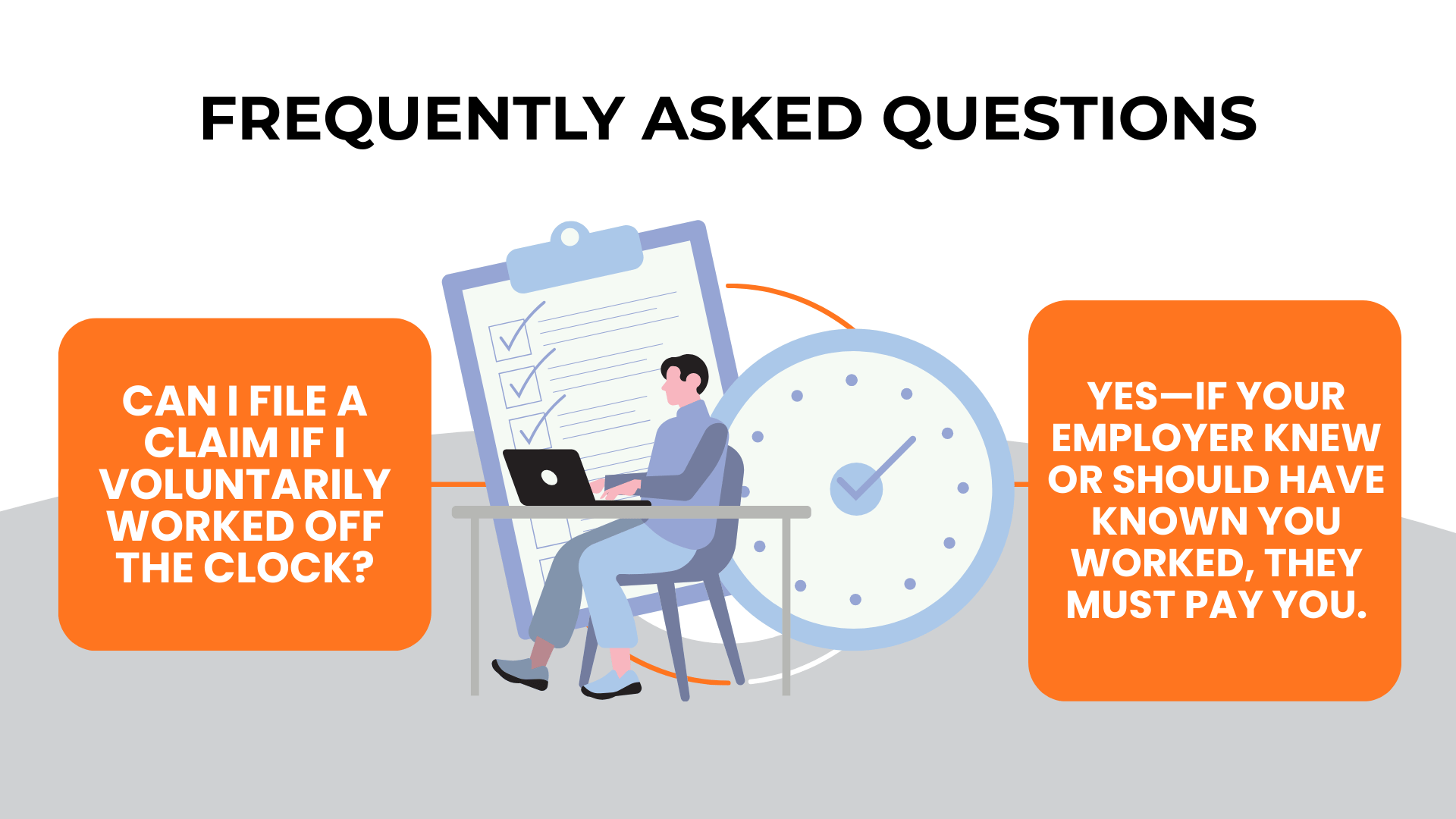
Yes, in most cases. The FLSA’s “suffered or permitted” standard doesn’t require that your employer explicitly told you to work off the clock—it only requires that your employer knew or should have known you were working. Employers who benefit from unpaid work cannot escape liability by claiming it was “voluntary.” However, if you worked in secret and actively concealed your extra hours from your employer, recovery may be more difficult to obtain.
How much money can I get for off-the-clock work violations?
You can recover your unpaid wages plus liquidated damages: an additional 100% under federal law, 200% under New Jersey law, or 25% under Pennsylvania law. All three frameworks also provide for attorney fees to be paid by the employer if you prevail. The total amount depends on how much unpaid work you performed, your hourly rate, how far back your claim reaches under the applicable statute of limitations, and which jurisdiction’s law provides the best recovery.
Will I get in trouble for reporting off-the-clock violations?
The law protects you from retaliation. Under the FLSA and state laws, employers cannot fire, demote, reduce hours, or take other adverse action against employees who report wage violations. New Jersey’s 90-day presumption makes retaliation claims particularly strong—if your employer takes action against you within 90 days of your complaint, the law presumes it was retaliatory. You don’t even need to win your underlying wage claim to maintain a retaliation claim, as long as your complaint was made in good faith.
Protect Your Right to Be Paid for All Hours Worked
Working off the clock isn’t just unfair—it’s illegal. Whether your employer requires pre-shift setup, automatic lunch deductions, post-shift closing tasks, or after-hours email responses without compensation, federal and state laws give you the right to recover unpaid wages plus substantial additional damages.
The filing deadlines for these claims are strict. In Pennsylvania, you have three years to file. In New Jersey, you have six years. Under federal law, you have two to three years depending on whether the violation was willful. Every pay period that passes without action is potential money you cannot recover.
If you have questions about unpaid off-the-clock work, contact The Lacy Employment Law Firm to discuss your situation.