Comments about being “overqualified.” Jokes about not understanding technology. Being passed over for a promotion that went to someone half your age. Ageism in the workplace takes many forms, and if you’ve experienced it, you’re far from alone.
Research shows that nearly two-thirds of workers over 50 have witnessed or experienced age discrimination on the job. Yet many people who face age-based treatment at work aren’t sure whether what happened to them crosses a legal line—or what they can do about it. This article explains what workplace ageism looks like, how widespread it is, who the law protects, and what options exist for workers in Pennsylvania, New Jersey, and under federal law.
What Does Ageism in the Workplace Actually Look Like?
Age discrimination doesn’t always announce itself. Sometimes it’s obvious—a supervisor telling you directly that you’re “too old” for a role. More often, it’s subtle, woven into workplace culture in ways that can be hard to name but impossible to ignore.
Overt Age Discrimination
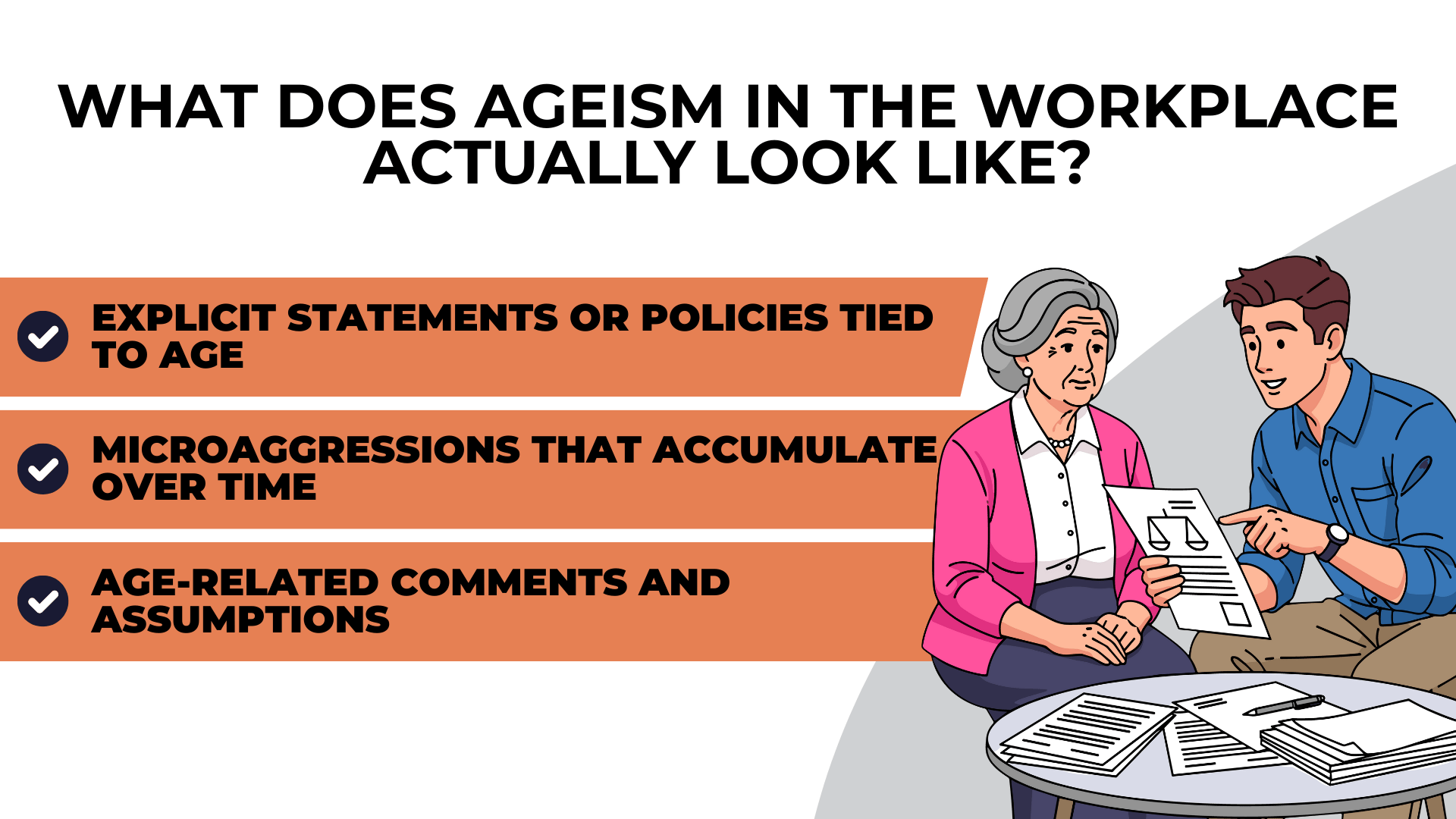
The clearest cases involve explicit statements or policies tied to age. An employer who tells a 58-year-old employee they’re being let go to “make room for fresh talent” has made their reasoning plain. A job posting that seeks “recent graduates” or workers with “no more than 5 years of experience” may signal age-based preferences in hiring.
According to the EEOC’s Office of General Counsel FY 2024 Annual Report, 71.4% of age discrimination lawsuits filed by the agency in fiscal year 2024 involved termination decisions, while 28.6% involved hiring. These are the most visible forms of age-based adverse actions.
Subtle Forms of Ageism
Most workplace ageism operates below the surface. According to AARP Research (2024-2025), 60% of workers 50 and older have experienced subtle forms of age discrimination. These microaggressions accumulate over time and can significantly affect working conditions:
- Being assumed to lack technical skills (reported by 33% of workers 50+)
- Being characterized as resistant to change (24-25%)
- Receiving less access to training opportunities (20%)
- Being excluded from important meetings or projects
- Facing pressure to retire or “make way” for younger workers
- Receiving comments about energy levels, health, or retirement plans
Comments and Assumptions That Signal Bias
Age-related comments often get dismissed as jokes or offhand remarks. But language matters. Terms like “dinosaur,” “over the hill,” “too old to learn new tricks,” and constant references to retirement can reveal underlying bias—especially when they come from supervisors or are tied to employment decisions.
The EEOC’s 2018 report on the State of Age Discrimination found that age-based harassment allegations tripled from 6% of ADEA charges in 1992 to 21% in 2017, making it the fastest-growing category of age discrimination complaints.
How Common Is Workplace Age Discrimination?
If you’ve experienced ageism at work, the numbers confirm you’re not imagining things. Age discrimination charges have surged in recent years, and surveys consistently show that most older workers have encountered age-based treatment.
Federal Charge Filing Trends
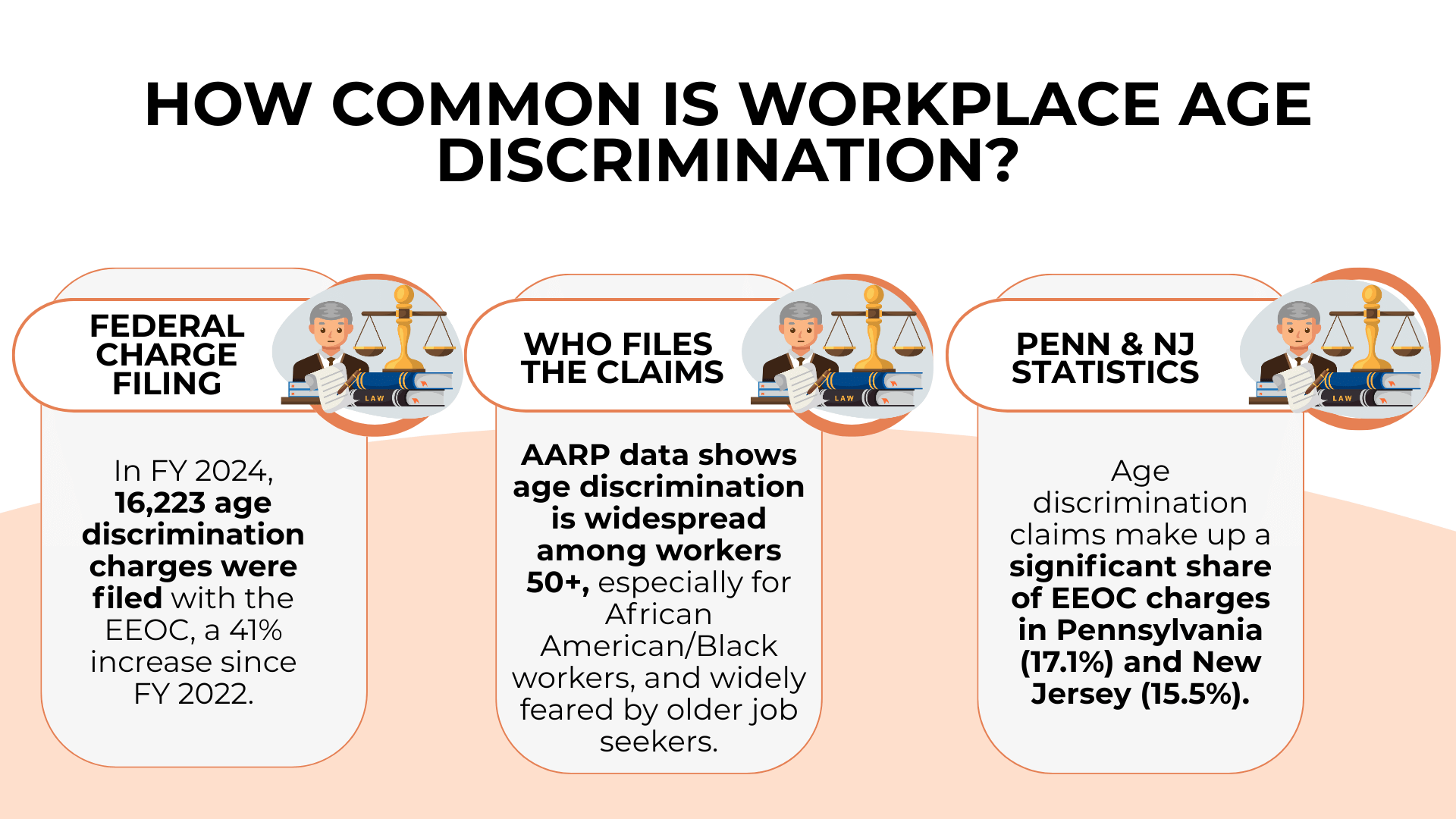
According to the EEOC’s Enforcement and Litigation Statistics (2025), workers filed 16,223 age discrimination charges with the EEOC in fiscal year 2024. This represents a 41% increase from fiscal year 2022, when 11,500 charges were filed—a significant resurgence in workplace age bias complaints after pandemic-era declines.
Age discrimination charges made up a substantial portion of the 88,531 total discrimination charges filed with the EEOC in FY 2024, according to the EEOC Annual Performance Report (2025).
Who Files Age Discrimination Claims
Survey data reveals just how widespread the experience is. According to AARP Research (2024-2025), 64% of workers age 50 and older have seen or experienced age discrimination in the workplace. Among job seekers, 74% of older workers believe their age will be considered a barrier by hiring managers.
The experience of ageism also varies by race. According to AARP Research on Age Discrimination by Race/Ethnicity (2025), 74% of African American/Black workers 50 and older have experienced age discrimination, compared to 67% of Asian American/Pacific Islander workers and 62% of Hispanic/Latino workers.
Pennsylvania and New Jersey Statistics
Workers in both states file age discrimination charges at notable rates. According to EEOC Enforcement and Litigation Statistics for Pennsylvania (2022), Pennsylvania workers filed 695 age discrimination charges in FY 2022, representing 17.1% of total Pennsylvania charges. Pennsylvania accounted for 6% of all national age discrimination charges despite having just 3.9% of the U.S. population.
In New Jersey, according to EEOC Enforcement and Litigation Statistics for New Jersey (2022), workers filed 197 age discrimination charges in FY 2022, representing 15.5% of total New Jersey charges.
Who Is Legally Protected from Workplace Ageism?
Three overlapping laws protect workers from age discrimination: the federal Age Discrimination in Employment Act (ADEA), the New Jersey Law Against Discrimination (LAD), and the Pennsylvania Human Relations Act (PHRA). Each has different coverage rules.
Federal Protection Under the ADEA
The ADEA, codified at 29 U.S.C. § 631(a), protects individuals age 40 and older from employment discrimination. However, it only applies to employers with 20 or more employees. The Supreme Court clarified in Mount Lemmon Fire District v. Guido, 586 U.S. 1, 139 S. Ct. 22 (2018), that state and local government employers are covered regardless of their employee count.
The ADEA does not protect workers under 40, even if they face discrimination for being “too young.” It also does not prohibit employers from favoring older workers over younger ones within the protected class, as the Supreme Court explained in O’Connor v. Consolidated Coin Caterers Corp., 517 U.S. 308, 116 S. Ct. 1307 (1996).
New Jersey’s Broader Protections
New Jersey offers the most expansive age discrimination protections in the region. Under N.J.S.A. 10:5-5, the New Jersey Law Against Discrimination protects individuals age 18 and older—meaning a 25-year-old could bring a claim for being considered “too young.” The New Jersey Supreme Court confirmed this interpretation in Bergen Commercial Bank v. Sisler, 157 N.J. 188, 723 A.2d 944 (1999).
Critically, the NJ LAD has no minimum employer size requirement. Even workers at small businesses with just a handful of employees have protection under state law.
Pennsylvania Human Relations Act Coverage
Under 43 P.S. § 954(b) and § 955(a), the Pennsylvania Human Relations Act protects workers age 40 and older from adverse employment actions. The PHRA applies to employers with 4 or more employees—a lower threshold than the federal ADEA, which means workers at smaller Pennsylvania businesses may have state-law protection even when federal law doesn’t apply.
Understanding which law applies to your situation matters because the protections differ:
- ADEA (Federal): Protects workers 40+; requires 20+ employees; provides liquidated damages for willful violations but no punitive damages
- NJ LAD: Protects workers 18+; no employer size minimum; allows uncapped compensatory and punitive damages
- PA PHRA: Protects workers 40+; requires 4+ employees; allows compensatory damages but no punitive damages
- NJ LAD unique advantage: No administrative exhaustion required—workers can file directly in court
- PHRA limitation: No jury trial right in Pennsylvania state court
What Types of Ageism Are Against the Law?
Not every unpleasant age-related experience at work is illegal. The law focuses on specific types of adverse employment actions and conditions that materially affect your job.
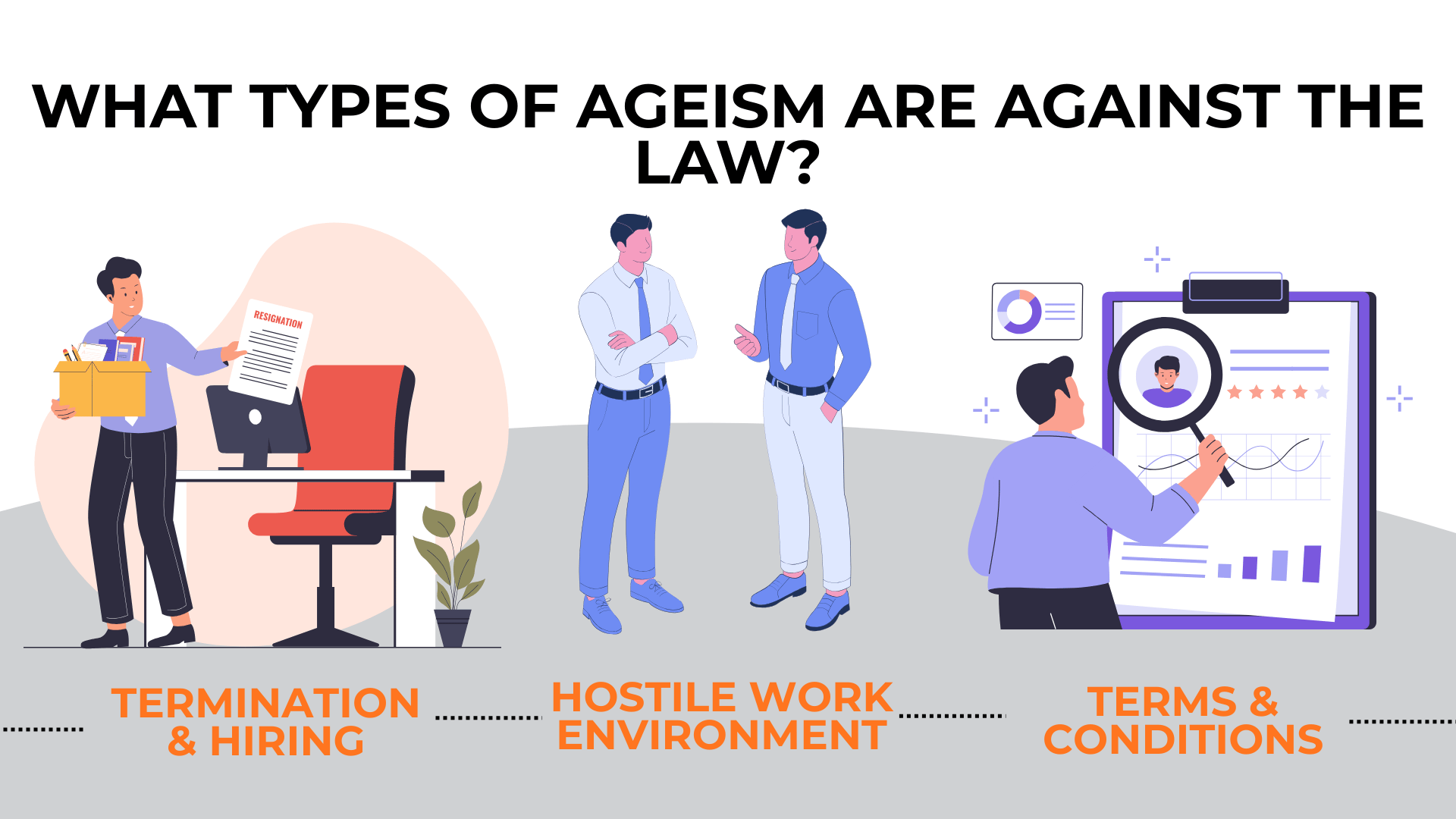
Termination and Hiring Decisions
The most clear-cut violations involve being fired, not hired, or forced out because of age. According to the EEOC’s 2018 State of Age Discrimination Report, 55% of ADEA charges alleged discriminatory discharge in FY 2017, up from 45% in 1992. Termination remains the dominant form of age discrimination claim.
Hiring discrimination is harder to prove but equally illegal. A Federal Reserve Bank of San Francisco Economic Letter (2017) analyzing over 40,000 job applications found that older female applicants ages 64-66 received 47% fewer callbacks than younger applicants ages 29-31 for administrative positions.
Hostile Work Environment
When age-based harassment becomes severe or pervasive enough to alter working conditions and create an abusive environment, it may constitute a hostile work environment claim. Under New Jersey law, the standard comes from Lehmann v. Toys ‘R’ Us, Inc., 132 N.J. 587, 626 A.2d 445 (1993), which requires showing the conduct: (1) would not have occurred but for age; (2) was severe or pervasive; (3) would make a reasonable person believe the environment was hostile; and (4) altered conditions of employment.
The New Jersey Supreme Court recognized in Taylor v. Metzger, 152 N.J. 490, 706 A.2d 685 (1998), that even a single incident can be actionable in “rare and extreme cases” when it involves a high-ranking official making an egregious statement.
Discriminatory Terms and Conditions
Beyond termination and harassment, the law prohibits discrimination in terms, conditions, and privileges of employment. According to the EEOC’s 2018 report, 25% of ADEA charges alleged discriminatory terms or conditions in 2017—nearly double the 13% rate in 1992. These claims can involve:
- Demotion with reduced pay, status, or responsibilities
- Denial of merit increases or bonuses available to younger workers
- Exclusion from training programs or professional development
- Significant reduction in job duties that affects career prospects
- Unequal access to desirable assignments, clients, or projects
The Supreme Court explained in Burlington Industries, Inc. v. Ellerth, 524 U.S. 742, 118 S. Ct. 2257 (1998), that a “tangible employment action” is a “significant change in employment status.” Minor inconveniences that don’t affect pay, benefits, or responsibilities generally don’t qualify as legally actionable discrimination.
What Is the Economic Impact of Workplace Ageism?
Ageism isn’t just a workplace indignity—it carries serious financial consequences for individuals and the broader economy.
The Cost to Individual Workers
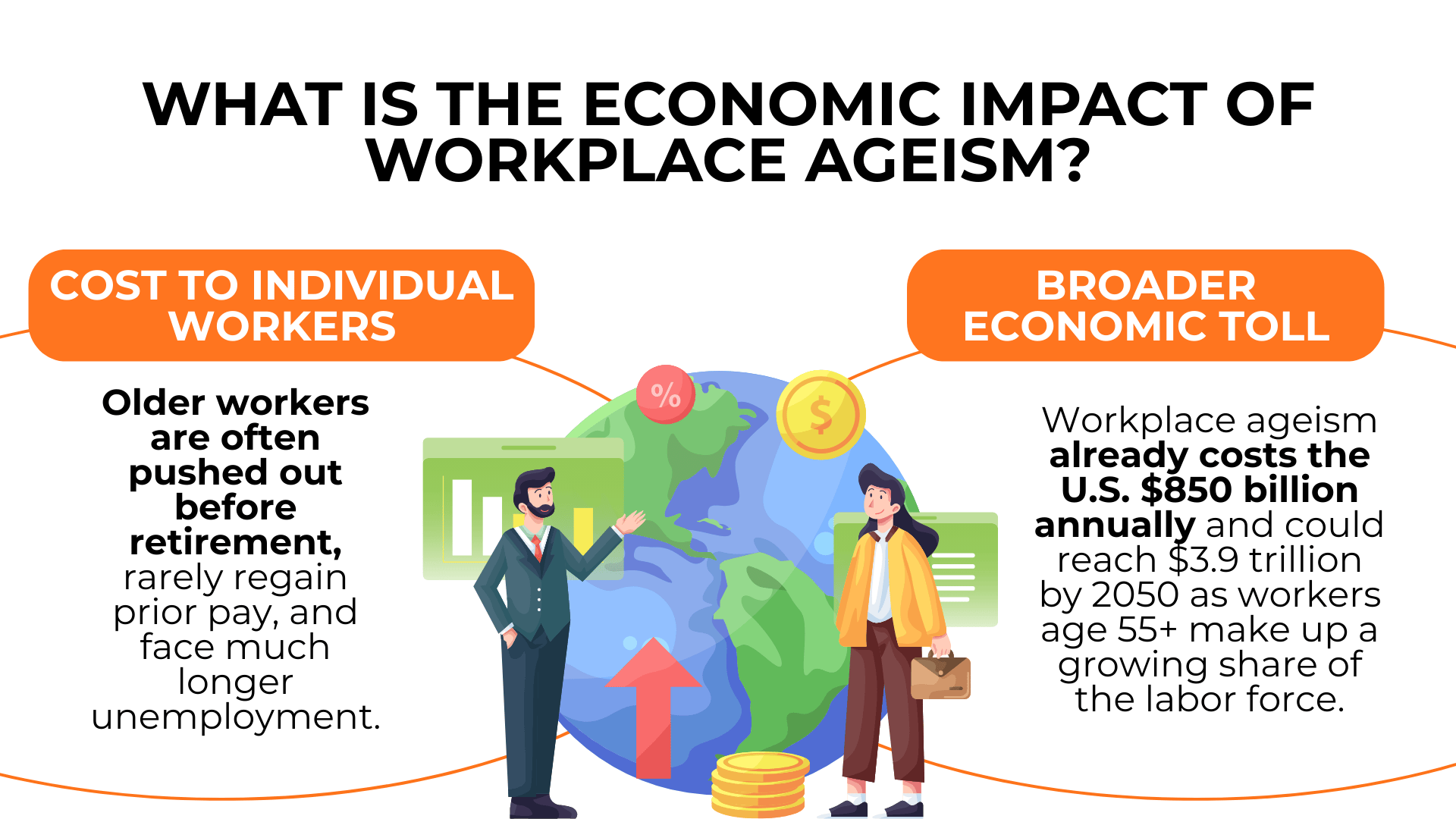
According to a ProPublica and Urban Institute analysis (2018), 56% of workers in their 50s with stable, long-held jobs are pushed out or laid off at least once before they’re ready to retire. The financial recovery is grim: according to the Urban Institute’s research (2018), only 10% of displaced older workers ever again earn as much as they did before their job loss.
When older workers lose their jobs, they face significantly longer periods of unemployment. According to BLS Spotlight on Statistics (2024), the median unemployment duration for workers ages 55-64 is 10.7 weeks—more than double the 5.2 weeks for teenagers ages 16-19. And according to the AARP Public Policy Institute (2025), 28.2% of jobseekers ages 55 and older are long-term unemployed, meaning they’ve been seeking work for 27 weeks or more.
The Broader Economic Toll
The cumulative effect of workplace ageism extends far beyond individual workers. According to AARP and The Economist Intelligence Unit (2020), age discrimination cost the U.S. economy an estimated $850 billion in lost GDP in 2018—the result of involuntary retirement, underemployment, and unemployment among older workers. If current patterns persist, the report projects annual losses could reach $3.9 trillion by 2050.
These losses occur against the backdrop of a rapidly aging workforce. According to BLS Employment Projections (2025), 38.8 million workers age 55 and older are currently in the U.S. labor force, representing 23.1% of all workers. That number is projected to reach 40.9 million by 2034.
What Are Your Options If You Experience Workplace Ageism?
If you believe you’ve experienced illegal age discrimination, several legal avenues exist. The path you take depends on your location, your employer’s size, and how quickly you act.
Filing Deadlines You Need to Know
Time limits are strict in employment discrimination cases. Missing a deadline can permanently bar your claim, regardless of how strong your evidence might be. The key deadlines to understand:
- EEOC Charge (Federal): 300 days from the discriminatory act to file with the EEOC in Pennsylvania and New Jersey (both are “deferral states” with state agencies)
- Pennsylvania PHRC: 180 days from the discriminatory act to file with the Pennsylvania Human Relations Commission
- New Jersey Court Filing: 2 years from the discriminatory act under N.J.S.A. 2A:14-2(a)—and no administrative filing is required first
- After EEOC Filing: You may file a federal lawsuit 60 days after filing your EEOC charge, or within 90 days of receiving a right-to-sue notice
The Administrative Process
Under federal law and the PHRA, you generally cannot file a lawsuit without first going through an administrative process. This means filing a charge with the EEOC (for federal claims) or the PHRC (for Pennsylvania state claims). According to EEOC guidance, the average time to investigate and resolve an EEOC charge is about 11 months, though mediation can resolve matters in an average of 84 days.
The Pennsylvania PHRA requires filing with the PHRC within 180 days under 43 P.S. § 959(h), followed by a one-year waiting period for the agency to investigate before you can proceed to court.
Going Directly to Court in New Jersey
New Jersey offers a significant advantage for workers: under the LAD, no administrative exhaustion is required. You can file a lawsuit directly in Superior Court within the 2-year limitations period. This can mean faster resolution and avoids the administrative waiting game. Combined with NJ LAD’s broader protections—coverage of workers 18 and older, no employer size minimum, and availability of punitive damages—New Jersey provides some of the strongest age discrimination protections in the country.
Frequently Asked Questions
Can I file an age discrimination claim if my replacement is also over 40?
Yes. The key question is whether your replacement was “substantially younger” than you, not whether they were under 40. The Supreme Court clarified this in O’Connor v. Consolidated Coin Caterers Corp., 517 U.S. 308 (1996). If you’re 60 and replaced by someone who is 45, you may still have a valid claim even though both of you are in the protected class.
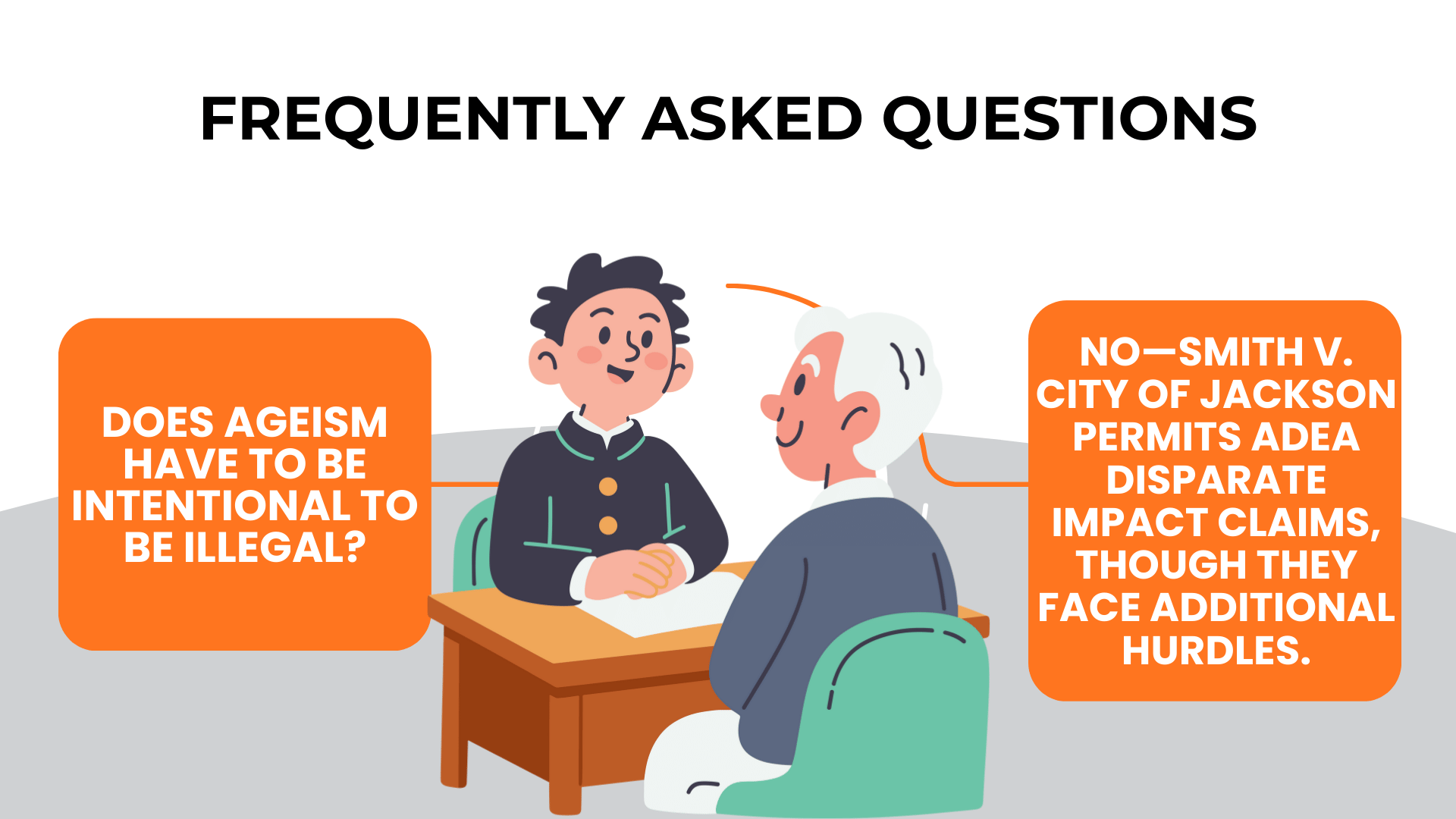
Does ageism have to be intentional to be illegal?
Not always. While most age discrimination claims involve intentional conduct (called “disparate treatment”), the Supreme Court recognized in Smith v. City of Jackson, 544 U.S. 228, 125 S. Ct. 1536 (2005), that “disparate impact” claims—where a neutral policy disproportionately harms older workers—can also be brought under the ADEA, though these claims face additional hurdles.
What if I experienced ageism but didn’t lose my job?
You may still have a claim. Age discrimination law covers more than just termination. Demotions, failure to promote, denial of training opportunities, significant changes in responsibilities, and hostile work environment conditions can all be actionable if they constitute a “significant change in employment status” or create working conditions severe or pervasive enough to alter your employment.
How long do I have to take legal action for workplace ageism?
It depends on which law applies. For federal ADEA claims in Pennsylvania and New Jersey, you have 300 days to file with the EEOC. For Pennsylvania state claims, you have 180 days to file with the PHRC. For New Jersey state claims, you have 2 years to file directly in court. These deadlines are strictly enforced, so acting promptly is essential.
Can workers under 40 be victims of age discrimination?
Under federal law and the Pennsylvania PHRA, no—protection begins at age 40. However, New Jersey’s Law Against Discrimination protects workers age 18 and older. This means a younger worker in New Jersey who faces discrimination for being “too young” may have a valid state-law claim, though such cases are less common.
Taking the Next Step
Ageism in the workplace is not just unfair—in many cases, it’s illegal. The law recognizes that workers over 40 deserve to be evaluated on their abilities, not their birth dates. Whether you’ve been terminated, passed over, harassed, or pushed out, understanding your rights is the first step toward addressing what happened.
The deadlines for taking action are strict, and the legal landscape varies depending on whether you work in Pennsylvania, New Jersey, or for an employer covered by federal law. If you have questions about ageism in your workplace, contact The Lacy Employment Law Firm to discuss your situation.