
When your employer fires you, demotes you, or forces you out because of your age, one of the first questions you’ll have is practical: what is my case worth? Age discrimination settlement amounts vary dramatically based on your earnings, the strength of your evidence, your employer’s conduct, and which laws apply to your claim. Understanding the damages frameworks under federal, Pennsylvania, and New Jersey law helps you evaluate your options and set realistic expectations for potential recovery.
This guide breaks down what age discrimination cases actually settle for, what damages you can recover under each applicable law, and what factors push settlement amounts higher or lower.
What Do Age Discrimination Cases Typically Settle For?
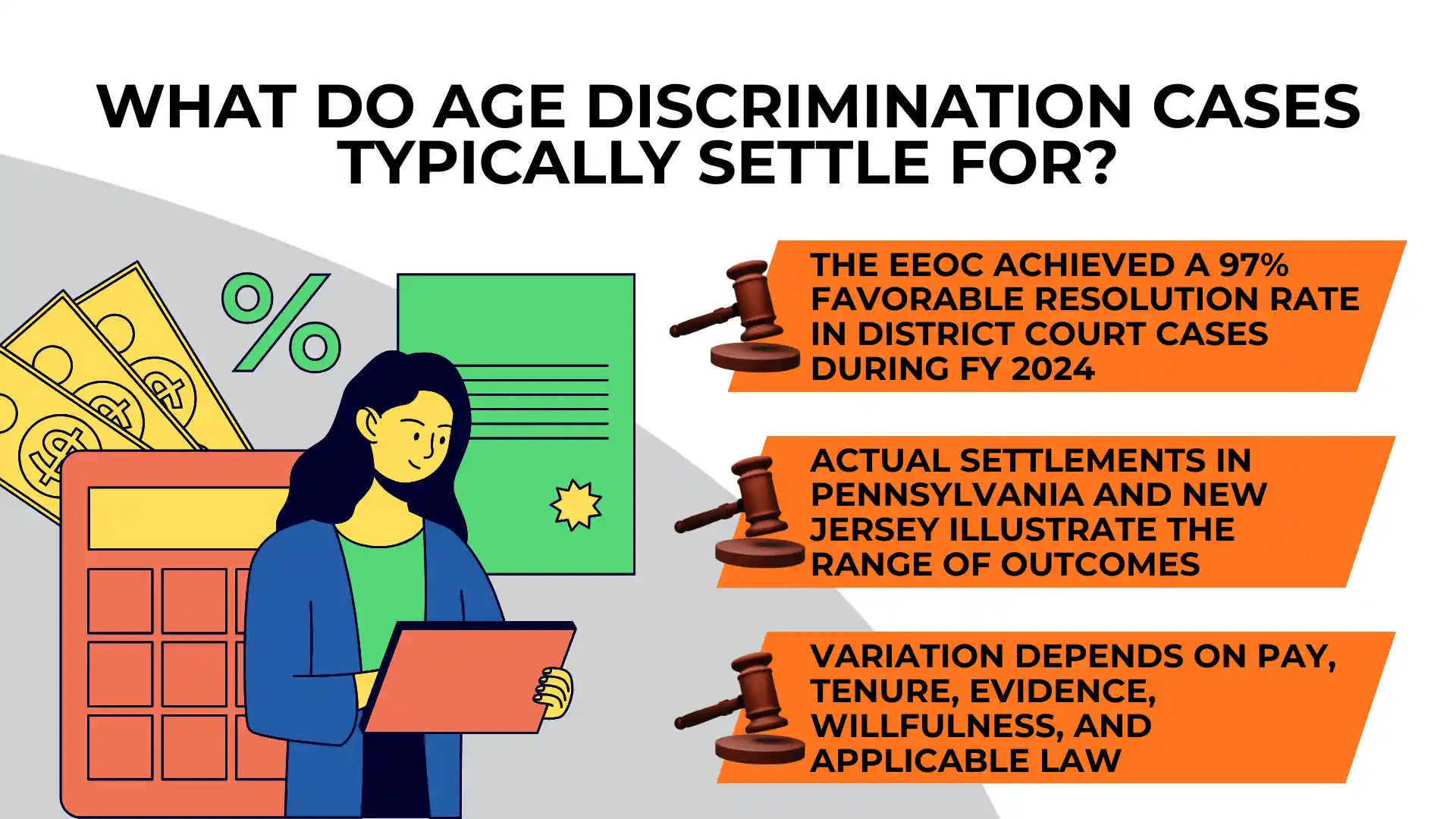
There is no “average” age discrimination settlement. Case values range from modest five-figure amounts to settlements exceeding several hundred thousand dollars, depending on individual circumstances. However, documented settlements and enforcement data provide useful reference points.
EEOC Recovery Statistics
The Equal Employment Opportunity Commission secured nearly $700 million for victims of all types of employment discrimination in fiscal year 2024, according to the EEOC Annual Performance Report (2025). This represented the highest total monetary recovery in the agency’s recent history. Of this amount, $3.18 million came specifically from ADEA litigation, according to the EEOC Office of General Counsel Fiscal Year 2024 Annual Report (2025).
The EEOC achieved a 97% favorable resolution rate in district court cases during FY 2024. While these figures include all discrimination types, they demonstrate that age discrimination claims can result in meaningful monetary recovery when properly pursued.
Documented Settlement Examples
Actual settlements in Pennsylvania and New Jersey illustrate the range of outcomes. In December 2023, the Camden City School District in New Jersey agreed to pay $175,487 in back pay plus pension credits to resolve an age discrimination complaint with the New Jersey Division on Civil Rights, according to a NJ Attorney General press release (2023).
A New Jersey nurse who alleged her termination during a reduction in force was pretext for age discrimination settled for $115,000 under the New Jersey Law Against Discrimination. In Pennsylvania, the Office of Public Records paid $60,000 to settle an ADEA hiring discrimination claim, according to an EEOC press release (2017).
Why Settlement Amounts Vary Widely
These examples—ranging from $60,000 to over $175,000—reflect how dramatically settlement values can differ. The variation depends on factors including your salary level, length of employment, strength of evidence, whether the employer’s conduct was willful, and which state and federal laws apply. A high-earning executive with documented discriminatory statements will have a case worth far more than a minimum-wage worker with circumstantial evidence.
What Damages Can You Recover Under Federal Law?
The Age Discrimination in Employment Act provides the baseline for federal age discrimination claims. However, ADEA damages are more limited than many people expect, which is why understanding state law alternatives matters.
Back Pay and Front Pay
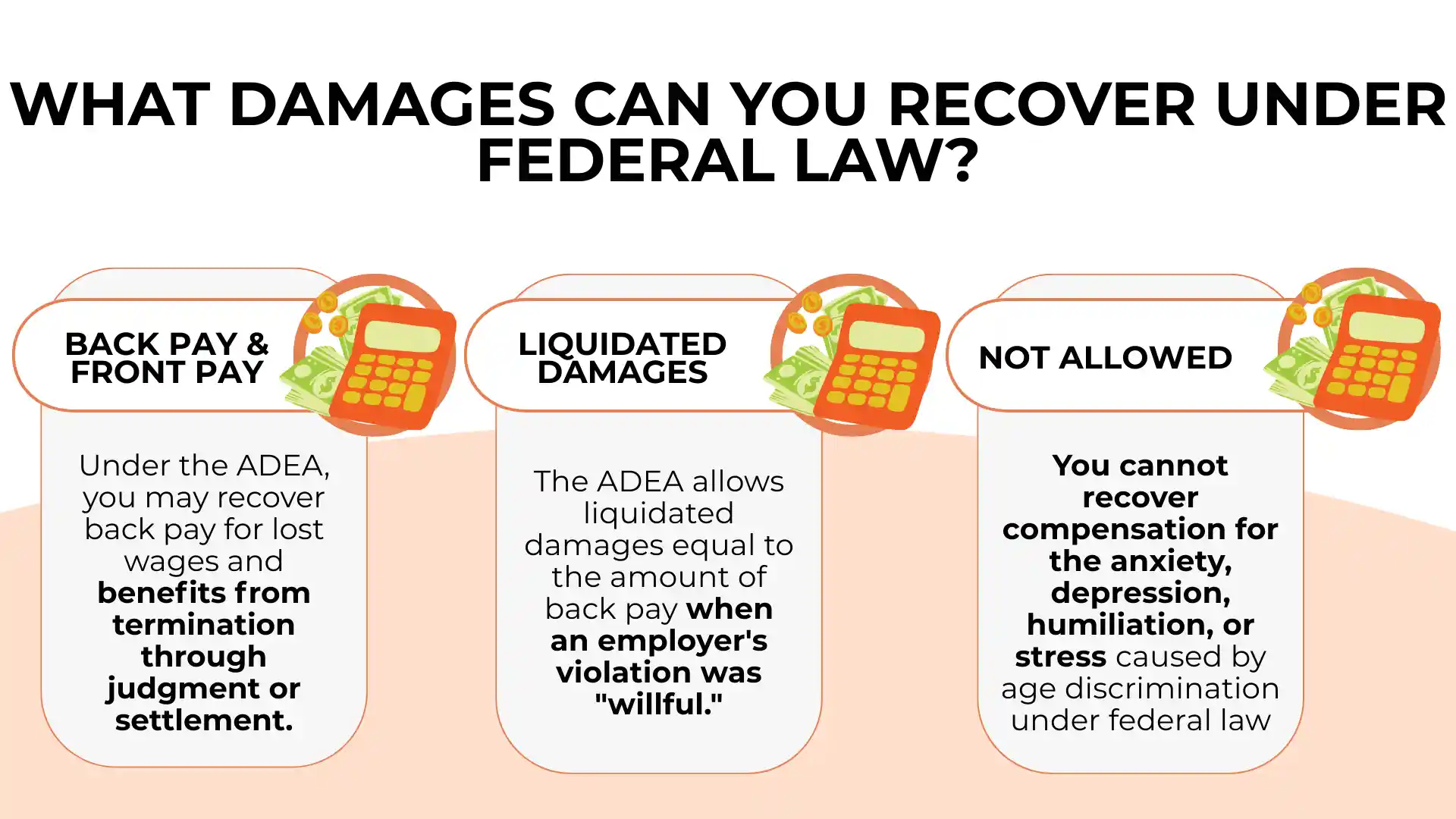
Under the ADEA, you can recover back pay—the wages and benefits you lost from the date of termination to the date of judgment or settlement. This includes salary, bonuses, commissions, health insurance value, and retirement contributions your employer would have made. You must subtract any earnings from new employment during this period.
Front pay compensates for future lost earnings when reinstatement to your former position isn’t feasible—for example, if the employer-employee relationship has become too hostile or your position was eliminated. Courts typically require expert testimony to calculate front pay projections.
Liquidated Damages for Willful Violations
The ADEA allows liquidated damages equal to the amount of back pay when an employer’s violation was “willful.” Under Trans World Airlines, Inc. v. Thurston, 469 U.S. 111 (1985), a violation is willful if the employer knew its conduct violated the ADEA or showed reckless disregard for whether it did.
This effectively doubles your back pay award. If you lost $100,000 in wages and benefits, a willfulness finding adds another $100,000 in liquidated damages. The jury decides whether the employer’s conduct meets the willfulness standard.
What Federal Law Does NOT Allow
Here’s what surprises many people: the ADEA does not permit separate damages for emotional distress. You cannot recover compensation for the anxiety, depression, humiliation, or stress caused by age discrimination under federal law. The ADEA also does not allow punitive damages designed to punish the employer.
These limitations make state law claims critical for maximizing recovery, particularly in cases involving significant emotional harm or egregious employer conduct.
How Do New Jersey Damages Differ From Federal Law?
The New Jersey Law Against Discrimination provides substantially broader remedies than federal law, making it one of the most plaintiff-friendly employment discrimination statutes in the country.
Uncapped Compensatory Damages
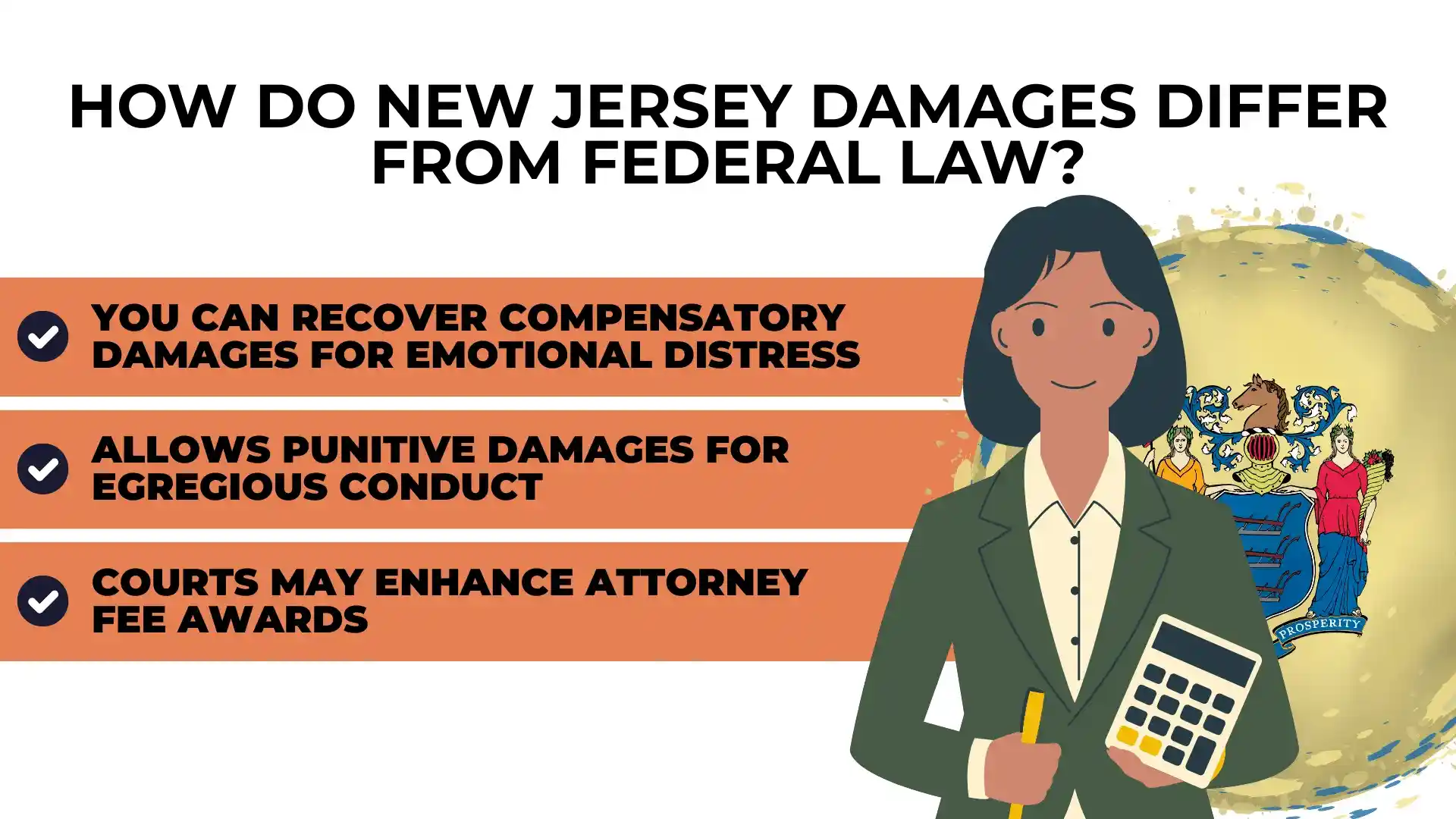
Under the NJ LAD, you can recover compensatory damages for emotional distress—and there is no statutory cap. If age discrimination caused you significant psychological harm, anxiety, depression, or damaged relationships, you can seek full compensation for that harm. Combined with back pay and front pay, uncapped compensatory damages can substantially increase total recovery.
Punitive Damages Availability
New Jersey allows punitive damages in LAD cases when the employer’s conduct was “especially egregious” and involved “actual participation or willful indifference” by upper management, as established in Lehmann v. Toys ‘R’ Us, Inc., 132 N.J. 587 (1993). You must prove entitlement to punitive damages by clear and convincing evidence—a higher standard than the preponderance standard for compensatory damages.
Importantly, the general Punitive Damages Act cap of $350,000 or five times compensatory damages does not apply to LAD claims. This means punitive damages in egregious age discrimination cases can be substantial.
Attorney Fee Enhancement
New Jersey’s fee-shifting provisions add another layer to potential recovery. Under Rendine v. Pantzer, 141 N.J. 292 (1995), courts can enhance attorney fee awards by 20-35% in typical cases, and up to 100% in exceptional cases. While this doesn’t go directly into your pocket, it ensures your attorney can be fully compensated without reducing your recovery, making it easier to find representation for meritorious claims.
What Can You Recover Under Pennsylvania Law?
The Pennsylvania Human Relations Act provides some advantages over federal law but also has significant limitations compared to New Jersey.
Compensatory Damages Without Cap
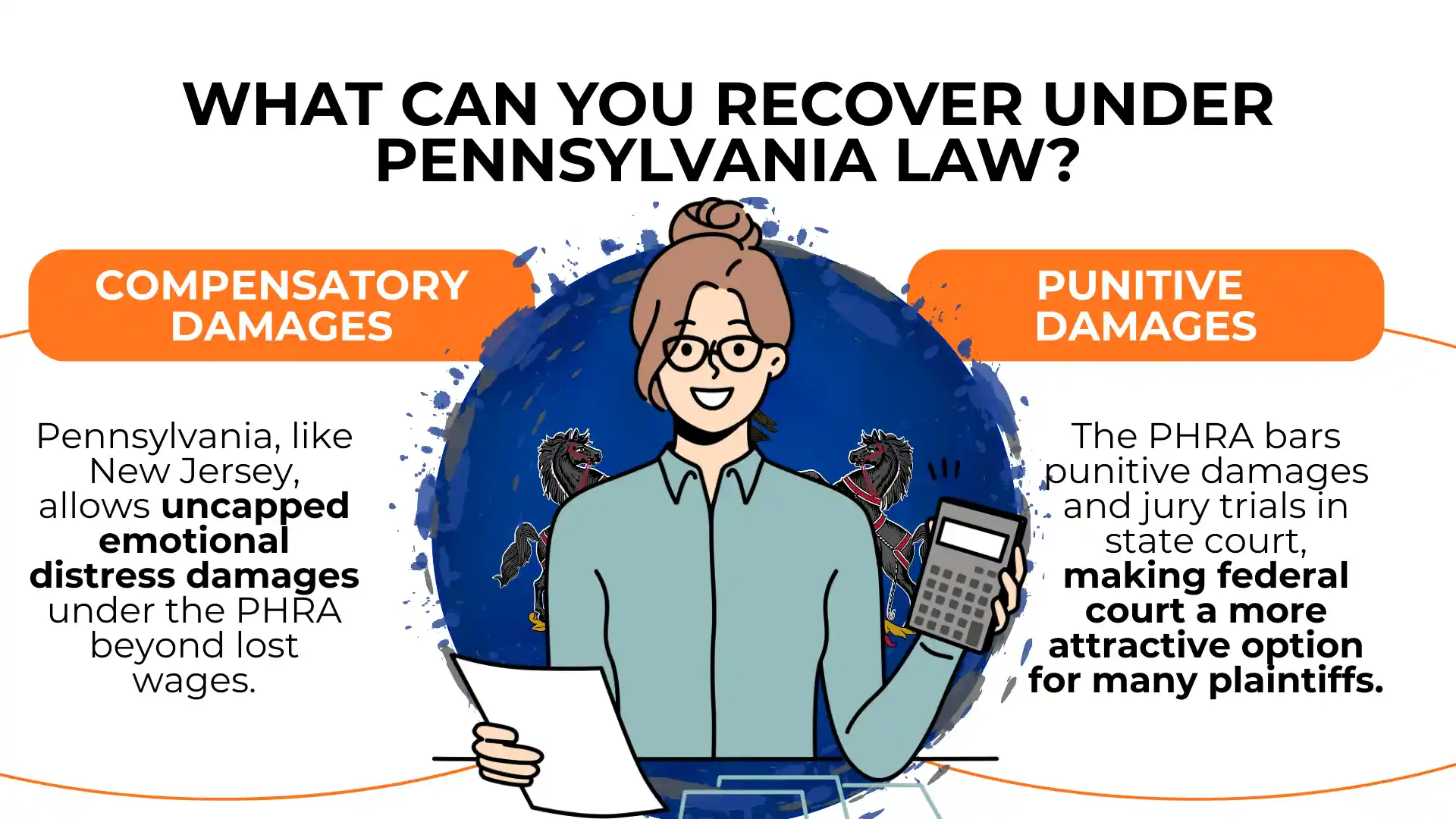
Like New Jersey, Pennsylvania allows recovery for emotional distress damages under the PHRA, and there is no statutory cap. This means high-earners and those with well-documented psychological harm can recover substantial compensatory damages beyond lost wages.
The Punitive Damages and Jury Trial Limitations
The PHRA has two significant limitations. First, under Hoy v. Angelone, 720 A.2d 745 (Pa. 1998), punitive damages are not available under the PHRA. No matter how egregious your employer’s conduct, you cannot recover punitive damages under Pennsylvania state law.
Second, PHRA claims tried in Pennsylvania state court do not include a right to jury trial. Cases are decided by a judge alone. Many plaintiffs and their attorneys prefer federal court for this reason, where ADEA claims carry jury trial rights and can be combined with PHRA claims for maximum damages exposure.
What Factors Increase Age Discrimination Settlement Amounts?
Several factors consistently drive settlement values higher. Understanding these can help you evaluate your case and make strategic decisions about how to document and present your claim.
Your Salary and Lost Earnings
Because back pay and front pay are calculated from your actual earnings, higher-paid employees have higher potential damages. A terminated executive earning $200,000 annually has dramatically higher back pay exposure than a worker earning $40,000.
The duration of lost earnings also matters. According to AARP’s analysis of Bureau of Labor Statistics data (2020), only 10% of displaced older workers ever again earn as much as they did before their employment setbacks. If you cannot find comparable employment, front pay projections can extend for years.
Strength of Your Evidence
The quality of your evidence significantly affects settlement value. Employers pay more to settle cases with strong proof of discrimination because they face greater risk at trial.
Evidence that strengthens age discrimination cases includes:
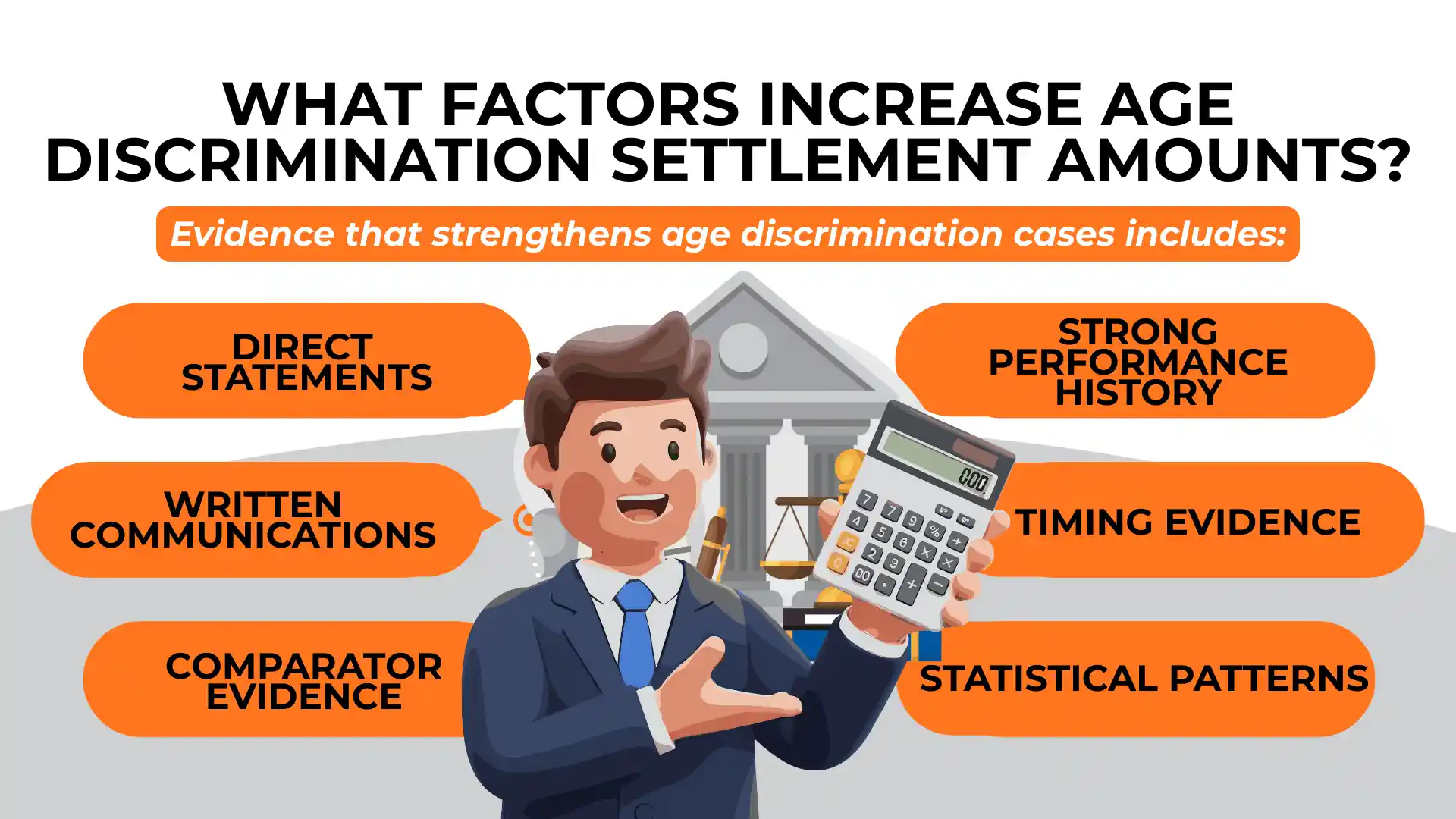
- Direct statements from decision-makers linking your age to the adverse action (“we need younger blood,” “you’re too old for this role”)
- Written communications—emails, texts, performance reviews—containing age-related comments
- Comparator evidence showing younger employees received better treatment under similar circumstances
- A strong performance history that contradicts claimed performance-based termination
- Timing evidence showing adverse action followed closely after age-related comments or after you turned a milestone age
- Statistical patterns showing older workers were disproportionately affected by layoffs or terminations
Employer’s Conduct and Willfulness
How your employer behaved affects both the legal standard and the practical settlement calculus. Willful ADEA violations double liquidated damages under federal law. Especially egregious conduct with management involvement triggers potential punitive damages under NJ LAD.
Employers also pay more to settle cases involving documented bad conduct because of reputational concerns. A company facing trial testimony about executives calling employees “dinosaurs” or systematically targeting older workers has incentives to resolve the case privately.
Your Mitigation Efforts
You have a legal obligation to mitigate damages by making reasonable efforts to find new employment. Failure to conduct a genuine job search can reduce your recovery. Document every application, interview, and rejection. The more thoroughly you can demonstrate active job-seeking, the stronger your damages claim.
What Reduces Settlement Value or Limits Recovery?
Several factors can decrease what your case is worth or cut off recovery entirely. Being aware of these issues early can help you avoid pitfalls.
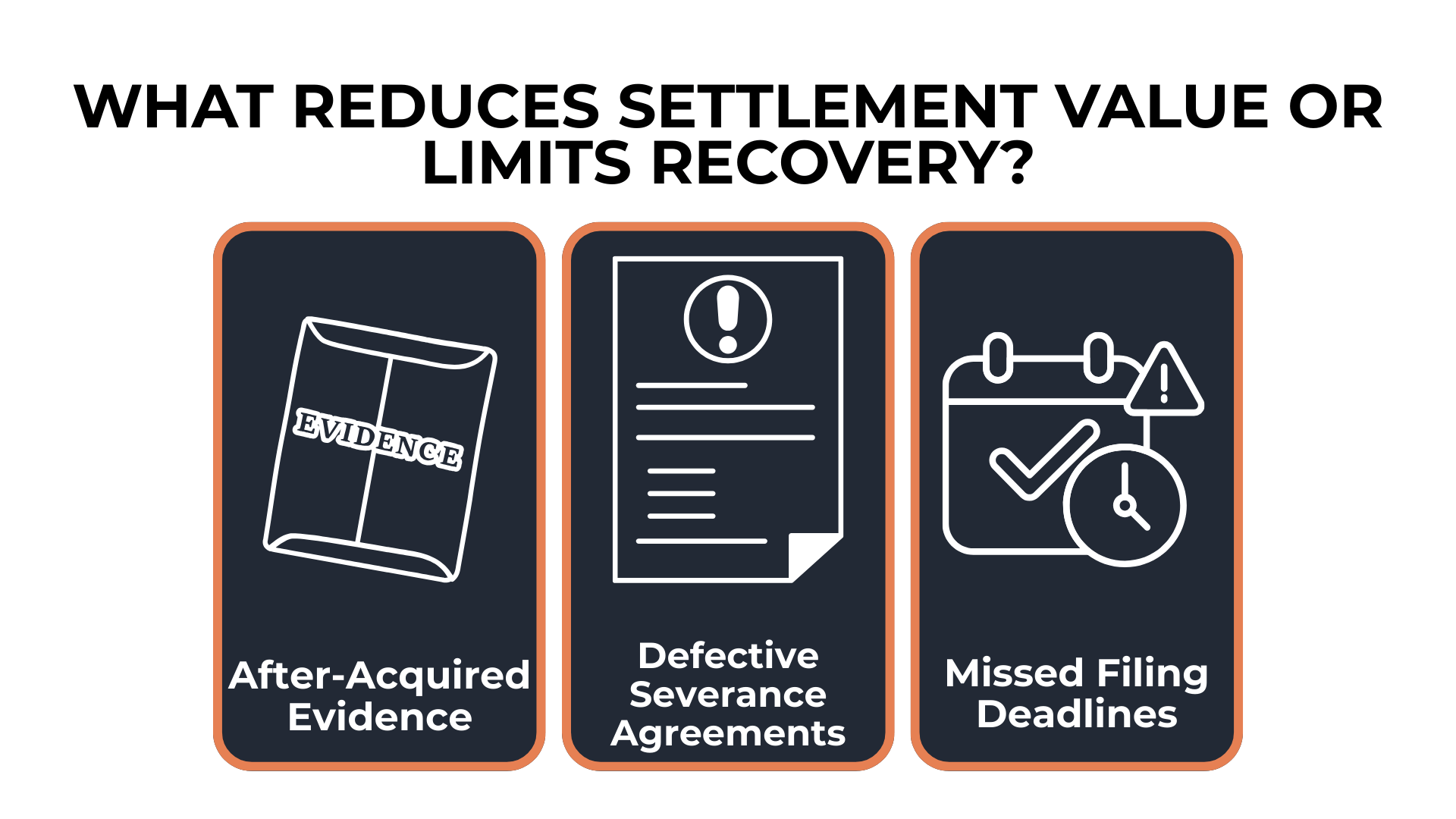
After-Acquired Evidence of Misconduct
Under McKennon v. Nashville Banner Publishing Co., 513 U.S. 352 (1995), if your employer discovers evidence of your own misconduct during litigation—misconduct serious enough that you would have been terminated for it—your remedies are limited. Back pay gets cut off at the date the employer discovered the misconduct. You also lose eligibility for reinstatement and front pay.
After-acquired evidence doesn’t eliminate your claim entirely, but it can significantly reduce recovery. Be prepared for your employer to scrutinize your employment history and conduct.
Defective Severance Agreements
If you signed a severance agreement releasing age discrimination claims, you might assume you cannot pursue a case. However, the Older Workers Benefit Protection Act imposes strict requirements for valid ADEA waivers. Under Oubre v. Entergy Operations, 522 U.S. 422 (1998), you can keep the severance money AND still sue if the release failed to comply with OWBPA requirements.
Common deficiencies that void ADEA waivers include inadequate consideration periods (less than 21 days for individual terminations or 45 days for group layoffs), missing 7-day revocation periods, failure to specifically reference ADEA rights, and inadequate disclosures in group termination situations. State law claims under NJ LAD and PA PHRA have different waiver requirements and may not be subject to OWBPA.
Missed Filing Deadlines
Missing filing deadlines can forfeit your entire claim, reducing settlement value to zero. The deadlines that apply depend on which laws and agencies are involved:
- 300 days to file an EEOC charge (Pennsylvania and New Jersey are both deferral states, extending the deadline from 180 days)
- 180 days to file with the Pennsylvania Human Relations Commission for PHRA claims
- 2 years to file a NJ LAD claim directly in court (no administrative exhaustion required)
- The continuing violation doctrine may extend deadlines for ongoing harassment, but not for discrete acts like termination
Late filing can completely bar recovery under federal law and PHRA. NJ LAD’s two-year court filing deadline provides more flexibility, but waiting too long allows evidence to disappear and memories to fade.
How Is an Age Discrimination Settlement Calculated?
Understanding how damages components are calculated helps you evaluate settlement offers and make informed decisions.
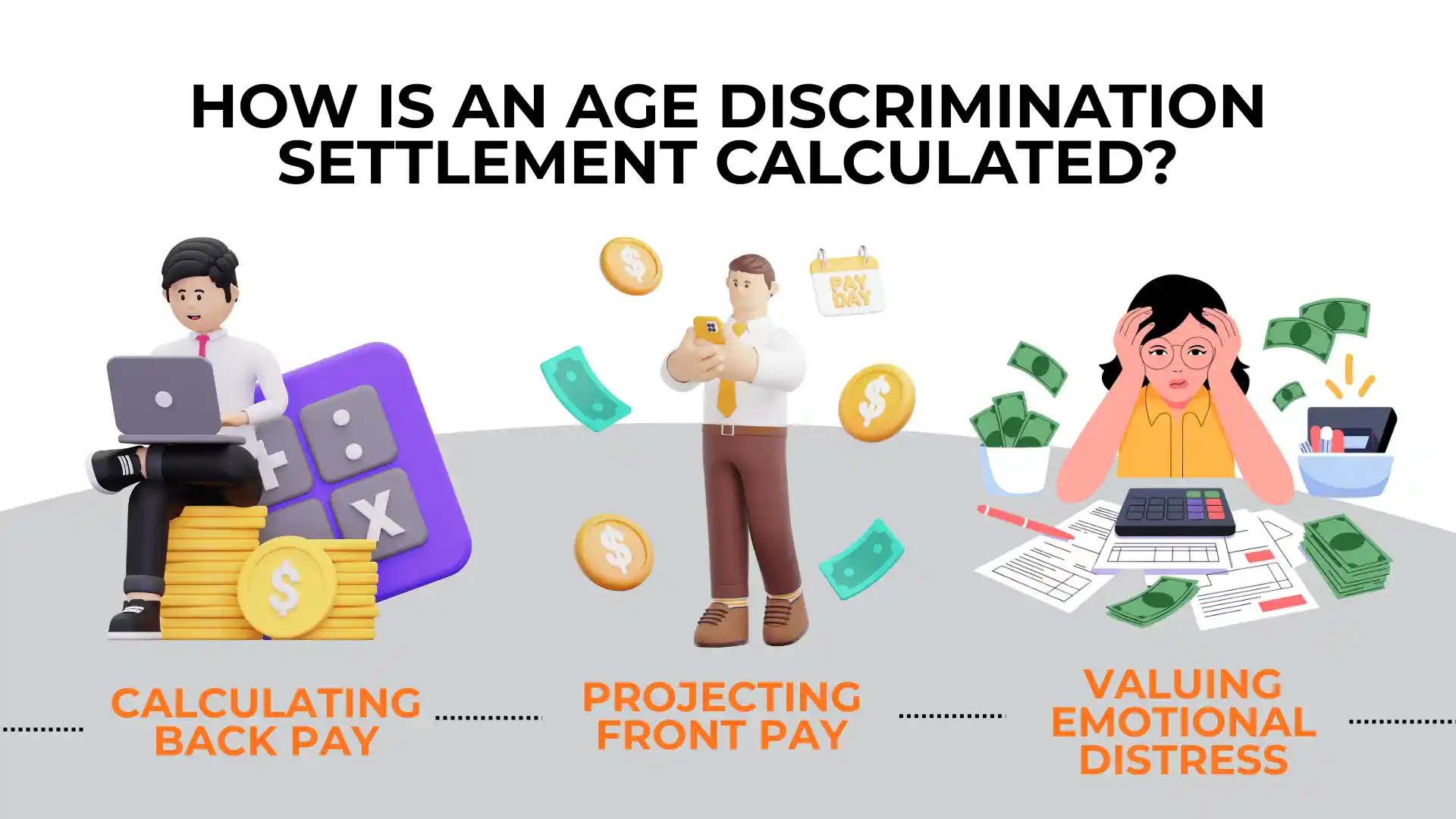
Calculating Back Pay
Back pay equals your total compensation from the date of termination through resolution, minus any interim earnings. Total compensation includes base salary, the value of benefits including health insurance and retirement contributions, expected bonuses and commissions based on historical patterns, and any raises you would have received.
If you find new employment at lower pay, you recover the difference between what you would have earned and what you actually earned. If you remain unemployed throughout the case, you recover the full amount.
Projecting Front Pay
When returning to your former position isn’t feasible, front pay compensates for future lost earnings. Courts consider your age, expected working years, likelihood of finding comparable employment, and health status. Expert testimony is often necessary to project future losses.
According to BLS data analyzed in Spotlight on Statistics (2024), the median unemployment duration for workers ages 55-64 is 10.7 weeks—more than double the 5.2-week median for teenagers. Many older workers face much longer job searches, supporting substantial front pay claims.
Valuing Emotional Distress
Emotional distress damages are available under NJ LAD and PA PHRA, though not under the federal ADEA. Valuation depends on the severity and duration of your psychological harm, whether you sought treatment, and how the discrimination affected your daily life and relationships.
Medical and psychological records documenting treatment strengthen emotional distress claims. Expert testimony about the permanency of harm can increase awards. However, emotional distress damages are inherently subjective, making them a significant negotiating point in settlement discussions.
Frequently Asked Questions
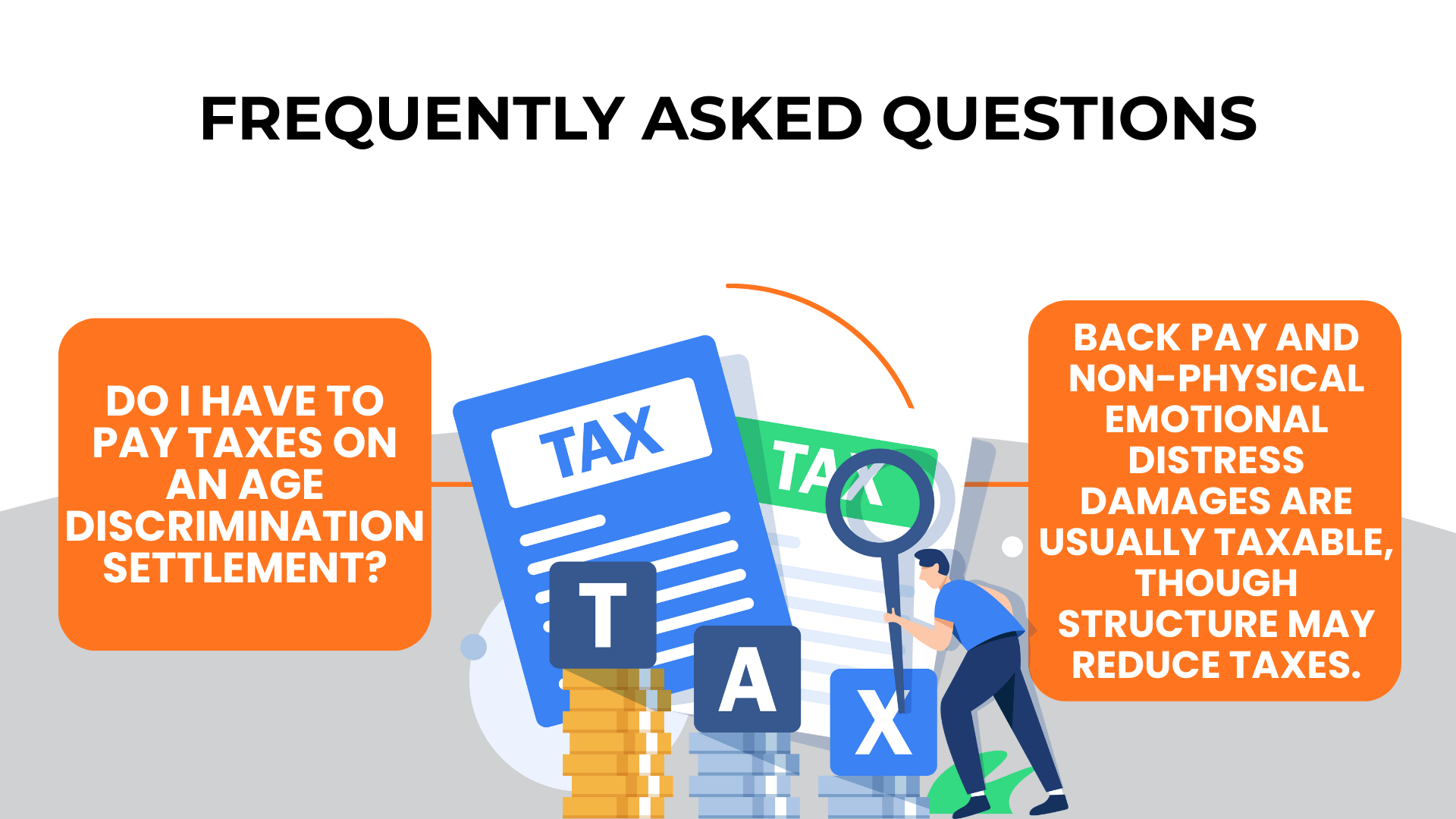
Do I have to pay taxes on an age discrimination settlement?
Tax treatment depends on how the settlement is structured. Back pay is generally taxable as ordinary income because it replaces wages you would have earned. Emotional distress damages not related to physical injury are also typically taxable. However, settlements can sometimes be structured to minimize tax impact, and specific circumstances vary. Consult a tax professional about your particular settlement.
Can I get a settlement if I signed a severance agreement?
Potentially yes. If your severance agreement failed to comply with OWBPA requirements for a valid ADEA waiver, the release may be void. Common deficiencies include insufficient time to consider the agreement, missing revocation periods, and failure to specifically reference ADEA rights. Under Oubre v. Entergy Operations, you do not have to return the severance money to pursue your claim if the release was defective.
How long does it take to settle an age discrimination case?
Timelines vary considerably. EEOC mediation averages 84 days when both parties participate. Full EEOC investigations average approximately 11 months. Cases that proceed to federal court litigation can take two to three years or longer. Many cases settle during litigation but before trial. Earlier settlement is possible when liability is clear and both parties are motivated to resolve the matter.
Will my age discrimination case go to trial or settle?
Most employment discrimination cases settle before trial. The EEOC achieved a 97% favorable resolution rate in FY 2024 litigation, but many of those resolutions were settlements rather than trial verdicts. Settlement allows both parties to avoid the uncertainty, expense, and public exposure of trial. However, some cases do proceed to verdict when parties cannot agree on value or when employers believe they can win.
Does the EEOC get part of my settlement?
No. The EEOC does not take a portion of settlements in cases you file yourself. When the EEOC itself files a lawsuit on your behalf (which happens in a small percentage of cases), any recovery goes to you as the aggrieved party. Your attorney’s fees come from your settlement or are paid separately by the employer under fee-shifting provisions, depending on how the case resolves.
Understanding Your Potential Recovery
Age discrimination settlement amounts depend on the intersection of your specific circumstances—your earnings, your evidence, your employer’s conduct—and the legal frameworks that apply to your claim. Federal ADEA claims provide back pay and potential liquidated damages but exclude emotional distress and punitive damages. New Jersey’s LAD offers the broadest recovery potential with uncapped compensatory damages, punitive damages for egregious conduct, and fee enhancement. Pennsylvania’s PHRA falls between, allowing emotional distress damages but prohibiting punitive damages.
The factors that increase case value—high earnings, strong evidence, willful employer conduct, documented emotional harm—can push settlements well into six figures. The factors that reduce value—missed deadlines, after-acquired evidence, weak documentation—can diminish or eliminate recovery entirely.
Contact The Lacy Employment Law Firm to discuss your age discrimination case and understand your potential recovery.