If you arrive early to set up your workstation, stay late to finish paperwork, or work through your lunch break, you’re not alone—and you may not be getting paid for it. According to the National Employment Law Project (2009), 70% of workers who came in early or stayed late did not receive pay for that work. Working off the clock is one of the most common forms of wage theft, and federal and state laws require employers to compensate you for all time you spend working—whether they asked you to or not.
This article explains what counts as compensable work time, which industries see the most violations, what you can recover, and how to protect yourself if you’ve been working without pay.
What Counts as Working Off the Clock?
The law defines work broadly. Any time you spend performing duties that benefit your employer—even if it happens before you clock in or after you clock out—may be compensable. The National Employment Law Project (2009) found that 68% of low-wage workers experienced at least one pay-related violation in the previous work week, with off-the-clock work being a leading cause.
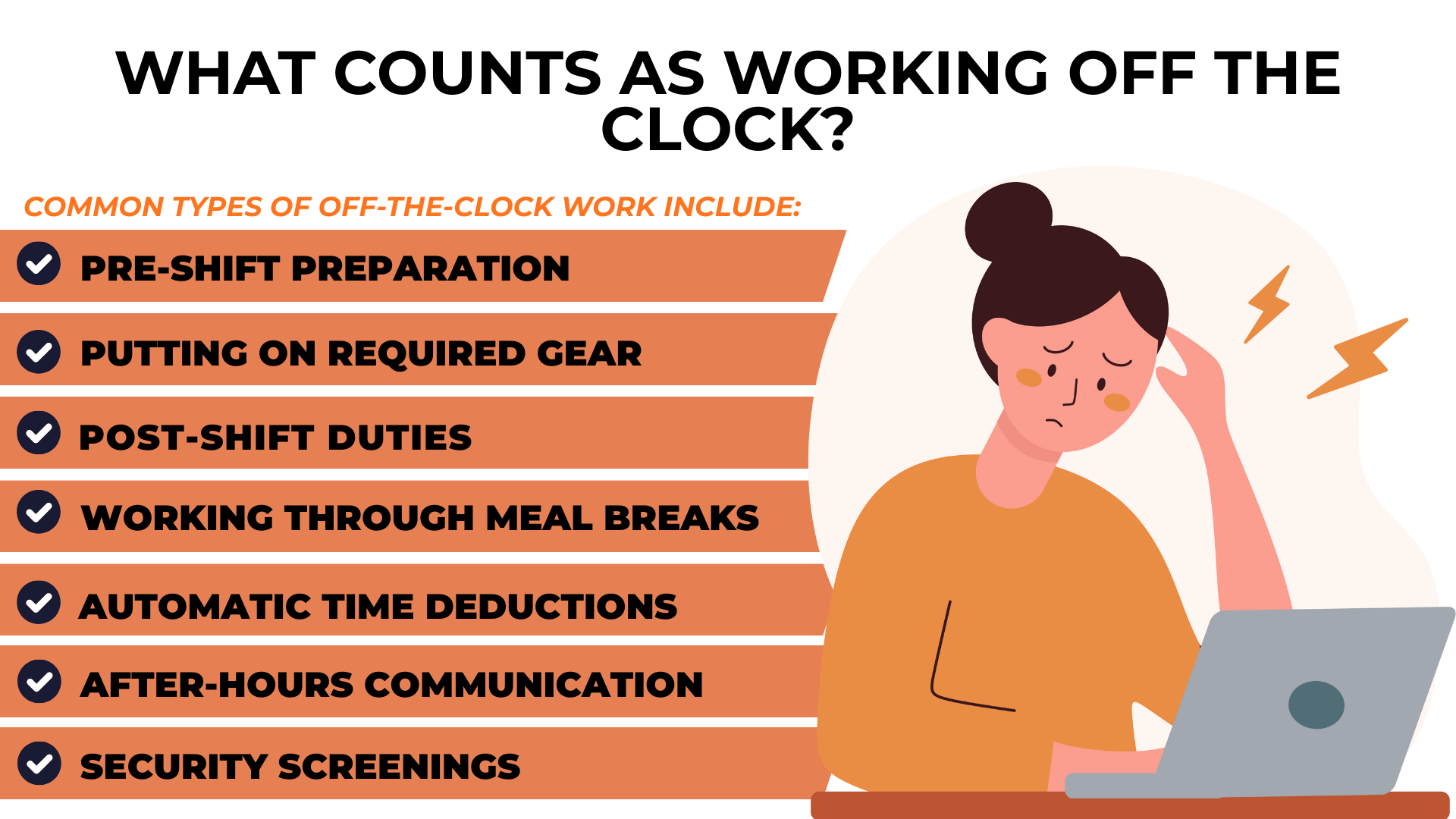
What are the most common types of off-the-clock work?
Off-the-clock violations take many forms. Some are obvious; others are built into workplace routines that employees may not realize are illegal. Common scenarios include:
- Pre-shift preparation: Booting up computers, logging into software systems, reviewing emails, or attending brief meetings before your scheduled start time
- Putting on required gear: Changing into uniforms, safety equipment, or protective clothing when required by your employer
- Post-shift duties: Cleaning your workspace, shutting down equipment, completing paperwork, or waiting for a manager to review your work
- Working through meal breaks: Answering phones, monitoring equipment, or remaining on-call during your “unpaid” lunch
- Automatic time deductions: When your employer automatically subtracts 30 minutes for lunch regardless of whether you actually took a break
- After-hours communication: Responding to work emails, texts, or calls from home before or after your shift
- Security screenings: In some cases, waiting in line for bag checks or security procedures after clocking out
Each of these scenarios can form the basis of a wage claim if your employer knew—or should have known—you were working.
Does it matter if my employer told me to work off the clock?
No. Under federal regulations, work not requested but suffered or permitted is still work time. This means your employer cannot escape liability by claiming they never asked you to work early or stay late. If management knew you were performing work duties off the clock—or could have discovered it through reasonable diligence—they were obligated to pay you. The focus is on whether the employer had knowledge, not whether they gave explicit instructions.
What if I volunteered to come in early or stay late?
Even “voluntary” work is compensable. The law doesn’t distinguish between mandatory and voluntary labor when determining whether time counts as hours worked. If you showed up early to prepare for your shift and your supervisor saw you doing it, that time should be on your paycheck. Your employer cannot avoid paying you simply because you weren’t ordered to work.
What Does Federal Law Say About Unpaid Work Time?
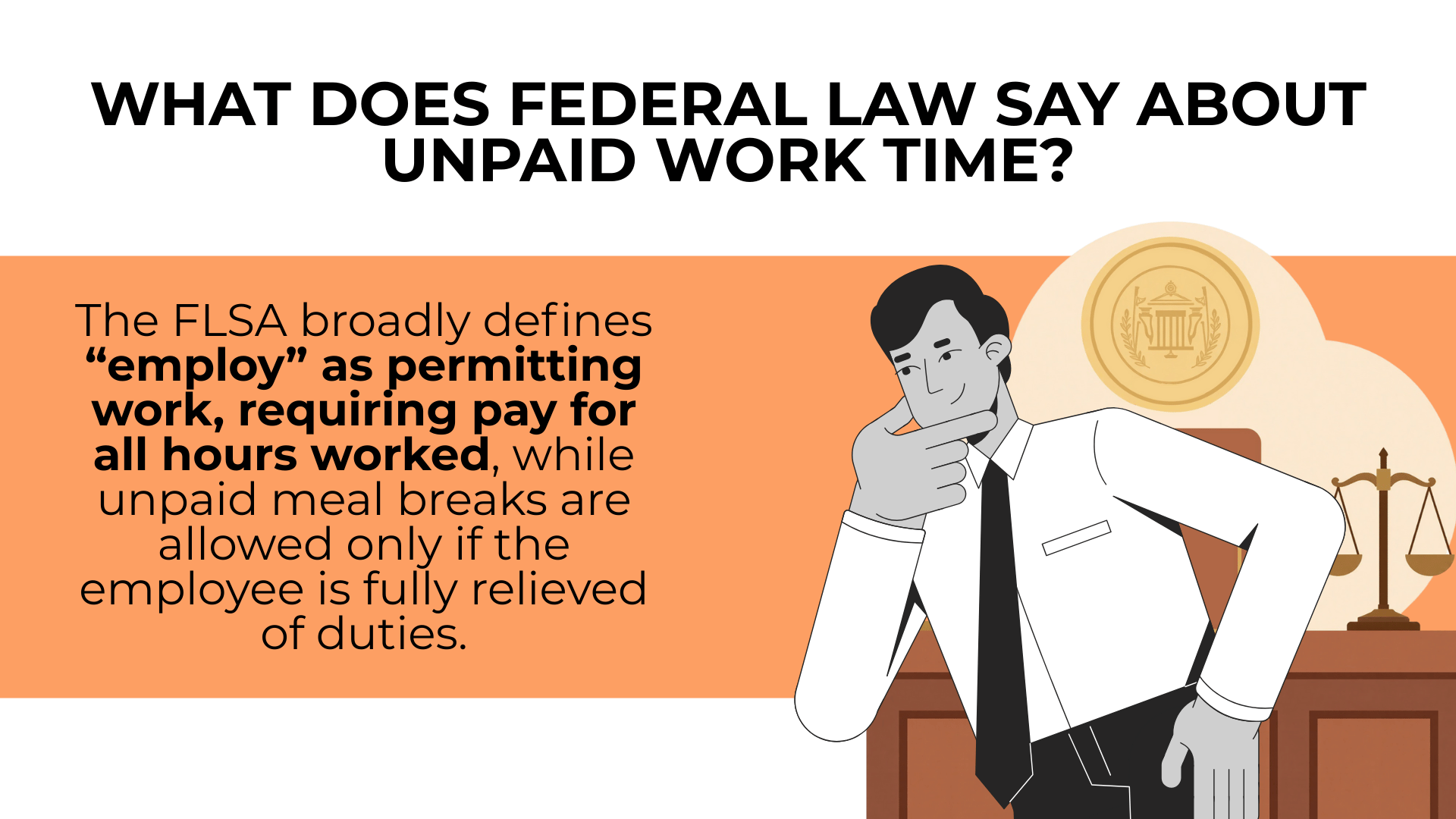
The Fair Labor Standards Act (FLSA) establishes the baseline for what employers must pay. Under federal law, the term “employ” includes to suffer or permit to work, 29 U.S.C. § 203(g). This broad definition means employers cannot look the other way while employees perform work duties without compensation.
How does the FLSA define “hours worked”?
Federal regulations make clear that all time during which an employee performs work duties is compensable. Under 29 C.F.R. § 785.11, work not requested but suffered or permitted is work time. If your employer knows you’re working—or has reason to know—they must pay you. In fiscal year 2025, the U.S. Department of Labor’s Wage and Hour Division recovered $259.3 million in back wages for workers nationwide, according to DOL enforcement data (2025). FLSA violations, including off-the-clock work, accounted for over $184 million of that recovery, per DOL data (2025).
What did the Supreme Court say about pre-shift and post-shift work?
Courts have grappled with exactly which activities are compensable. In IBP, Inc. v. Alvarez, 546 U.S. 21 (2005), the U.S. Supreme Court held that time spent walking between donning/doffing areas and production areas is compensable under the FLSA when the activity is integral and indispensable to the employee’s principal work. Workers at a meatpacking plant were entitled to pay for the time spent walking after putting on required protective gear.
However, not all post-shift time qualifies. In Integrity Staffing Solutions, Inc. v. Busk, 574 U.S. 27 (2014), the Court ruled that post-shift security screenings were not compensable because they weren’t integral to the employees’ warehouse work. The key distinction is whether the activity is central to your job duties or merely a condition of employment.
When are meal breaks considered work time?
Under 29 C.F.R. § 785.19, a meal period qualifies as unpaid only if the employee is completely relieved of duties. If you must remain at your desk, answer phones, monitor equipment, or stay available for work during your “break,” that time is compensable. Many employers violate this rule by automatically deducting lunch breaks from time records even when employees continue working.
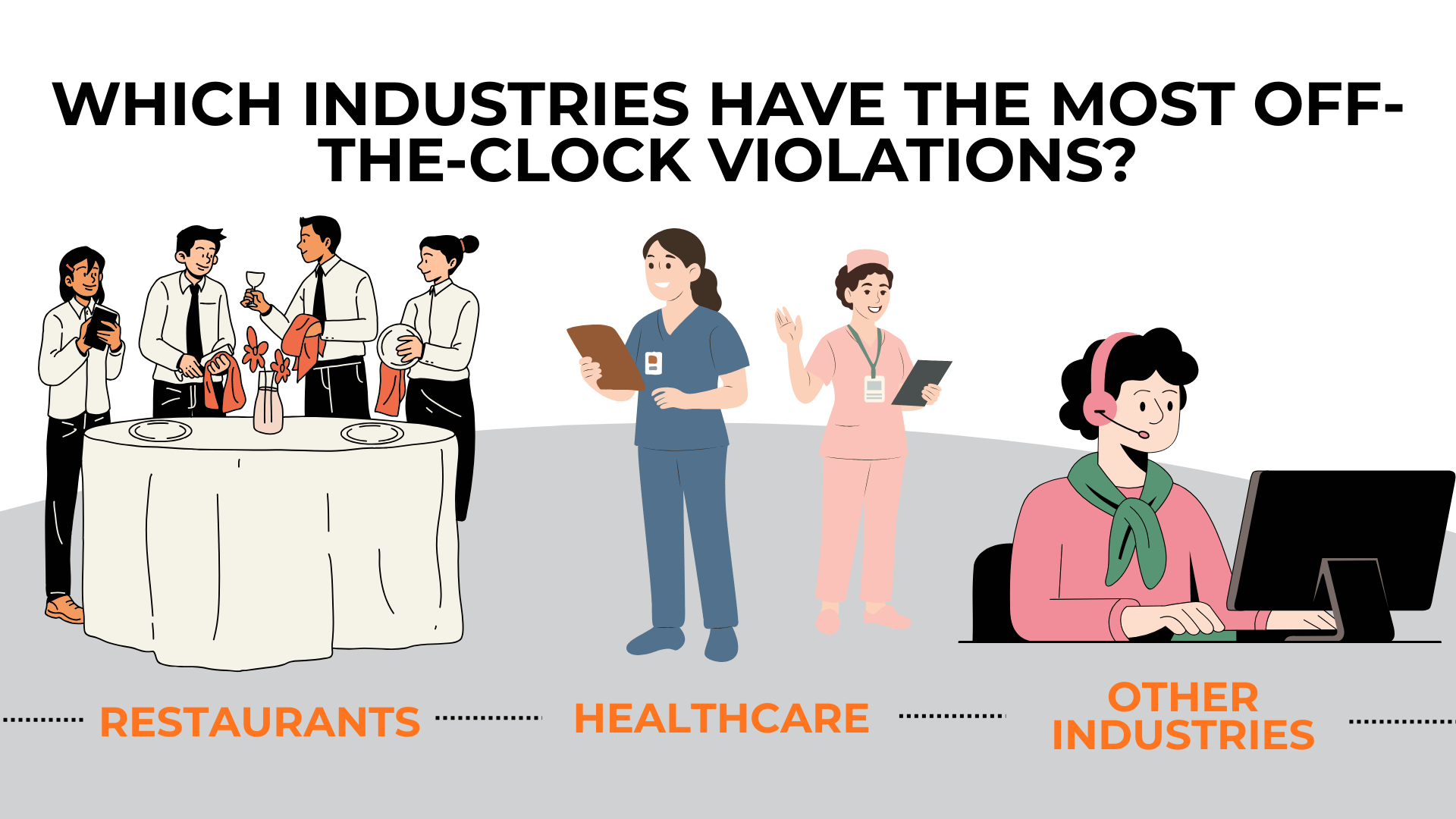
Which Industries Have the Most Off-the-Clock Violations?
Certain industries have chronic problems with unpaid work time. If you work in one of these sectors, your risk of experiencing off-the-clock violations is significantly higher.
Why are restaurants a hotspot for off-the-clock violations?
The restaurant industry has one of the highest violation rates in the country. According to the U.S. Department of Labor (2021), 85% of DOL restaurant investigations resulted in violations. In fiscal year 2025, the DOL resolved 4,088 food service violations and recovered over $42 million in back wages, per DOL data (2025).
Common off-the-clock scenarios in restaurants include:
- Arriving early to prep ingredients, set tables, or attend pre-shift meetings without pay
- “Side work” performed before or after serving shifts, such as rolling silverware or stocking supplies
- Staying late to clean, close out cash registers, or complete inventory counts
- Working through meal breaks because the restaurant is too busy to allow a real break
These violations are often systematic—built into the restaurant’s scheduling practices rather than isolated incidents.
What about healthcare and nursing facilities?
Healthcare workers face significant off-the-clock risks due to the nature of shift-based work. The DOL (2025) resolved 2,370 healthcare violations in fiscal year 2025, recovering over $53 million in back wages. Common violations include arriving early to review patient charts, staying late to complete documentation, and being interrupted during meal breaks for patient needs.
One notable case illustrates the scale of the problem: In 2024, the DOL secured a $35.8 million judgment against 15 Pennsylvania nursing facilities for willful overtime violations affecting 6,000 employees, according to DOL records (2024). Healthcare workers are particularly vulnerable because patient care demands often extend beyond scheduled shifts.
Are there other industries where this happens frequently?
Off-the-clock work isn’t limited to food service and healthcare. Retail workers often perform opening and closing procedures off the clock, including setting up displays, counting cash drawers, and attending brief meetings. Manufacturing workers may be required to don safety equipment or prepare machinery before their shift officially starts. Call center employees frequently must log into computer systems and software before their scheduled start time.
The common thread is any job where preparation, cleanup, or transition activities happen outside recorded work hours.
How Much Can You Recover for Off-the-Clock Work?
Understanding potential recovery helps you evaluate whether pursuing a claim makes sense. The amounts can be substantial, especially when enhanced damages apply.
What are liquidated damages under federal law?
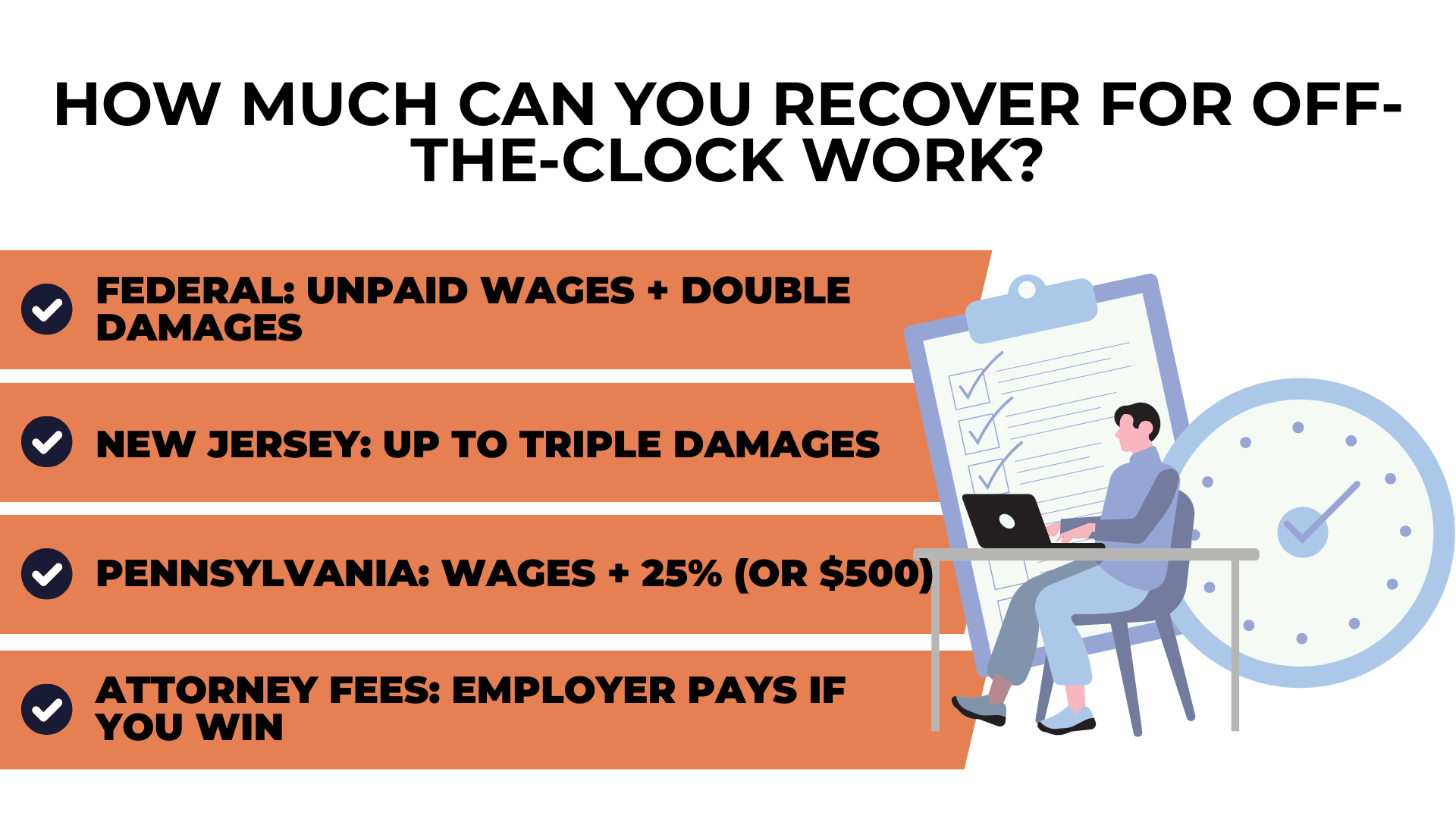
The FLSA provides that employees who prove wage violations can recover unpaid wages plus an equal amount in liquidated damages, effectively doubling the recovery under 29 U.S.C. § 216(b). Courts treat these damages as the norm. In Souryavong v. Lackawanna County, 872 F.3d 122 (3d Cir. 2017), the Third Circuit confirmed that liquidated damages are the rule, not the exception—the employer bears the burden of proving good faith to reduce them.
FLSA collective action settlements reached $493,571,392 across 423 cases in 2023, with an average settlement of approximately $1.17 million per case, according to Seyfarth Shaw’s litigation report (2023).
What additional damages are available in New Jersey?
New Jersey’s 2019 Wage Theft Act provides some of the strongest worker protections in the nation. Under N.J. Stat. Ann. § 34:11-4.10, employees can recover:
- Treble damages: Up to three times the amount of unpaid wages
- Attorney fees and costs: Mandatory fee-shifting to prevailing plaintiffs
- Six-year statute of limitations: Significantly longer than federal law
New Jersey’s framework makes even smaller individual claims economically viable to pursue.
What can Pennsylvania workers recover?
Pennsylvania’s Wage Payment and Collection Law (WPCL) provides different but still meaningful remedies. Under 43 Pa. Stat. § 260.10, employees can recover:
- Full amount of wages due
- 25% liquidated damages(or $500, whichever is greater) if wages remain unpaid more than 30 days
- Attorney fees and costs
Pennsylvania’s three-year statute of limitations falls between federal and New Jersey timeframes.
Do I have to pay my lawyer upfront?
All three jurisdictions—federal, New Jersey, and Pennsylvania—provide mandatory attorney fee shifting for prevailing plaintiffs. This means the employer pays your attorney fees if you win. This structure allows workers to pursue valid claims without paying legal fees out of pocket, making even smaller cases worth bringing.
How Do You Prove Off-the-Clock Work?
Building a strong case requires documentation. The more evidence you can gather, the stronger your position.
What evidence should you gather?
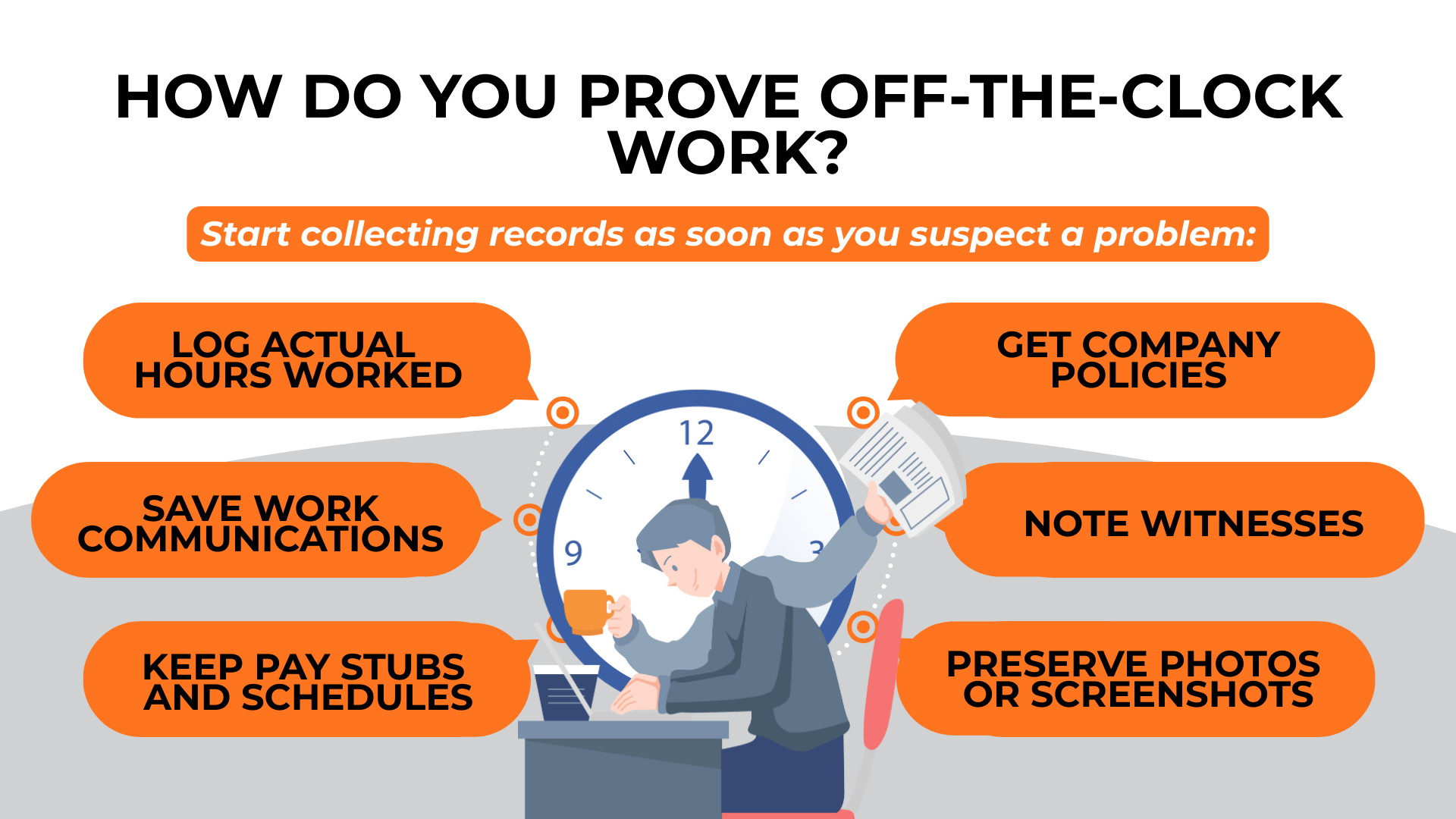
Start collecting records as soon as you suspect a problem. Useful evidence includes:
- Personal time log: Write down your actual start and end times daily, including any work performed before clocking in or after clocking out
- Work communications: Save text messages, emails, or chat logs showing you were working outside your scheduled hours
- Pay stubs: Review them for automatic deductions that don’t match your actual breaks
- Company policies: Obtain copies of timekeeping policies, break policies, and any written rules about off-the-clock work
- Witness information: Note the names of coworkers who witnessed or experienced the same practices
- Schedules and time records: Keep copies of your work schedule and any records of your clocked hours
- Photos or screenshots: Document relevant evidence like work emails sent at unusual hours or messages from supervisors
Even if you’ve already experienced violations, start documenting now. Your records can help establish a pattern.
What if my employer has a policy against working off the clock?
Many employers have written policies prohibiting off-the-clock work—and then ignore them in practice. A policy does not excuse the employer if supervisors knew or should have known employees were working without pay. The “suffered or permitted” standard under 29 C.F.R. § 785.11 focuses on employer knowledge, not written rules. An employer cannot benefit from willful blindness.
Can I join with coworkers who had the same experience?
Yes. If your employer’s off-the-clock practices affected multiple workers, you may be able to pursue a collective action under the FLSA or a class action under state law. In fiscal year 2025, 176,957 workers received back wages through Department of Labor enforcement actions, according to DOL data (2025). FLSA collective actions had a 75% conditional certification success rate in 2023, according to Seyfarth Shaw (2023). Joining together increases leverage and efficiency.
How Long Do You Have to File a Claim?
Time limits apply to wage claims. Waiting too long means losing the ability to recover older violations.
What are the federal deadlines?
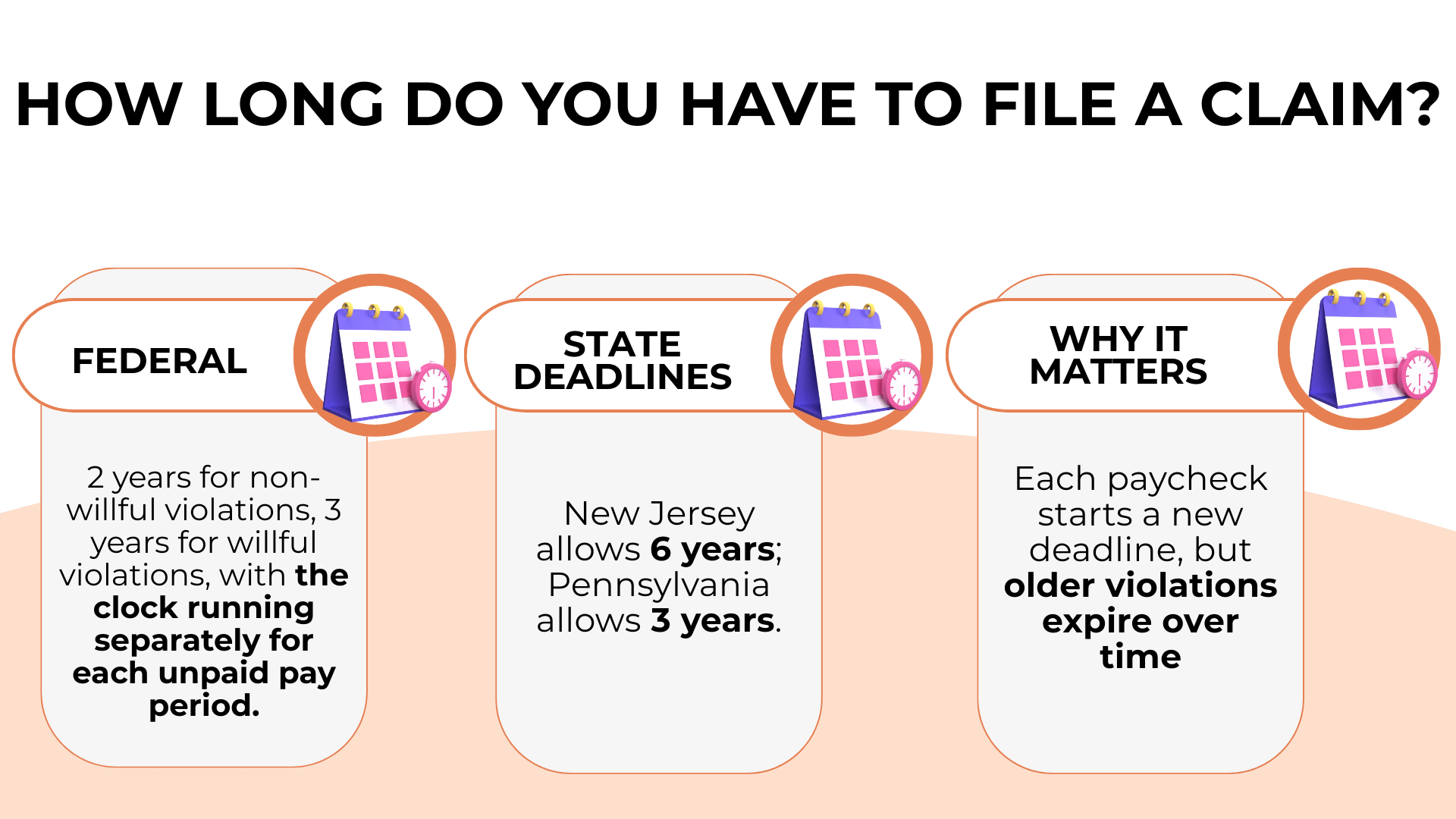
Under the FLSA, the statute of limitations is two years for non-willful violations and three years for willful violations, 29 U.S.C. § 255(a). A willful violation occurs when the employer knew or showed reckless disregard for whether its conduct violated the law. The clock runs separately from each pay period—meaning every unpaid paycheck starts its own limitations period.
What are the state deadlines in New Jersey and Pennsylvania?
State laws provide different—and sometimes longer—windows:
New Jersey offers a six-year statute of limitations under the Wage Theft Act, N.J. Stat. Ann. § 34:11-56a25.1(a). This is one of the longest in the nation and allows workers to recover wages going back several years.
Pennsylvania provides a three-year statute of limitations under the WPCL, 43 Pa. Stat. § 260.10. This exceeds the federal non-willful period but falls short of New Jersey’s protections.
Why does the deadline matter for ongoing violations?
If your employer is still engaging in off-the-clock practices, each pay period creates a new violation with its own limitations period. However, older violations expire continuously. Every week you wait means potentially losing recovery for the oldest violations. Acting promptly preserves the maximum recovery period.
What Protections Exist Against Retaliation?
Fear of retaliation prevents many workers from coming forward. The law provides specific protections.
What happens if my employer fires me for complaining?
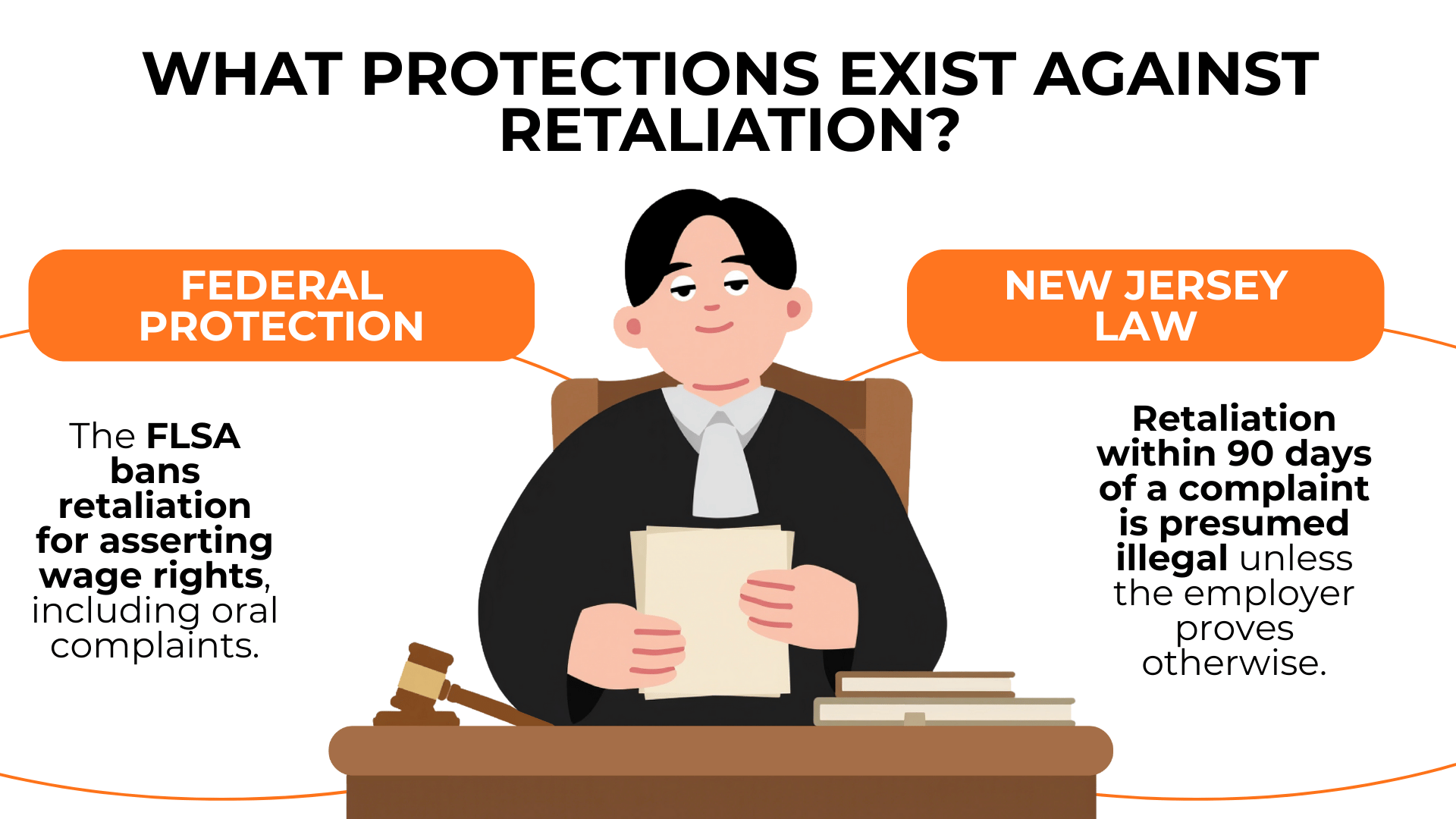
The FLSA’s anti-retaliation provision, 29 U.S.C. § 215(a)(3), prohibits employers from discharging or discriminating against employees who file complaints or assert wage rights. Importantly, the Supreme Court held in Kasten v. Saint-Gobain Performance Plastics Corp., 563 U.S. 1 (2011), that this protection covers oral as well as written complaints. You don’t need to file a formal legal document to be protected—raising concerns to your supervisor or HR counts.
Despite these protections, the National Employment Law Project (2019) found that 43% of workers who complained about wages or attempted organizing experienced illegal retaliation, including firing, suspension, threats, and reduced hours. Only about 22% of workers report labor violations to any authority, largely due to fear of consequences.
Does New Jersey have stronger retaliation protections?
Yes. Under the New Jersey Wage Theft Act, if an employer takes adverse action within 90 days of a worker’s protected activity, retaliation is presumed, N.J. Stat. Ann. § 34:11-4.10(c). The employer can only defeat this presumption with clear and convincing evidence of a legitimate, non-retaliatory reason. This is a high burden for employers and provides meaningful protection for workers who speak up.
Frequently Asked Questions
Can my employer require me to work off the clock if I agreed to it?
No. Your consent does not make unpaid work legal. Under federal law, employers must compensate you for all hours worked regardless of any agreement to the contrary. The “suffered or permitted” standard means that if your employer knew you were working, they were required to pay you—even if you volunteered or signed a waiver.
What if my employer automatically deducts 30 minutes for lunch but I work through my break?
This is a common violation. Under 29 C.F.R. § 785.19, meal periods are only unpaid if you are completely relieved of duties. If you work through lunch or remain on-call, that time is compensable. Automatic deductions that don’t reflect actual breaks taken violate federal and state wage laws.
How far back can I recover wages for off-the-clock work?
It depends on the jurisdiction. Under the FLSA, the period is two years (or three for willful violations). Under the Pennsylvania WPCL, you have three years. New Jersey provides the longest window at six years under the Wage Theft Act. Filing promptly preserves the maximum recovery period.
Can I file a claim even if I’m still employed?
Yes, and the law protects you from retaliation for doing so. Both federal and state anti-retaliation provisions prohibit employers from firing, demoting, or taking other adverse action against employees who assert their wage rights. New Jersey’s 90-day presumption makes retaliation claims particularly strong.
What if many coworkers at my job are also working off the clock?
You may be able to join together in a collective action under the FLSA or a class action under state law. Collective actions allow workers with similar claims to pool their resources and share litigation costs. Courts granted conditional certification in 75% of FLSA collective actions in 2023, making this a viable path for systemic violations.
Taking Action on Unpaid Work Time
Working off the clock isn’t just unfair—it’s illegal under federal and state wage laws. Whether you’re arriving early, staying late, working through breaks, or having time automatically deducted from your pay, you have the right to be compensated. The law provides meaningful remedies, including doubled or tripled damages and recovery of attorney fees.
Time limits apply to these claims. Each week you wait means potentially losing recovery for older violations. Documenting your hours now—even if you’re unsure whether to take action—preserves your options.
If you have questions about unpaid work time, contact The Lacy Employment Law Firm to discuss your situation.