
Wage theft is exactly what it sounds like: your employer taking money you earned and keeping it for themselves. It happens when employers fail to pay minimum wage, refuse to pay overtime, force you to work off the clock, steal your tips, or misclassify you as an independent contractor to avoid paying you properly. According to the Economic Policy Institute (2014), American workers lose an estimated $50 billion every year to wage theft—more than all robberies, car thefts, and burglaries in the country combined. If you suspect your employer isn’t paying you everything you’re owed, understanding what wage theft looks like is the first step toward getting your money back.
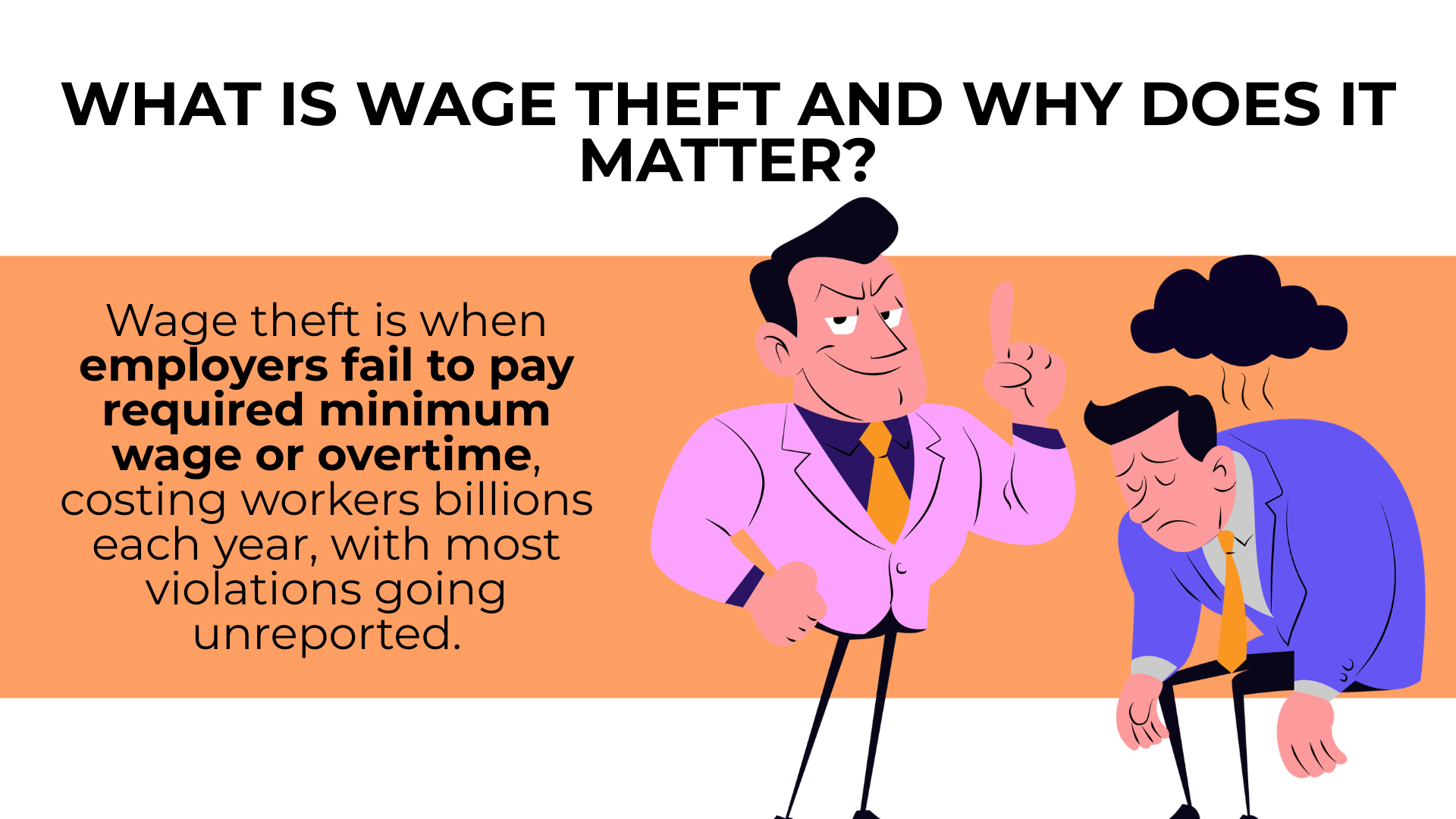
What Is Wage Theft and Why Does It Matter?
Wage theft refers to any practice where an employer denies workers the wages or benefits they’re legally entitled to receive. Under federal law, the Fair Labor Standards Act (FLSA) requires covered employers to pay at least the federal minimum wage of $7.25 per hour and overtime at 1.5 times the regular rate for hours exceeding 40 in a workweek. 29 U.S.C. § 206(a); 29 U.S.C. § 207(a)(1). When employers violate these requirements—whether through deliberate policy or careless payroll practices—they commit wage theft.
How big is the wage theft problem?
The scale of wage theft dwarfs other forms of property crime. The Economic Policy Institute (2014) found that wage theft losses exceed the combined value of all robberies, car thefts, and burglaries reported to the FBI. Yet enforcement recovers only a fraction of what’s stolen.
In fiscal year 2025, the U.S. Department of Labor’s Wage and Hour Division recovered $259.3 million in back wages for workers—a 28% increase over the prior year, according to DOL enforcement data (2025). That sounds substantial until you compare it to the $50 billion stolen annually. The Economic Policy Institute (2017) estimates that enforcement recovers only about 4% of total wage theft.
Who commits wage theft?
Wage theft isn’t limited to shady employers operating out of back alleys. It happens across every industry, from fast food to healthcare to professional services. Sometimes it’s deliberate—a manager pocketing tips or a company policy that shaves minutes off time cards. Other times it’s systemic: automated payroll systems that round hours down or break policies that deduct lunch time even when employees work through meals.
According to the DOL Wage and Hour Division (2021), 85% of restaurant industry investigations found violations. That’s not a few bad actors—it’s an industry-wide pattern.
Why don’t more workers report it?
Fear keeps most wage theft hidden. According to the National Employment Law Project (2019), only about 22% of workers who experience labor violations report them to any authority. Workers worry about losing their jobs, having their hours cut, or facing immigration consequences. Many don’t even realize what’s happening to them is illegal.
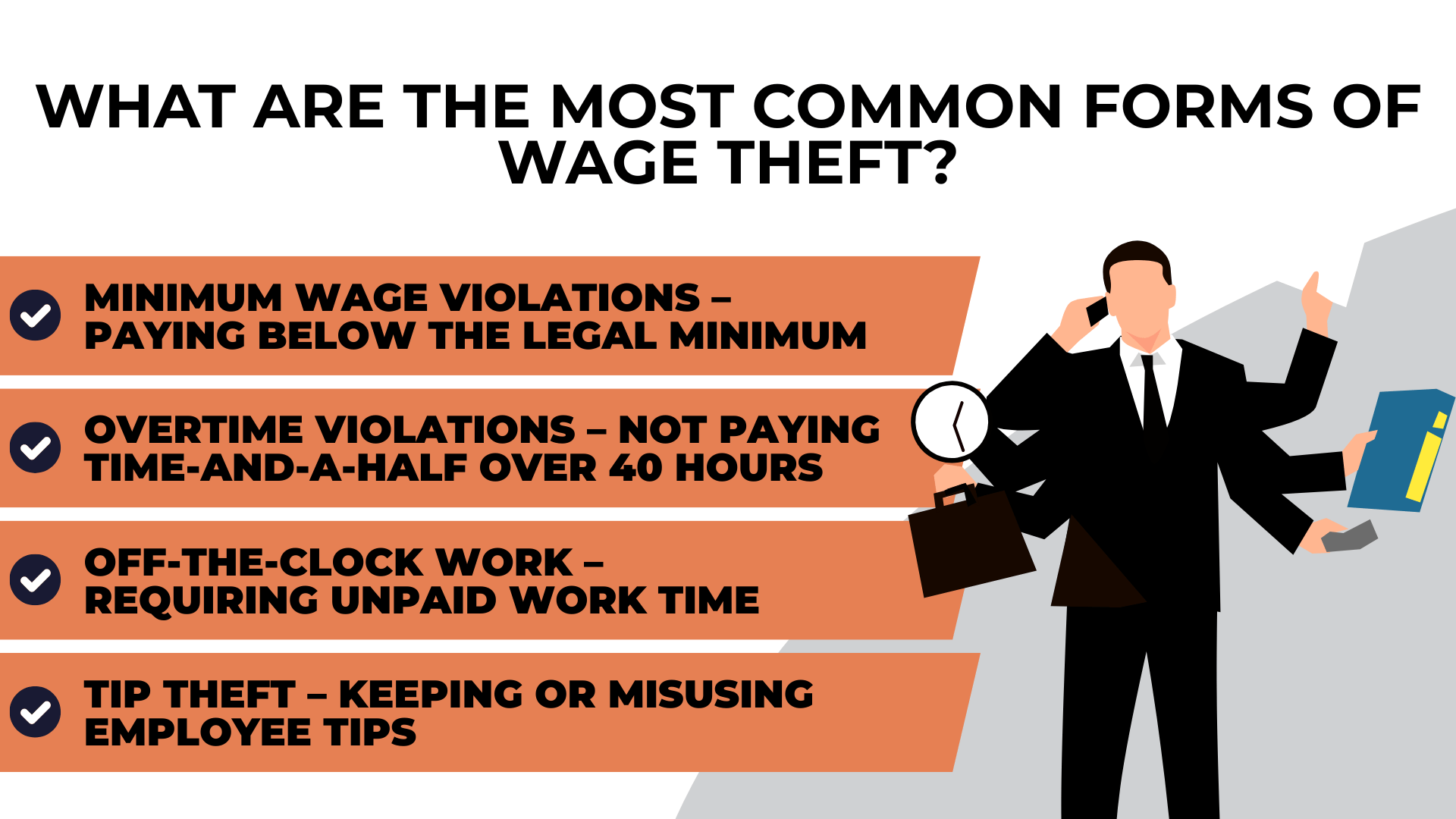
What Are the Most Common Forms of Wage Theft?
Wage theft takes many forms, but most violations fall into a few major categories. Understanding these categories helps you recognize whether your employer’s practices cross the line from unfair to illegal.
What counts as a minimum wage violation?
A minimum wage violation occurs when your employer pays you less than the legally required hourly rate. Under federal law, that floor is $7.25 per hour. But state law often provides higher protection. New Jersey’s minimum wage is $15.92 per hour as of January 2026, according to the NJ Department of Labor (2026). Pennsylvania’s minimum wage remains at $7.25—unchanged since 2009.
According to the National Employment Law Project (2009), 26% of low-wage workers in major cities were paid below minimum wage in a given work week.
When does unpaid overtime become wage theft?
If you’re a non-exempt employee who works more than 40 hours in a workweek, your employer must pay you 1.5 times your regular rate for every overtime hour. 29 U.S.C. § 207(a)(1). When employers refuse to pay overtime—or misclassify you as “exempt” to avoid it—that’s wage theft.
The National Employment Law Project (2009) found that 76% of low-wage workers who worked more than 40 hours in a week did not receive legally required overtime pay. The average worker experiencing overtime theft lost 11 hours of overtime either underpaid or unpaid each week.
What is off-the-clock wage theft?
Under the FLSA, “hours worked” includes all time during which an employee is “suffered or permitted to work.” 29 C.F.R. § 785.11. That means if your employer knows you’re working—or should know—they must pay you for that time. Common off-the-clock violations include:
- Requiring you to arrive early for unpaid “setup” time
- Automatically deducting lunch breaks even when you work through them
- Making you stay late to finish tasks after clocking out
- Requiring off-site work (answering emails, phone calls) without compensation
The NELP survey (2009) found that 70% of workers who came in early or stayed late did not receive pay for that extra time.
How do tip violations work?
Tips belong to the employee who earns them—period. Under 29 U.S.C. § 203(m), employers are prohibited from keeping employee tips regardless of whether they take a tip credit. Tip theft happens when managers take a cut of tips, when employers require illegal tip pools that include non-tipped workers, or when employers fail to make up the difference when tips don’t bring a worker up to minimum wage.
According to the Economic Policy Institute (2017), approximately 12% of tipped workers experienced direct tip confiscation by their employer or supervisor.
The most common forms of wage theft include:
- Minimum wage violations— Paying below the federal, state, or local minimum wage
- Overtime violations— Failing to pay 1.5x for hours over 40 per week
- Off-the-clock work— Requiring work before, after, or during unpaid breaks
- Tip theft— Managers taking tips or illegal tip pooling arrangements
- Misclassification— Labeling employees as independent contractors to avoid wage requirements
- Illegal deductions— Taking money from paychecks for uniforms, cash register shortages, or breakage
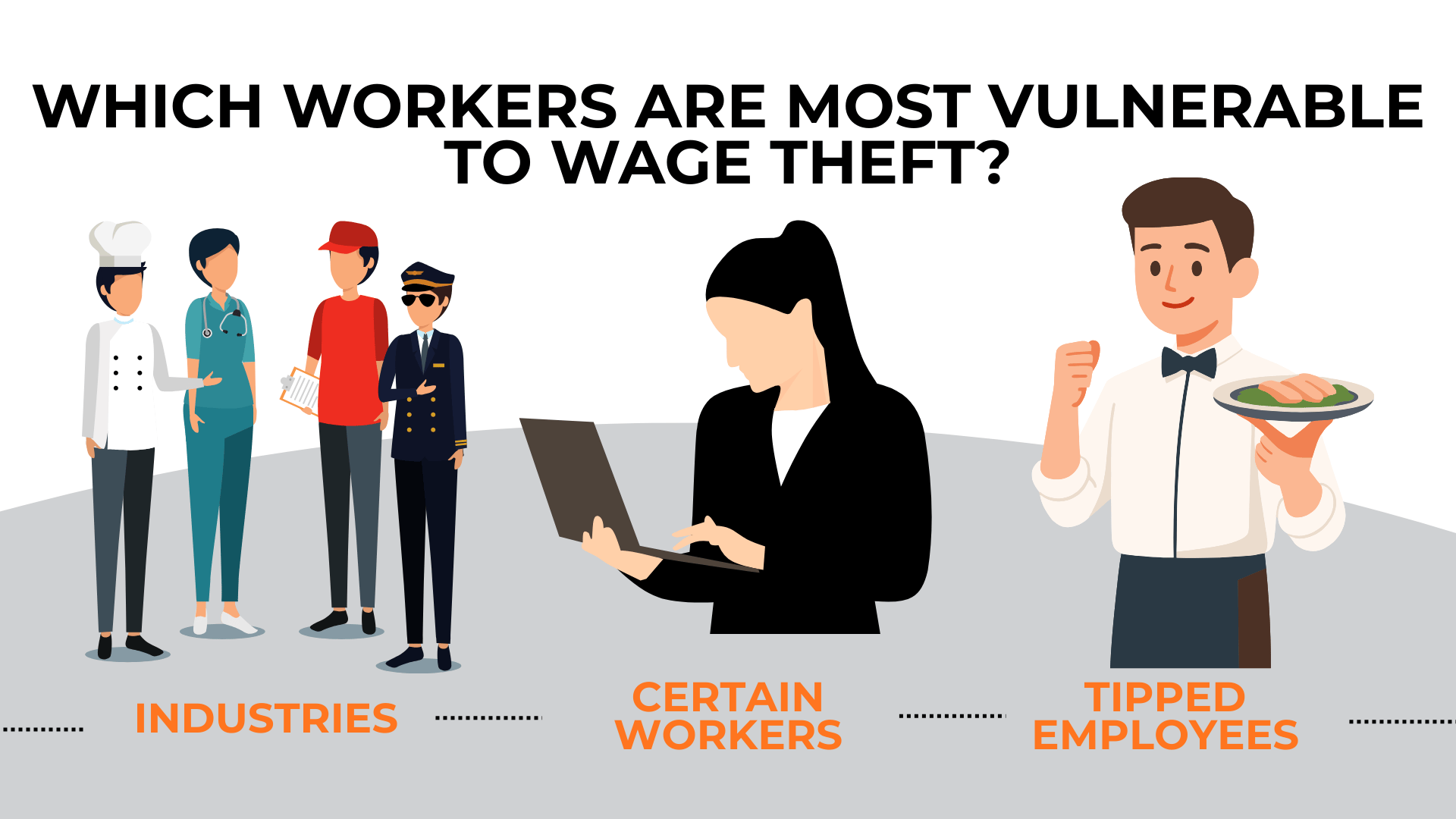
Which Workers Are Most Vulnerable to Wage Theft?
Wage theft doesn’t affect all workers equally. Certain industries and demographics face much higher violation rates than others.
Which industries have the highest violation rates?
Some industries are so notorious for wage theft that federal regulators designate them as “low wage, high violation” priority sectors. According to the DOL Wage and Hour Division (2021), 85% of restaurant industry investigations uncovered violations. In fiscal year 2025, food service violations resulted in over $42 million in back wage recoveries, while healthcare violations yielded $53 million, according to DOL data (2025).
Industries with the highest wage theft rates include:
- Restaurants and food service— 85% investigation violation rate
- Healthcare and nursing facilities— $53M+ recovered in FY 2025
- Construction— High misclassification rates
- Retail— Off-the-clock and overtime violations common
- Janitorial and cleaning services— High misclassification risk
Are certain workers targeted more than others?
Wage theft disproportionately affects workers who have less power to fight back. The National Employment Law Project (2009) found that 30% of women experienced minimum wage violations compared to 20% of men—a 50% higher rate. Undocumented workers faced even steeper odds: 37.1% experienced minimum wage violations, more than double the rate for U.S.-born workers.
According to the Bureau of Labor Statistics (2024), workers under age 25 accounted for 43% of those earning federal minimum wage or less, despite representing only about one-fifth of hourly workers.
What about tipped employees?
Tipped workers face unique vulnerabilities. The federal tipped minimum wage has been frozen at $2.13 per hour since 1991, according to the Department of Labor. That means tipped workers depend almost entirely on customer generosity and employer compliance with tip credit rules.
According to the Economic Policy Institute (2014), 66.6% of tipped workers are women, making tip theft a significant gender equity issue. Nearly 5 million workers hold food and beverage serving jobs where tips form a substantial portion of their income, per BLS data (2024).
How Does Misclassification Lead to Wage Theft?
One of the most insidious forms of wage theft doesn’t involve withholding a paycheck—it involves reclassifying you so that wage laws don’t seem to apply.
What is employee misclassification?
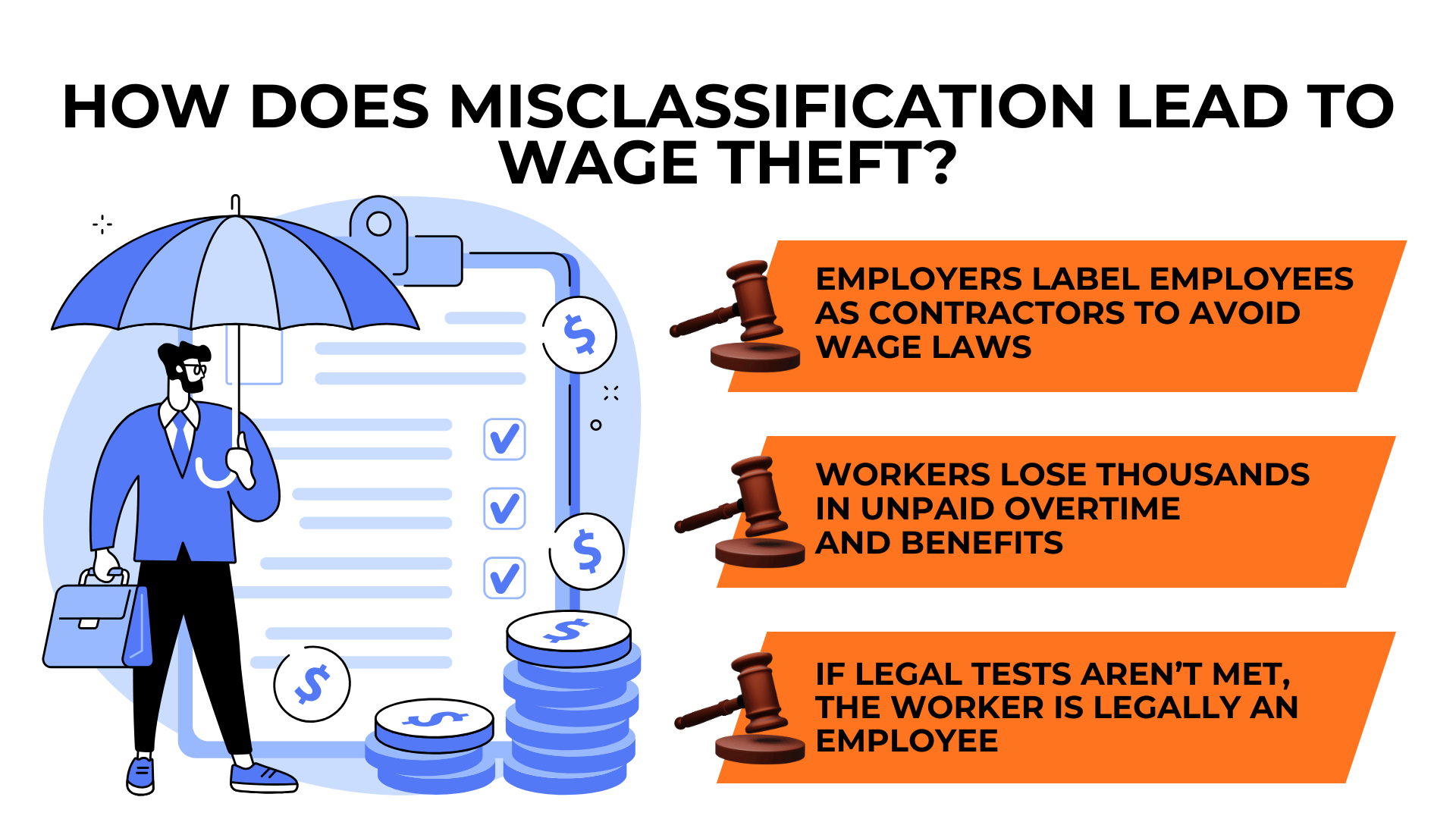
Employee misclassification occurs when an employer labels a worker as an independent contractor (1099) when the worker should legally be classified as an employee (W-2). This distinction matters enormously because independent contractors aren’t protected by minimum wage laws, overtime requirements, or unemployment insurance.
As the Supreme Court explained in Rutherford Food Corp. v. McComb, 331 U.S. 722 (1947), the economic reality of the working relationship—not the label the parties use—determines whether an employment relationship exists.
How much does misclassification cost workers?
The financial impact of misclassification is staggering. According to the Economic Policy Institute (2025), the per-worker cost ranges from $6,517 for janitors in Mississippi to $26,253 for truck drivers in New Jersey. That’s money lost to minimum wage violations, unpaid overtime, and denied benefits.
New Jersey has been particularly aggressive in combating misclassification. The NJ Department of Labor (2025) recovered $37 million for nearly 8,500 workers specifically for misclassification violations in 2024-2025.
How do courts determine if you’re misclassified?
Different jurisdictions use different tests. The FLSA applies the “economic reality” test, which examines the totality of the working relationship. Razak v. Uber Techs., Inc., 951 F.3d 137 (3d Cir. 2020).
New Jersey uses the ABC test, which is far more worker-friendly. Under Hargrove v. Sleepy’s, LLC, 220 N.J. 289 (N.J. 2015), the employer must prove all three prongs to establish independent contractor status: (A) the worker is free from control, (B) the work is outside the employer’s usual business, and (C) the worker is customarily engaged in an independent business. If the employer fails any prong, the worker is an employee.
What Happens If You Report Wage Theft?
Many workers who suspect wage theft never come forward because they fear retaliation. That fear is understandable—but the law provides significant protections.
Can your employer fire you for reporting wage theft?
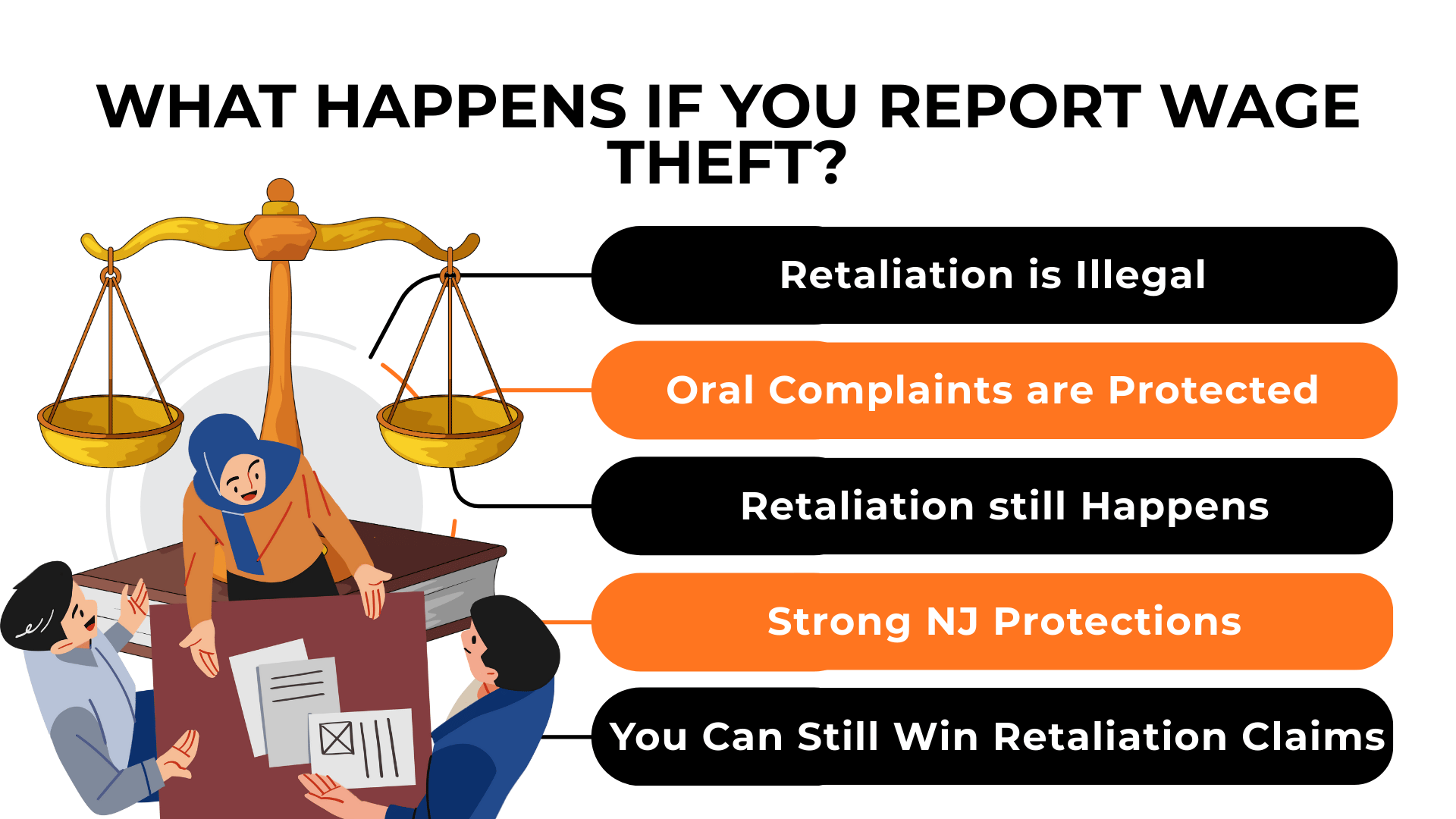
No. Federal and state laws explicitly prohibit retaliation against workers who assert their wage and hour rights. Under 29 U.S.C. § 215(a)(3), employers cannot “discharge or in any other manner discriminate against any employee” who files a wage complaint or participates in a wage theft investigation.
Importantly, you don’t need to file a formal complaint to be protected. The Supreme Court held in Kasten v. Saint-Gobain Performance Plastics Corp., 563 U.S. 1 (2011), that the FLSA’s anti-retaliation provision protects oral complaints as well as written ones, as long as the complaint is clear enough to put the employer on notice.
Despite these protections, the National Employment Law Project (2019) found that 43% of workers who complained to their employer or attempted organizing experienced illegal retaliation, including firing, suspension, reduced hours, or threats.
What protections exist in New Jersey?
New Jersey’s 2019 Wage Theft Act created some of the strongest anti-retaliation protections in the country. Under N.J. Stat. Ann. § 34:11-4.10(c), if an employer takes adverse action within 90 days of a worker’s protected activity (like filing a wage complaint), the employer is presumed to have retaliated. The employer can only defeat this presumption with clear and convincing evidence of a legitimate, non-retaliatory reason.
What if you don’t win the underlying wage claim?
Even if your wage claim ultimately fails, your retaliation claim can survive. The Third Circuit held in Brock v. Richardson, 812 F.2d 121 (3d Cir. 1987), that an employee need not prevail on the underlying wage claim to maintain a retaliation action under the FLSA—the complaint need only be made in good faith.
If you’re concerned about reporting wage theft, speaking with an employment lawyer can help you understand your options and protections before you take action.
What Can You Recover in a Wage Theft Case?
Wage theft laws don’t just let you recover what you’re owed—they add significant penalties to punish employers and deter future violations.
What are liquidated damages?
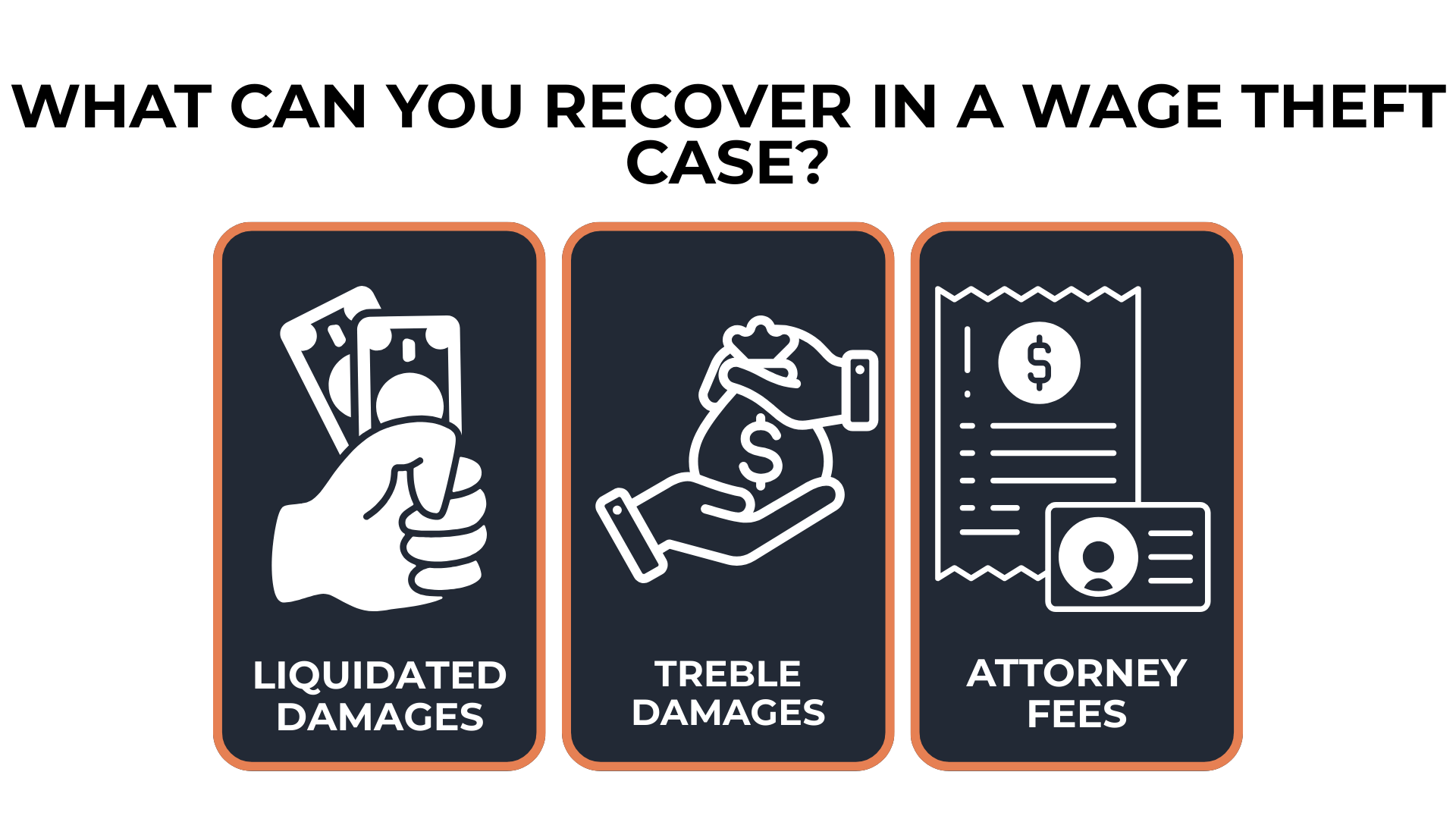
Under the FLSA, employees who prove wage violations can recover their unpaid wages plus an equal amount in liquidated damages—effectively doubling the recovery. 29 U.S.C. § 216(b). Liquidated damages are automatic unless the employer proves both subjective good faith and objectively reasonable grounds for believing they weren’t violating the law. Souryavong v. Lackawanna Cty., 872 F.3d 122 (3d Cir. 2017).
This means if your employer owes you $10,000 in unpaid wages, you could recover $20,000 total under the FLSA.
How does New Jersey’s treble damages law work?
New Jersey’s 2019 Wage Theft Act provides even greater penalties. Under N.J. Stat. Ann. § 34:11-4.10, workers can recover up to three times their unpaid wages (the original amount plus 200% in liquidated damages). Combined with mandatory attorney fee shifting, New Jersey has one of the strongest wage theft frameworks in the nation.
Do you have to pay your lawyer upfront?
All three jurisdictions—federal, New Jersey, and Pennsylvania—require prevailing plaintiffs to receive attorney fees. 29 U.S.C. § 216(b); N.J. Stat. Ann. § 34:11-4.10; 43 Pa. Stat. § 260.10. This means even relatively small wage claims can be economically viable to pursue, because the employer—not you—pays your legal fees if you win.
According to Seyfarth Shaw’s litigation report (2023), FLSA collective action settlements totaled $493.6 million across 423 cases in 2023, with an average settlement of approximately $1.17 million per case.
Damages comparison by jurisdiction:
- Federal (FLSA)— Unpaid wages + 100% liquidated damages (double recovery) + attorney fees
- New Jersey— Unpaid wages + 200% liquidated damages (triple recovery) + attorney fees
- Pennsylvania (WPCL)— Unpaid wages + 25% liquidated damages + attorney fees
- All jurisdictions— Mandatory attorney fee shifting for prevailing plaintiffs
How Long Do You Have to File a Wage Theft Claim?
Time limits vary by jurisdiction, and missing your deadline can permanently bar your claim. Understanding these limits is critical.
What are the federal filing deadlines?
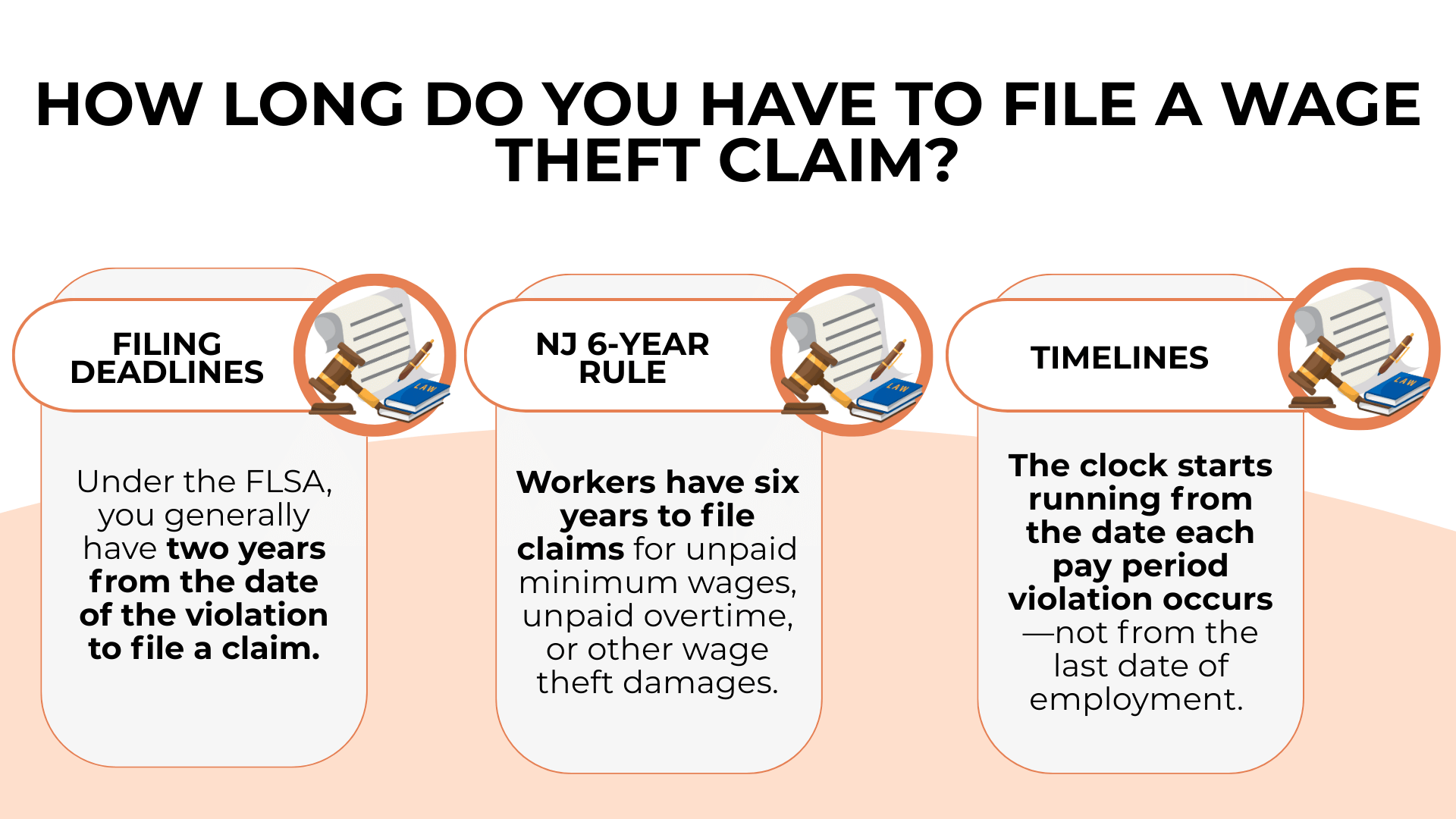
Under the FLSA, you generally have two years from the date of the violation to file a claim. 29 U.S.C. § 255(a). However, if the violation was “willful”—meaning the employer knew or showed reckless disregard for whether its conduct violated the law—the statute of limitations extends to three years.
How does the New Jersey 6-year rule work?
New Jersey’s 2019 Wage Theft Act dramatically extended the filing window. Under N.J. Stat. Ann. § 34:11-56a25.1(a), workers have six years to file claims for unpaid minimum wages, unpaid overtime, or other wage theft damages. This is the longest statute of limitations in the region and one of the longest in the country.
When does the clock start running?
Each unpaid paycheck is treated as a separate violation with its own limitations period. The clock starts running from the date each pay period violation occurs—not from the last date of employment. This means you may be able to recover wages from violations that occurred years ago, as long as each individual violation falls within the applicable limitations period.
Because deadlines vary by jurisdiction and claim type, it’s important to act promptly to preserve your full recovery.
Frequently Asked Questions
Is it wage theft if my employer rounds my hours down?
It depends on the rounding policy. Federal regulations permit rounding to the nearest five minutes, one-tenth of an hour, or quarter hour—but only if the rounding averages out over time. If your employer’s rounding policy systematically reduces your compensable time, that’s wage theft. A policy that always rounds down, or rounds in a way that consistently benefits the employer, violates the FLSA.
Can I file a wage theft claim if I was paid in cash?
Yes. The FLSA and state wage laws protect all covered employees regardless of how they’re paid. Being paid in cash doesn’t exempt your employer from minimum wage, overtime, or recordkeeping requirements. In fact, cash payments are sometimes a red flag that an employer is trying to avoid legal obligations.
What if I signed something agreeing to my pay rate?
You cannot waive your right to minimum wage or overtime pay, even if you signed an agreement. FLSA protections are non-waivable—meaning an employer cannot contract around them. As established in Sendi v. NCR Comten, Inc., 619 F. Supp. 1577 (E.D. Pa. 1985), employment agreements establish what compensation is owed, but they cannot reduce wages below legal minimums.
Does wage theft only apply to hourly workers?
No. Salaried workers can also be victims of wage theft, particularly through misclassification as “exempt” from overtime requirements. Many employers incorrectly classify workers as exempt based on job title alone, when the employee’s actual duties don’t meet the legal tests for exemption under 29 C.F.R. § 541.
Can I file a wage theft claim as a group with my coworkers?
Yes. The FLSA permits “collective actions” where similarly situated employees can join together in a single lawsuit. 29 U.S.C. § 216(b). This mechanism allows workers to share legal costs and strengthen their cases. State law claims may also proceed as class actions under court rules. According to Seyfarth Shaw (2023), approximately 45% of FLSA lawsuits are filed as collective actions.
Conclusion
Wage theft takes many forms—minimum wage violations, unpaid overtime, off-the-clock work, tip theft, and misclassification—but they all share one thing in common: your employer keeping money that belongs to you. With an estimated $50 billion stolen from American workers each year, wage theft is one of the most widespread yet underreported workplace violations in the country.
The law provides real remedies. Federal law doubles your recovery through liquidated damages. New Jersey allows you to recover triple your unpaid wages. All three jurisdictions require employers to pay your attorney fees if you prevail. But these protections come with time limits—two to three years under federal law, six years in New Jersey, three years in Pennsylvania—and every missed paycheck starts its own clock.
If you believe you’re experiencing wage theft, contact The Lacy Employment Law Firm to discuss your situation.