Working for tips means relying on customers to supplement your wages—but what happens when your employer controls how those tips get divided? Tip pooling arrangements are common in restaurants, bars, and hotels, yet many workers don’t realize employers must follow strict rules about who can participate and what they can do with pooled tips. According to the Economic Policy Institute (2017), approximately 12% of tipped workers have had tips stolen by an employer or supervisor. Understanding tip pooling laws protects you from illegal arrangements that take money out of your pocket.
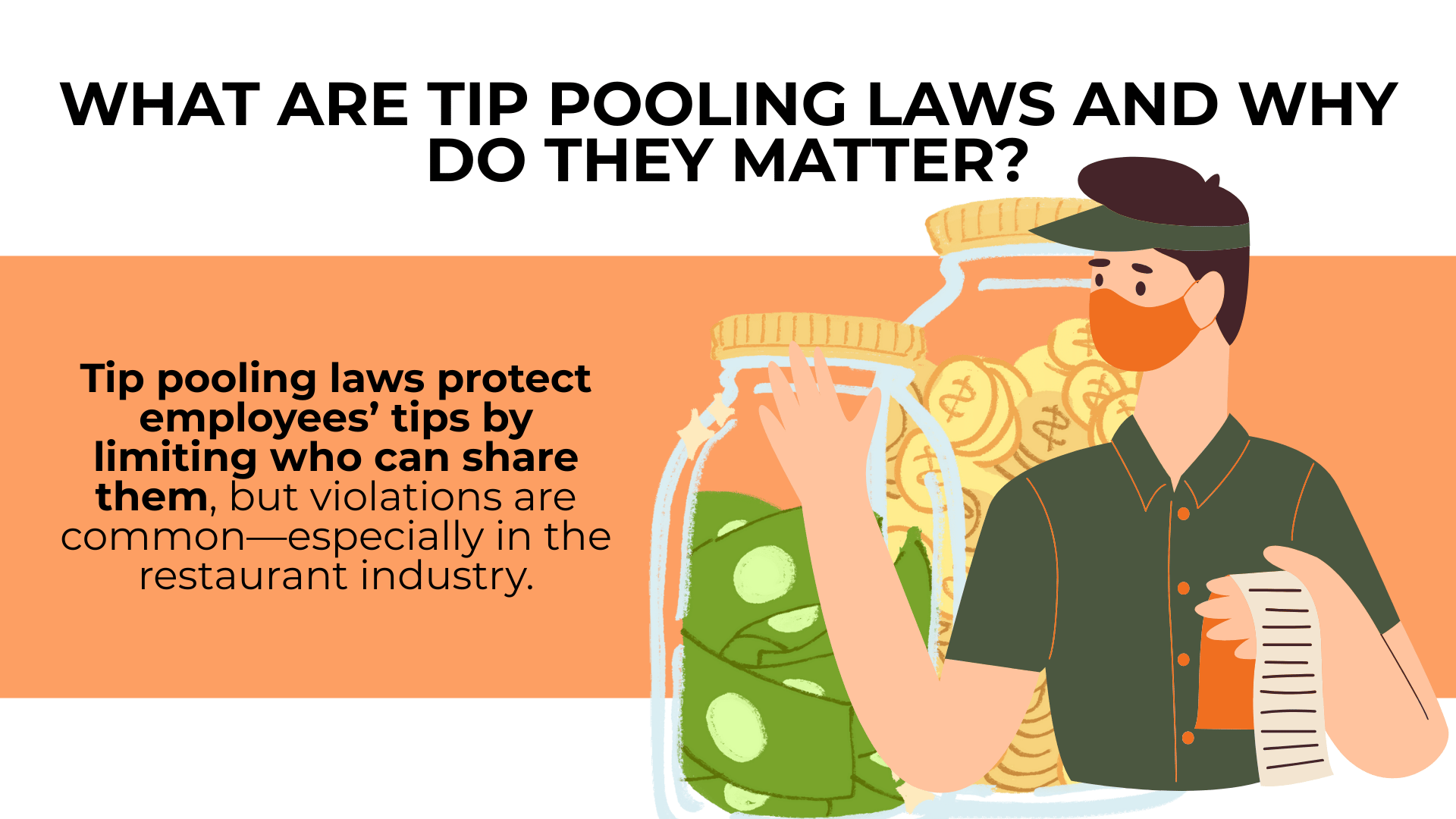
What Are Tip Pooling Laws and Why Do They Matter?
Tip pooling laws establish the legal boundaries for how employers can require employees to share their tips. These rules exist because tips belong to employees, not employers, and federal and state laws protect that right. When employers violate these rules, workers lose income they earned through their service.
What is a tip pool and how does it work?
A tip pool is an arrangement where tipped employees contribute some or all of their tips to a common fund that gets redistributed among eligible workers. The idea is to share gratuities more evenly across staff who contribute to customer service. However, the law places significant limits on who can participate and how the pool operates.
Under federal law, employers who take a tip credit—paying less than minimum wage and making up the difference with tips—have traditionally been required to limit tip pools to employees who “customarily and regularly” receive tips. The Consolidated Appropriations Act of 2018 expanded these rules to apply even to employers who don’t take a tip credit.
Who qualifies as a “tipped employee” under the law?
Federal law defines a tipped employee as someone who customarily and regularly receives more than $30 per month in tips, according to 29 U.S.C. § 203(m). This definition matters because it determines who can participate in tip pools and who receives tip credit protections.
The tipped workforce is substantial. The Bureau of Labor Statistics (2024) reports that 5.0 million workers hold food and beverage serving and related jobs. Many of these workers depend heavily on tips because the federal tipped minimum wage has remained at just $2.13 per hour since 1991, according to the U.S. Department of Labor (2024).
Workers who typically qualify as tipped employees include:
- Servers and wait staff who receive gratuities directly from customers
- Bartenders who receive tips for drink preparation and service
- Bussers and food runners who receive a share of tips for supporting service
- Hosts and hostesses in establishments where they receive tips
- Delivery drivers who receive gratuities from customers
The tipped workforce is also predominantly female. According to the Economic Policy Institute (2014), 66.6% of tipped workers are women, making tip pooling violations a significant workplace issue with gender dimensions.
Why are tip pooling violations so common?
Tip pooling violations occur frequently because many employers either don’t understand the rules or deliberately exploit workers who don’t know their rights. The restaurant industry in particular has a poor compliance record.
According to the U.S. Department of Labor Wage and Hour Division (2021), 85% of restaurant investigations resulted in violations—one of the highest rates of any industry. The DOL recovered $34.7 million in back wages from restaurant employers that fiscal year alone. Tip-related violations, including illegal tip pooling, represent a significant portion of these findings.
Who Can Legally Participate in a Tip Pool?
The question of who can share in a tip pool is one of the most contested areas of tip law. Federal rules changed significantly in 2018, but many employers still operate under outdated assumptions—or deliberately violate the law.
Which front-of-house employees can share in tips?
Employees who “customarily and regularly” receive tips have always been permitted to participate in tip pools. These are typically front-of-house workers whose roles involve direct customer interaction.
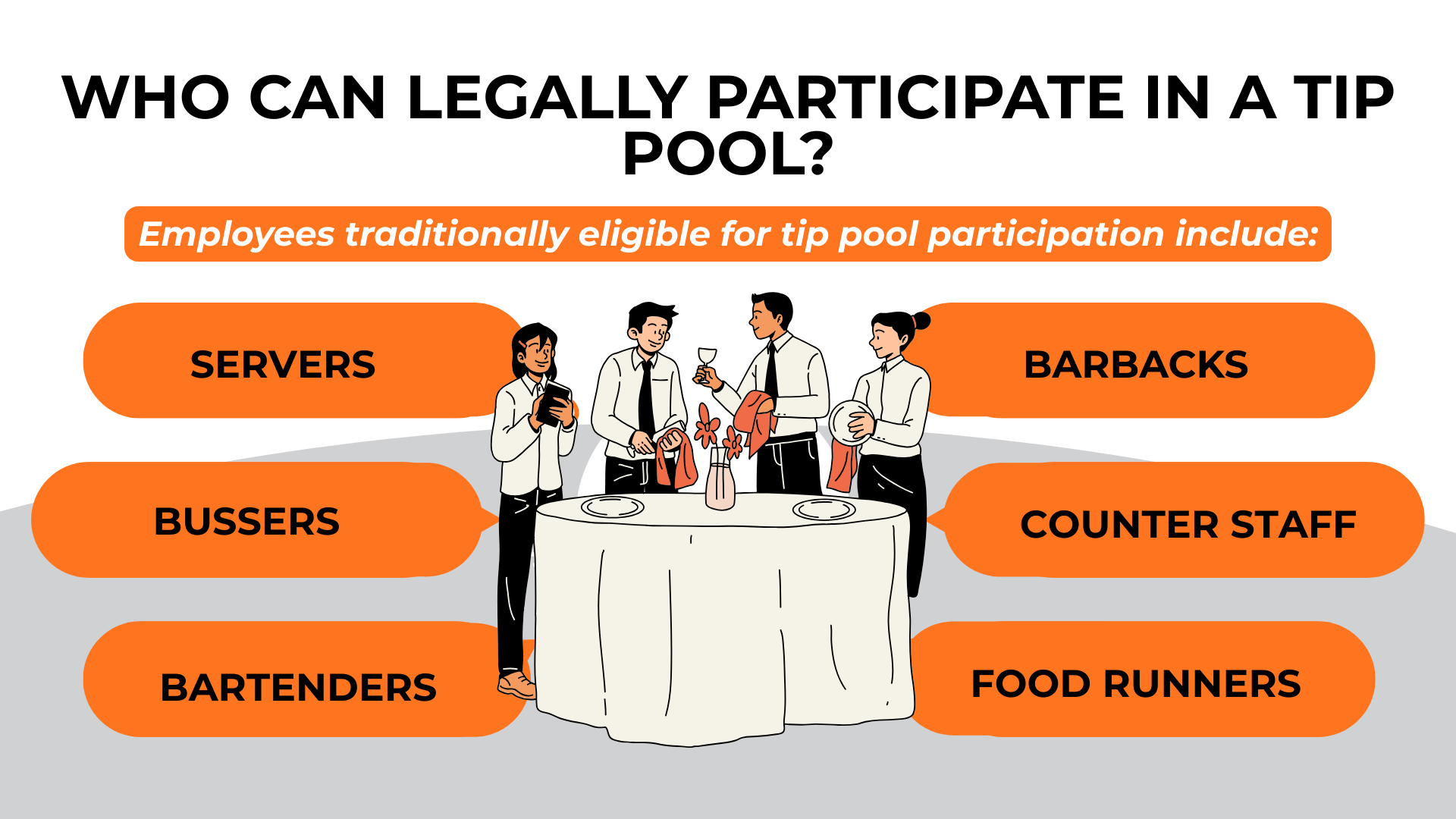
Employees traditionally eligible for tip pool participation include:
- Servers who take orders and deliver food
- Bartenders who prepare and serve drinks
- Bussers who clear tables and assist servers
- Barbacks who support bartender operations
- Counter staff who serve customers directly
- Food runners who deliver orders to tables
The key factor is whether the employee regularly receives tips as part of their job duties. An employee who occasionally receives a tip doesn’t automatically become a tipped employee eligible for the pool.
Can back-of-house workers like cooks be included?
This is where tip pooling law becomes complicated. The rules depend on whether the employer takes a tip credit.
If the employer takes a tip credit (pays less than minimum wage, using tips to make up the difference), the tip pool must be limited to employees who customarily and regularly receive tips. Back-of-house workers like cooks, dishwashers, and prep staff cannot be included because they don’t interact with customers and don’t receive tips directly.
If the employer pays full minimum wage and does not take a tip credit, the rules are different. Under the 2018 Consolidated Appropriations Act amendments to 29 U.S.C. § 203(m), employers who pay full minimum wage can require tip pooling that includes back-of-house workers—but with a critical restriction.
What changed after the 2018 federal law update?
The Consolidated Appropriations Act of 2018 made two major changes to tip pooling law.
First, it prohibited employers from keeping any portion of employee tips regardless of whether they take a tip credit. This closed a loophole that previously allowed non-tip-credit employers to retain tips. Under 29 U.S.C. § 203(m)(2)(B), employers, managers, and supervisors cannot keep tips under any circumstances.
Second, it allowed employers who pay full minimum wage to include back-of-house workers in tip pools. However, this doesn’t mean anything goes. The prohibition on employer and manager retention still applies, and the arrangement must be a genuine tip pool—not a mechanism for the employer to subsidize labor costs.
Before this change, the Ninth Circuit’s decision in Cumbie v. Woody Woo, Inc., 596 F.3d 577 (9th Cir. 2010), had held that tip pooling restrictions only applied to employers claiming a tip credit. The 2018 Act effectively superseded that ruling by extending protections to all tipped workers.
What Are Employers Prohibited From Doing With Tip Pools?
Understanding what employers cannot do with tip pools is just as important as knowing who can participate. Federal law and regulations under 29 C.F.R. § 531.50-531.60 establish clear prohibitions.
Can managers or supervisors take a share of the tip pool?
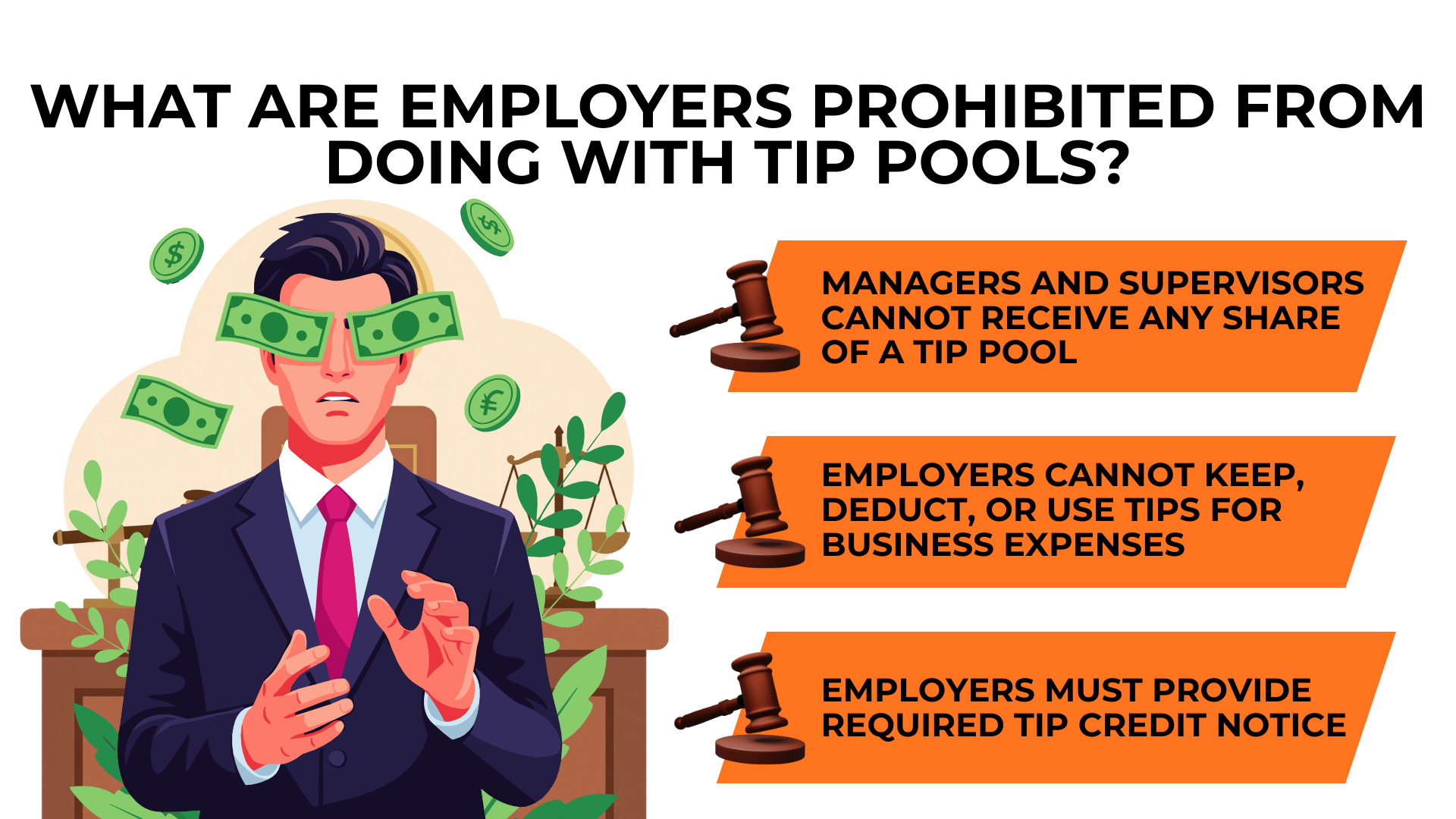
No. Under 29 U.S.C. § 203(m)(2)(B), employers, managers, and supervisors are prohibited from receiving any portion of employees’ tips. This applies whether or not the employer takes a tip credit.
The law defines “manager” and “supervisor” based on job duties, not job titles. An employee who has authority to hire, fire, discipline, or direct the work of other employees is likely considered a manager or supervisor who cannot participate in the tip pool—even if their title doesn’t include those words.
This prohibition is absolute. A manager who occasionally helps with service during a rush still cannot share in tips. The rationale is that managers already receive higher compensation and have power over tipped employees, creating potential for coercion.
Can employers deduct credit card fees or breakage from tips?
Employers are prohibited from using tips for any purpose other than as a tip credit (where permitted) or as part of a valid tip pool. This means several common practices violate the law.
Prohibited employer practices with employee tips include:
- Retaining any portion of tips, including credit card processing fees
- Requiring employees to pay for customer walkouts or dine-and-dash incidents
- Deducting breakage, spillage, or equipment damage from tips
- Using tips to offset cash register shortages
- Requiring tip-outs to managers or supervisors
- Keeping tips when customers dispute credit card charges
- Using tips as general business revenue
Some employers argue that deducting credit card processing fees is fair because they incur that cost. However, tips belong to employees, and employers cannot shift business expenses onto workers through tip deductions.
What notice must employers provide about tip pooling?
Employers who take a tip credit must inform employees of the tip credit provisions before using tips to satisfy minimum wage obligations. Under 29 C.F.R. § 531.59, this notice must include:
- The amount of cash wage the employer will pay (at least $2.13 federally)
- The additional amount claimed as a tip credit
- That the tip credit cannot exceed the tips actually received
- That employees retain all tips except for valid tip pool contributions
- That the tip credit will not apply unless the employee has been informed of these provisions
Failure to provide proper notice means the employer cannot claim a tip credit at all. In that case, the employer owes the employee full minimum wage for all hours worked, plus the employee retains all tips.
How Do New Jersey Tip Pooling Laws Differ From Federal Rules?
New Jersey has enacted some of the strongest wage theft protections in the nation, and these apply to tip pooling violations. Workers in New Jersey benefit from both federal protections and enhanced state remedies.
What is New Jersey’s tip credit and cash wage requirement?
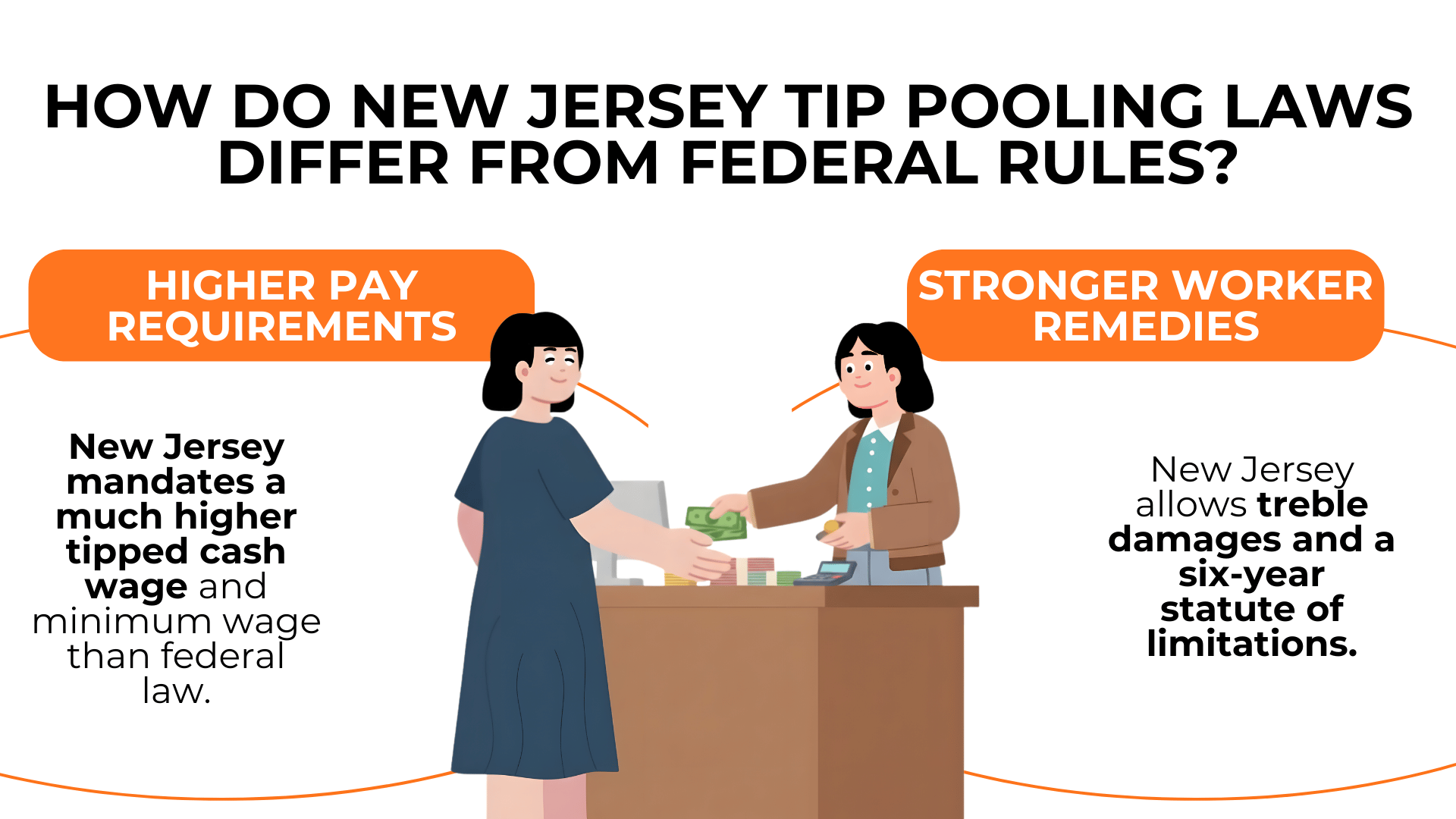
As of January 1, 2026, New Jersey’s minimum wage is $15.92 per hour, according to the New Jersey Department of Labor & Workforce Development (2026). For tipped employees, employers can take a tip credit of up to $9.87 per hour, but must pay a cash wage of at least $5.62 per hour.
This is significantly higher than the federal cash wage of $2.13. If an employer fails to comply with New Jersey’s tip credit requirements—including proper notice and valid tip pooling—they owe the employee the full $15.92 minimum wage for all hours worked.
New Jersey’s minimum wage is also constitutionally embedded under N.J. Const. art. I, § 23, with automatic annual adjustments for inflation. This provides more stable protection than states relying solely on legislative action.
Why are New Jersey’s penalties stronger than federal law?
The New Jersey Wage Theft Act, enacted in 2019, dramatically increased penalties for wage violations including illegal tip pooling. Under N.J. Stat. Ann. § 34:11-4.10, employees can recover treble damages—three times the amount of wages owed—plus attorney fees and costs.
Compare this to federal law, where the FLSA provides liquidated damages equal to unpaid wages (effectively doubling recovery). New Jersey’s 200% additional liquidated damages makes it one of the most plaintiff-friendly jurisdictions for wage theft claims.
New Jersey also provides a six-year statute of limitations under N.J. Stat. Ann. § 34:11-56a25.1, compared to two years (or three for willful violations) under federal law. This longer window allows workers to recover tips stolen years ago.
What Damages Can You Recover for Tip Pooling Violations?
When employers violate tip pooling laws, workers can recover substantial damages. The combination of unpaid wages, liquidated damages, and attorney fee shifting makes these claims economically viable even for relatively small amounts.
What are liquidated and treble damages?
Liquidated damages are additional compensation beyond the actual wages owed, designed to compensate workers for the delay in receiving their pay and to deter employer violations.
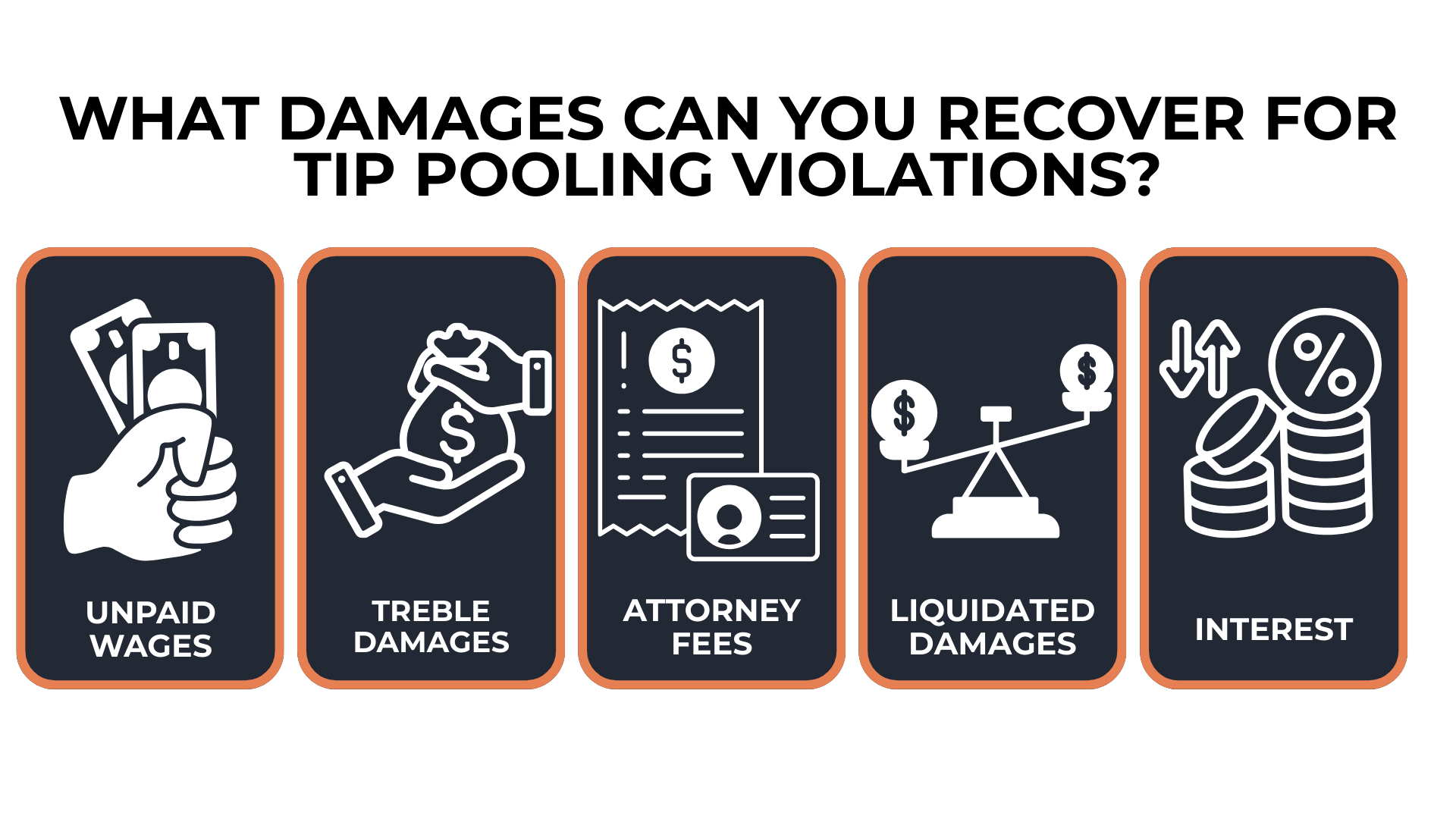
Damages available for tip pooling violations include:
- Unpaid wages: The actual tips improperly taken or not distributed
- FLSA liquidated damages: An amount equal to unpaid wages (doubling recovery)
- New Jersey treble damages: Up to 200% of unpaid wages (tripling recovery)
- Interest: Pre-judgment and post-judgment interest on amounts owed
- Attorney fees: Mandatory fee shifting to prevailing plaintiffs
Under FLSA, liquidated damages are presumed appropriate. The Third Circuit held in Souryavong v. Lackawanna County, 872 F.3d 122 (3d Cir. 2017), that liquidated damages are “the norm rather than the exception” and employers bear the burden of proving good faith to reduce them.
The potential recovery is significant. According to Seyfarth Shaw’s 2023 FLSA Litigation Report, FLSA collective action settlements totaled $493.6 million across 423 cases in 2023, with an average settlement of approximately $1.17 million per case.
Can you recover attorney fees?
Yes. Both FLSA under 29 U.S.C. § 216(b) and New Jersey law under N.J. Stat. Ann. § 34:11-4.10 provide for mandatory attorney fee shifting to prevailing plaintiffs. This means the employer pays your attorney fees if you win.
Fee shifting is critical because it allows workers to pursue claims without worrying about legal costs. Even if your individual tip loss seems small, an attorney can take the case knowing fees will be recovered from the employer.
How long do you have to file a claim?
Statutes of limitations vary by jurisdiction:
- Federal FLSA: Two years for non-willful violations; three years for willful violations
- New Jersey: Six years under the Wage Theft Act
- Pennsylvania: Three years under the WPCL
The FLSA’s statute of limitations runs from each pay period when tips were improperly taken. Each paycheck is a new violation with its own limitations clock. This means you can potentially recover tips from violations going back several years, depending on which law applies.
New Jersey’s six-year window is particularly valuable for workers who didn’t realize their rights were violated until years later or who feared retaliation for coming forward sooner.
What Should You Do If Your Employer Violates Tip Pooling Laws?
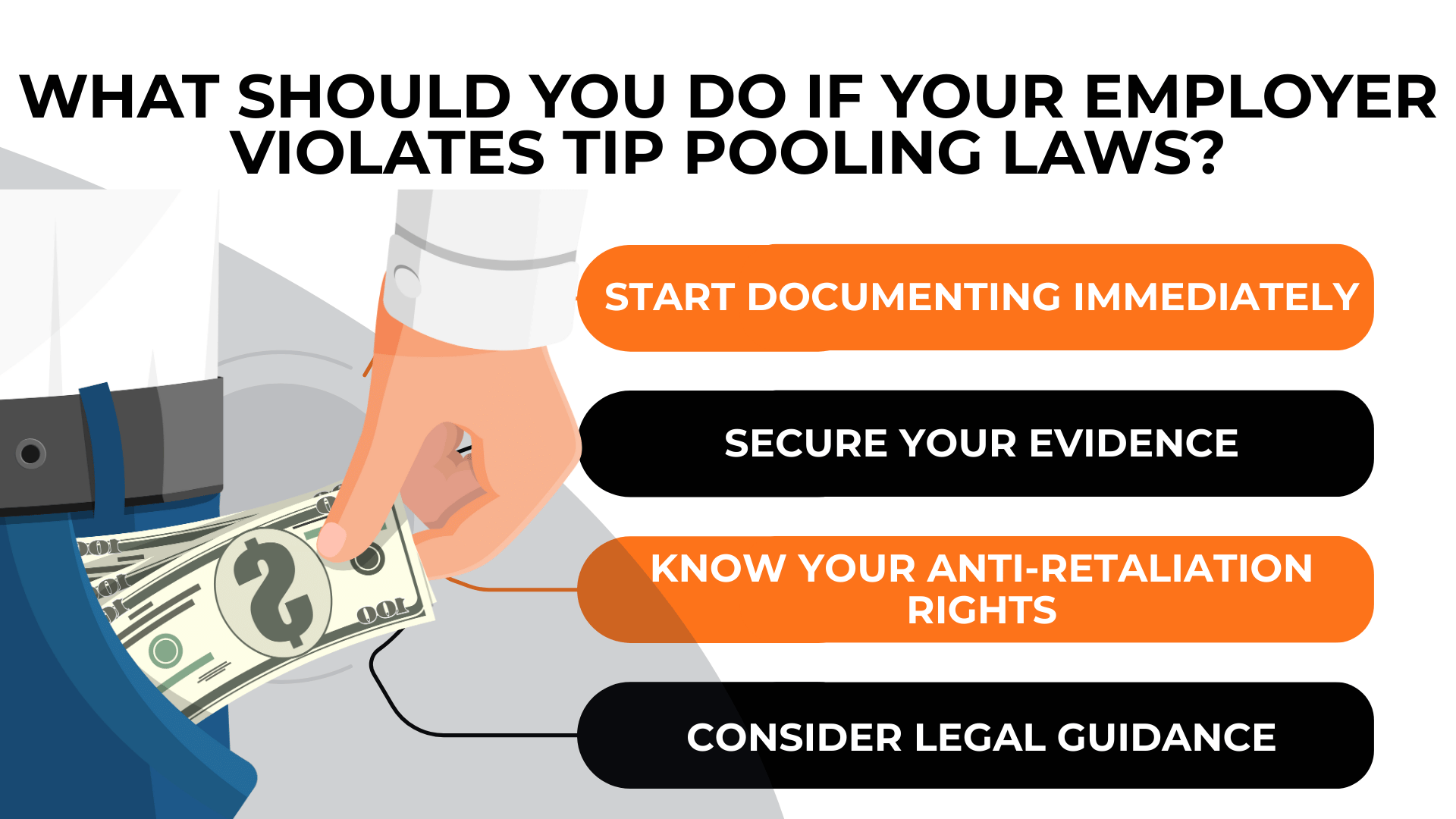
If you suspect your employer is violating tip pooling laws, taking the right steps protects your ability to recover what you’re owed. Documentation and understanding your protections are essential.
What evidence should you collect?
Strong documentation strengthens any wage claim. Start gathering evidence as soon as you suspect a violation.
Evidence to document for a tip pooling claim includes:
- Pay stubs showing cash wages, tips reported, and deductions
- Tip pool distribution records or tip-out sheets
- Written policies about tip pooling from employee handbooks
- Text messages, emails, or memos about tip pool rules
- Records of who participates in the tip pool (including any managers)
- Your own records of tips received before pooling
- Names and contact information for coworkers who can corroborate
Keep copies of everything in a location your employer cannot access. If your employer provides tip records electronically, save copies to your personal email or device.
Are you protected if you complain about tip violations?
Yes. Federal law under 29 U.S.C. § 215(a)(3) prohibits employers from retaliating against employees who complain about wage violations. This protection covers both formal complaints to government agencies and informal complaints to management.
The Supreme Court confirmed in Kasten v. Saint-Gobain Performance Plastics Corp., 563 U.S. 1 (2011), that FLSA’s anti-retaliation provision protects oral complaints—not just written filings. If you verbally complained to your manager about illegal tip pooling, that’s protected activity.
Despite these protections, retaliation remains common. According to the National Employment Law Project (2019), 43% of workers who complained to their employer about wage issues experienced illegal retaliation, including firing, reduced hours, and threats.
New Jersey provides even stronger retaliation protections. Under N.J. Stat. Ann. § 34:11-4.10(c), if an employer takes adverse action within 90 days of a wage complaint, retaliation is presumed. The employer must provide clear and convincing evidence of a legitimate reason to overcome this presumption.
Speaking with an employment attorney before making a formal complaint can help you understand your options and protections.
Frequently Asked Questions About Tip Pooling Laws
Can my employer force me to share tips with kitchen staff?
It depends on whether your employer takes a tip credit. If your employer pays less than minimum wage and uses tips to make up the difference, tip pools must be limited to employees who customarily receive tips—typically front-of-house staff. If your employer pays full minimum wage without taking a tip credit, federal law now permits including back-of-house workers. However, managers and supervisors can never participate regardless of what your employer pays.
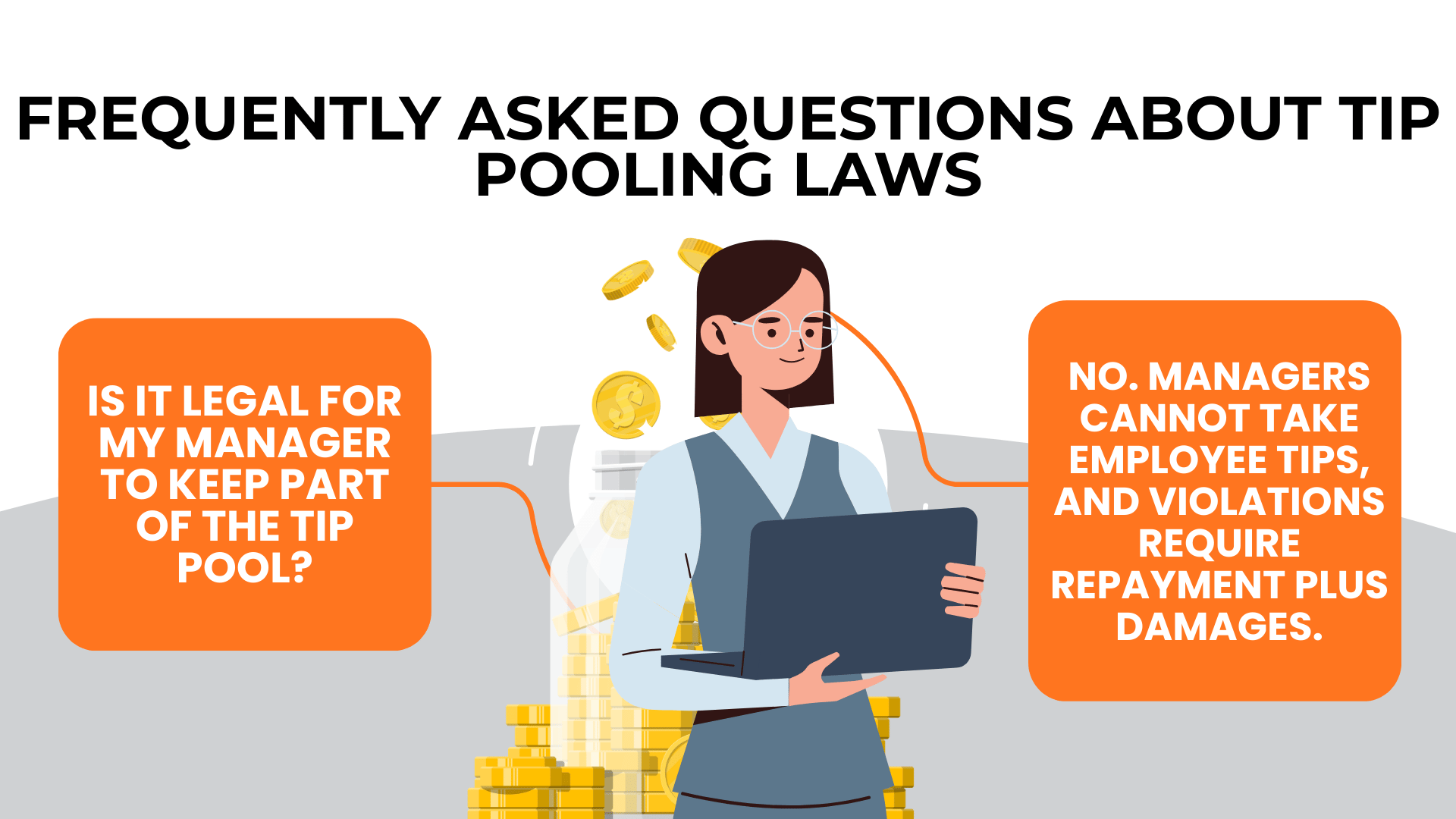
Is it legal for my manager to keep part of the tip pool?
No. Under 29 U.S.C. § 203(m)(2)(B), managers and supervisors are prohibited from receiving any portion of employee tips. This applies regardless of whether the employer takes a tip credit. Even if your manager occasionally helps with tables during busy periods, they cannot share in the tip pool. Violations of this rule entitle you to recover the tips taken plus additional damages.
Can my employer deduct credit card processing fees from my tips?
No. Tips belong to employees, and employers cannot deduct credit card fees, walkouts, breakage, or other business expenses from your tips. When a customer tips on a credit card, you are entitled to the full tip amount. An employer who deducts processing fees is effectively taking your tips in violation of federal law.
What if I’m fired after complaining about illegal tip pooling?
You likely have a retaliation claim in addition to your wage claim. FLSA protects employees who complain about wage violations, and New Jersey law presumes retaliation if adverse action occurs within 90 days of a complaint. You don’t need to win your underlying wage claim to pursue retaliation—you only need to have complained in good faith about a reasonably believed violation.
How far back can I recover tips that were illegally taken?
Under federal law, you can recover tips from violations going back two years, or three years if the violation was willful. In New Jersey, the statute of limitations is six years under the Wage Theft Act. Each pay period when tips were improperly taken starts its own limitations clock, so you may be able to recover significant amounts depending on how long the illegal practice continued.
Protecting Your Right to Keep What You Earn
Tip pooling laws exist to ensure that the money customers leave for your service actually reaches you. Federal law under 29 U.S.C. § 203(m) establishes that tips are employee property, and employers who violate tip pooling rules face significant liability. With New Jersey’s treble damages and six-year statute of limitations, workers have powerful tools to recover stolen tips.
If your employer includes managers in tip pools, deducts fees from your tips, or requires you to share with ineligible employees, you may have a claim. The widespread nature of tip violations—with 85% of restaurant investigations finding violations—means you’re not alone, and enforcement mechanisms exist to help.
If you have questions about tip pooling laws or believe your employer has violated your rights, contact The Lacy Employment Law Firm to discuss your situation.