
Something has shifted at work. Maybe the comments about your “experience” have taken on a different tone. Perhaps you’ve noticed younger colleagues getting opportunities that once came your way. Or you’ve been left off meeting invites that everyone else received. These patterns can be difficult to name, but they may point to age discrimination.
Recognizing the signs of age discrimination is the first step toward understanding your rights. Not every frustrating workplace situation involves illegal bias, but certain patterns—both subtle and overt—may cross the line into conduct that federal and state laws prohibit. This guide walks through the specific behaviors and circumstances that may indicate age-based discrimination, helping you evaluate what you’re experiencing and understand when it may be time to take action.
What Does Age Discrimination Actually Look Like at Work?
Age discrimination rarely announces itself. Unlike some forms of workplace bias, it often operates through assumptions, exclusions, and gradual marginalization rather than explicit statements. Understanding what discrimination actually looks like in practice helps you identify patterns that might otherwise seem like isolated incidents.
Overt Discrimination vs. Subtle Bias
Age discrimination exists on a spectrum. On one end, there are explicit statements: a manager saying the company needs “young blood” or that an employee is “too old to learn new systems.” On the other end, there’s subtle bias that accumulates over time—being passed over for training, excluded from team activities, or subjected to patronizing treatment.
According to AARP Research (2024-2025), 64% of workers age 50 and older have seen or experienced age discrimination in the workplace. Of those, 60% report experiencing subtle forms of discrimination rather than overt conduct. This means most age discrimination doesn’t come with obvious warning signs.
The Most Common Forms of Age Bias
Age discrimination manifests in several distinct patterns. According to the EEOC’s 50-year report on age discrimination (2018), 55% of all ADEA charges allege discriminatory discharge—making termination the most common complaint. Another 21% allege age-based harassment, a figure that has more than tripled since 1992. And 25% allege discrimination in terms and conditions of employment, such as work assignments, schedules, or access to opportunities.
Why Age Discrimination Often Goes Unrecognized
Many workers experience age discrimination without realizing it because ageist comments have become normalized in workplace culture. Jokes about memory, technology skills, or being “over the hill” often get dismissed as harmless. Gradual changes—fewer invitations to important meetings, less challenging assignments—may not register as significant until a clear pattern emerges.

What Are the Subtle Signs of Age Discrimination?
The majority of age discrimination takes subtle forms. These behaviors may not feel like discrimination in the moment, but they create a pattern of differential treatment that disadvantages older workers.
Assumptions About Technology and Learning
One of the most common subtle signs involves assumptions about technological competence. According to AARP Research (2024-2025), 33% of workers 50 and older report facing assumptions about their technology skills. This might look like being excluded from software training that younger colleagues receive automatically, or having IT explain basic functions in a patronizing way while assuming younger employees already know them.
Stereotypes About Flexibility and Adaptability
Another prevalent form of subtle bias involves assumptions that older workers resist change. AARP’s research (2024-2025) found that 24-25% of workers 50+ face stereotypes about being resistant to change or set in their ways.
These assumptions often appear in specific workplace behaviors:
- Being excluded from new initiatives because leadership assumes you prefer “the old way”
- Receiving comments like “I know this is different from what you’re used to” when processes change
- Getting passed over for cross-functional projects in favor of “more adaptable” team members
- Having your concerns about new procedures dismissed as resistance rather than legitimate feedback
- Being left out of brainstorming sessions where “fresh perspectives” are valued
- Receiving feedback that you need to be “more open to new ideas” without specific examples
Reduced Access to Training and Development
Employers sometimes invest less in training older workers based on assumptions about their remaining tenure. AARP data (2024-2025) shows that 20% of workers 50+ receive less training than their younger counterparts. This may manifest as being passed over for professional certifications, excluded from leadership development programs, or denied conference attendance that younger employees routinely receive.
Social Exclusion and Marginalization
Subtle discrimination often includes social exclusion—being left off email chains, not invited to team lunches, or excluded from after-work gatherings where informal networking happens. While any single incident may seem minor, a pattern of exclusion can signal that colleagues or supervisors view you as not “fitting in” due to age.

What Are the Overt Warning Signs of Age Bias?
While subtle discrimination is more common, overt signs of age bias do occur. These behaviors are often easier to identify and document.
Direct Comments About Age
Explicit comments about age in the workplace may contribute to a hostile work environment claim. Courts have recognized that language such as “dinosaur,” “over the hill,” “too old to learn new tricks,” and persistent references to retirement can constitute evidence of age-based animus when connected to adverse employment decisions. Under New Jersey law, per Taylor v. Metzger, 152 N.J. 490, 706 A.2d 685 (1998), even a single egregious comment by a high-ranking official may be actionable in rare cases.
Common age-related comments that may indicate discriminatory intent include:
- “We need some young blood around here” or “fresh perspective”
- “When are you planning to retire?” asked repeatedly without legitimate purpose
- “You’re overqualified” as a reason for not promoting or hiring
- “That’s how people your age think” or references to generational stereotypes
- “You should make room for the younger generation”
- Comments about physical appearance related to age, such as gray hair or energy levels
- “Back in your day” or similar phrases that emphasize generational difference
Pressure to Retire or “Make Way”
According to AARP Research (2024-2025), 22% of workers 50 and older feel they are being pushed out of their job because of their age. This pressure may come through repeated questions about retirement plans, discussions about succession planning that focus on replacing rather than supporting you, or suggestions that you should “enjoy your golden years.”
Sudden Changes in Performance Evaluations
A particularly telling sign involves sudden negative changes in performance reviews after years of positive evaluations. Since 55% of ADEA charges involve termination according to the EEOC (2018), employers sometimes manufacture performance problems to justify removing older workers. If your evaluations shift dramatically without corresponding changes in your actual work, this may indicate pretextual documentation.
Exclusion from Important Work
Being removed from key projects, having clients reassigned, or watching your responsibilities shrink can all signal discriminatory treatment. These changes represent potential adverse employment actions when they significantly alter your job duties, reduce your visibility, or diminish your career prospects—even if your title and pay remain the same initially.

How Do Hiring and Promotion Patterns Reveal Age Discrimination?
Age discrimination doesn’t only affect current employees. Job seekers and those seeking advancement often face significant barriers based on age.
Callback and Interview Disparities
Research reveals striking disparities in hiring. A Federal Reserve Bank of San Francisco study (2017) analyzing over 40,000 job applications found that older female applicants (ages 64-66) received 47% fewer callbacks than younger applicants (ages 29-31) for administrative positions. For retail sales positions, the callback gap was 36%. These patterns suggest systemic age bias in hiring that individual applicants may recognize across multiple job applications.
Promotion Patterns Favoring Younger Workers
When qualified older workers are consistently passed over for promotions that go to younger, less experienced colleagues, this may indicate age-based discrimination. The EEOC’s report (2018) notes that 25% of ADEA charges allege discrimination in terms and conditions of employment—a category that includes promotion decisions.
“Culture Fit” and “Overqualified” as Red Flags
Certain phrases in hiring and promotion contexts often serve as proxies for age. According to AARP Research (2024-2025), 74% of older job seekers believe their age will be considered a barrier by hiring managers.
Watch for these phrases that may mask age bias:
- “Overqualified” when experience would normally be valued
- “Not the right culture fit” without substantive explanation
- “Looking for someone who can grow with the company” implying longevity concerns
- “Digital native” as a stated preference
- “High energy environment” suggesting age-related stamina concerns
- “Recent graduate preferred” in roles where experience should matter
Industry-Specific Patterns
Some industries show more pronounced age discrimination patterns. According to the EEOC’s High Tech report (2024), workers age 40 and older in the high-tech workforce declined from 55.9% in 2014 to 52.1% in 2022. This declining representation may indicate barriers to hiring and retention of older workers in technology sectors.

When Do Patterns of Discrimination Become Legally Actionable?
Recognizing discrimination patterns is important, but not every unfair workplace situation violates the law. Understanding the legal threshold helps you evaluate whether your experience may warrant formal action.
The Difference Between Unfair and Illegal
Employment discrimination laws don’t prohibit all unfair treatment—only treatment based on protected characteristics like age. Under the Age Discrimination in Employment Act (ADEA), 29 U.S.C. § 623(a), workers age 40 and older are protected from age-based discrimination. New Jersey’s Law Against Discrimination (LAD), N.J.S.A. 10:5-12(a), extends protection to workers age 18 and older. Pennsylvania’s Human Relations Act (PHRA), 43 P.S. § 955(a), protects workers 40 and older.
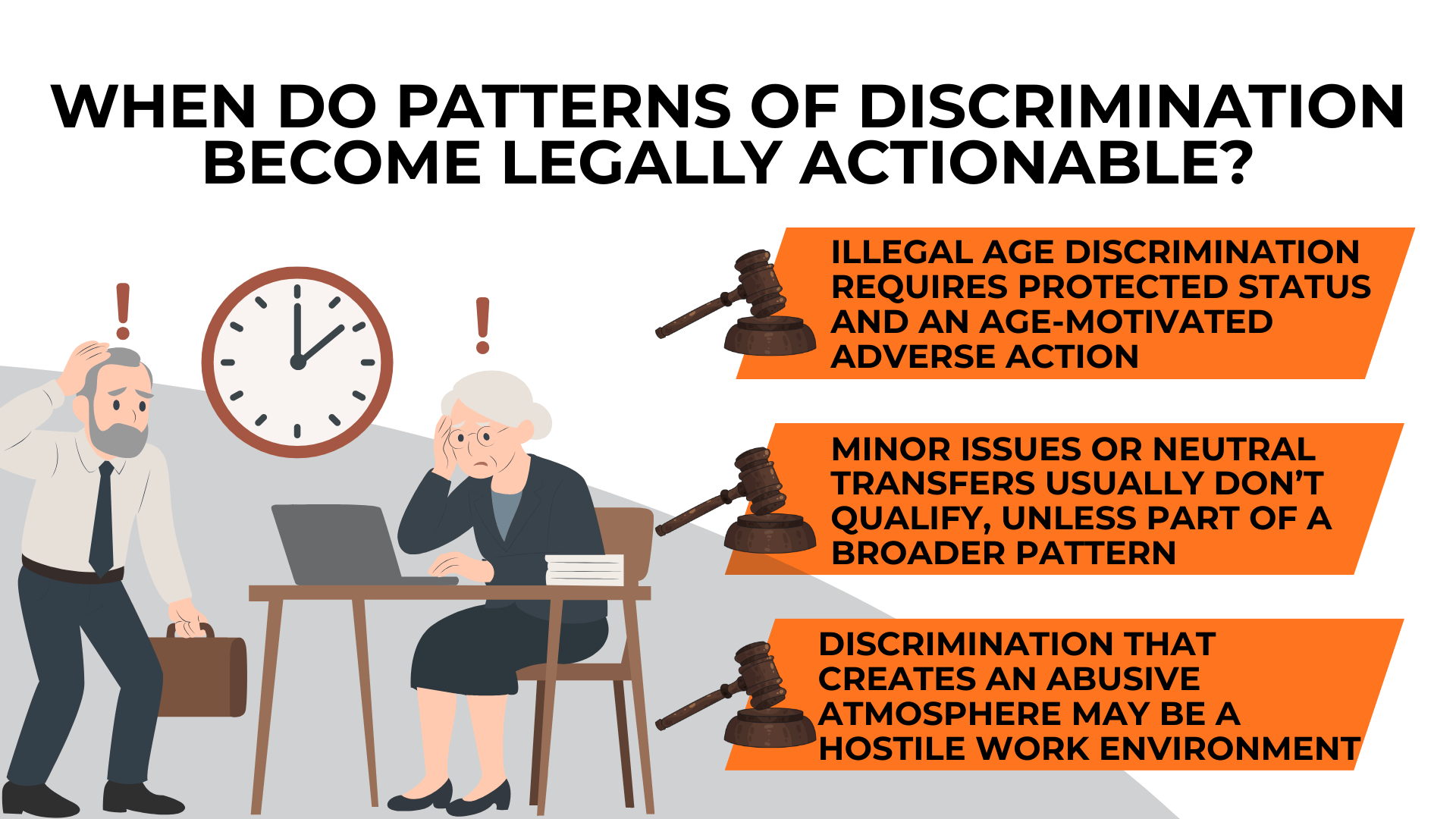
For conduct to be illegal, it generally must involve both membership in a protected class and an adverse employment action motivated at least in part by age.
What Qualifies as an Adverse Employment Action
Not every negative workplace experience qualifies as an adverse employment action. Under Burlington Industries, Inc. v. Ellerth, 524 U.S. 742 (1998), courts look for “a significant change in employment status.” Clear adverse actions include termination, demotion with reduced pay or status, failure to promote, denial of a raise, significant reduction in duties, and forced resignation.
Minor inconveniences, negative performance feedback without tangible consequences, or lateral transfers that maintain pay and benefits generally do not qualify—though patterns of such treatment may contribute to other claims.
When Hostile Environment Claims Apply
When discriminatory conduct doesn’t result in termination or demotion but creates an abusive atmosphere, a hostile work environment claim may apply. Under New Jersey’s standard from Lehmann v. Toys ‘R’ Us, Inc., 132 N.J. 587, 626 A.2d 445 (1993), the conduct must: (1) occur because of a protected characteristic; (2) be severe or pervasive; (3) make a reasonable person believe the environment is hostile; and (4) actually affect the employee’s working conditions.
Isolated incidents are generally insufficient unless extremely serious. But a pattern of age-related comments, exclusions, and differential treatment may cumulatively create a hostile environment.
The Importance of Documentation
If you recognize potential discrimination, documentation becomes critical. Record specific incidents with dates, exact language used, witnesses present, and context. Save emails, performance reviews, and any written communications that may be relevant. This contemporaneous documentation can prove essential if you later pursue a claim.
What Should You Do If You Recognize These Signs?
Understanding your options—and the time constraints on those options—helps you make informed decisions about next steps.
Filing Deadlines You Cannot Miss
Employment discrimination claims have strict filing deadlines that vary by jurisdiction. Missing these deadlines can permanently bar your claim regardless of how strong your case might be.
Key deadlines to understand:
- Federal EEOC charge:300 days from the discriminatory act in Pennsylvania and New Jersey (deferral states), per 29 U.S.C. § 626(d)
- Pennsylvania PHRC complaint:180 days from the discriminatory act, per 43 P.S. § 959(h), followed by a one-year administrative waiting period
- New Jersey DCR complaint:180 days from the discriminatory act for administrative filing
- New Jersey court filing:2 years under N.J.S.A. 2A:14-2(a), with no administrative exhaustion required—you can proceed directly to Superior Court
Internal Complaints and HR Reports
Filing an internal complaint creates a documented record of your concerns and may trigger legal protections against retaliation. Under Burlington Northern & Santa Fe Railway Co. v. White, 548 U.S. 53 (2006), employers cannot retaliate against workers who report discrimination through actions that would dissuade a reasonable worker from making a complaint. Written complaints—rather than verbal ones—create clearer documentation.
When to Consult an Employment Attorney
Consider consulting an attorney when you’ve identified a pattern of discriminatory treatment, when you’re facing a potential adverse action like termination, or when you’re unsure whether your situation rises to the level of illegal discrimination. An attorney can evaluate the specific facts of your situation, explain your options under federal and state law, and help you understand the strength of a potential claim before deadlines expire.

Frequently Asked Questions
Can I be discriminated against for being “too young” in New Jersey?
Yes. Unlike federal law and Pennsylvania law, which only protect workers 40 and older, New Jersey’s Law Against Discrimination protects workers age 18 and older from age-based discrimination. Under Bergen Commercial Bank v. Sisler, 157 N.J. 188, 723 A.2d 944 (1999), a 25-year-old may bring a discrimination claim for being treated unfavorably due to youth.
Is it age discrimination if my employer keeps making jokes about my age?
It depends on the frequency, severity, and context. Isolated comments generally don’t constitute illegal discrimination, but a pattern of age-related jokes and comments may contribute to a hostile work environment claim if the conduct is severe or pervasive enough to alter your working conditions. Under New Jersey’s Lehmann standard, courts examine the totality of circumstances.
What if I can’t prove my employer’s intent to discriminate?
Direct proof of discriminatory intent is rarely available. Most discrimination cases rely on circumstantial evidence—patterns of treatment, timing, comments, and comparisons to how younger workers are treated. Courts recognize that employers rarely announce their discriminatory motives, so statistical patterns and indirect evidence can support claims.
Does my employer have to say something explicitly about age for it to be discrimination?
No. While explicit comments about age strengthen a claim, discrimination can be proven through patterns of conduct without any explicit statements. The 60% of workers who experience subtle discrimination often face bias through exclusion, assumptions, and differential treatment rather than direct comments about age.
How long do I have to take action if I’m experiencing age discrimination?
Deadlines vary by jurisdiction and type of filing. The strictest deadline is typically 180 days for Pennsylvania PHRC complaints. Federal EEOC charges allow 300 days in Pennsylvania and New Jersey. New Jersey allows direct court filing within 2 years without any administrative filing requirement. Consult an attorney promptly to understand which deadlines apply to your situation.
What if my company is small—am I still protected?
Coverage depends on employer size and which law applies. The federal ADEA covers employers with 20 or more employees. Pennsylvania’s PHRA covers employers with 4 or more employees. New Jersey’s LAD covers all employers regardless of size. Even if your employer is too small for federal protection, state law may still apply.

Taking the First Step
Recognizing the signs of age discrimination is essential, but recognition alone doesn’t protect your rights. The patterns described here—from subtle assumptions about technology skills to overt comments about retirement—affect millions of workers. According to AARP (2024-2025), nearly two-thirds of workers 50 and older have experienced or witnessed age discrimination, and the AARP/Economist Intelligence Unit (2020) estimates this bias costs the U.S. economy $850 billion annually.
If you’re experiencing these patterns at work, document what you observe, understand the deadlines that apply to your situation, and consider whether the conduct you’re facing may cross the line from unfair to illegal. Time-sensitive filing requirements mean that delay can limit your options.
If you have questions about age discrimination at work, contact The Lacy Employment Law Firm to discuss your situation.