When a co-worker’s comments make you dread going to work, or a supervisor’s behavior leaves you feeling unsafe, you may wonder whether what you’re experiencing crosses a legal line. Sexual harassment in the workplace is illegal under both federal and New Jersey law, but many employees are unsure what conduct qualifies or what they can do about it. This guide explains how the law defines sexual harassment, when employers can be held responsible, and what options exist for employees who have been harassed.
What Counts as Sexual Harassment Under the Law?
Sexual harassment isn’t just about physical contact or explicit demands. The law recognizes a range of conduct that can make a workplace hostile, intimidating, or abusive based on sex.
The legal definition of sexual harassment
Federal law prohibits sexual harassment through Title VII of the Civil Rights Act of 1964, which makes it unlawful for employers to discriminate based on sex. The Equal Employment Opportunity Commission defines sexual harassment as “unwelcome sexual advances, requests for sexual favors, and other verbal or physical conduct of a sexual nature” that affects employment or creates a hostile environment. New Jersey’s Law Against Discrimination (NJLAD) provides even broader protection, covering all employers regardless of size and offering additional remedies not available under federal law.
Two forms harassment can take
Courts recognize two distinct types of sexual harassment. Quid pro quo harassment occurs when a supervisor conditions job benefits—like promotions, raises, or continued employment—on an employee’s submission to sexual demands. Hostile work environment harassment involves conduct that is severe or pervasive enough to alter the conditions of employment and create an abusive working environment. Most sexual harassment claims involve hostile work environment, which can result from a pattern of conduct or, in some cases, a single severe incident.
Who experiences workplace sexual harassment
Sexual harassment affects workers across all industries and demographics. According to the EEOC’s Data Highlight on Sexual Harassment (2022), women filed 78.2% of sexual harassment charges between FY 2018 and FY 2021, while men filed 21.8%. The EEOC Select Task Force on the Study of Harassment in the Workplace (2016) found that anywhere from 25% to 85% of women report experiencing workplace sexual harassment, depending on how the question is asked. When surveys describe specific behaviors rather than using the term “harassment,” approximately 60% of women report experiencing such conduct.
Conduct that may constitute harassment
Sexual harassment can take many forms beyond physical contact. The following types of conduct may create a hostile work environment when sufficiently severe or pervasive:
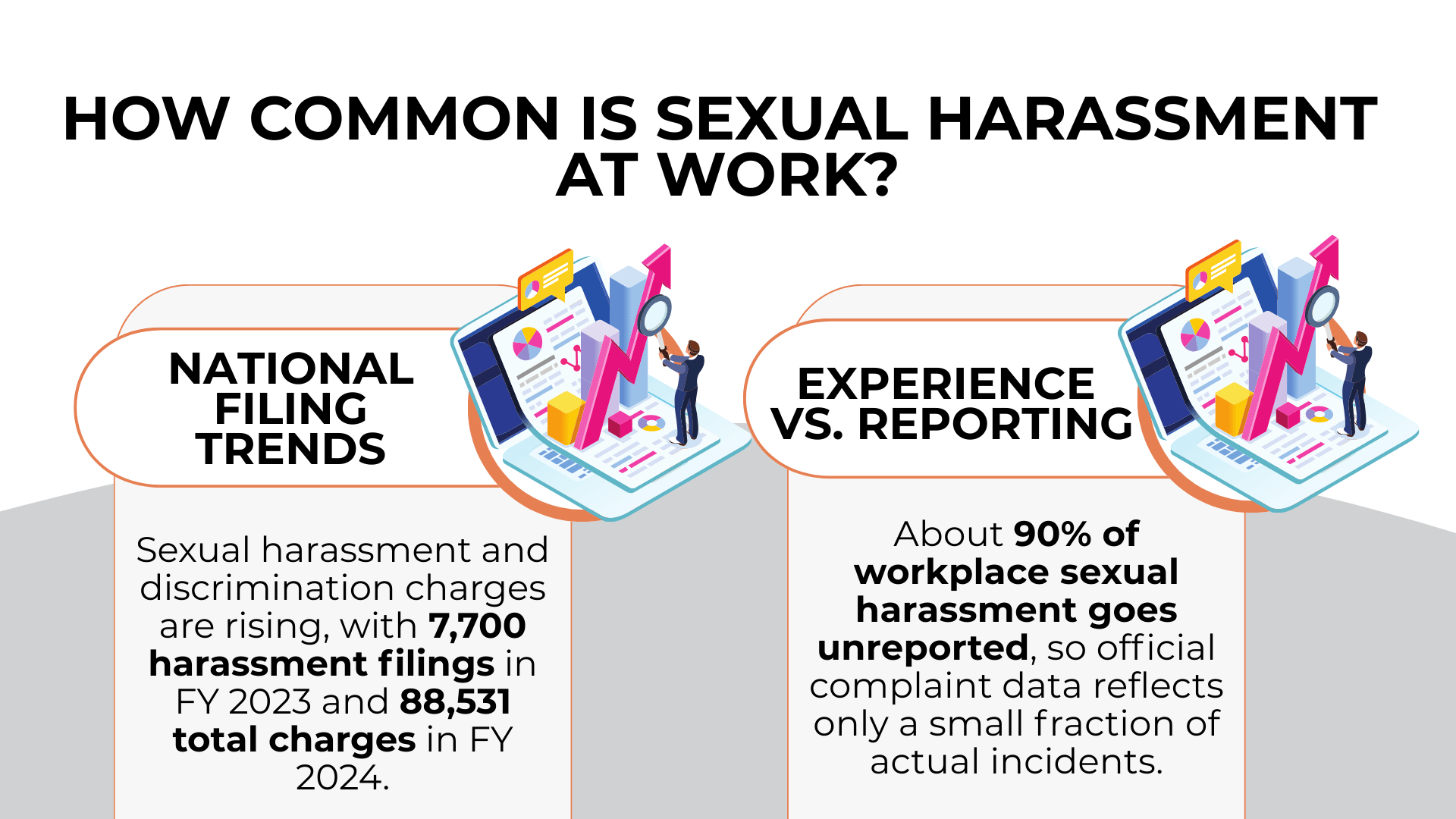
- Verbal harassment includes sexual comments, jokes, innuendos, repeated requests for dates, comments about someone’s body or appearance, and sexually degrading language directed at an employee.
- Physical harassment encompasses unwanted touching, blocking someone’s movement, physical intimidation, or assault.
- Visual harassment involves displaying sexually explicit images, posters, screensavers, or cartoons in the workplace.
- Written or digital harassment includes sexually explicit emails, text messages, social media messages, or notes.
- Nonverbal harassment consists of leering, making sexual gestures, or following someone in a threatening manner.
- Quid pro quo conduct involves explicit or implied demands for sexual favors in exchange for job benefits or to avoid adverse consequences.
How Common Is Sexual Harassment at Work?
The gap between how many people experience sexual harassment and how many take formal action reveals the challenges employees face in addressing this conduct.
National filing trends
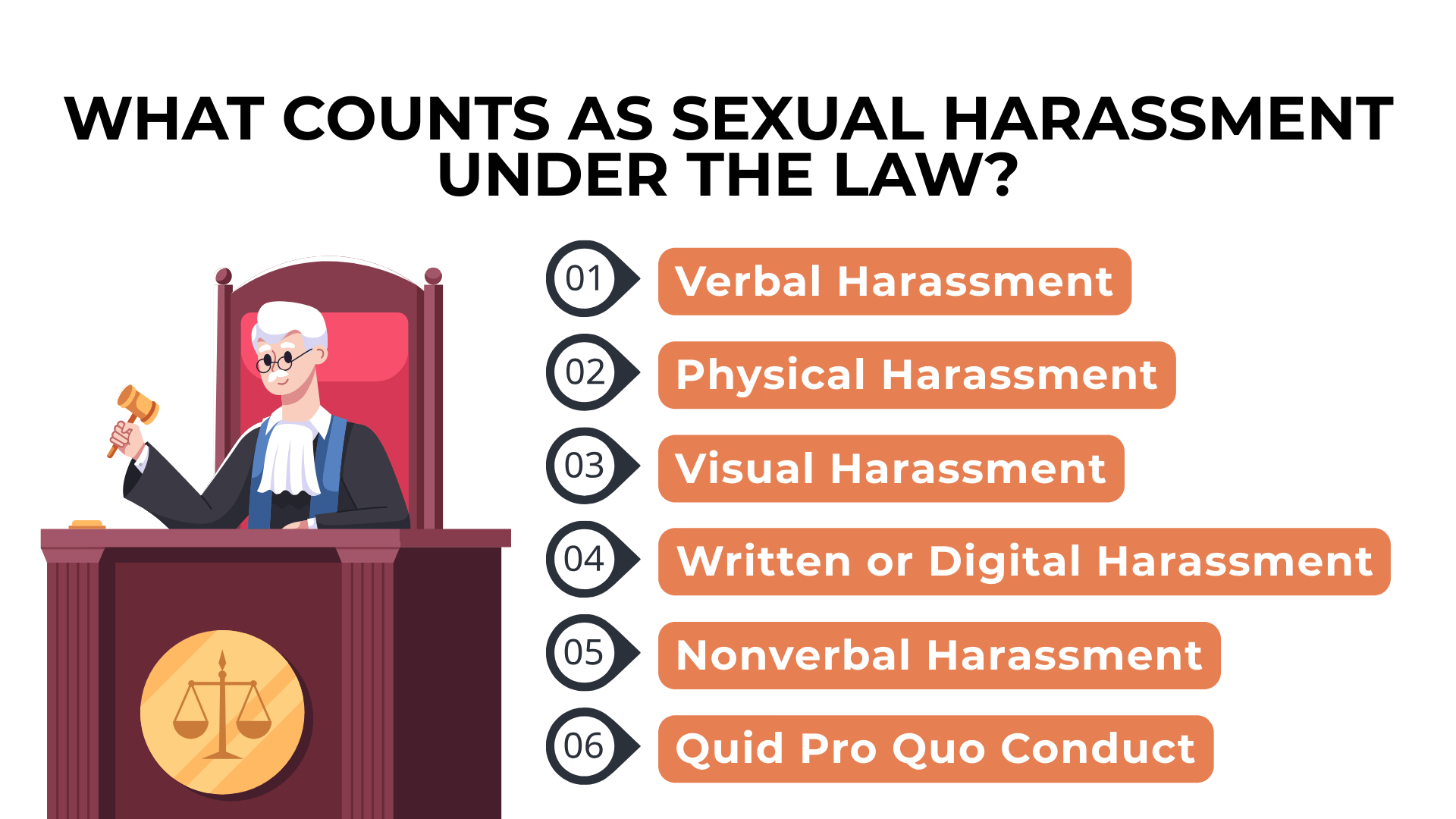
Sexual harassment charges have increased significantly in recent years. According to EEOC Enforcement and Litigation Statistics (FY 2023), more than 7,700 sexual harassment charges were filed with the EEOC in fiscal year 2023—a 25% increase from the prior year and the highest number in 12 years. The EEOC’s 2024 Annual Performance Report shows that 88,531 total discrimination charges were filed in FY 2024, a 9.2% increase that reflects continued growth in workplace discrimination claims across all protected categories.
The gap between experience and reporting
Most employees who experience sexual harassment never file a formal complaint. The EEOC Select Task Force (2016) found that approximately 90% of individuals who experience workplace harassment never take formal action such as filing a charge. Employees may hesitate to report for many reasons: fear of retaliation, concern they won’t be believed, uncertainty about whether their experience “counts,” or worry about professional consequences. This underreporting means that formal charge statistics capture only a fraction of actual harassment occurring in American workplaces.
Sexual harassment charges in New Jersey
New Jersey employees file hundreds of sex-based discrimination charges with the EEOC each year. According to EEOC Charge Statistics by State (FY 2022), 1,270 total EEOC charges were filed from New Jersey, with 281 involving sex-based claims—which include but are not limited to sexual harassment. These figures represent only federal filings; employees can also pursue claims through the New Jersey Division on Civil Rights or file directly in New Jersey Superior Court under the NJLAD, which provides broader protections than federal law.
What Makes a Hostile Work Environment Illegal?
Not every offensive comment or unpleasant interaction rises to the level of illegal harassment. Courts apply specific standards to determine when conduct crosses the legal threshold.
The severe or pervasive standard
To establish a hostile work environment claim, an employee must show that unwelcome conduct based on sex was “severe or pervasive” enough to alter the conditions of employment. The Supreme Court established this framework in Harris v. Forklift Systems, Inc., 510 U.S. 17 (1993), holding that the conduct must create an environment that a reasonable person would find hostile or abusive, and that the employee actually perceived it as such. Importantly, the standard is “severe or pervasive”—meaning either extreme severity or a pattern of conduct can satisfy the test.
Factors courts consider
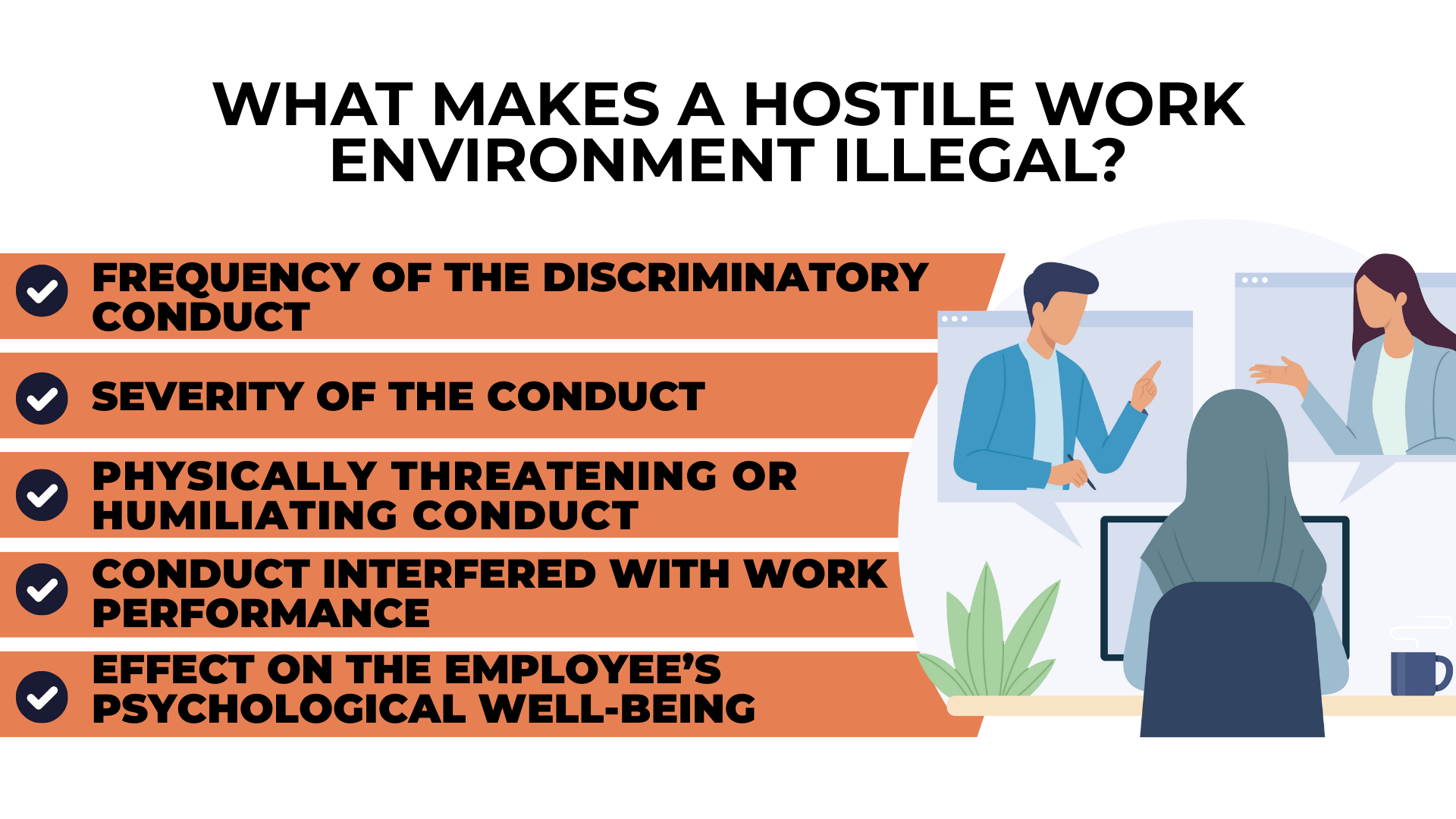
When evaluating whether conduct rises to the level of a hostile work environment, courts examine the totality of circumstances. The following factors guide this analysis:
- The frequency of the discriminatory conduct—isolated incidents are generally insufficient unless extremely severe.
- The severity of the conduct—physically threatening or humiliating behavior carries more weight than mere offensive utterances.
- Whether the conduct was physically threatening or humiliating versus a mere offensive comment.
- Whether the conduct unreasonably interfered with the employee’s work performance.
- The effect on the employee’s psychological well-being, though proof of psychological injury is not required.
New Jersey’s more plaintiff-friendly approach
New Jersey courts apply the same “severe or pervasive” standard but have shown greater willingness to find harassment actionable based on fewer incidents. In Taylor v. Metzger, 152 N.J. 490 (1998), the New Jersey Supreme Court held that a single racial slur by a supervisor—calling the plaintiff “jungle bunny”—created an actionable hostile environment. The court emphasized that supervisor conduct “greatly magnifies the gravity of the comment.” More recently, in Rios v. Meda Pharmaceutical, Inc., 247 N.J. 1 (2021), the court held that two demeaning slurs were sufficient to support a hostile work environment claim, reinforcing that severity can substitute for pervasiveness.
When Is an Employer Liable for Sexual Harassment?
Employers don’t automatically face liability for every instance of harassment. The law distinguishes between harassment by supervisors and harassment by co-workers, applying different standards to each.
Harassment by supervisors
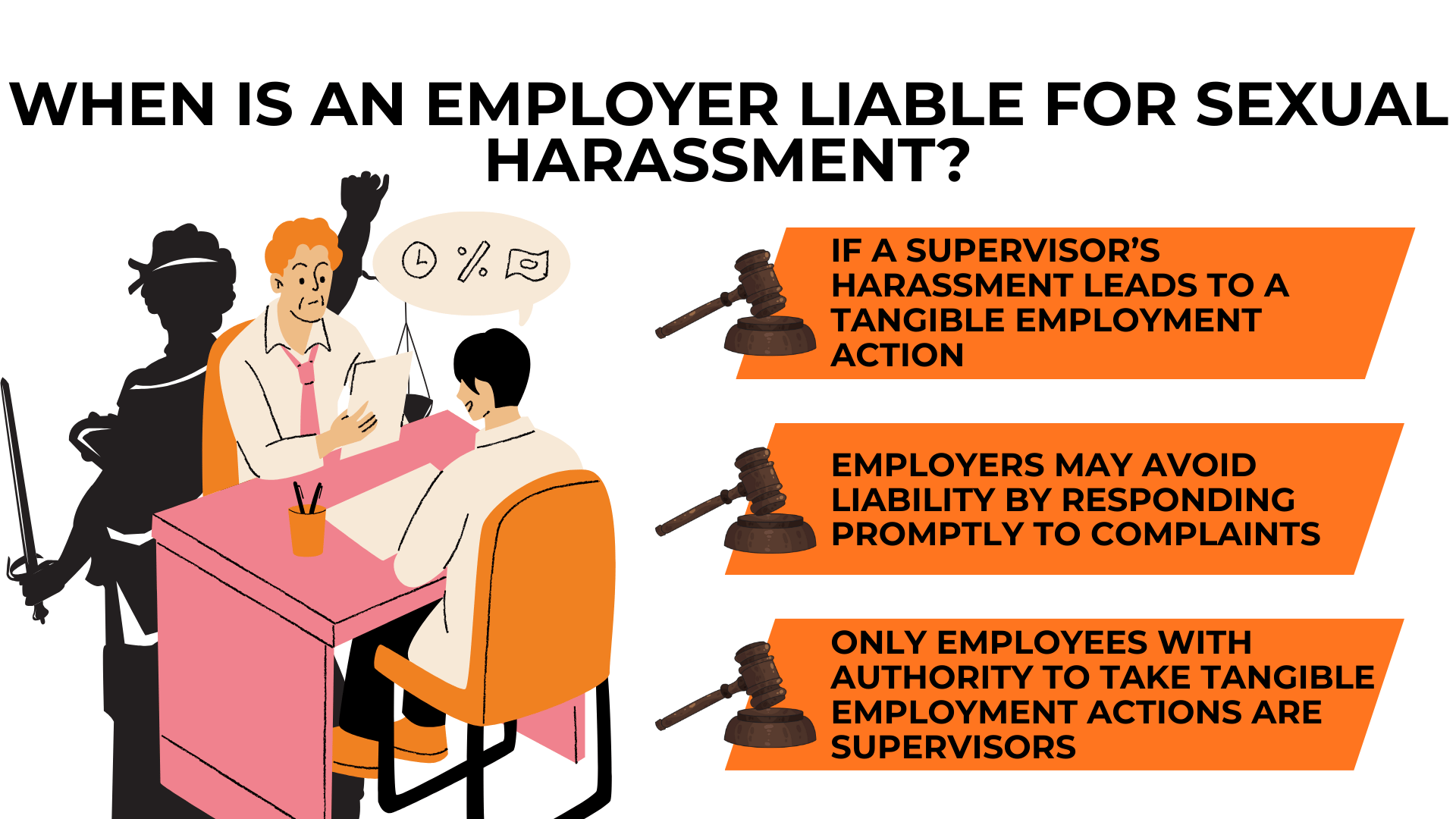
When a supervisor harasses an employee, the employer faces potential vicarious liability under the framework established in Faragher v. City of Boca Raton, 524 U.S. 775 (1998), and Burlington Industries, Inc. v. Ellerth, 524 U.S. 742 (1998). If the supervisor’s harassment culminates in a “tangible employment action”—such as firing, demotion, or denial of promotion—the employer is strictly liable with no available defense. When no tangible employment action occurs, the employer may raise an affirmative defense by proving it exercised reasonable care to prevent and correct harassment, and that the employee unreasonably failed to take advantage of preventive or corrective opportunities.
Harassment by co-workers
For harassment by co-workers rather than supervisors, employers face liability only under a negligence standard. The employee must show that the employer “knew or should have known” about the harassment but failed to take prompt and appropriate corrective action. This means employers who respond quickly and effectively to complaints may avoid liability for co-worker harassment, while those who ignore complaints or conduct inadequate investigations may be held responsible.
New Jersey’s broader definition of supervisor
New Jersey provides an important advantage for employees in determining who qualifies as a “supervisor.” Under the federal standard from Vance v. Ball State University, 570 U.S. 421 (2013), only employees empowered to take tangible employment actions qualify as supervisors. New Jersey rejected this narrow definition in Aguas v. State, 220 N.J. 494 (2015), adopting a broader standard: a supervisor includes employees who can make or recommend tangible employment actions, or who are placed in charge of the employee’s daily work activities. This broader definition makes vicarious liability available in more cases under New Jersey law.
What Can Victims of Sexual Harassment Recover?
Employees who prevail on sexual harassment claims may be entitled to substantial compensation. New Jersey law offers particularly strong remedies compared to federal law.
Types of damages available
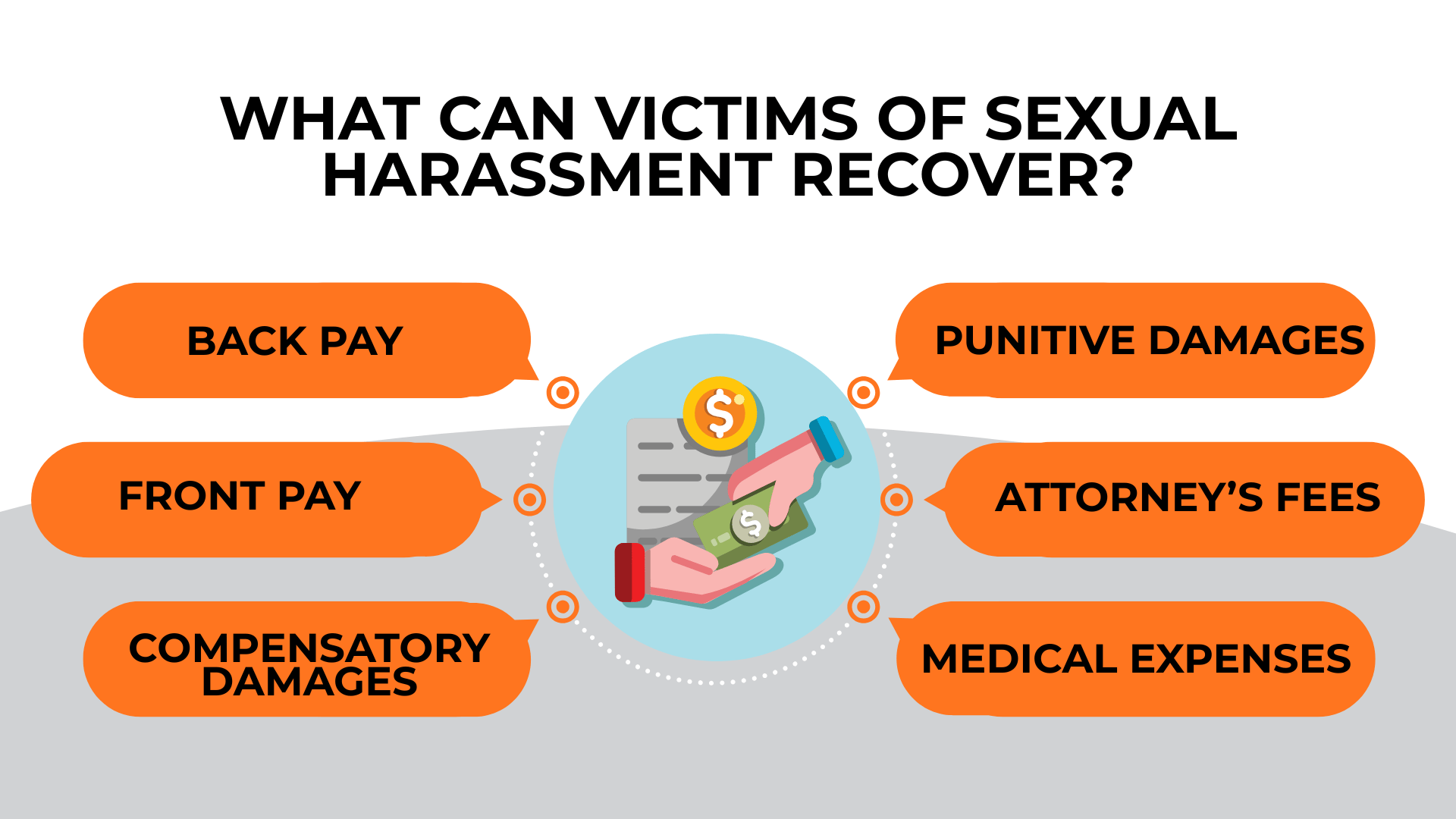
Successful sexual harassment plaintiffs may recover several categories of damages. These include:
- Back pay compensates for wages and benefits lost from the time of the harassment or termination through the date of judgment.
- Front pay compensates for future lost earnings when reinstatement is not feasible, potentially covering years of projected income.
- Compensatory damages address emotional pain and suffering, mental anguish, loss of enjoyment of life, and other nonpecuniary harm.
- Punitive damages punish employers for particularly egregious conduct and deter future violations.
- Attorney’s fees allow prevailing plaintiffs to recover the cost of legal representation.
- Medical expenses cover costs for treatment of harassment-related physical or psychological harm.
Federal damages caps versus New Jersey’s uncapped recovery
A critical difference between federal and state law involves damages caps. Federal law under Title VII limits combined compensatory and punitive damages based on employer size: $50,000 for employers with 15-100 employees, scaling up to $300,000 for employers with more than 500 employees. Back pay and front pay are not subject to these caps. New Jersey’s NJLAD places no statutory caps on compensatory damages, including emotional distress awards. This difference can be substantial—in Quinlan v. Curtiss-Wright Corp., 204 N.J. 239 (2010), a New Jersey court upheld a $3.6 million front pay award alone.
Holding individual harassers accountable in New Jersey
Unlike federal law, which permits suits only against the employer entity, New Jersey allows individual liability for harassers. Under N.J.S.A. 10:5-12(e), supervisors and individual harassers can be held personally liable for “aiding and abetting” discriminatory conduct. This creates additional accountability and potential recovery sources unavailable under federal law.
What harassment victims have recovered
Recovery statistics demonstrate the substantial compensation available to harassment victims. According to the EEOC’s 2024 Annual Performance Report, the agency recovered nearly $700 million for discrimination victims in FY 2024—the highest monetary recovery in recent history. The EEOC’s Data Highlight (2022) reports that $299.8 million was recovered specifically for sexual harassment claims between FY 2018-2021, benefiting 8,147 individuals. An employment attorney can evaluate your situation and explain your options for pursuing similar recovery.
What Are the Deadlines for Taking Action?
Time limits apply to sexual harassment claims, and missing these deadlines can bar otherwise valid claims entirely.
Federal filing deadlines
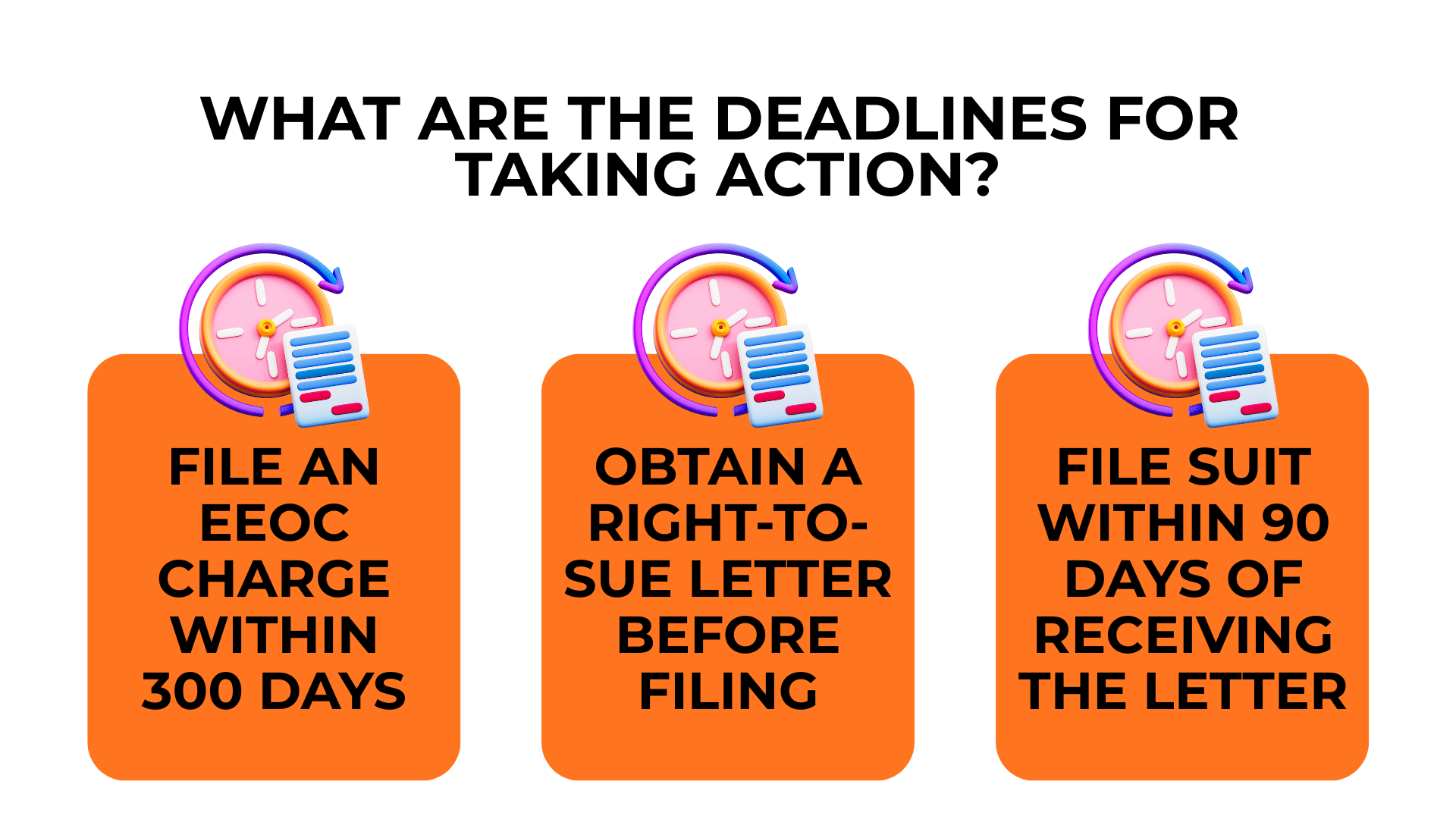
To preserve federal Title VII claims, employees must file a charge with the EEOC within 300 days of the discriminatory conduct in states like New Jersey that have local enforcement agencies. After filing, the employee must obtain a “right-to-sue” letter before proceeding to federal court, and then has only 90 days from receiving that letter to file suit. These deadlines are strictly enforced.
New Jersey’s longer window for court filing
New Jersey provides more flexibility. Employees may file directly in New Jersey Superior Court without first filing an administrative complaint—unlike federal law, which requires EEOC exhaustion. The statute of limitations for NJLAD claims filed in court is two years, providing substantially more time than the 300-day EEOC deadline. This flexibility allows employees to pursue state law remedies even if federal deadlines have passed.
Outcomes when cases move forward
When sexual harassment cases proceed through the enforcement process, outcomes are frequently favorable for victims. According to the EEOC Office of General Counsel’s FY 2024 Annual Report, the agency achieved a 97% favorable resolution rate in district court litigation, obtaining settlement or favorable judgment in 128 of 132 merits suits resolved that year. Because deadlines can bar otherwise valid claims, consulting an attorney promptly is important.
Frequently Asked Questions About Sexual Harassment at Work
Does sexual harassment have to be physical to be illegal?
No. Sexual harassment can be entirely verbal, visual, or written. Repeated sexual comments, jokes, or innuendos can create a hostile work environment even without any physical contact. The key question is whether the conduct is severe or pervasive enough to alter employment conditions, not whether it involves touching.
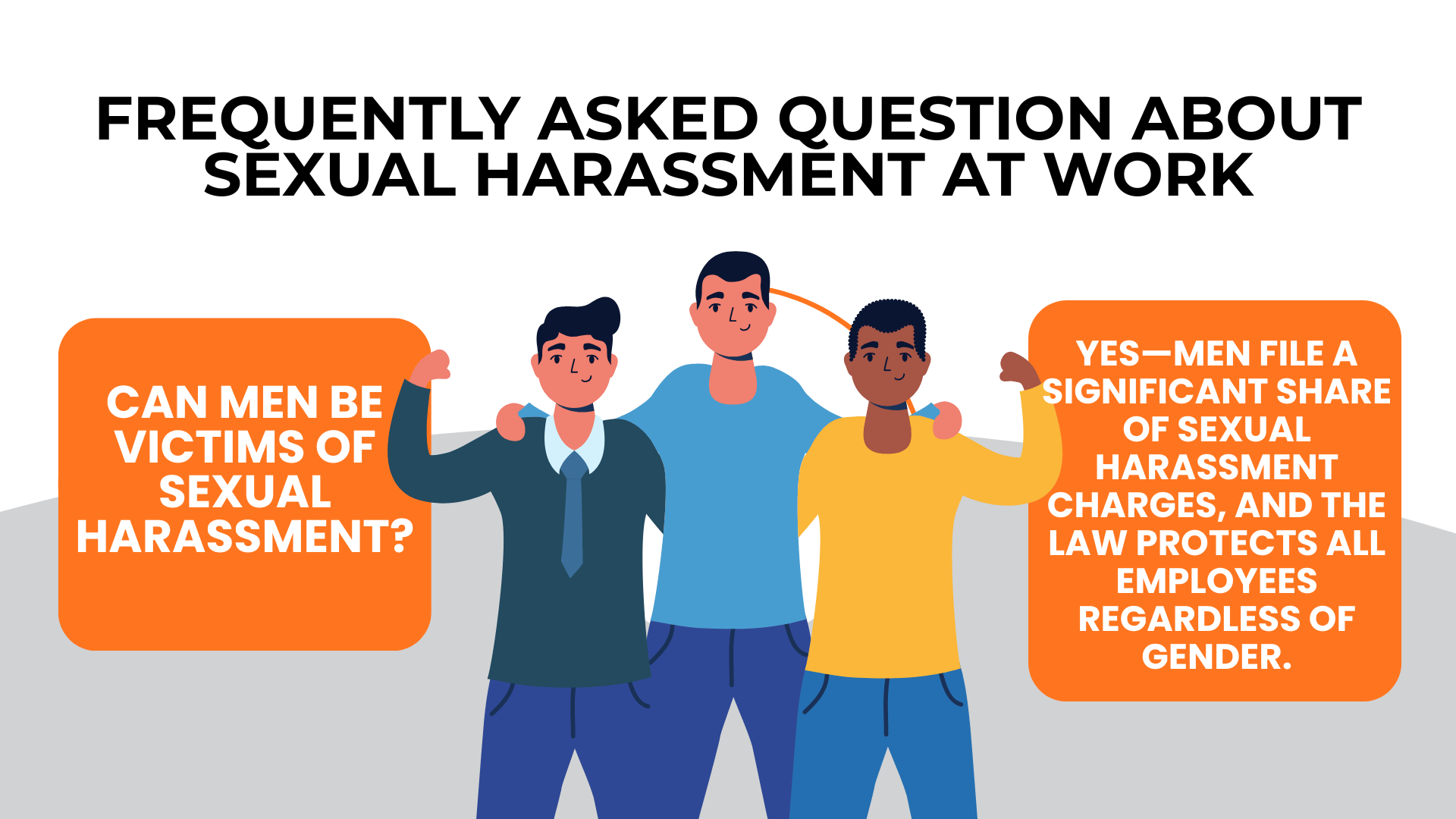
Can men be victims of sexual harassment?
Yes. While women file the majority of sexual harassment charges—78.2% according to EEOC data—men filed 21.8% of charges between FY 2018 and FY 2021. The law protects all employees from unwelcome conduct based on sex, regardless of the victim’s or harasser’s gender.
What if I didn’t report the harassment to HR?
Failure to report does not necessarily bar your claim. While employers may argue you failed to take advantage of internal complaint procedures, courts recognize that employees may have valid reasons for not reporting—including fear of retaliation or belief that reporting would be futile. EEOC data shows approximately 90% of harassment victims never file formal charges, and courts consider whether an employee’s failure to report was reasonable under the circumstances.
How long do I have to file a sexual harassment claim in New Jersey?
New Jersey employees have multiple options with different deadlines. To preserve federal Title VII claims, you must file an EEOC charge within 300 days of the harassment. For NJLAD claims filed directly in New Jersey Superior Court, you have two years—and unlike federal claims, no administrative filing is required first. The two-year deadline provides substantially more flexibility.
Can I sue my harasser personally in New Jersey?
Yes. Unlike federal law, which only allows claims against the employer, New Jersey’s NJLAD permits individual liability. Under the statute’s “aiding and abetting” provision, supervisors and individual harassers can be held personally liable for their discriminatory conduct. This provides an additional avenue for accountability and potential recovery.
Taking the Next Step
Sexual harassment in the workplace is illegal, and employees have meaningful legal protections under both federal and New Jersey law. New Jersey offers particularly strong remedies: no employer-size threshold, uncapped damages, individual liability for harassers, and more favorable legal standards than federal law provides. While the path forward may feel uncertain, the law provides real options for those who have experienced harassment.
Time limits apply to all sexual harassment claims, and evidence can become harder to gather as time passes. If you have questions about sexual harassment in the workplace, contact The Lacy Employment Law Firm to discuss your situation.