You’re preparing for one of the most important conversations of your professional life. After experiencing what you believe was age discrimination at work, you’ve taken the step of scheduling a consultation with an employment lawyer. The questions you ask during that meeting will determine whether you understand your legal options—and whether this attorney is the right person to handle your case.
A productive consultation goes both ways. You’re evaluating the lawyer just as much as they’re evaluating your case. Knowing which questions to ask helps you gather critical information about deadlines, case strength, potential damages, and legal strategy while also revealing whether this attorney has the experience and approach you need.
What Should You Ask About Whether You Have a Valid Age Discrimination Claim?
Before diving into strategy, you need to understand whether the law protects you and whether your situation meets the basic requirements for a discrimination claim. These foundational questions establish whether you have standing to pursue legal action.
Questions About Your Protected Status
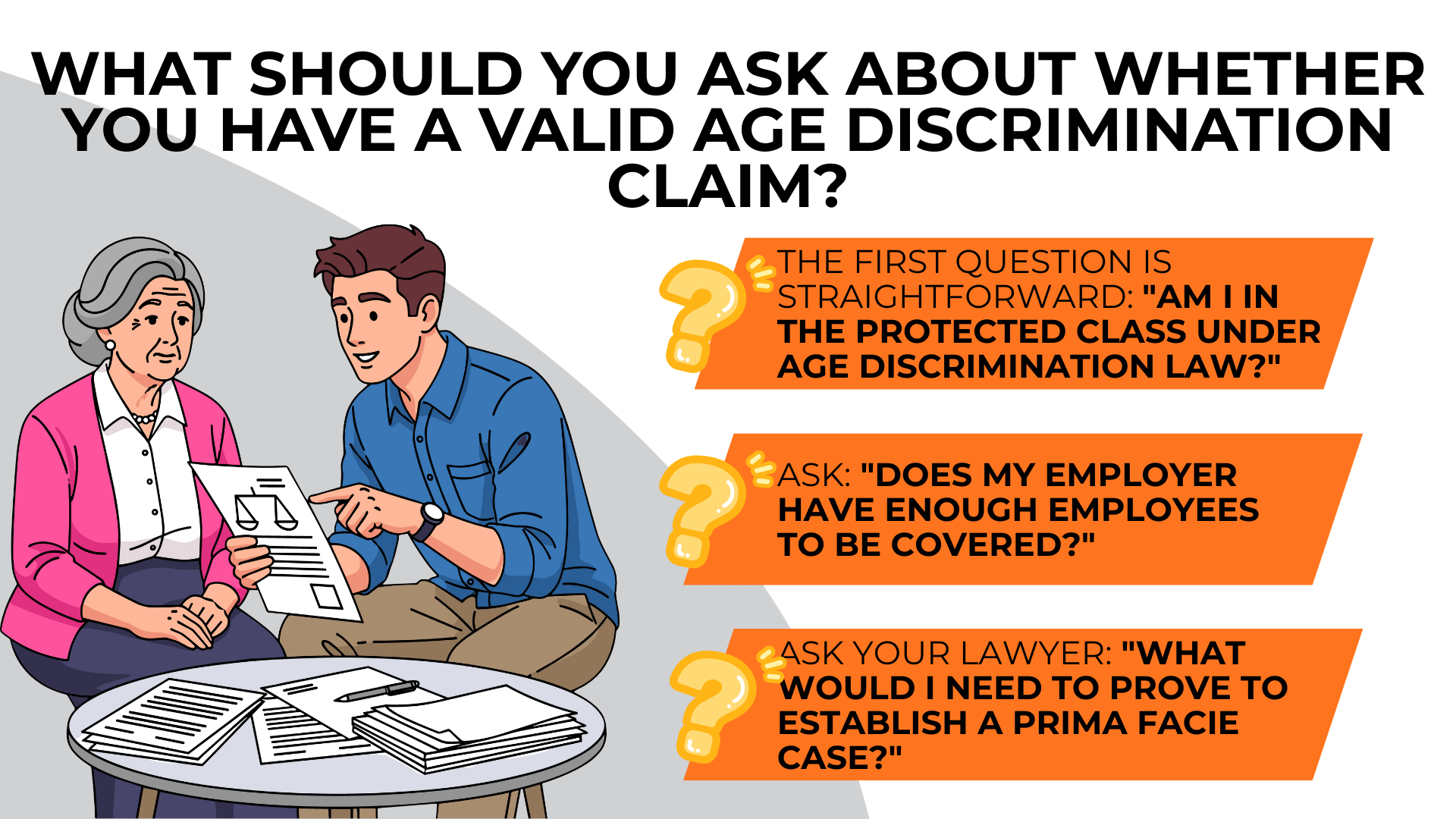
The first question is straightforward: “Am I in the protected class under age discrimination law?” Federal law under the Age Discrimination in Employment Act protects workers age 40 and older. Pennsylvania’s Human Relations Act also protects workers 40 and older. New Jersey’s Law Against Discrimination is broader, protecting workers age 18 and older from age-based discrimination in either direction.
Ask your lawyer which laws apply based on your age and location. If you’re under 40 but experienced discrimination for being “too young,” New Jersey law may still protect you under Bergen Commercial Bank v. Sisler, 157 N.J. 188, 723 A.2d 944 (1999).
Questions About Your Employer’s Coverage
Not every employer is covered by every anti-discrimination law. Ask: “Does my employer have enough employees to be covered?” The ADEA requires 20 or more employees. Pennsylvania’s PHRA covers employers with just 4 or more employees under 43 P.S. § 954(b). New Jersey’s LAD covers all employers regardless of size under N.J.S.A. 10:5-5.
This question matters because smaller employers may only be subject to state law, which affects your available remedies and filing requirements.
Questions About Initial Case Strength
Ask your lawyer: “What would I need to prove to establish a prima facie case?” Under the McDonnell Douglas framework, you generally must show you were 40 or older, qualified for your position, suffered an adverse employment action, and were replaced by or treated less favorably than someone substantially younger.
A good follow-up: “Was my replacement or the person who got the promotion substantially younger than me?” The Supreme Court clarified in O’Connor v. Consolidated Coin Caterers Corp., 517 U.S. 308 (1996), that your replacement doesn’t need to be under 40—the focus is on whether they were significantly younger than you.
What Questions Reveal Whether Your Employer’s Reason Was Pretextual?
Most employers don’t admit to age discrimination. They offer seemingly legitimate reasons for termination, failure to promote, or other adverse actions. Understanding how courts evaluate these reasons helps you ask the right questions about your case.
Questions About the Employer’s Stated Reason
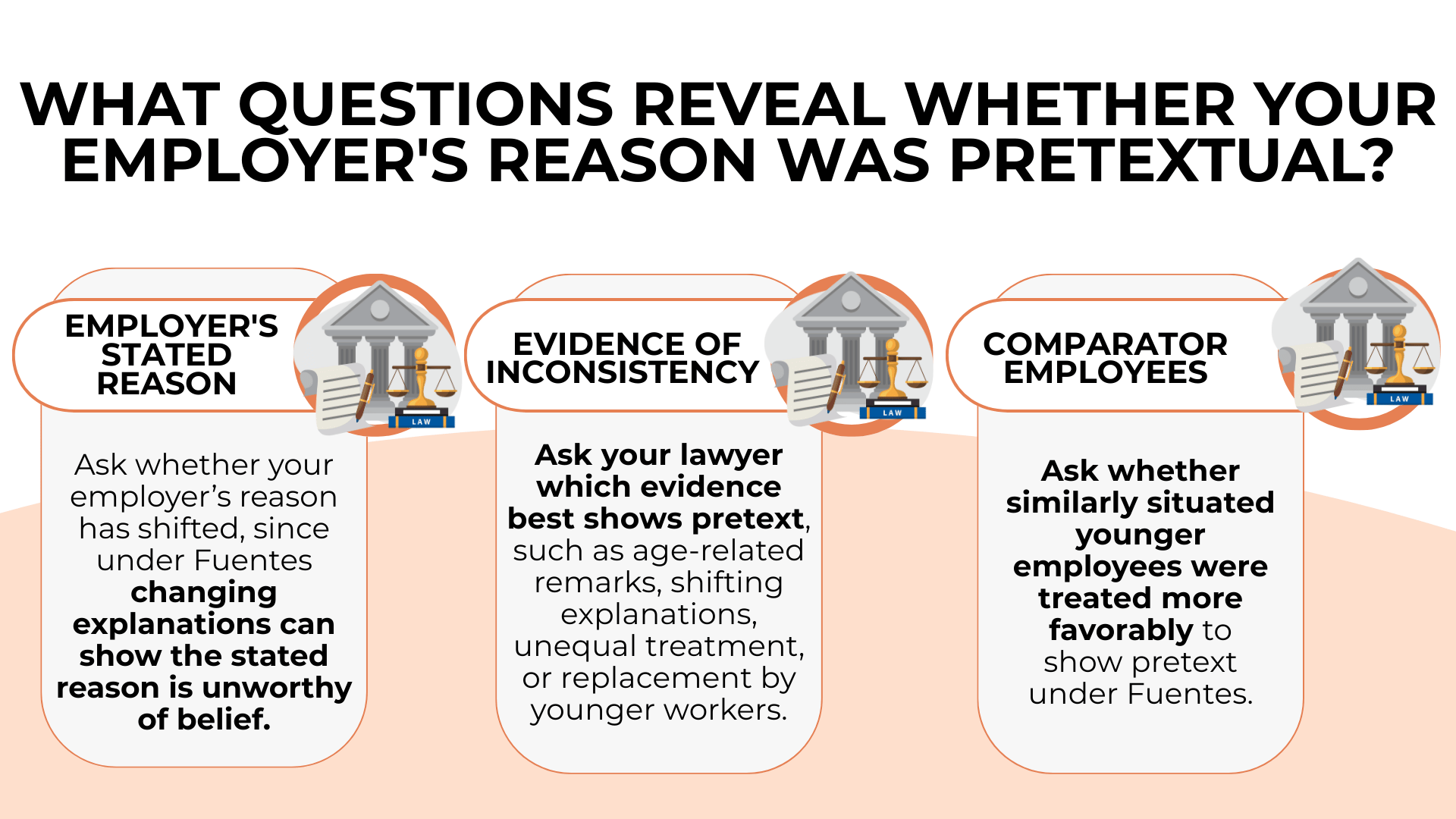
Ask: “What reason did my employer give, and how do we show it’s false?” Your lawyer should explain that under the Third Circuit’s Fuentes v. Perskie standard, 32 F.3d 759 (3d Cir. 1994), you must point to “weaknesses, implausibilities, inconsistencies, incoherencies, or contradictions” in the employer’s stated reason that would allow a factfinder to conclude it’s unworthy of belief.
Follow up with: “Has my employer’s explanation changed over time?” Shifting rationales are a classic indicator of pretext. If your employer initially cited “restructuring” but later claimed “performance issues,” that inconsistency can support your case.
Questions About Evidence of Inconsistency
Ask your lawyer which types of evidence best support a pretext argument. Strong pretext evidence typically includes:
- Performance reviews that were positive before the adverse action but suddenly turned negative
- Statements from supervisors referencing your age, retirement, or being “overqualified”
- Documentation showing the employer’s reason doesn’t match the timeline of events
- Evidence that the stated policy was applied differently to younger employees
- Records showing your position was filled or your duties were reassigned to younger workers
- Testimony from coworkers about discriminatory comments or attitudes
Questions About Comparator Employees
Ask: “Were younger employees treated differently in similar situations?” Under Fuentes, comparator evidence—showing that similarly situated younger employees received better treatment—can powerfully demonstrate pretext. Your lawyer should ask about younger colleagues who committed similar alleged infractions but faced lesser consequences, or who had similar qualifications but received promotions you were denied.
What Should You Ask About Filing Deadlines and Legal Procedures?
Time limits in employment discrimination cases are strict and unforgiving. Missing a deadline can permanently bar your claims regardless of how strong they are. These questions should be high on your list.
Questions About Federal Filing Deadlines
Ask: “How much time do I have to file a charge with the EEOC?” In Pennsylvania and New Jersey—both “deferral states” with their own enforcement agencies—the deadline is 300 days from the discriminatory act under 29 U.S.C. § 626(d). This is longer than the 180-day deadline in non-deferral states, but it still passes quickly.
Follow up: “When can I file a lawsuit after filing with the EEOC?” Unlike Title VII, the ADEA allows you to file suit 60 days after submitting your charge—you don’t need to wait for a right-to-sue letter. However, if you receive a Notice of Dismissal, you have only 90 days to file suit, and courts enforce this deadline strictly.
Questions About State Filing Requirements
Ask: “What are the state-level deadlines, and are they different from federal?” Pennsylvania’s PHRA requires filing with the Pennsylvania Human Relations Commission within 180 days under 43 P.S. § 959(h)—significantly shorter than the EEOC deadline. After filing, you must wait one year before filing a court action unless the PHRC dismisses earlier.
New Jersey is different. Ask: “Do I need to file with a state agency in New Jersey?” The answer is no. Under N.J.S.A. 10:5-12, you can file directly in Superior Court within the 2-year statute of limitations without any administrative exhaustion requirement.
Questions About Preserving All Your Claims
Given these overlapping deadlines, ask: “How do we make sure I don’t lose any claims?” The answer involves filing deadlines that require careful attention:
- EEOC charge: 300 days from the discriminatory act (PA and NJ as deferral states)
- Pennsylvania PHRC complaint: 180 days from the discriminatory act
- New Jersey court filing: 2 years from the incident under N.J.S.A. 2A:14-2(a)
- Federal lawsuit after right-to-sue: 90 days from receipt of notice
- ADEA lawsuit without waiting: 60 days after filing EEOC charge
Your lawyer should explain “dual-filing”—checking boxes to file with both the EEOC and state agency simultaneously through worksharing agreements—to preserve all options.
What Questions Help You Understand Potential Damages and Recovery?
Understanding what you might recover shapes realistic expectations about your case. The available damages differ significantly depending on which law you file under.
Questions About Federal ADEA Damages
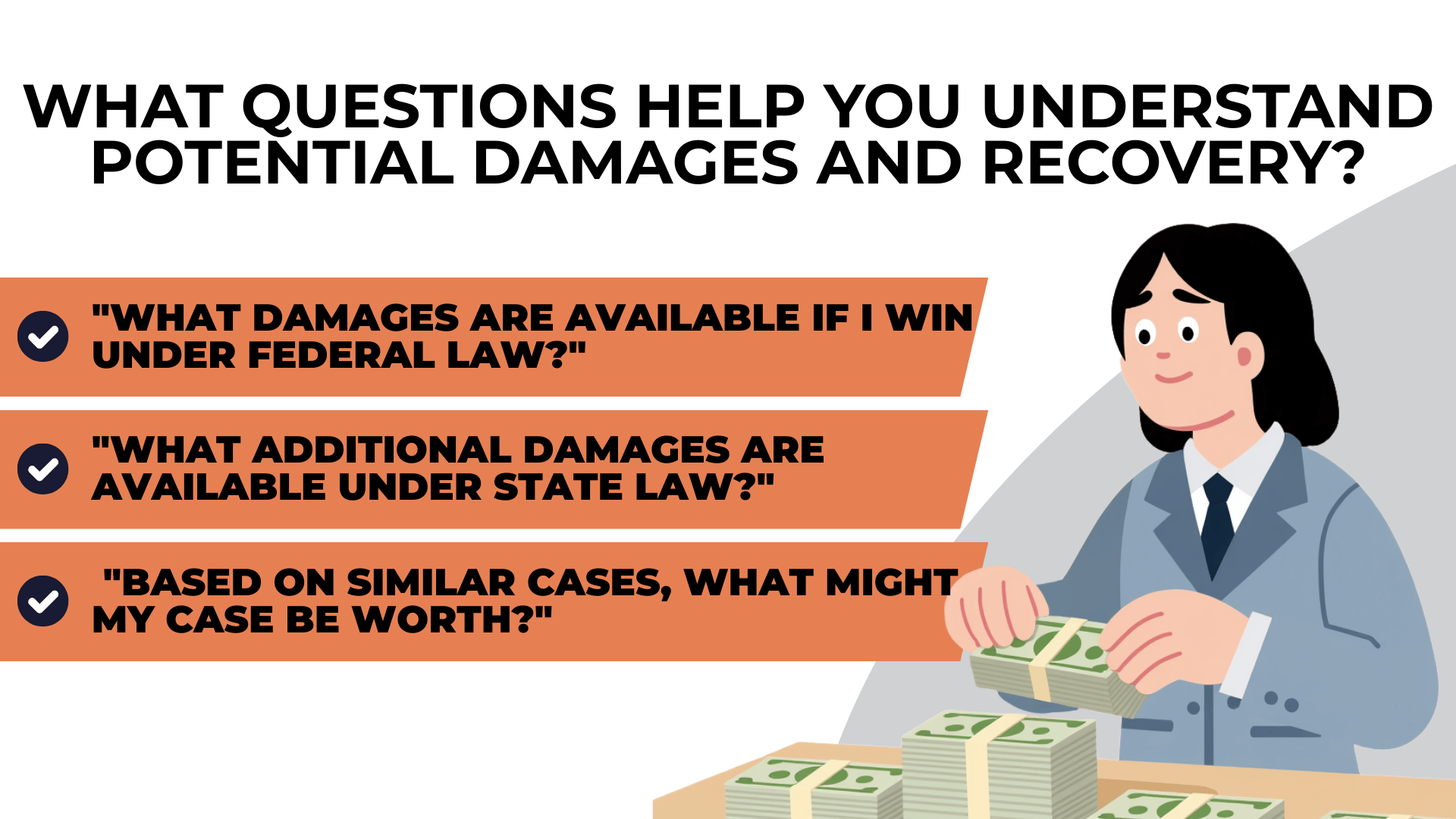
Ask: “What damages are available if I win under federal law?” The ADEA provides back pay (lost wages from termination to resolution), front pay (future lost earnings when reinstatement isn’t feasible), and liquidated damages that double your back pay if the violation was “willful” under 29 U.S.C. § 626(b).
A critical follow-up: “Can I recover for emotional distress under the ADEA?” The answer is no. Unlike Title VII, the ADEA does not provide compensatory damages for emotional suffering or punitive damages. This limitation makes state claims particularly valuable.
Questions About State Law Damage Advantages
Ask: “What additional damages are available under state law?” New Jersey’s LAD provides uncapped compensatory damages including emotional distress, plus punitive damages upon clear and convincing evidence of “especially egregious” conduct, per Lehmann v. Toys ‘R’ Us, Inc., 132 N.J. 587, 626 A.2d 445 (1993). New Jersey also allows attorney fee enhancement of 20-35% in typical cases under Rendine v. Pantzer, 141 N.J. 292, 661 A.2d 1202 (1995).
Pennsylvania’s PHRA provides uncapped compensatory damages including emotional distress under 43 P.S. § 959, but Hoy v. Angelone, 720 A.2d 745 (Pa. 1998), established that punitive damages are not available.
Questions About Realistic Case Value
Ask: “Based on similar cases, what might my case be worth?” While no attorney can guarantee results, they can provide context. According to EEOC data (2025), the agency recovered $3.18 million through ADEA litigation in FY 2024. Individual settlements vary widely—the New Jersey Attorney General (2023) announced a $175,487 settlement against Camden City School District, while a New Jersey nurse settled an age discrimination RIF case for $115,000.
Ask about the average timeline as well. According to EEOC guidance, the average charge takes approximately 11 months to investigate and resolve, though mediation averages just 84 days.
What Should You Ask About Federal Versus State Law Strategy?
Choosing which claims to pursue—and where to file them—involves strategic tradeoffs your lawyer should explain clearly.
Questions About New Jersey Law Advantages
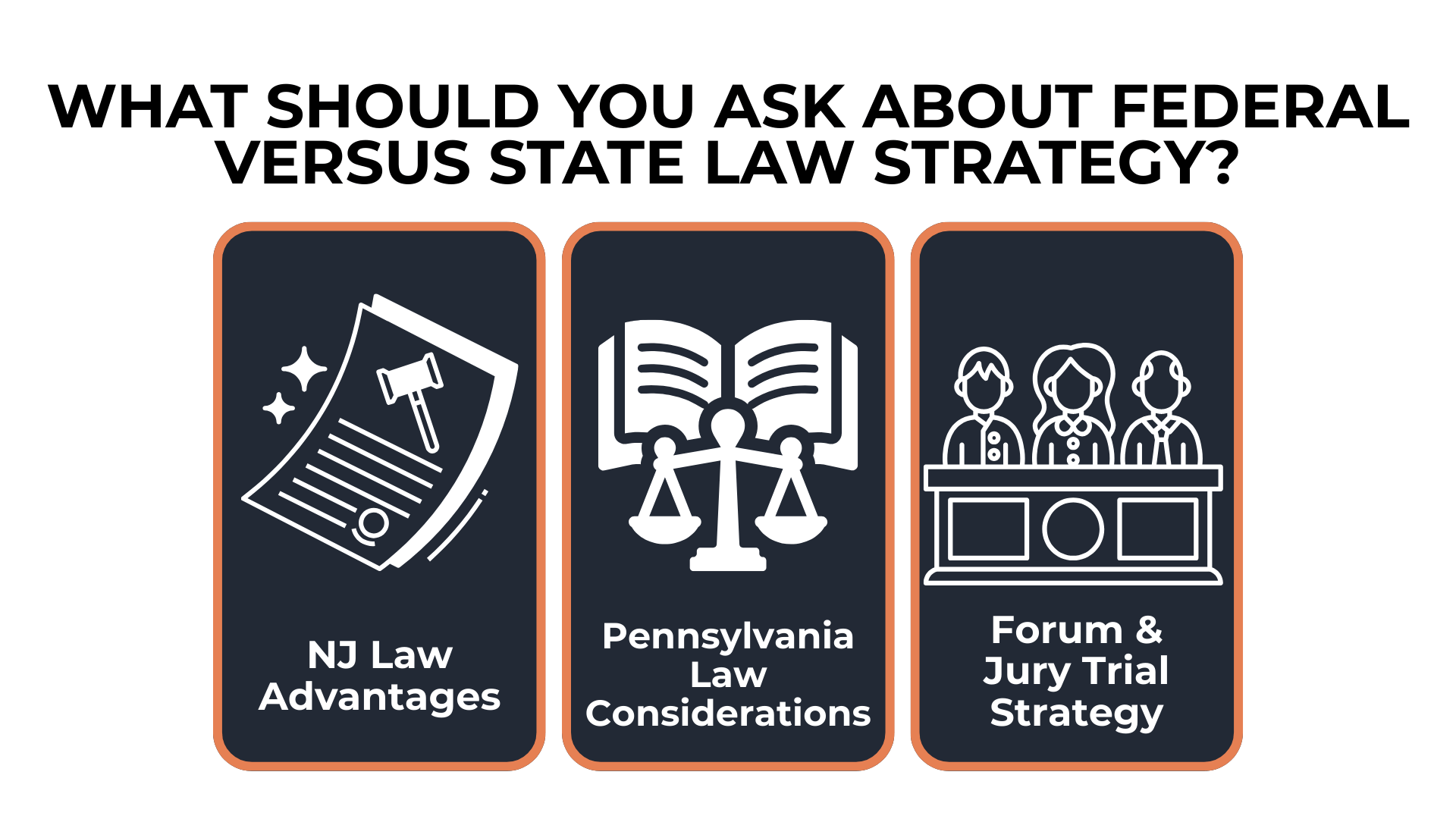
If your case involves New Jersey, ask: “Why might filing under the LAD be better than federal court?” New Jersey’s Law Against Discrimination offers several plaintiff-friendly features that the ADEA lacks.
Questions About Pennsylvania Law Considerations
For Pennsylvania cases, ask: “What are the tradeoffs between PHRA and ADEA claims?” Understanding the differences helps you make informed strategic decisions:
- The PHRA covers employers with 4+ employees (vs. 20+ for ADEA), expanding coverage for smaller workplaces
- The PHRA allows individual supervisor liability under the aiding/abetting provision at 43 P.S. § 955(e), adding potential defendants
- The PHRA provides no punitive damages per Hoy v. Angelone
- The PHRA provides no jury trial in Pennsylvania state court, though federal court PHRA claims may go to a jury
- The PHRA has a shorter 180-day filing deadline with a mandatory one-year administrative waiting period
- The ADEA provides jury trial rights under Lorillard v. Pons, 434 U.S. 575 (1978), which may benefit plaintiffs
Questions About Forum and Jury Trial Strategy
Ask: “Will I get a jury trial, and does that matter for my case?” The ADEA guarantees jury trial rights for legal claims including back pay. New Jersey LAD claims in Superior Court also provide jury rights. PHRA claims in Pennsylvania state court do not—they’re tried to a judge under 43 P.S. § 962(c).
Many plaintiff’s attorneys believe juries are more sympathetic to discrimination victims than judges. If jury trial matters to your case, ask how your lawyer plans to structure claims to preserve that right.
What Questions Should You Ask About the Lawyer’s Experience and Approach?
Beyond legal strategy, you’re evaluating whether this particular attorney is right for your case.
Questions About the Attorney’s Background
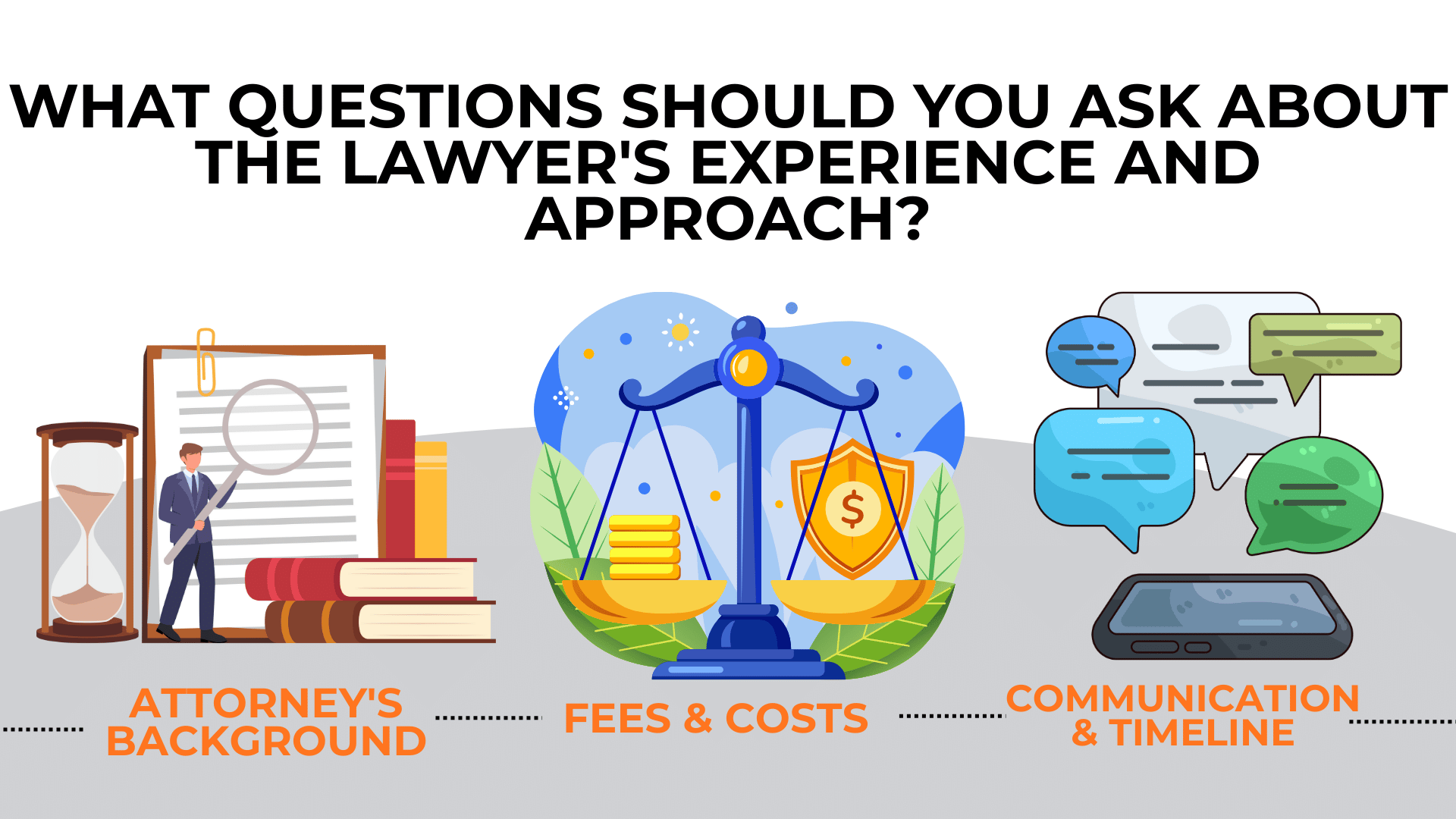
Ask: “Do you primarily represent employees or employers?” This matters because employment law has two distinct sides with different perspectives. A lawyer who primarily defends companies may not have the plaintiff-focused instincts your case requires.
Follow up: “How many age discrimination cases have you handled?” Experience with the specific legal framework—ADEA, LAD, or PHRA—matters. The procedural requirements, burden-shifting analysis, and damages calculations differ from other employment claims.
Questions About Fees and Costs
Ask: “How do you charge for age discrimination cases?” Most plaintiff-side employment lawyers work on contingency—they receive a percentage of any recovery rather than hourly fees. Ask what percentage they take and whether it differs depending on settlement versus trial.
Also ask: “Who pays for litigation costs like filing fees, depositions, and expert witnesses?” These costs can be substantial. Understand whether you’re responsible for costs if the case doesn’t succeed.
Questions About Communication and Timeline
Ask: “How will we communicate, and how quickly should I expect responses?” Knowing whether you’ll work primarily with the attorney or with staff, and what response times to expect, prevents frustration later.
Finally, ask: “What’s a realistic timeline for my case?” Based on EEOC data, the administrative process alone averages 11 months. Litigation can extend significantly longer. Understanding this timeline helps you prepare emotionally and financially for the process ahead.
Frequently Asked Questions About Age Discrimination Consultations
Should I bring documents to my first meeting with an age discrimination lawyer?
Yes. Bring any termination letters, performance reviews, emails referencing your age or retirement, the employee handbook, and a timeline of events. Your employment contract and any severance agreement you’ve been asked to sign are also essential. The more documentation you provide, the better your attorney can evaluate your case during the initial consultation.
How long do age discrimination cases typically take to resolve?
Timelines vary significantly. According to EEOC data, the average charge investigation takes approximately 11 months, while mediation averages 84 days. If your case proceeds to litigation after the administrative process, resolution may take an additional one to three years depending on court schedules and whether the case settles or goes to trial.
What if I already signed a severance agreement?
Ask your lawyer to review it carefully. Under the Older Workers Benefit Protection Act, waivers of ADEA claims must meet seven specific requirements including a 21-day consideration period and 7-day revocation period. If your agreement doesn’t comply, the Supreme Court held in Oubre v. Entergy Operations, 522 U.S. 422 (1998), that you may still pursue your claims without returning the severance payment.
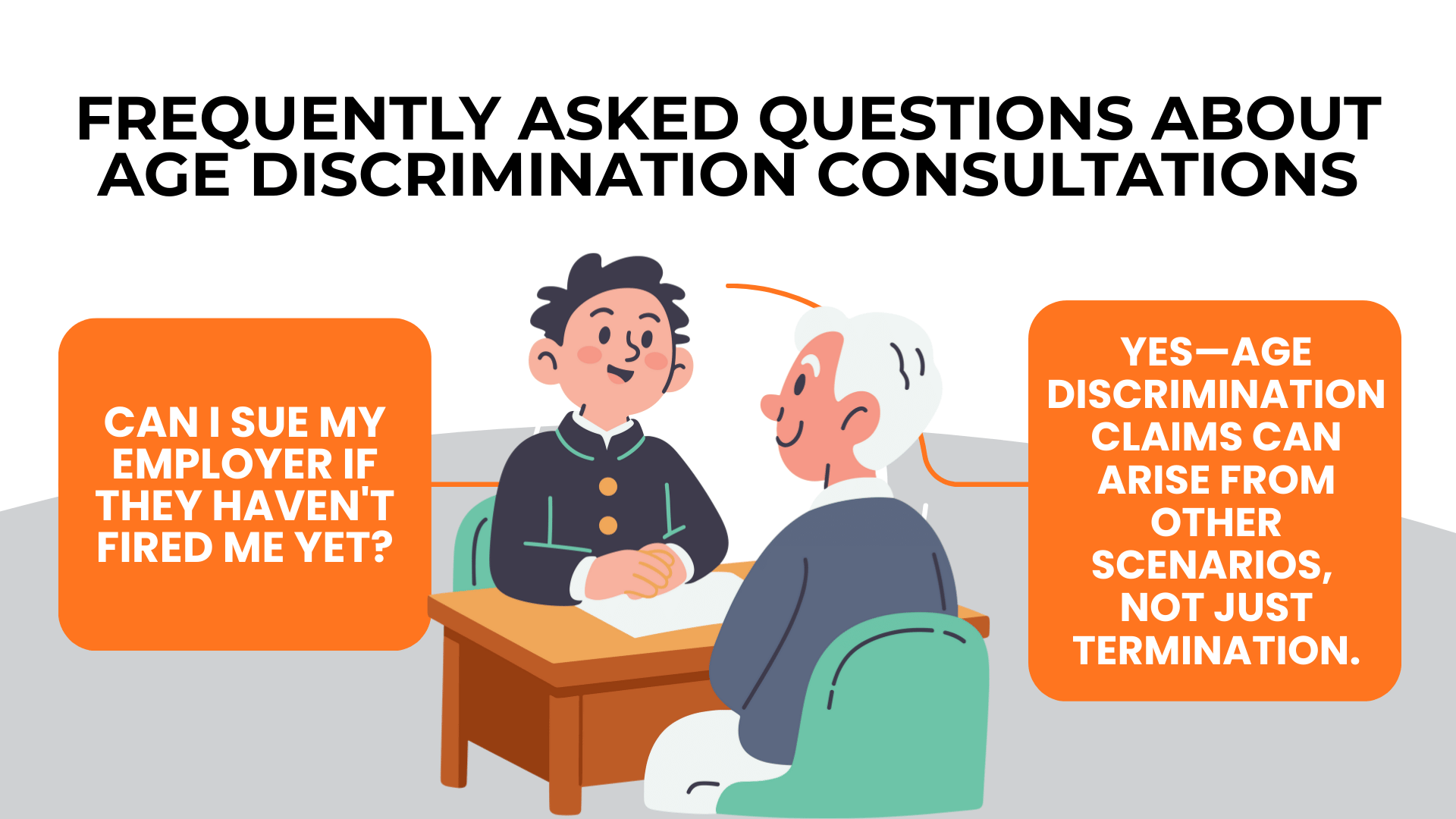
Can I sue my employer if they haven’t fired me yet?
Yes, if you’ve experienced other adverse employment actions like demotion, failure to promote, significant reduction in pay or responsibilities, or a hostile work environment based on age. Termination is the most common claim—according to EEOC data (2018), 55% of ADEA charges allege discriminatory discharge—but it’s not the only basis for a claim.
What’s the difference between an EEOC complaint and a lawsuit?
Filing a charge with the EEOC is an administrative process that must typically occur before filing a federal lawsuit. The EEOC investigates, may attempt mediation, and issues findings. Under the ADEA, you can file a lawsuit 60 days after submitting your charge without waiting for the investigation to conclude. In New Jersey, you can skip this process entirely and file directly in court under the LAD.
Taking the Next Step
The questions you ask during your consultation reveal both the strength of your potential case and whether you’ve found the right attorney to handle it. Focus on understanding the legal framework, the deadlines you face, the damages available under different laws, and the strategic choices that will shape your case.
According to AARP research (2025), 64% of workers age 50 and older have seen or experienced age discrimination in the workplace. You’re not alone in facing this situation, and the law provides meaningful remedies when employers discriminate based on age.
If you have questions about your age discrimination case, contact The Lacy Employment Law Firm to discuss your situation.