
When your employer pays you as an independent contractor but controls your work like an employee, you may be losing thousands of dollars in wages you’re legally owed. Employee misclassification occurs when businesses improperly label workers as independent contractors to avoid paying minimum wage, overtime, and payroll taxes. According to the Economic Policy Institute (2025), misclassified workers lose between $6,517 and $26,253 per year in compensation depending on their occupation and state—with New Jersey truck drivers experiencing the highest losses nationally.
This isn’t just a paperwork issue. When you’re misclassified, you lose legal protections that employees receive under federal and state law. Understanding how courts determine your true employment status can help you recognize whether you have a claim and what you can recover.
What Is Employee Misclassification and Why Does It Matter?
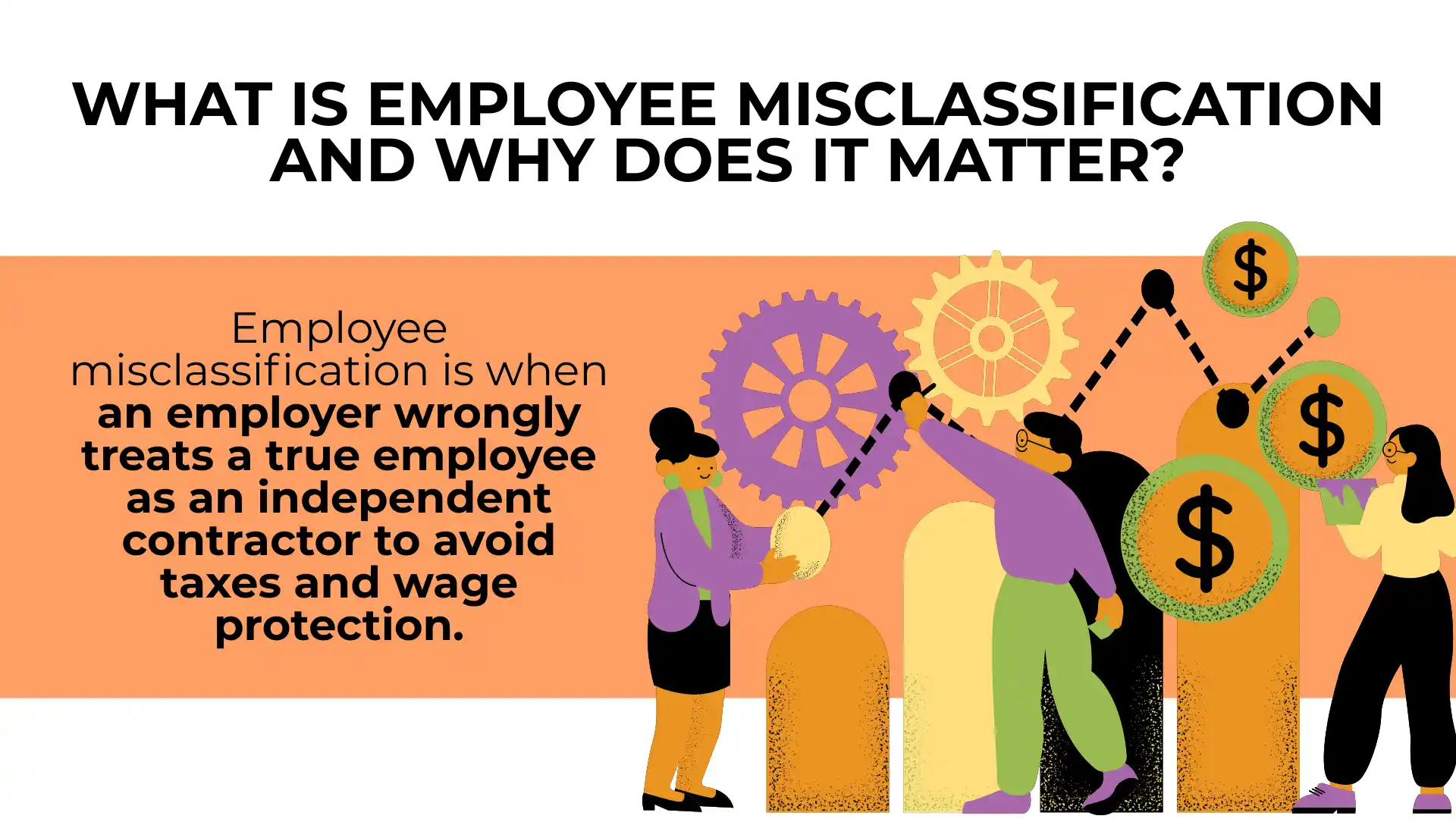
Employee misclassification happens when an employer treats a worker as an independent contractor even though the nature of the working relationship meets the legal definition of employment. The label your employer uses—whether they call you a “freelancer,” “1099 worker,” or “independent contractor”—does not determine your legal status. What matters is how courts analyze your actual working relationship.
Why would an employer misclassify workers?
Employers misclassify workers primarily to reduce labor costs. When a business treats you as an independent contractor, it avoids paying the employer’s share of Social Security and Medicare taxes (7.65% of wages), unemployment insurance contributions, and workers’ compensation premiums. It also avoids overtime obligations and minimum wage requirements under federal and state law.
For employers, misclassification can represent significant savings. For workers, those savings come directly out of your pocket.
What legal protections do employees have that contractors don’t?
The difference between employee and independent contractor status affects nearly every aspect of workplace protection. Employees receive rights that contractors do not, including:
- Minimum wage guarantees under the FLSA and state wage laws
- Overtime pay at 1.5 times the regular rate for hours exceeding 40 per week
- Unemployment insurance eligibility if you lose your job
- Workers’ compensation coverage for workplace injuries
- Employer contributions to Social Security and Medicare
- Anti-retaliation protections for reporting wage violations
When you’re misclassified, you lose access to all of these protections—and your employer pockets the difference.
How Do Courts Decide If You’re an Employee or Independent Contractor?
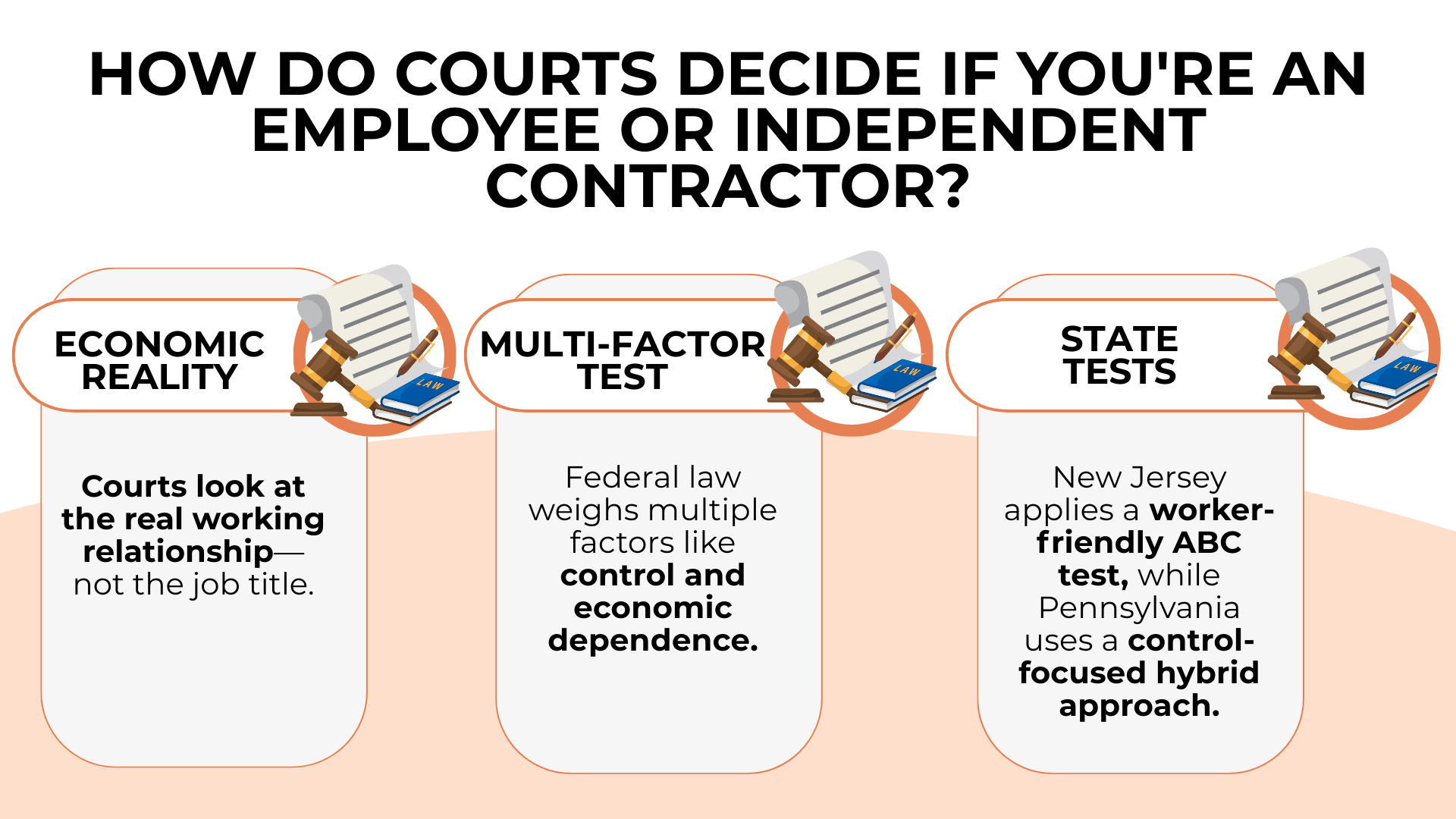
Courts don’t simply accept whatever classification your employer assigned. Instead, they apply legal tests that examine the substance of your working relationship. The Supreme Court established this principle in Rutherford Food Corp. v. McComb, 331 U.S. 722 (1947), holding that the economic reality of the relationship—not the label the parties assign—determines whether an employment relationship exists.
Different jurisdictions apply different tests, and some are more favorable to workers than others.
What is the economic reality test under federal law?
Under the Fair Labor Standards Act, courts apply the “economic reality” test to determine employment status. This test examines the totality of the working relationship through multiple factors:
- The extent to which the work is an integral part of the employer’s business
- The worker’s opportunity for profit or loss based on managerial skill
- The worker’s investment in equipment or materials
- Whether the work requires special skill and initiative
- The permanence of the relationship
- The degree of control the employer exercises over the work
No single factor is determinative. As the Third Circuit explained in Razak v. Uber Technologies, Inc., 951 F.3d 137 (3d Cir. 2020), FLSA classification is a fact-intensive inquiry that depends on the totality of the circumstances.
How does New Jersey’s ABC test work?
New Jersey applies the ABC test, which is significantly more favorable to workers than the federal economic reality test. Under the New Jersey Supreme Court’s decision in Hargrove v. Sleepy’s, LLC, 220 N.J. 289 (2015), the employer bears the burden of proving all three prongs to establish that a worker is an independent contractor rather than an employee.
If the employer fails to prove even one prong, the worker is classified as an employee entitled to wage protections.
What test does Pennsylvania apply?
Pennsylvania uses a hybrid approach that combines elements of the common law control test with economic reality factors. This test focuses primarily on the employer’s right to control the manner and means of the work performed.
For most industries, Pennsylvania’s test is less favorable to workers than New Jersey’s ABC test because it places less burden on employers. However, Pennsylvania has enacted industry-specific protections for construction workers through the Construction Workplace Misclassification Act.
What Do Misclassified Workers Lose?
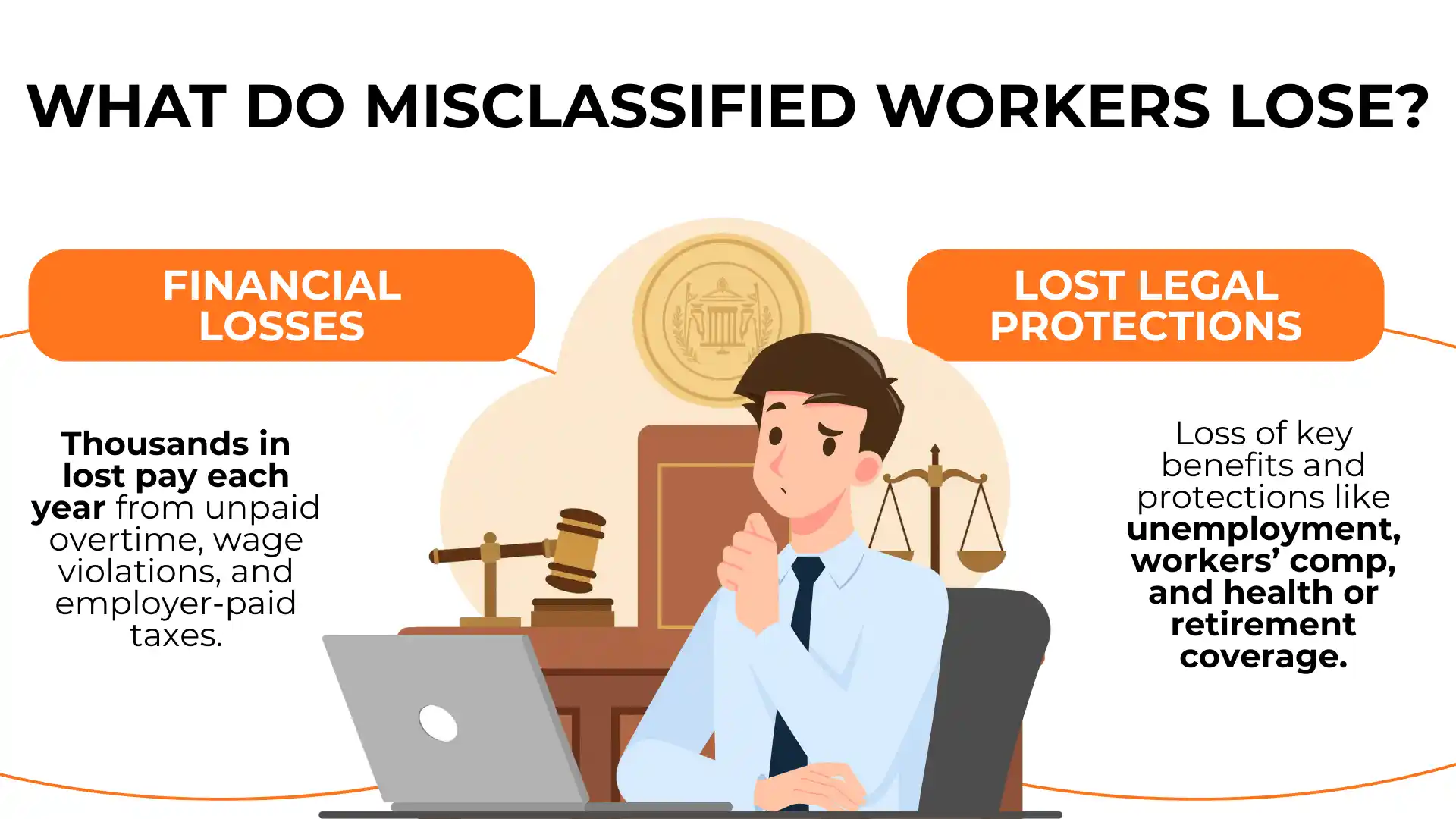
The financial impact of misclassification extends far beyond a simple paycheck calculation. When your employer classifies you as an independent contractor, you lose both immediate wages and long-term benefits that add up to substantial sums over time.
How much money do misclassified workers lose?
The Economic Policy Institute (2025) calculated the per-worker cost of misclassification across occupations and states. Losses range from $6,517 per year for janitors in Mississippi to $26,253 per year for truck drivers in New Jersey. These figures account for lost overtime pay, minimum wage violations, and denied benefits.
Beyond individual losses, misclassification drains public programs. The same EPI research found that misclassification costs social insurance funds between $609 and $3,713 per worker annually in lost contributions to Social Security, Medicare, and unemployment insurance. The Government Accountability Office estimates that worker misclassification costs the federal government $3 to $4 billion per year in lost tax revenue.
What benefits are you missing out on?
Misclassified workers lose access to essential workplace protections and benefits that employees receive:
- Overtime compensation at time-and-a-half for hours over 40 per week
- Unemployment benefits if you lose your job through no fault of your own
- Workers’ compensation for medical bills and lost wages after workplace injuries
- Half of your FICA taxes that employers must pay for employees (7.65%)
- Potential employer-sponsored benefits like health insurance and retirement contributions
These losses compound over time. A worker misclassified for several years may have claims worth tens of thousands of dollars in back wages and damages.
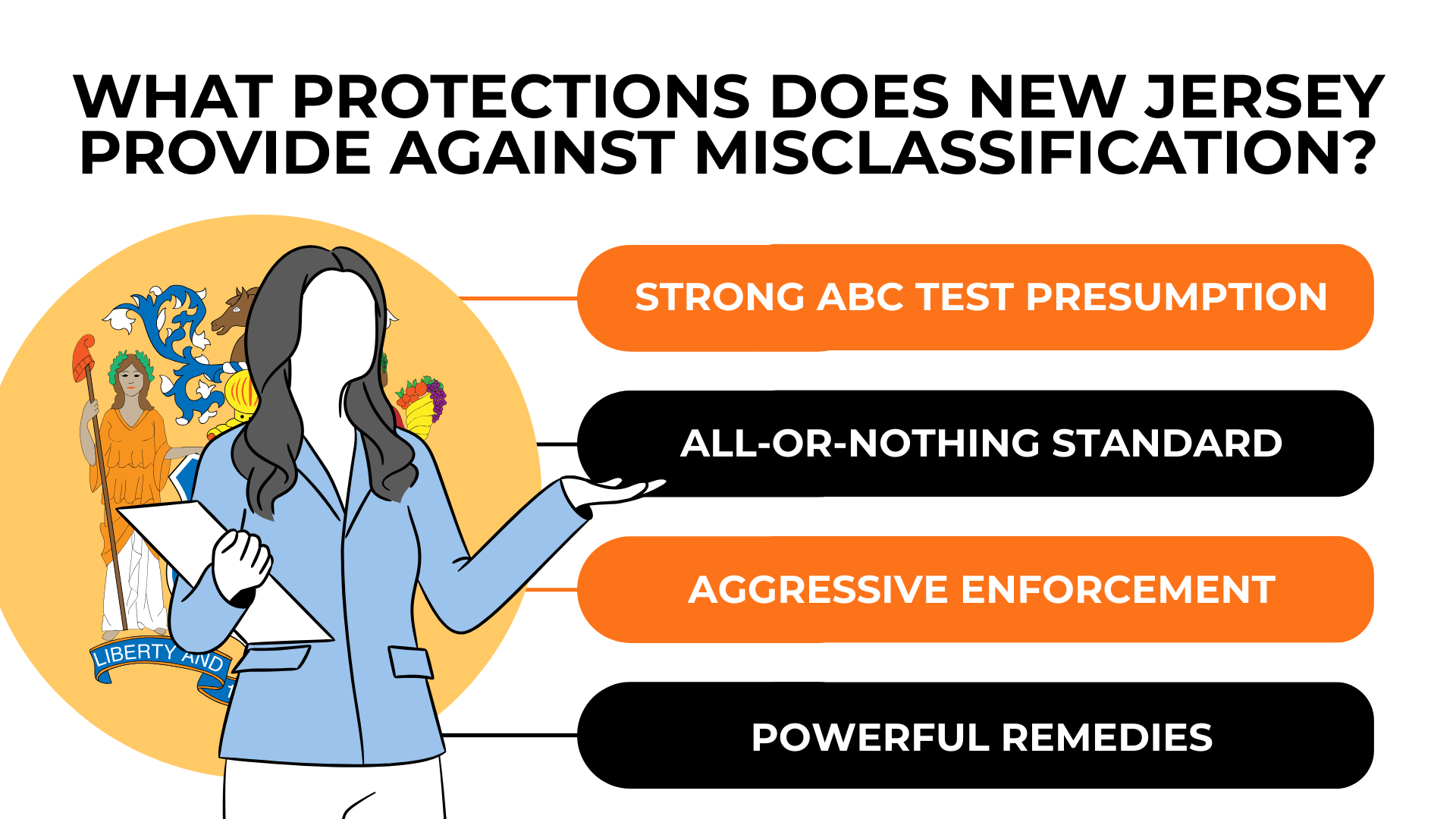
What Protections Does New Jersey Provide Against Misclassification?
New Jersey offers some of the strongest misclassification protections in the country through its ABC test and the enhanced remedies available under the New Jersey Wage Theft Act.
What are the three prongs of New Jersey’s ABC test?
Under the ABC test established in Hargrove v. Sleepy’s, LLC, 220 N.J. 289 (2015), a worker is presumed to be an employee unless the employer proves all three of the following prongs:
Prong A: The worker is free from control or direction over the performance of the work, both under contract and in fact.
Prong B: The work is performed outside the usual course of the employer’s business or outside all the employer’s places of business.
Prong C: The worker is customarily engaged in an independently established trade, occupation, profession, or business.
Each prong presents a significant hurdle for employers. A delivery driver working for a delivery company will struggle to satisfy Prong B. A worker who performs services exclusively for one business will struggle to satisfy Prong C.
Why is New Jersey’s test favorable for workers?
The ABC test’s burden-shifting structure creates a strong presumption of employment. Unlike federal law, where courts weigh multiple factors with no single factor controlling, New Jersey requires employers to prove all three prongs. Failure on any single prong means the worker is an employee.
New Jersey’s enforcement reflects this strength. According to the New Jersey Department of Labor (2025), the state recovered $37 million for nearly 8,500 workers specifically for misclassification violations in 2024-2025. The department has also issued 210 stop-work orders since 2019 to employers violating classification rules, according to NJ DOL enforcement data.
What damages can you recover under New Jersey law?
The New Jersey Wage Theft Act, enacted in 2019, provides for treble damages—meaning you can recover up to three times your unpaid wages. The Act also provides a six-year statute of limitations, giving workers more time to bring claims than federal law allows. Prevailing plaintiffs also recover attorney fees and costs, making it economically viable to pursue claims that might otherwise be too small to justify litigation.
How Does Pennsylvania Handle Misclassification Claims?
Pennsylvania’s approach to misclassification differs significantly from New Jersey’s, with fewer automatic protections for workers in most industries.
What classification test does Pennsylvania use?
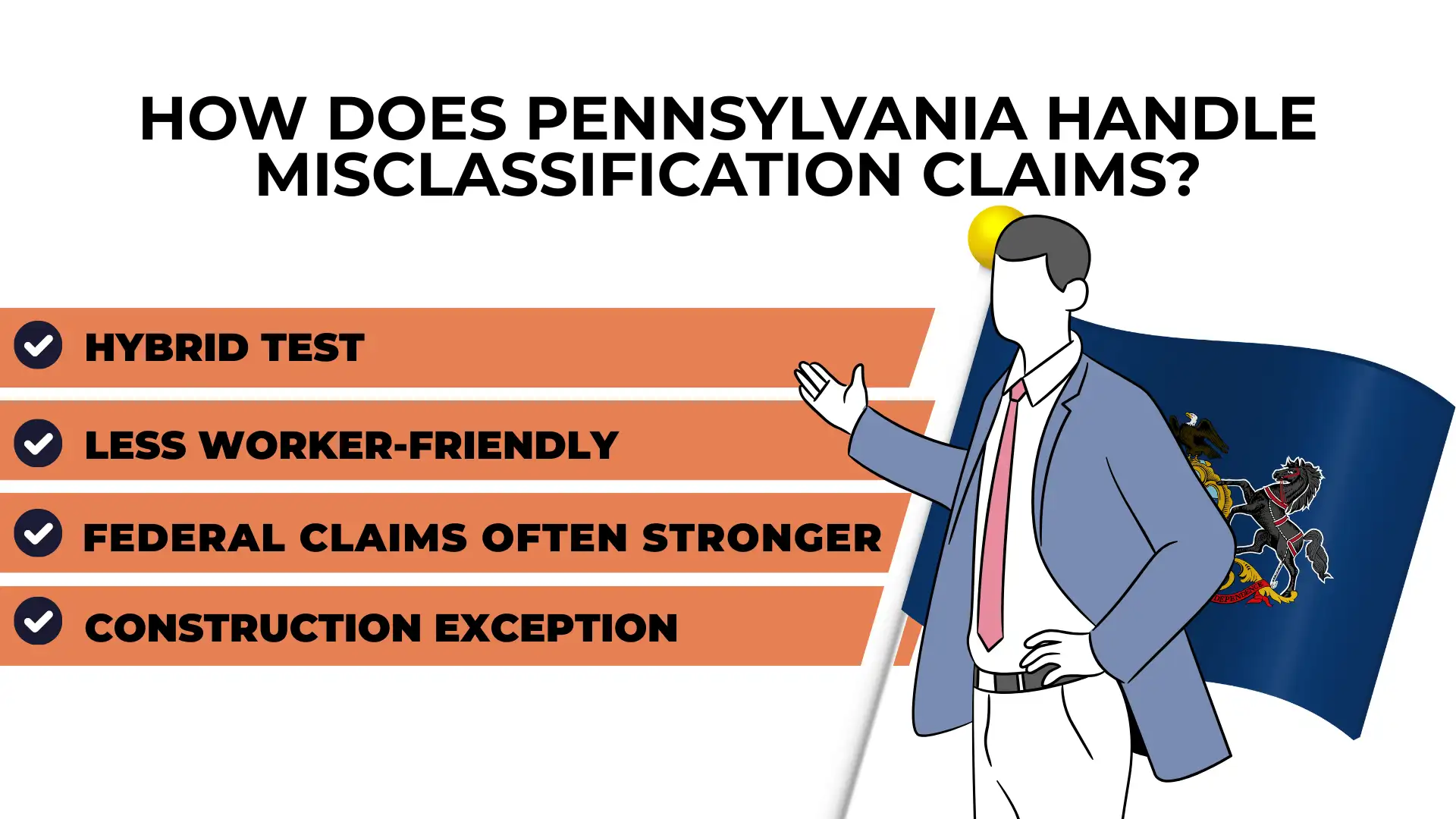
Pennsylvania applies a hybrid test that combines the common law “right to control” analysis with economic reality factors. This test examines whether the employer has the right to control how the work is performed, not just the end result.
While this test can support misclassification claims, it is generally less favorable to workers than New Jersey’s ABC test because it does not create a presumption of employment or place the full burden on employers.
Pennsylvania workers may have stronger claims under federal FLSA than under state law alone. A 2024 Department of Labor judgment awarded $35.8 million to 6,000 employees of Pennsylvania nursing facilities for willful overtime violations—demonstrating that federal enforcement remains active in the state.
Does Pennsylvania have special rules for construction workers?
Yes. Pennsylvania enacted the Construction Workplace Misclassification Act (Act 72 of 2010), codified at 43 Pa. Stat. §§ 933.1–933.17, which provides specific protections for construction industry workers.
Under Act 72, construction workers are presumed to be employees unless the employer can demonstrate that the worker meets specific criteria for independent contractor status. This industry-specific statute provides stronger protections than Pennsylvania’s general classification test, though it remains narrower than New Jersey’s universal ABC test.
What Damages Can You Recover in a Misclassification Case?
Successful misclassification claims can result in substantial recoveries beyond just the wages you were denied. Federal and state laws provide enhanced damages designed to punish employers and compensate workers for the full harm of misclassification.
What are liquidated damages?
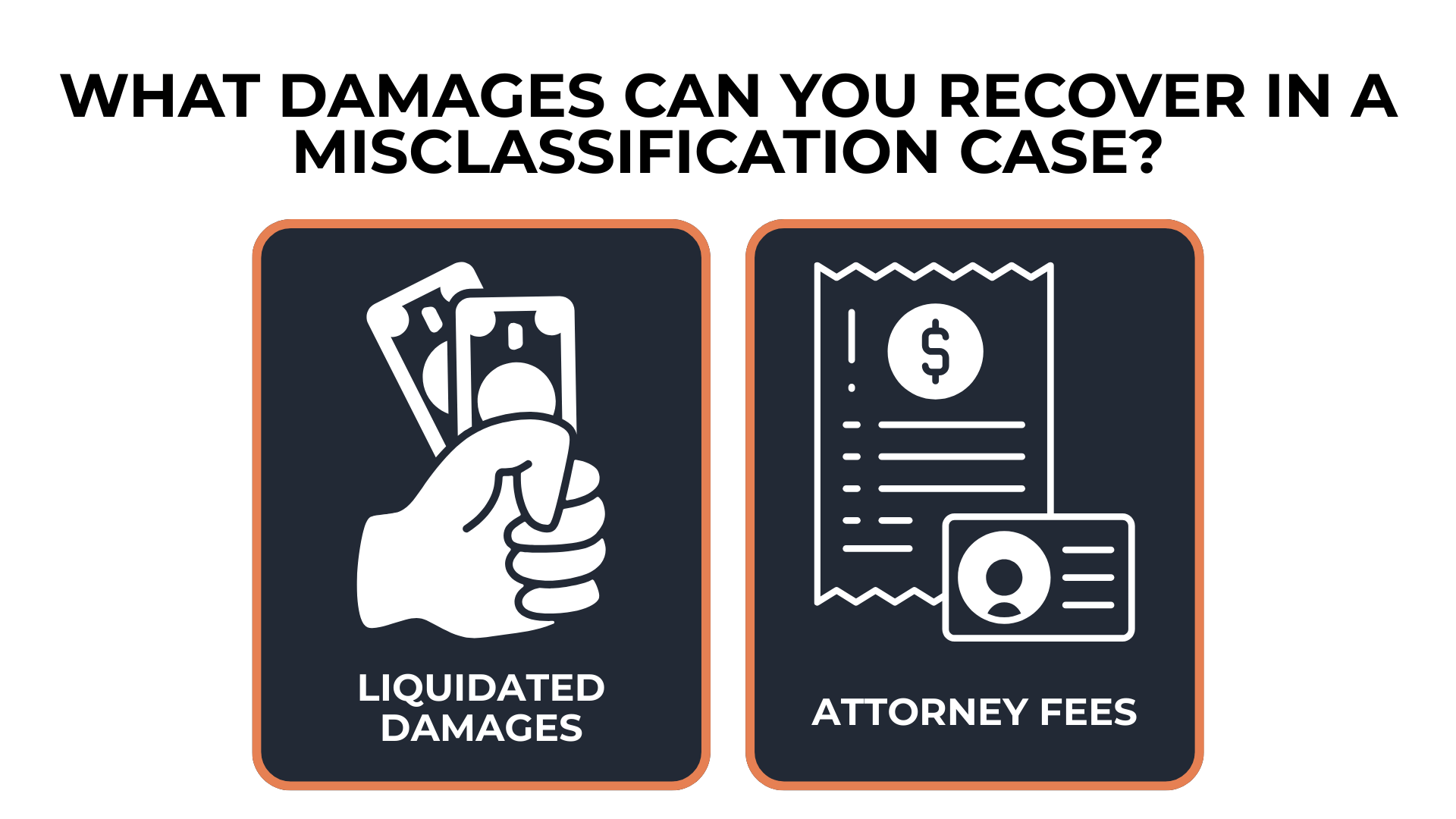
Liquidated damages are additional amounts that statutes authorize beyond unpaid wages. They serve both to compensate workers and to deter employer violations.
The recovery structure varies by jurisdiction:
- FLSA: Unpaid wages plus an equal amount in liquidated damages (effectively doubling recovery), plus attorney fees
- New Jersey Wage Theft Act: Up to treble damages (three times unpaid wages) plus attorney fees
- Pennsylvania WPCL: Unpaid wages plus 25% liquidated damages plus attorney fees
You cannot recover duplicative damages under multiple statutes for the same wages. However, you can pursue claims under whichever statute provides the greatest recovery for your situation.
Collective action settlements demonstrate the significant value of these claims. According to Seyfarth Shaw’s 2023 FLSA Litigation Report, FLSA collective action settlements totaled $493.6 million across 423 cases in 2023, with an average settlement of approximately $1.17 million per case.
Can you recover attorney fees?
Yes. All three frameworks—FLSA, New Jersey Wage Theft Act, and Pennsylvania WPCL—provide mandatory attorney fee shifting to prevailing plaintiffs. This means your employer must pay your attorney fees if you win, making it possible to pursue claims that might otherwise be too small to justify the cost of litigation.
Attorney fee provisions are critical for wage theft enforcement because they allow workers to find representation even when their individual damages are modest.
How Long Do You Have to File a Misclassification Claim?
Statutes of limitations vary significantly between federal and state law. Missing these deadlines can permanently bar your claims, so understanding the applicable time limits is essential.
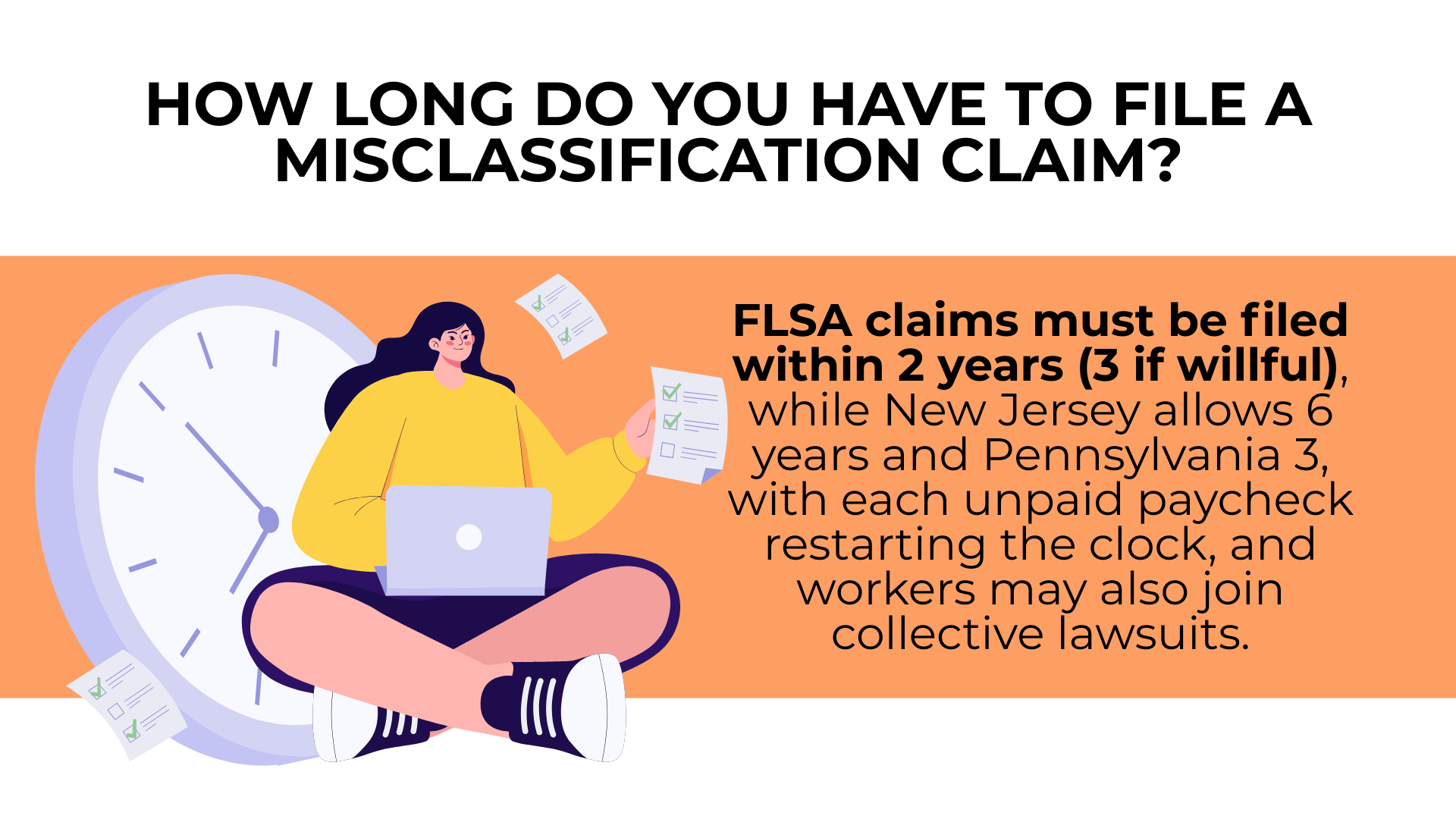
Under federal FLSA, you have two years to file a claim—or three years if your employer’s violation was willful. New Jersey provides the longest window: six years under the Wage Theft Act. Pennsylvania’s WPCL allows three years.
Importantly, each unpaid paycheck starts a new limitations clock. If your employer has been misclassifying you for five years, you may still recover wages from the most recent two, three, or six years depending on which statute applies.
What if my employer’s violation was intentional?
Under the FLSA, a “willful” violation extends the statute of limitations from two years to three years. A violation is willful if the employer knew or showed reckless disregard for whether its conduct violated the law. Deliberate misclassification schemes—where employers know workers should be classified as employees—typically meet this standard.
Can you join a group lawsuit against your employer?
Yes. The FLSA permits collective actions that allow similarly situated workers to join together against a common employer. Under Hoffman-La Roche Inc. v. Sperling, 493 U.S. 165 (1989), courts may facilitate notice to potential plaintiffs by authorizing discovery of employee names and addresses.
Collective actions can be highly effective. Seyfarth Shaw’s 2023 analysis found that 75% of FLSA conditional certification motions succeeded, allowing cases to proceed on a collective basis.
Frequently Asked Questions
Can my employer call me an independent contractor if I work set hours and use their equipment?
The label your employer uses does not control your legal status. If you work set hours, use employer-provided equipment, and have little control over how you perform your work, these facts support employee classification regardless of what your employer calls you. Courts examine the substance of the relationship, not the label.
What if I signed an independent contractor agreement?
A signed agreement does not determine your legal status. Courts regularly find workers to be employees despite contracts stating otherwise. The legal tests focus on the actual working relationship, and employers cannot contract around wage laws by having workers sign independent contractor agreements.
Do gig economy workers like Uber drivers have misclassification claims?
Gig economy workers may have viable claims depending on the jurisdiction and specific facts. The Third Circuit in Razak v. Uber Technologies, Inc. held that driver classification is a fact-intensive inquiry. New Jersey’s ABC test is particularly favorable for gig workers because employers must prove workers are genuinely operating independent businesses.
Can I file a misclassification claim if I still work for the employer?
Yes, and federal and state laws prohibit retaliation against workers who assert wage claims. However, many workers wait until after employment ends to avoid workplace conflict. Consulting with an attorney can help you understand your options and protections.
What evidence do I need to prove I was misclassified?
Helpful evidence includes pay stubs (or 1099 forms), work schedules, communications showing employer control over your work, evidence that you worked exclusively for one company, and documentation of employer-provided equipment or training. An employment attorney can help identify what evidence is most relevant to your situation.
Will I have to pay back taxes if I win a misclassification case?
Your tax situation may change, but winning a misclassification case typically results in a net financial benefit. You may owe employee-side FICA taxes, but your employer becomes responsible for the employer share. The wages and damages you recover generally exceed any additional tax obligations.

Conclusion
Employee misclassification costs workers thousands of dollars per year in lost wages and benefits while depriving them of basic workplace protections. Understanding the legal tests courts apply—particularly New Jersey’s worker-friendly ABC test—can help you determine whether you have a claim worth pursuing.
The deadlines for filing claims vary from two years under federal law to six years in New Jersey. Each missed paycheck represents potential lost recovery, so understanding your rights sooner rather than later matters.
If you have questions about whether you’ve been misclassified as an independent contractor, contact The Lacy Employment Law Firm to discuss your situation.