When you leave a job—whether you quit, get laid off, or are fired—your employer owes you every dollar you earned. Yet according to Temple University’s Sheller Center for Social Justice (2024), $19 to $32 million in wages are stolen from Pennsylvania workers every single week. A significant portion of that theft happens when employers delay, reduce, or simply refuse to pay final wages.
Final paycheck laws exist to prevent this. These state laws impose specific deadlines for when employers must deliver your last paycheck and create penalties when they fail. Understanding these laws gives you leverage to recover what you’re owed—plus substantial additional damages in many cases.
This guide explains final paycheck requirements in Pennsylvania and New Jersey, the penalties employers face for violations, and what steps you can take if your former employer won’t pay.
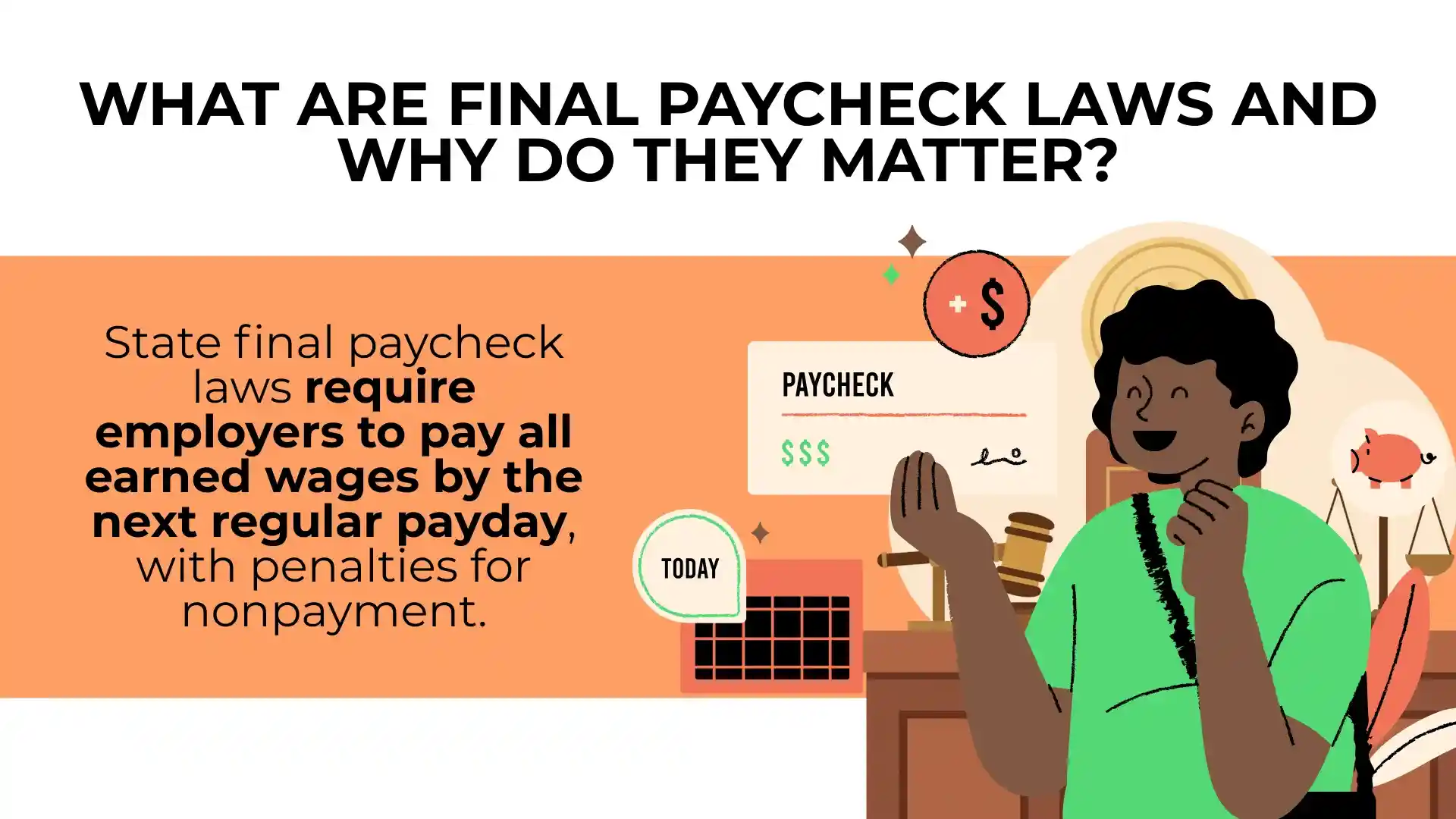
What Are Final Paycheck Laws and Why Do They Matter?
Final paycheck laws are state statutes that require employers to pay departing employees all wages owed within a specific timeframe. These laws recognize that workers depend on their earnings and shouldn’t have to chase down money they’ve already earned.
The stakes are significant. According to the Economic Policy Institute (2017), only 17% of wage theft victims who win their cases actually receive payment. This collection gap makes understanding the law—and the enhanced damages available—essential for workers seeking to recover final wages.
What counts as “wages” in my final paycheck?
Both Pennsylvania and New Jersey define “wages” broadly. Under Pennsylvania’s Wage Payment and Collection Law (43 Pa. Stat. §§ 260.1–260.13) and New Jersey’s Wage Payment Law (N.J. Stat. Ann. § 34:11-4.1 et seq.), your final paycheck must include all compensation your employer owes you.
This typically includes:
- Regular hourly or salary wages for all time worked
- Earned commissions that have become calculable and due
- Accrued but unused vacation or PTO (if company policy or your employment agreement requires payout)
- Bonuses that have been earned under the terms of your agreement
- Expense reimbursements owed under company policy
- Any other compensation promised in your employment contract or handbook
The key principle is that wages are defined by agreement—whether written employment contracts, company policies, or established practices. In Sendi v. NCR Comten, Inc., 619 F. Supp. 1577 (E.D. Pa. 1985), the court held that the Pennsylvania WPCL applies only to wages that are contractually due, meaning there must be an agreement establishing the employer’s obligation to pay.
Why do states have different deadlines?
Employment law in the United States is primarily governed at the state level. Each state has enacted its own wage payment statute with different deadlines, definitions, and penalties. Some states require immediate payment upon termination; others allow until the next regular payday.
Pennsylvania and New Jersey both follow the “next regular payday” standard, but New Jersey’s 2019 Wage Theft Act added significantly enhanced penalties that make it one of the strongest wage theft enforcement frameworks in the nation.
Does federal law require a final paycheck deadline?
No. The federal Fair Labor Standards Act (29 U.S.C. § 206 et seq.) establishes minimum wage and overtime requirements but does not mandate when final wages must be paid. This means state law controls final paycheck timing entirely.
However, if your final paycheck fails to include all minimum wages or overtime you earned, federal law provides an additional avenue for recovery with its own penalties.
When Must Pennsylvania Employers Pay Final Wages?
Pennsylvania’s Wage Payment and Collection Law establishes clear deadlines for final wage payment. Employers who miss these deadlines face significant penalties.
What is the deadline for final pay in Pennsylvania?
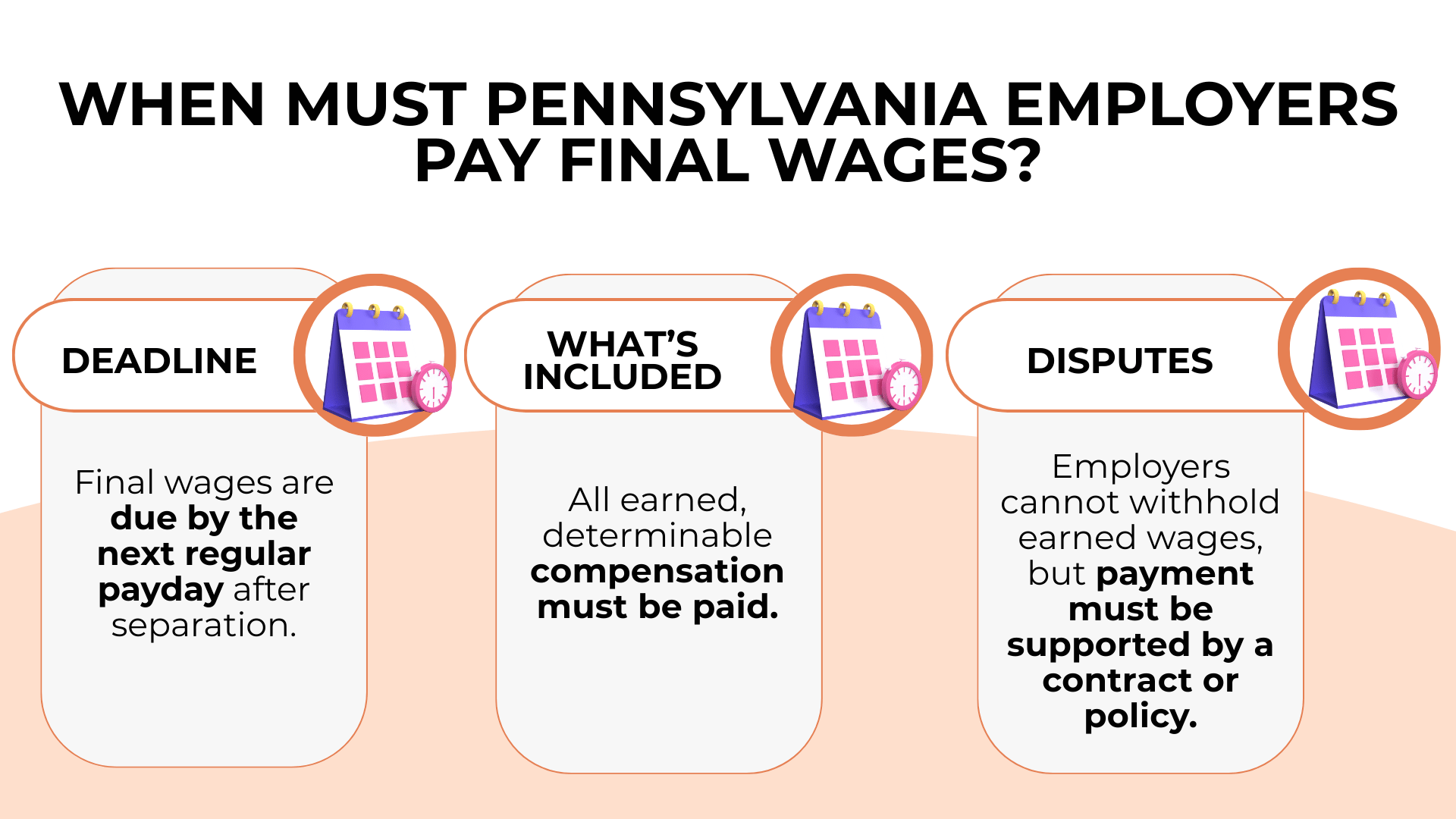
Under 43 Pa. Stat. § 260.3, employers must pay all wages due no later than the next regular payday following separation from employment. If your employer pays weekly and you leave on a Tuesday, your final wages must be paid on the next regular Friday payday. If your employer pays biweekly, you may wait up to two weeks.
The WPCL covers all forms of compensation owed under your employment relationship:
- Wages and salaries for hours worked
- Earned commissions that are determinable
- Bonuses earned under your employment terms
- Fringe benefits owed per company policy
- Severance pay if contractually required
In Thomas v. CRJ Corp., 2011 Pa. Dist. & Cnty. Dec. LEXIS 6066 (Lancaster Cty. Comm. Pl. 2011), the court confirmed that commissions become wages under the WPCL when they are earned and determinable, even if the employment relationship has ended.
Does it matter if I quit or was fired?
No. Pennsylvania law applies the same deadline regardless of whether you resigned voluntarily, were laid off, or were terminated for cause. The circumstances of your departure do not affect your right to timely final wages.
Some employers mistakenly believe they can withhold pay from employees who quit without notice or who were fired for misconduct. This is incorrect under Pennsylvania law.
What if my employer claims they don’t owe me anything?
Employers sometimes dispute that wages are owed—particularly with commissions, bonuses, or accrued vacation. Under Sendi v. NCR Comten, the WPCL requires that a contractual basis exists for the wages claimed.
This means you should gather evidence of any written or verbal agreements, company policies, or established practices that create an obligation to pay. Your employee handbook, offer letter, commission plan, or even consistent past payments can establish what your employer owes.
In Braun v. Wal-Mart Stores, Inc., 24 A.3d 875 (Pa. Super. Ct. 2011), the court held that an employer’s uniform policy of not paying employees for rest breaks stated a cognizable wage theft claim under the WPCL. This shows that employer policies themselves can create enforceable wage obligations.
When Must New Jersey Employers Pay Final Wages?
New Jersey provides some of the strongest final paycheck protections in the country, particularly since the 2019 Wage Theft Act dramatically enhanced penalties and extended the time workers have to file claims.
What is New Jersey’s final paycheck deadline?
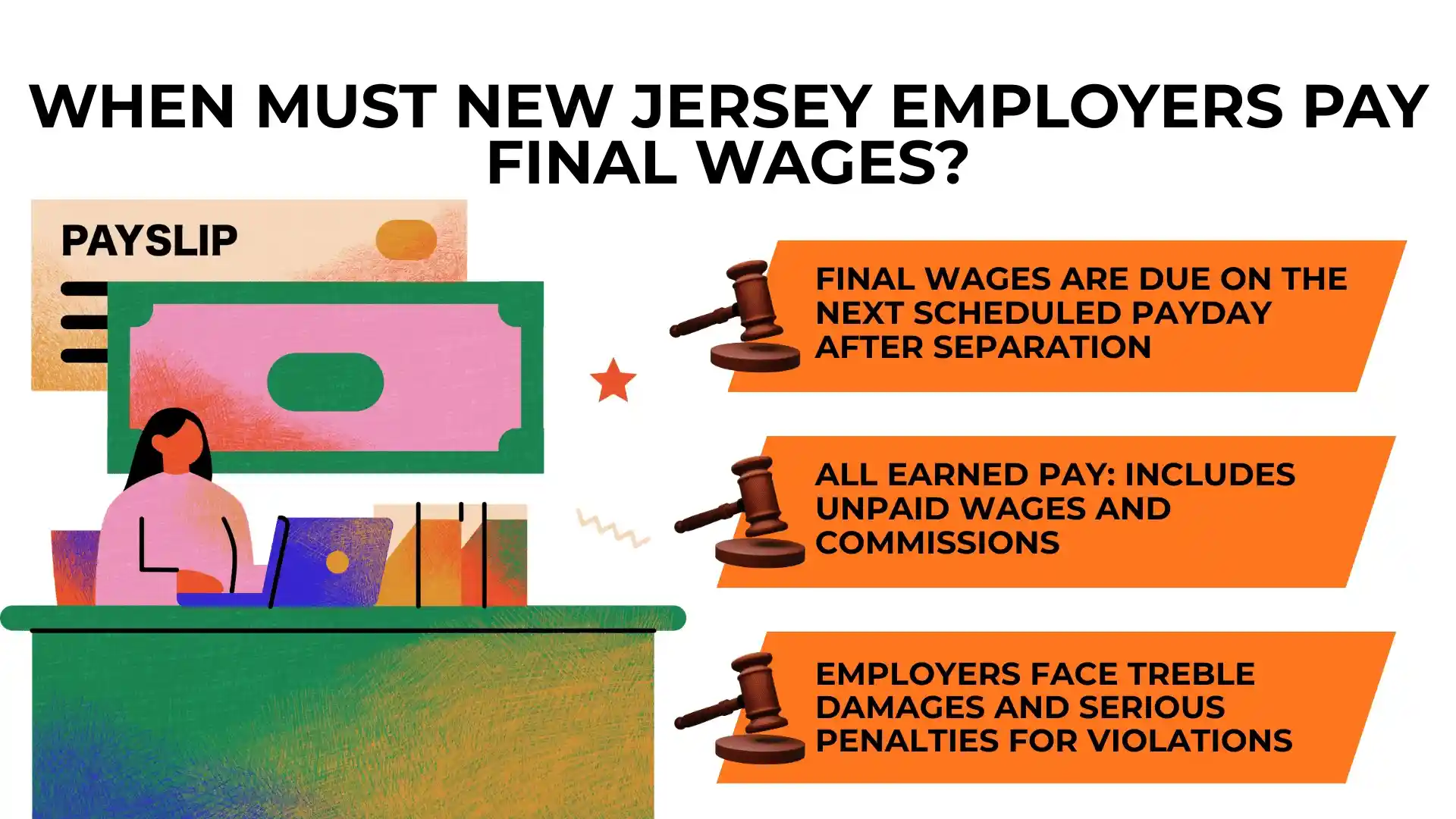
Under the New Jersey Wage Payment Law (N.J. Stat. Ann. § 34:11-4.1 et seq.), employers must pay final wages by the next regular payday after separation. This mirrors Pennsylvania’s standard, but New Jersey’s enforcement mechanisms and penalties are substantially stronger.
The New Jersey Department of Labor (2024) has aggressively enforced wage payment requirements, collecting $84 million in cumulative wage assessments and penalties since 2018. In 2024 alone, the state assessed $19 million in wage violations.
What makes New Jersey’s law stronger than other states?
The 2019 Wage Theft Act transformed New Jersey into a national leader in wage theft enforcement through several key provisions:
Treble damages: Employees can recover up to three times the amount of unpaid wages (the original amount plus 200% in liquidated damages) under N.J. Stat. Ann. § 34:11-4.10.
Six-year statute of limitations: Workers have six years to file claims under N.J. Stat. Ann. § 34:11-56a25.1—double the federal FLSA period and twice Pennsylvania’s limit.
Criminal penalties: Willful wage theft can be prosecuted as a disorderly persons offense or even a felony depending on the amount stolen.
Stop-work orders: The state can order businesses to cease operations until they comply with wage laws. According to NJ DOL (2025), 210 stop-work orders have been issued since 2019.
Can I recover unpaid commissions as part of my final pay?
Yes. In Winslow v. Corporate Express, Inc., 364 N.J. Super. 128 (App. Div. 2003), the court held that an employer’s failure to pay earned commissions upon termination states a viable wage payment claim even without a written agreement, where an oral agreement or established course of dealing exists.
This is significant because many commission arrangements are informal. If your employer routinely paid you commissions based on verbal promises or consistent practice, that pattern can establish your right to final commission payment.
What Penalties Do Employers Face for Late Final Paychecks?
The penalties for final paycheck violations create significant leverage for workers seeking to recover unpaid wages. Both Pennsylvania and New Jersey impose enhanced damages that can substantially increase your recovery.
What are liquidated damages under Pennsylvania law?
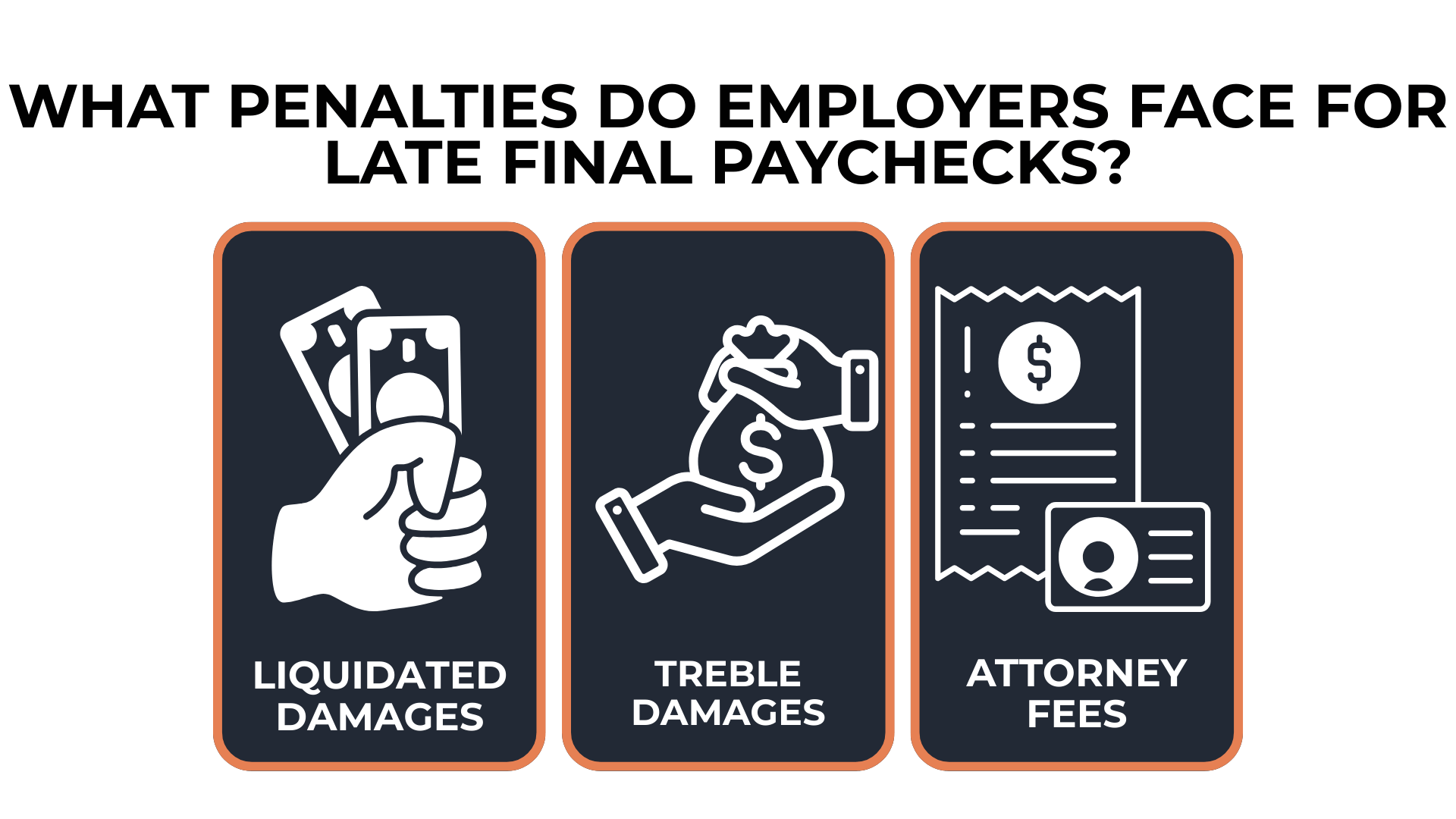
Under 43 Pa. Stat. § 260.10, when an employer fails to pay wages and those wages remain unpaid for more than 30 days past the regular payday, employees can recover the full amount of wages due plus 25% liquidated damages (or $500, whichever is greater), plus reasonable attorney fees and costs.
This means if your employer owes you $5,000 in final wages, you could recover $6,250 plus your legal fees if they don’t pay within 30 days of the deadline.
How do New Jersey’s treble damages work?
New Jersey’s penalty structure is more aggressive. Under the 2019 Wage Theft Act, employees can recover three times the amount of unpaid wages—the original amount plus 200% in liquidated damages.
Using the same $5,000 example, a New Jersey worker could recover $15,000 plus attorney fees. This treble damages provision makes New Jersey one of the most favorable jurisdictions for wage theft claims nationally.
According to the U.S. Department of Labor Wage and Hour Division (2025), federal enforcement recovered $259.3 million in back wages nationally in FY 2025, with 176,957 workers receiving back wage awards. State penalties like New Jersey’s treble damages incentivize compliance beyond what federal enforcement alone can achieve.
Can I recover attorney fees if I win?
Yes. Both Pennsylvania and New Jersey provide mandatory attorney fee shifting for prevailing employees. This means your employer—not you—pays your legal fees if you successfully recover unpaid wages.
Here’s how Pennsylvania and New Jersey penalties compare:
- Pennsylvania: Unpaid wages + 25% liquidated damages (or $500 minimum) + attorney fees + costs
- New Jersey: Unpaid wages + 200% liquidated damages (treble total) + attorney fees + costs
- Pennsylvania SOL: 3 years
- New Jersey SOL: 6 years
- Criminal exposure (NJ): Yes, willful violations can be prosecuted
Attorney fee shifting is critical because it makes even smaller wage claims economically viable to pursue. An employer who withholds $2,000 knows they could face $6,000 in damages (NJ) plus thousands more in attorney fees—creating strong incentive to pay.
How Long Do I Have to File a Final Paycheck Claim?
Every wage claim has a deadline. Missing the statute of limitations means losing your right to recover, regardless of how valid your claim may be.
What is the statute of limitations in Pennsylvania?
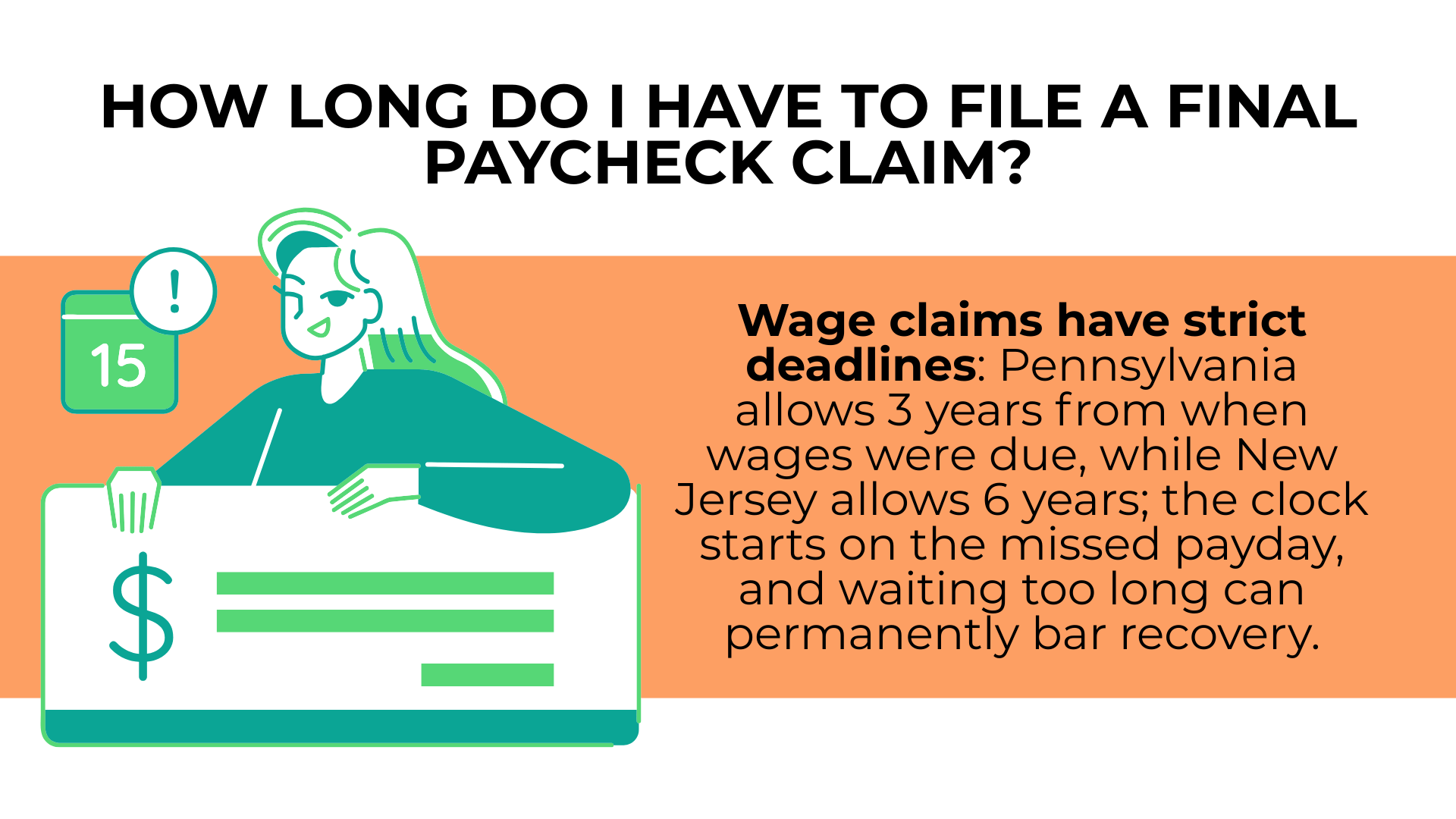
Under 43 P.S. Labor § 260/8, Pennsylvania workers have three years from the date wages were due to file a claim under the WPCL. For final paycheck claims, the clock starts on the regular payday when your final wages should have been paid.
What is the statute of limitations in New Jersey?
New Jersey’s 2019 Wage Theft Act extended the limitations period to six years under N.J. Stat. Ann. § 34:11-56a25.1. This is among the longest in the nation and gives workers substantially more time to pursue claims.
When does the clock start running on my claim?
The limitations period begins when the violation occurs—meaning the payday when your employer should have paid but didn’t. Each pay period where wages remain unpaid could constitute a separate violation with its own clock.
Acting quickly matters. The Economic Policy Institute (2017) found that only 4% of total estimated annual wage theft is recovered through enforcement. Workers who document their claims promptly and pursue them within the limitations period are far more likely to recover.
What Should I Do If My Employer Won’t Pay My Final Wages?
If your former employer hasn’t paid your final wages by the deadline, you have several options. Taking systematic steps strengthens any eventual claim.
What evidence should I gather?
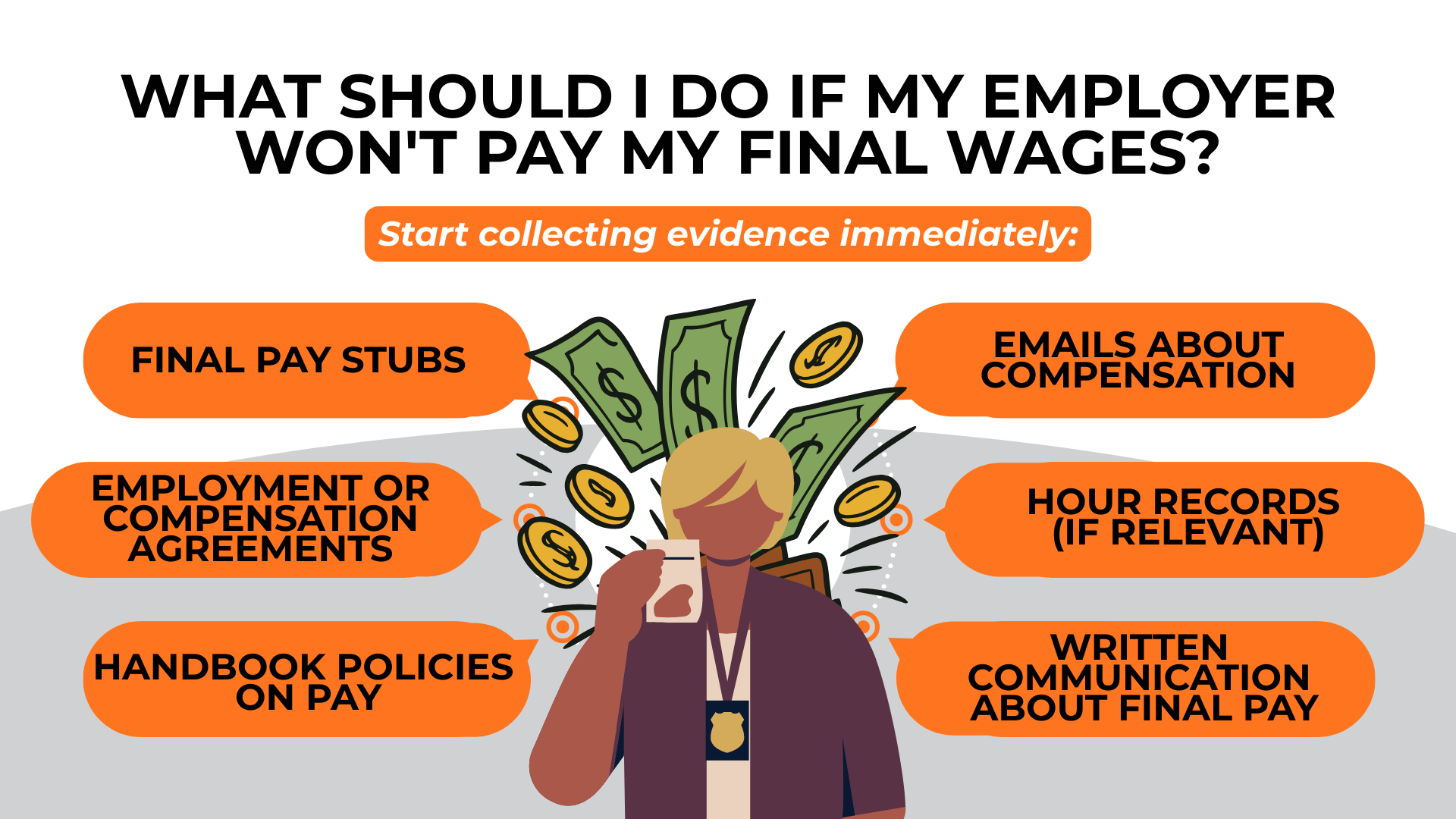
Documentation is essential for any wage claim. Start collecting evidence immediately:
- Pay stubs from your final weeks of employment
- Your employment contract, offer letter, or any written compensation agreements
- Company handbook or policy documents addressing vacation payout, commissions, or bonuses
- Emails or written communications about your compensation
- Records of hours worked (if relevant to unpaid wages)
- Any written correspondence with your employer about your final pay
Keep copies of everything. If your employer disputes what you’re owed, this evidence establishes the contractual basis for your claim.
Should I file a complaint with the state or hire a lawyer?
You have two primary paths: filing an administrative complaint with your state’s labor department or hiring an employment attorney to pursue a civil lawsuit.
State agency complaints are free to file and can result in the agency investigating and ordering payment. In New Jersey, the Department of Labor has been particularly aggressive—the NJ DOL (2025) recovered $37 million for nearly 8,500 workers specifically for wage violations in 2024-2025.
Civil lawsuits allow you to pursue the full enhanced damages (25% in PA, treble in NJ) plus attorney fees. Because fee shifting makes your employer pay legal costs if you win, many attorneys take these cases on contingency with no upfront cost to you.
Consider consulting an attorney even before deciding which path to take. Many offer free consultations to evaluate your situation.
What if my employer retaliates against me for demanding payment?
Retaliation is illegal under both federal and state law. Under 29 U.S.C. § 215(a)(3), the FLSA prohibits employers from retaliating against employees who file complaints or assert wage rights. In Kasten v. Saint-Gobain Performance Plastics Corp., 563 U.S. 1 (2011), the Supreme Court held that even oral complaints are protected—you don’t need to file formal paperwork.
New Jersey’s Wage Theft Act provides even stronger protection. Under N.J. Stat. Ann. § 34:11-4.10(c), if an employer takes adverse action within 90 days of protected activity, retaliation is presumed. The employer must prove a legitimate reason by clear and convincing evidence—a high bar.
Despite these protections, the National Employment Law Project (2019) found that 43% of workers who complained about wages experienced illegal retaliation, including firing, suspension, reduced hours, or threats. The same research shows that only 22% of workers report labor violations to any authority—fear of retaliation is a major barrier.
Knowing that retaliation protections exist and carry significant penalties can help you feel more confident asserting your rights.
Frequently Asked Questions About Final Paycheck Laws
Can my employer withhold my final paycheck if I didn’t return company property?
Generally, no. Pennsylvania and New Jersey law require employers to pay wages owed regardless of property disputes. Your employer may have a separate claim against you for unreturned property, but they cannot use your earned wages as leverage. Withholding final pay for this reason typically violates wage payment laws.
Does my employer have to pay out my unused vacation time in my final check?
It depends on your employer’s policy or your employment agreement. Neither Pennsylvania nor New Jersey requires vacation payout by statute, but if your employer’s handbook promises payout or has consistently paid out vacation in the past, that policy creates an enforceable obligation under the WPCL and NJ Wage Payment Law.
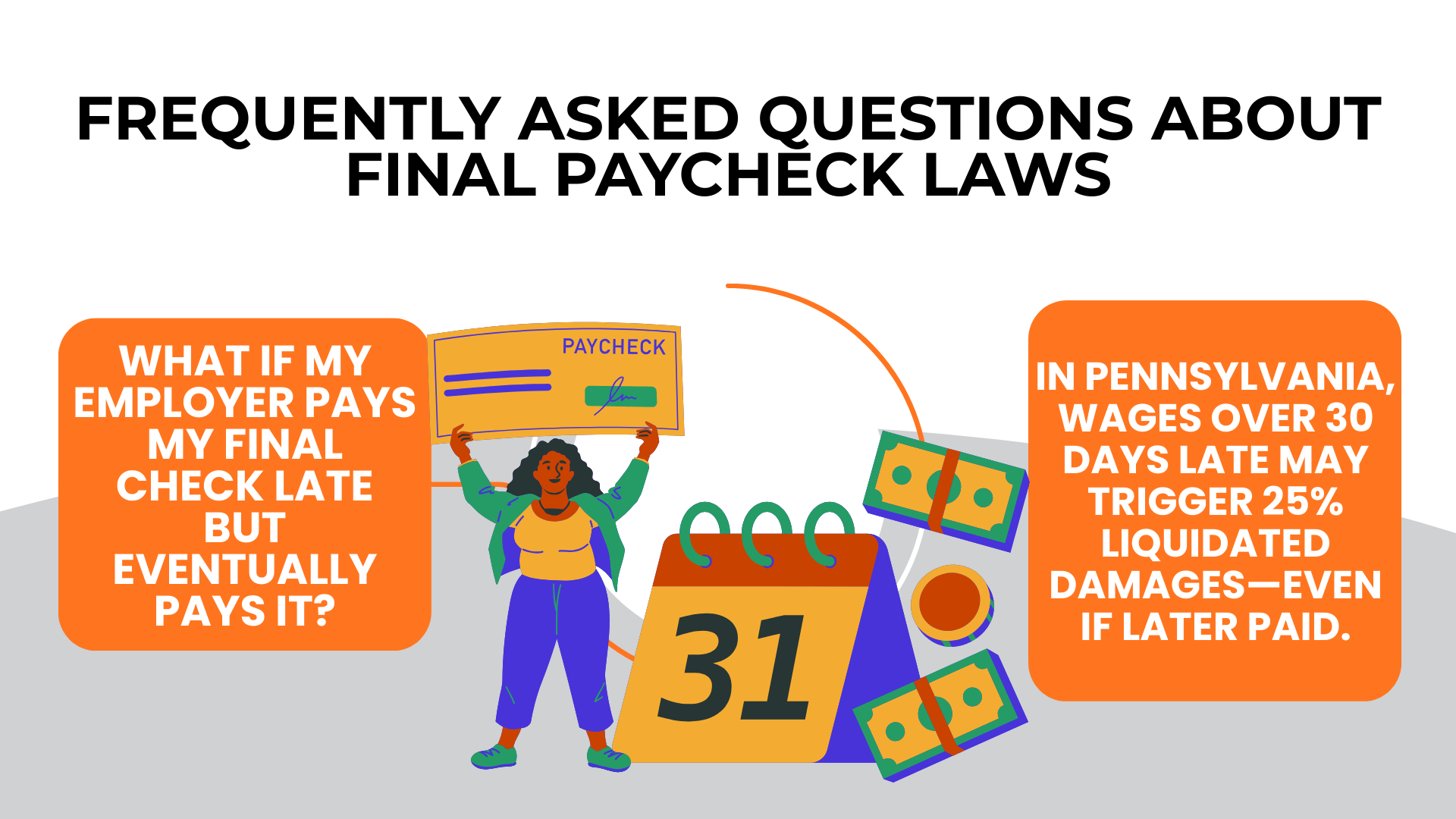
What if my employer pays my final check late but eventually pays it?
You may still be entitled to liquidated damages. In Pennsylvania, the 25% liquidated damages apply when wages remain unpaid more than 30 days past the due date. Even if your employer eventually pays, the late payment itself may entitle you to additional damages. Consult an attorney to evaluate whether pursuing damages makes sense in your situation.
Can I file a claim for unpaid commissions in my final paycheck?
Yes. Both Pennsylvania and New Jersey courts have held that earned, determinable commissions are “wages” under state law. Under Winslow v. Corporate Express in New Jersey and Thomas v. CRJ Corp. in Pennsylvania, commissions you earned before leaving must be included in your final pay, even if they weren’t yet paid out on your last day.
Do final paycheck laws apply to independent contractors?
No. The WPCL and NJ Wage Payment Law apply only to employees, not independent contractors. However, if you were misclassified as an independent contractor when you should have been treated as an employee, you may have claims both for misclassification and for unpaid final wages. New Jersey uses the ABC test, which places the burden on employers to prove contractor status.
Protect Your Right to Final Wages
Final paycheck laws exist because workers shouldn’t have to beg for money they’ve already earned. Pennsylvania requires payment by the next regular payday, with 25% liquidated damages for violations. New Jersey goes further with treble damages and a six-year statute of limitations—making it one of the strongest states for wage recovery.
If your employer has missed the deadline for your final pay, you have legal options. The enhanced damages and attorney fee provisions in both states mean that even smaller claims can be worth pursuing—and pursuing them sends a message that wage theft has consequences.
If you have questions about recovering your final paycheck, contact The Lacy Employment Law Firm to discuss your situation.