
If your employer rounds your clock-in and clock-out times, you may be losing money every single shift without realizing it. Time clock rounding is a common payroll practice, but when it consistently shaves minutes in the employer’s favor, it crosses the line into wage theft. According to the U.S. Department of Labor Wage and Hour Division (2025), federal enforcement actions recovered $259.3 million in back wages in fiscal year 2025 alone—the highest total in five years. Much of that recovery came from employers who failed to pay workers for all time actually worked, including time lost to improper rounding practices.
This article explains how time clock rounding works, when it becomes illegal, and what New Jersey and Pennsylvania workers can do to recover lost wages.
What Is Time Clock Rounding and Why Do Employers Use It?
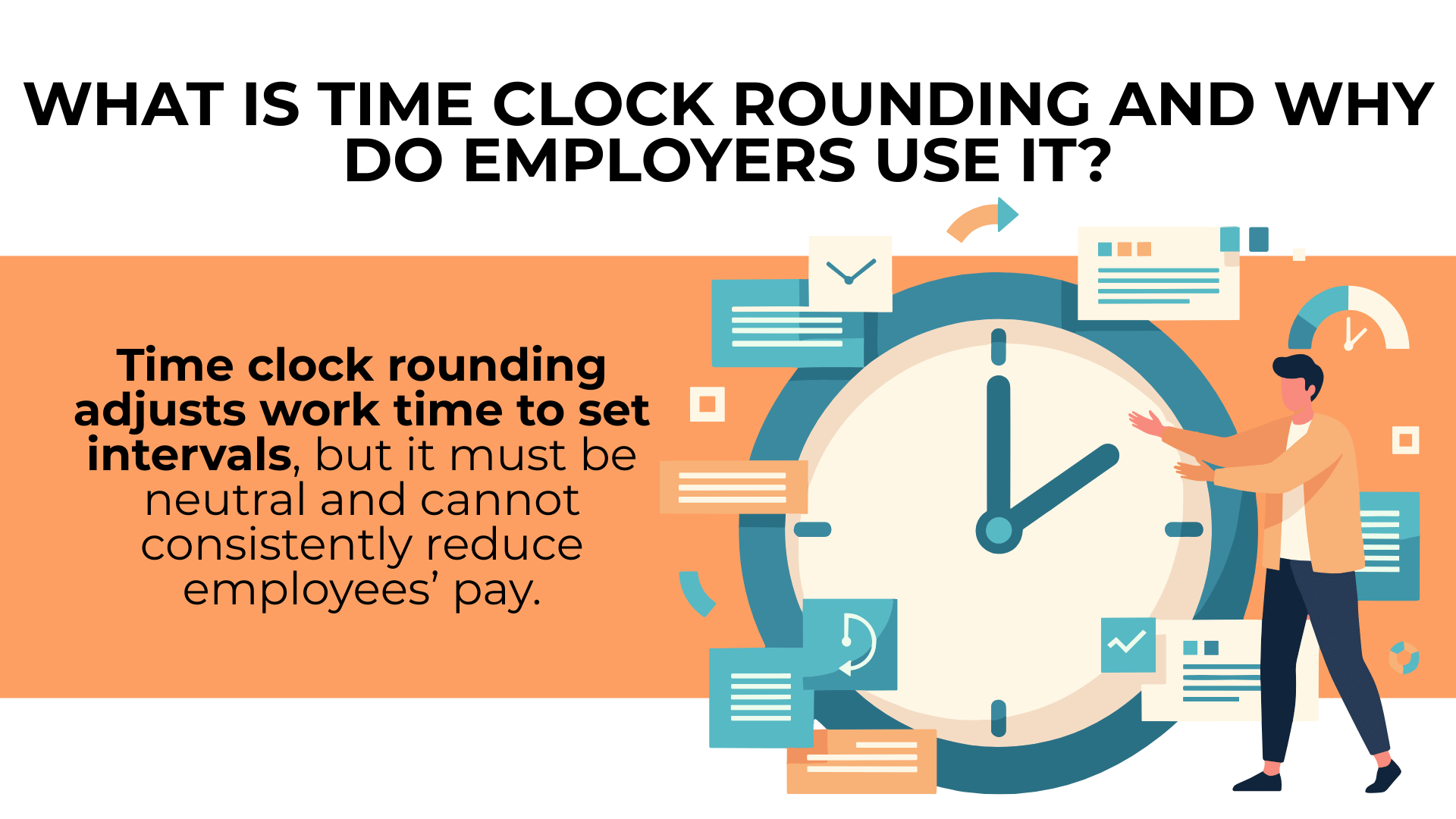
Time clock rounding is an employer policy that adjusts your recorded work time to the nearest set interval—typically 5, 6, or 15 minutes. Instead of recording that you clocked in at 8:07 a.m., the system might round your start time to 8:15 a.m. The policy applies the same logic to clock-out times, rounding your departure either up or down based on the interval.
How does time clock rounding actually work?
Under a 15-minute rounding policy, any clock-in time between 8:01 and 8:07 rounds back to 8:00, while times between 8:08 and 8:14 round forward to 8:15. The same applies to clock-out times. If you leave at 5:07 p.m., your recorded time becomes 5:00 p.m. If you leave at 5:08 p.m., it rounds to 5:15 p.m.
Why do employers round to the nearest quarter hour?
Employers claim rounding simplifies payroll calculations and reduces the administrative burden of tracking exact minutes. Before digital timekeeping, this had some practical justification. Today, most payroll systems can track time to the minute, making the simplification argument harder to defend—especially when the policy results in employees consistently losing time.
Does rounding always hurt employees?
Not necessarily. A truly neutral rounding policy should average out over time, sometimes benefiting the employee and sometimes benefiting the employer. The problem arises when the policy is designed or applied in ways that systematically favor the employer. When rounding always seems to cost you time rather than give you time, something is wrong.
When Does Time Clock Rounding Become Illegal?
Time clock rounding crosses from permissible payroll practice into illegal wage theft when it stops being neutral. Under federal law, employers must pay employees for all time during which they are “suffered or permitted to work.” According to 29 C.F.R. § 785.11, work not requested but suffered or permitted is still compensable work time. When a rounding policy systematically reduces that compensable time, the employer violates this fundamental requirement.
What makes a rounding policy “neutral”?
A neutral rounding policy must, over time, roughly balance out—meaning employees gain as much time as they lose. The policy fails this test when it is structured or implemented in ways that consistently benefit the employer. For example, if employees are required to be at their workstations and ready to work at the start of their scheduled shift, but the rounding policy doesn’t credit them until the next interval, the policy is not neutral.
What does “suffered or permitted to work” mean for my paycheck?
This legal standard means your employer cannot avoid paying you simply because they didn’t explicitly ask you to work. If you arrived at 7:53 a.m. and started working, but the time clock rounded your start to 8:00 a.m., you worked those 7 minutes. Your employer “suffered or permitted” that work—and owes you for it. According to the National Employment Law Project (2009), 70% of workers who came in early or stayed late did not receive pay for work outside their regular shift.
What are warning signs that rounding is costing me money?
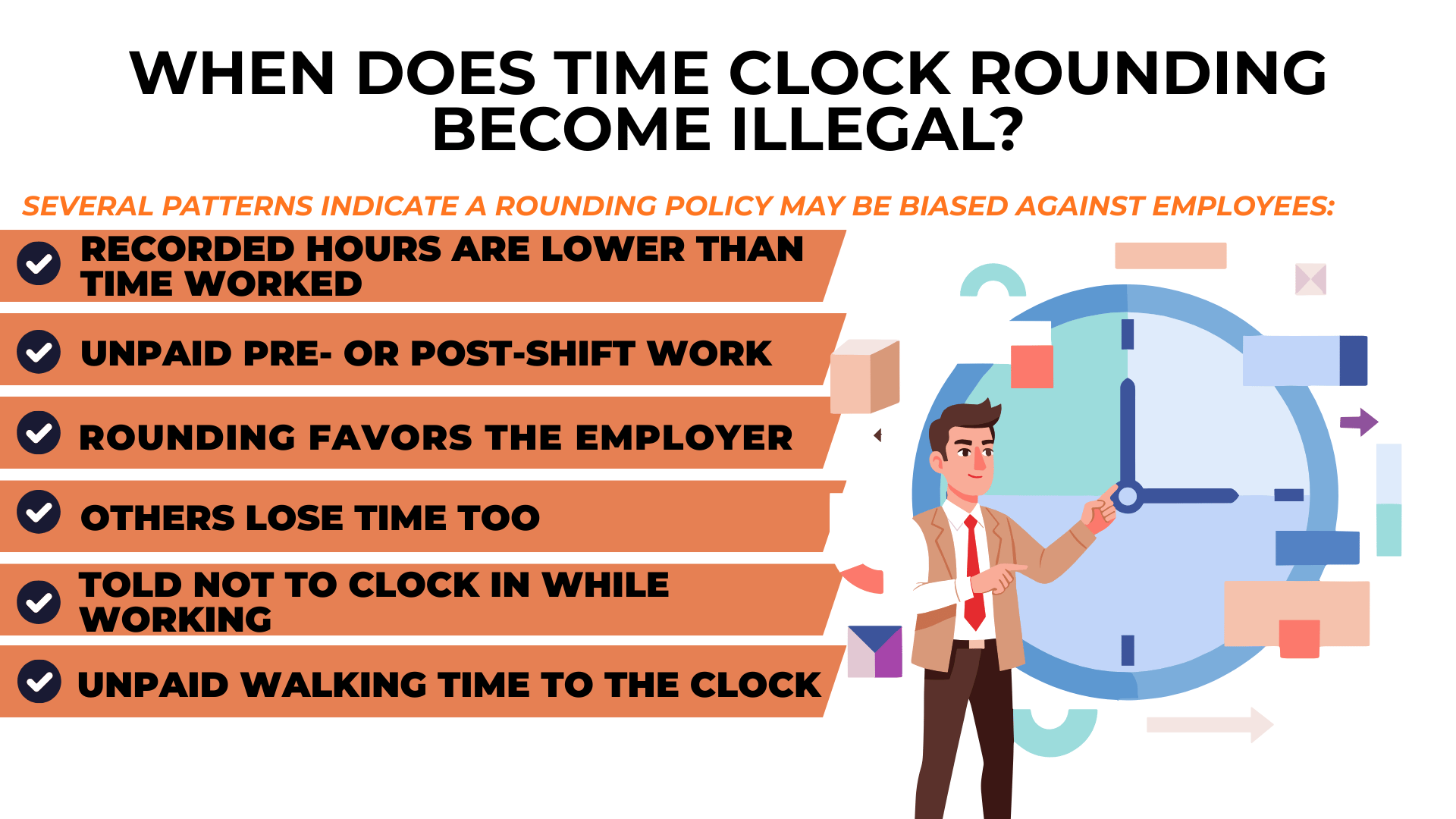
Several patterns indicate a rounding policy may be biased against employees:
- Your recorded hours are consistently less than the time you actually spent at work
- You are required to arrive before your shift starts (for security checks, equipment setup, or meetings) but your pay doesn’t reflect that time
- The rounding policy rounds down at clock-in but does not proportionally round up at clock-out
- You notice that coworkers who arrive early or stay late experience the same pattern of lost time
- Your employer discourages clocking in until exactly the scheduled start time, even when you’re already working
- The time clock is located far from your actual work area, and walking time isn’t compensated
If these patterns look familiar, you may have a claim worth pursuing.
How Much Money Can Time Rounding Cost You?
The amounts lost to time clock rounding may seem small on a daily basis, but they accumulate into significant wage theft over time. Losing just 7 minutes per shift might not seem like much—until you calculate what that means over weeks, months, and years.
How do small amounts of lost time add up over a year?
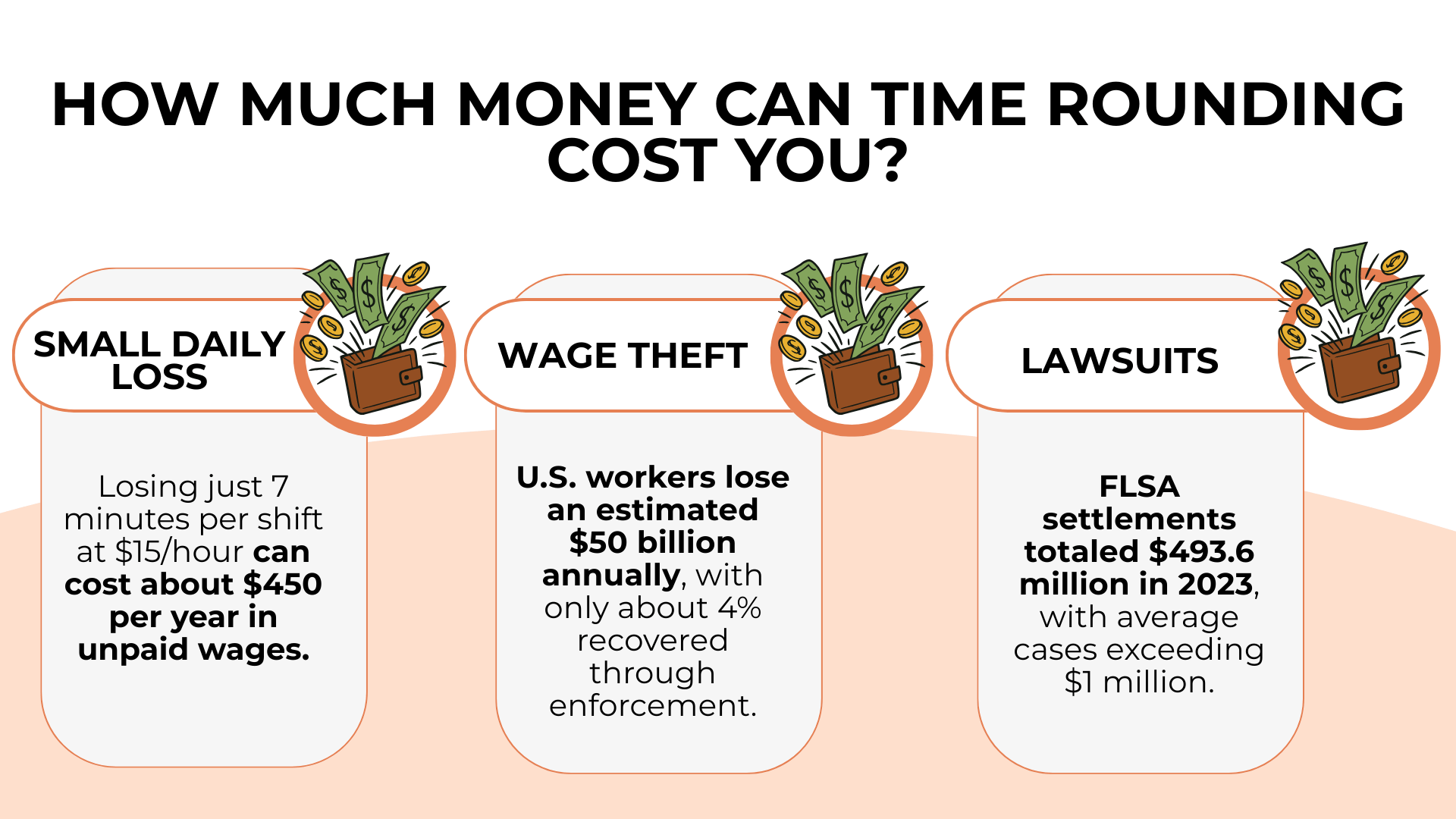
Consider an employee earning $15 per hour who loses an average of 7 minutes per shift due to rounding. Over a five-day work week, that’s 35 minutes of unpaid work—worth about $8.75. Over a year, that same employee loses more than 30 hours of work time, worth approximately $450 in stolen wages. For higher-paid workers or those losing more time per shift, the annual impact grows substantially. Multiply this across every employee subject to the same policy, and the employer saves thousands of dollars by not paying for time actually worked.
How common are off-the-clock violations like this?
Extremely common—and dramatically underenforced. According to the Economic Policy Institute (2014), American workers lose an estimated $50 billion annually to all forms of wage theft. This figure exceeds the combined value of all robberies, car thefts, and burglaries in the country. Yet according to EPI’s 2017 analysis, only about 4% of stolen wages are recovered through enforcement actions. The gap between what employers take and what workers recover is enormous.
What have other workers recovered in wage theft cases?
Workers who pursue claims can recover substantial amounts. According to the Seyfarth Shaw 2023 FLSA Litigation Metrics & Trends Report, FLSA collective action settlements totaled $493.6 million across 423 cases in 2023, with an average settlement of approximately $1.17 million per case. The largest single settlement that year reached $65.5 million. These figures demonstrate that wage theft claims—including those involving systematic timekeeping violations—can result in meaningful recovery for affected workers.
Which Industries Have the Worst Time Rounding Problems?
Certain industries have disproportionately high rates of wage and hour violations, including problems with timekeeping and off-the-clock work. Workers in these fields should pay especially close attention to how their employers track and round their time.
Why are restaurants and food service so problematic?
The food service industry has one of the worst wage violation track records of any sector. According to the U.S. Department of Labor (2021), 85% of restaurant investigations resulted in violations. The DOL recovered $34.7 million in back wages from restaurant employers that fiscal year alone. In FY 2025, according to DOL data, 4,088 food service violations were resolved with over $42 million in back wages recovered. Time rounding issues are common in this industry because of the prevalence of pre-shift prep work, post-shift cleanup, and irregular scheduling.
What about healthcare workers and shift-based jobs?
Healthcare workers face similar vulnerabilities. According to the U.S. Department of Labor (2025), 2,370 healthcare violations were resolved in FY 2025 with over $53 million in back wages recovered. Shift-based work in hospitals, nursing homes, and care facilities often involves handoff meetings, charting, and equipment preparation that can fall outside recorded work time when rounding policies are applied improperly.
Are some jobs more vulnerable than others?
Yes. Industries and positions with the highest risk for time rounding violations include:
- Restaurants and food service: Pre-shift prep, post-shift cleanup, mandatory meetings before clocking in
- Healthcare and nursing facilities: Shift handoffs, charting requirements, patient care that extends past scheduled hours
- Retail: Opening and closing procedures, inventory counts, security screenings
- Manufacturing and warehouses: Donning and doffing protective equipment, walking to production areas, mandatory security checks
- Call centers: System login requirements, mandatory training sessions, queue time before calls begin
- Hospitality and hotels: Room preparation, guest service that runs past shift end
Workers in these industries should carefully compare their actual hours worked against their pay records.

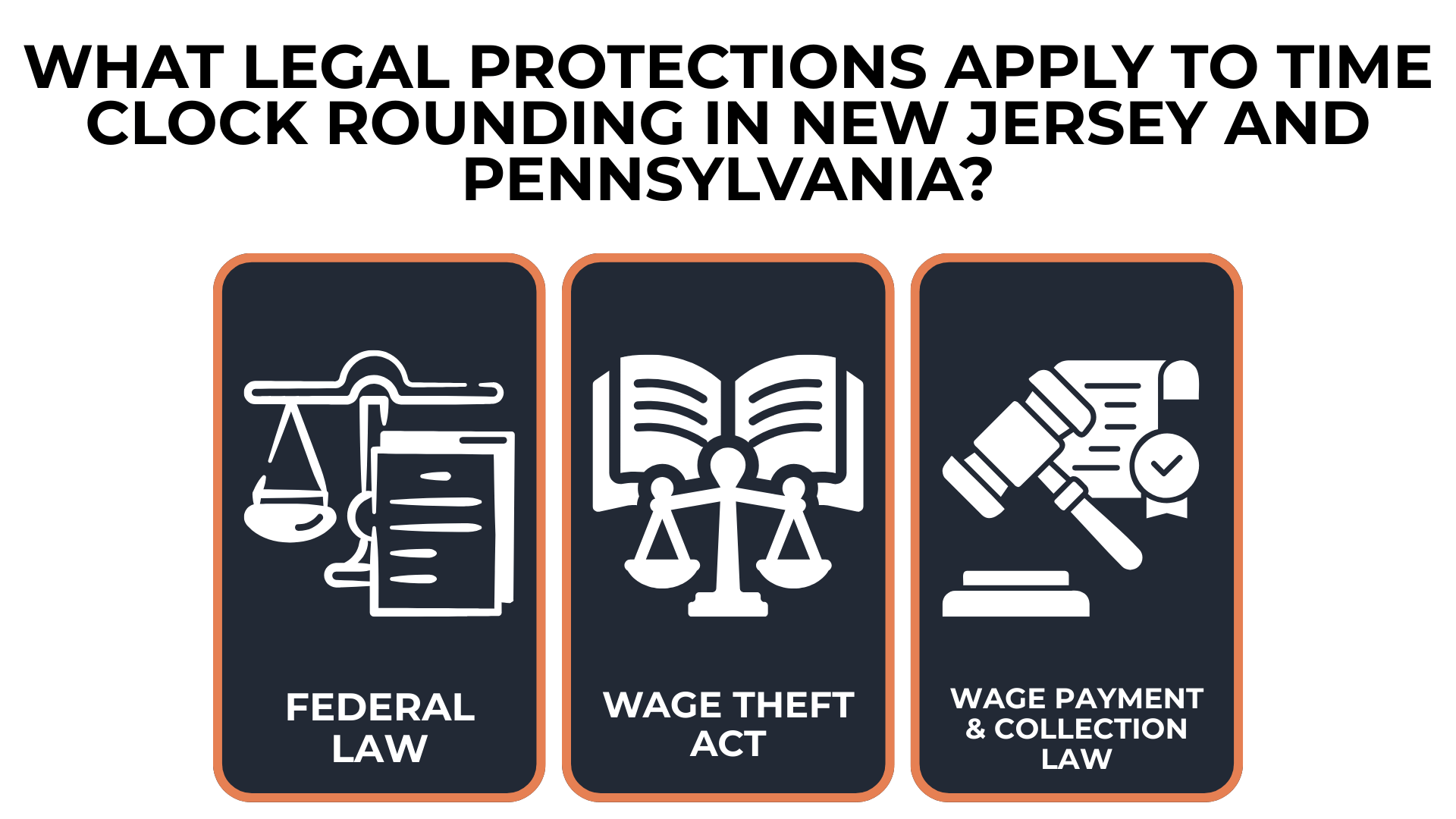
What Legal Protections Apply to Time Clock Rounding in New Jersey and Pennsylvania?
Federal law establishes baseline protections for all workers, but New Jersey and Pennsylvania have their own wage laws that may provide stronger remedies. Understanding which laws apply—and what you can recover under each—is essential for evaluating your options.
What does federal law require employers to pay?
Under the Fair Labor Standards Act, covered employers must pay employees at least the federal minimum wage ($7.25/hour) for all hours worked and overtime at 1.5 times the regular rate for hours exceeding 40 in a workweek. 29 U.S.C. § 206(a) and § 207(a)(1) establish these requirements. When a time rounding policy causes employees to work hours that aren’t compensated, the employer violates these provisions.
Employees who successfully prove FLSA violations can recover unpaid wages plus an equal amount in liquidated damages (effectively doubling the recovery), along with attorney fees and costs. 29 U.S.C. § 216(b).
How does New Jersey’s Wage Theft Act protect workers?
New Jersey enacted one of the nation’s strongest wage theft laws in 2019. According to the New Jersey Department of Labor (2024), the state has collected $84 million in cumulative wage assessments and penalties since 2018. The NJ Wage Theft Act provides:
- Treble damages: Employees can recover up to three times the unpaid wages owed (the original wages plus 200% in liquidated damages). N.J. Stat. Ann. § 34:11-4.10.
- Six-year statute of limitations: Workers have six years to file claims, compared to two or three years under federal law. N.J. Stat. Ann. § 34:11-56a25.1.
- Mandatory attorney fee shifting: Prevailing employees recover their attorney fees from the employer.
- Criminal penalties: Wage theft violations can be classified as potential felonies.
What can Pennsylvania workers recover?
Pennsylvania’s Wage Payment and Collection Law (WPCL) provides remedies for workers whose employers fail to pay all wages due. According to the Temple University Sheller Center for Social Justice (2024), an estimated $19 to $32 million in wages are stolen from Pennsylvania workers every week. Under PA law, workers can recover:
- Full unpaid wages plus 25% liquidated damages (or $500, whichever is greater) if wages remain unpaid more than 30 days past the regular payday. 43 Pa. Stat. § 260.10.
- Three-year statute of limitations for filing claims.
- Attorney fees and costs for prevailing plaintiffs.
Pennsylvania’s minimum wage remains at $7.25 per hour—unchanged since 2009—while New Jersey’s minimum wage has risen to $15.92 per hour as of January 2026. This disparity means Pennsylvania workers may have larger potential claims for minimum wage violations.
Understanding what you can recover is the first step toward getting it back.
What Should You Do If You Think Time Rounding Is Costing You Wages?
Taking action starts with documentation. The stronger your records, the stronger your potential claim. You also need to understand your protections against retaliation and the deadlines for filing.
What records should you keep?
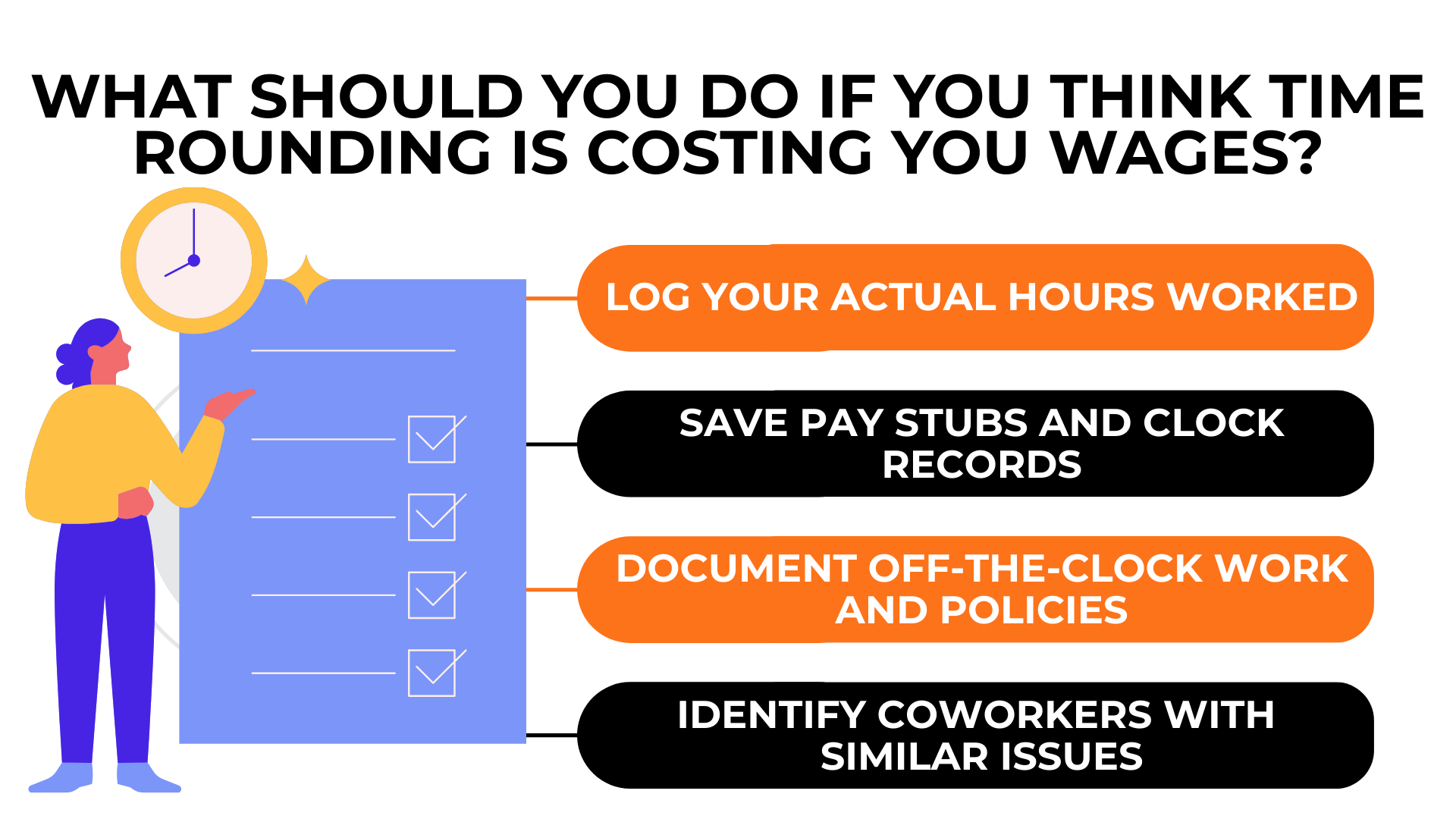
Building a solid record of your actual hours worked is critical. Start gathering evidence now:
- Keep a personal time log: Record your actual arrival and departure times daily, separate from the company time clock
- Save your pay stubs: Compare recorded hours against your personal log over multiple pay periods
- Screenshot or photograph the time clock: Document any discrepancy between when you punch and what the system records
- Note required pre-shift activities: Document any tasks you’re required to perform before your recorded shift starts (meetings, equipment checks, security screenings)
- Save any written policies: Keep copies of employee handbooks, time and attendance policies, or memos about timekeeping
- Document communications: Save emails or messages about scheduling, required arrival times, or complaints about time recording
- Identify coworkers with similar experiences: Others subject to the same policy may have the same losses
Taking these steps now protects your ability to act later.
Can your employer retaliate against you for complaining?
No—and the law provides strong protections. Under 29 U.S.C. § 215(a)(3), employers cannot discharge, threaten, or discriminate against employees who file wage complaints or participate in proceedings. This protection covers both formal complaints and informal complaints made to management.
Despite these protections, retaliation remains common. According to the National Employment Law Project (2019), 43% of workers who complained about wages experienced illegal retaliation—including firing, suspension, reduced hours, and threats. This fear of retaliation is a major reason that, according to NELP analysis, only about 22% of workers report labor violations to any authority.
New Jersey’s Wage Theft Act provides especially strong retaliation protections. Under N.J. Stat. Ann. § 34:11-4.10(c), if your employer takes adverse action within 90 days of your protected complaint, retaliation is presumed. The employer can only defeat this presumption with clear and convincing evidence of a legitimate, non-retaliatory reason.
How long do you have to file a claim?
Statutes of limitations vary by jurisdiction and affect how far back you can recover:
- Federal FLSA: Two years for non-willful violations; three years for willful violations. 29 U.S.C. § 255(a).
- New Jersey: Six years under the Wage Theft Act. N.J. Stat. Ann. § 34:11-56a25.1.
- Pennsylvania: Three years under the WPCL.
The clock runs from when each violation occurred—meaning each unpaid pay period is a separate violation with its own deadline. Waiting too long means losing the ability to recover older wages.
How Do Time Rounding Wage Claims Work?
Pursuing a wage claim for improper time clock rounding can take several forms. Understanding the process helps you know what to expect.
Can you file a claim with coworkers who have the same problem?
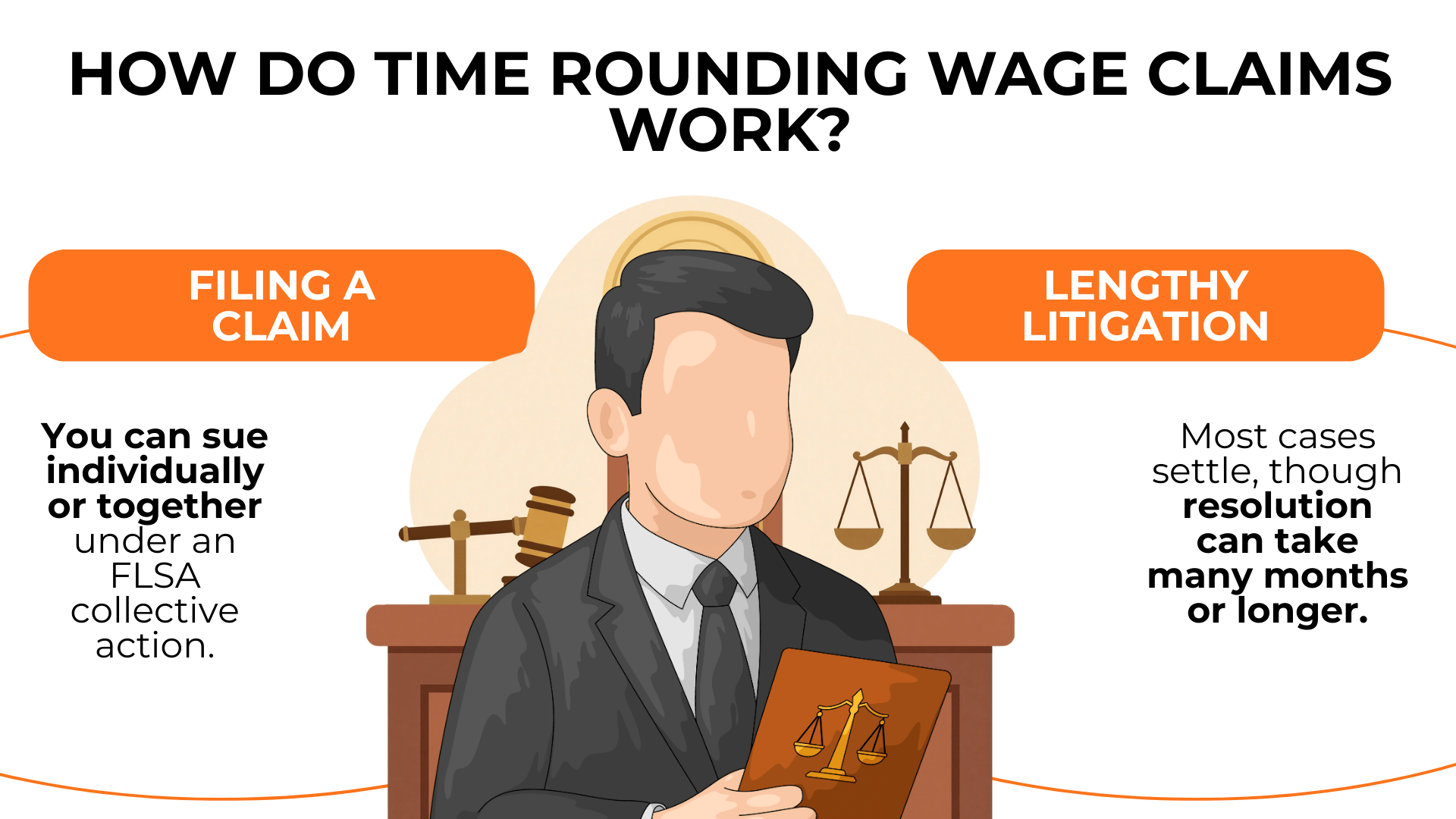
Yes. The FLSA allows employees to file collective actions—lawsuits where similarly situated workers join together. Under 29 U.S.C. § 216(b), affected employees must affirmatively opt in by filing written consent. According to the Seyfarth Shaw 2023 Report, approximately 75% of motions for conditional certification in FLSA collective actions succeeded in 2023. Courts may facilitate notice to potential plaintiffs, allowing discovery of names and addresses of similarly situated employees. Hoffman-La Roche Inc. v. Sperling, 493 U.S. 165 (1989).
Collective actions are particularly effective for time rounding claims because the same policy typically affects all employees subject to it.
How long do these cases typically take?
Wage and hour litigation takes time to resolve. According to Seyfarth Shaw’s 2023 data, the median time from filing to conditional certification ruling was 333 days. Cases that proceed further take longer—the median time to summary judgment was 793 days. However, the overwhelming majority of cases settle before trial. Only 41 of 2,909 terminated FLSA collective actions (1.4%) went to trial in 2023.
What outcomes can you expect?
Settlement is the most common resolution. In 2023, FLSA collective action settlements totaled $493.6 million across 423 cases, with settlements ranging from modest recoveries to the largest single settlement of $65.5 million. The outcome depends on factors including the size of the affected workforce, the duration of the violation, the amount of unpaid time per worker, and the strength of the evidence.
Frequently Asked Questions About Time Clock Rounding
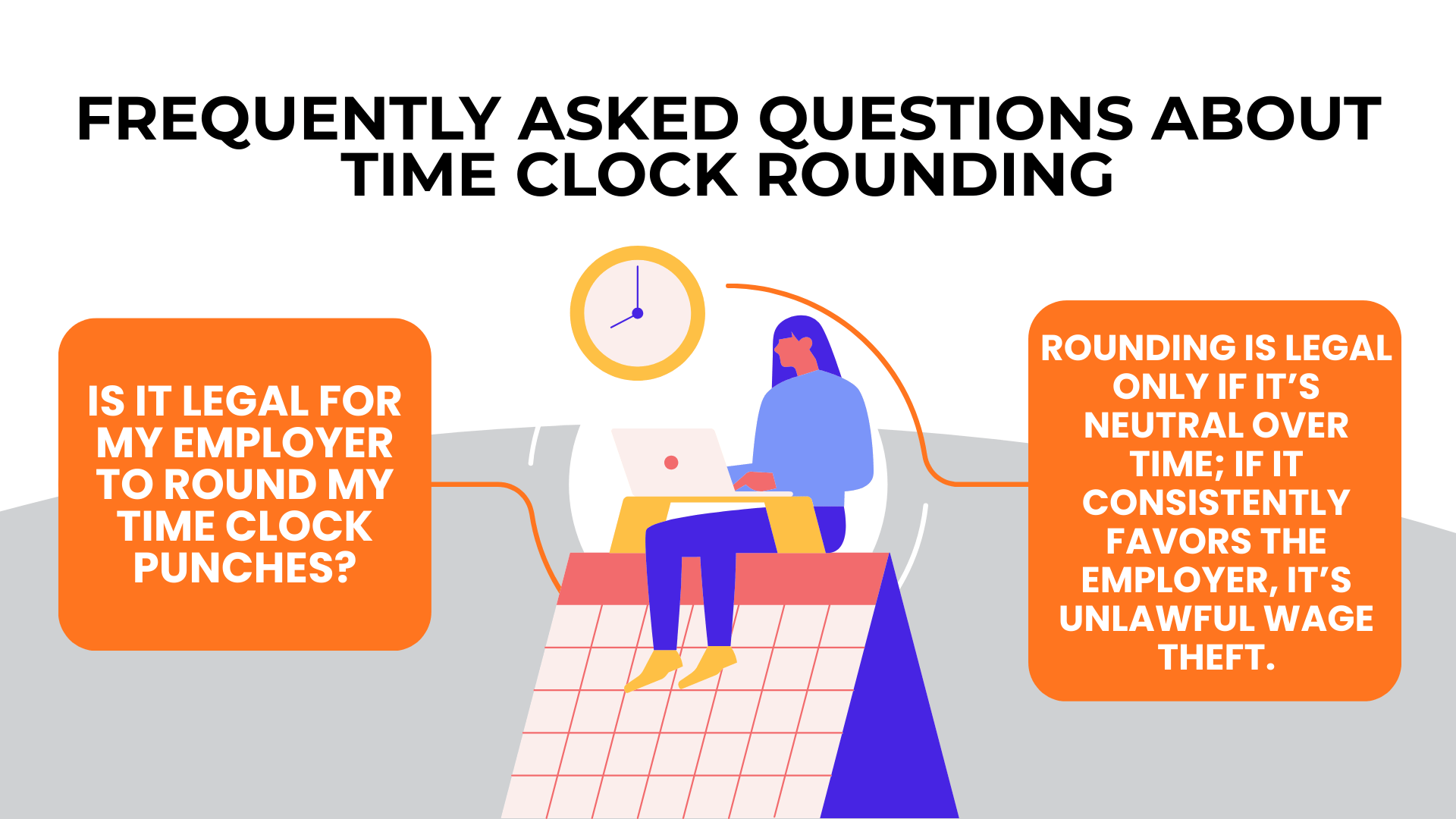
Is it legal for my employer to round my time clock punches?
Yes, but only if the rounding policy is neutral over time—meaning it must benefit employees as often as it benefits the employer. If the policy systematically rounds in the employer’s favor (for example, always rounding down at clock-in and up at clock-out), it becomes illegal wage theft.
How do I know if my employer’s rounding policy is costing me money?
Compare your actual arrival and departure times to what appears on your pay stub over several weeks. If you consistently see less time than you actually worked, the rounding policy may be biased. Losing even 7-8 minutes per shift adds up to over 30 hours of unpaid work per year.
Can I recover wages for time clock rounding that happened years ago?
Yes, within the statute of limitations. Under federal law, you can recover unpaid wages from the past two years (three years if the violation was willful). New Jersey’s Wage Theft Act extends this to six years, and Pennsylvania allows three years.
What if my coworkers are experiencing the same time rounding problem?
You may be able to file a collective action under the FLSA, allowing similarly situated employees to join together in a single lawsuit. Approximately 75% of motions to certify these collective actions succeed, and the average FLSA collective action settlement exceeded $1.1 million in 2023.
Can my employer fire me for complaining about time clock rounding?
No. Federal and state laws prohibit employers from retaliating against employees who complain about wage violations. Under New Jersey law, if your employer takes adverse action within 90 days of your complaint, retaliation is presumed—and the employer must prove otherwise with clear and convincing evidence.
Conclusion
Time clock rounding is legal only when it’s neutral—when it averages out over time without systematically favoring the employer. When a rounding policy consistently costs you minutes from every shift, those small losses accumulate into real wage theft. Federal law requires employers to pay for all time worked. New Jersey and Pennsylvania laws add enhanced damages and longer time periods to file claims.
If you’ve noticed that your recorded hours don’t match the time you actually work, start documenting. Keep your own time log, save your pay stubs, and compare the numbers. The statute of limitations runs from each unpaid pay period, so waiting costs you the ability to recover older wages.
If you believe your employer’s time clock rounding policy is costing you wages, contact The Lacy Employment Law Firm to discuss your situation.