When a coworker makes repeated sexual comments, when a supervisor’s behavior makes you dread coming to work, or when inappropriate conduct has become part of your daily routine—you may be experiencing illegal sexual harassment in the workplace. Pennsylvania employees are protected under both federal and state law, and understanding your rights is the first step toward addressing what’s happening.
Sexual harassment at work is not just uncomfortable—it’s a form of sex discrimination that violates your legal rights. Whether you work for a large corporation or a small business, Pennsylvania law provides protections that may be broader than you realize. This guide explains what qualifies as harassment, who is protected, and what you can do about it.
What Qualifies as Sexual Harassment Under Pennsylvania Law?
Sexual harassment is a form of sex discrimination prohibited under both Title VII of the Civil Rights Act of 1964 (42 U.S.C. § 2000e et seq.) and the Pennsylvania Human Relations Act (43 P.S. §§ 951-963). Neither statute uses the phrase “sexual harassment” explicitly—instead, courts have interpreted the prohibition against discrimination “because of sex” to include harassing conduct.
Two forms of illegal harassment
The law recognizes two distinct forms of sexual harassment. Quid pro quo harassment occurs when a supervisor conditions job benefits—like promotions, raises, or continued employment—on submission to sexual demands. Hostile work environment harassment occurs when unwelcome conduct based on sex is severe or pervasive enough to alter the conditions of employment and create an abusive working environment.
Behaviors that may constitute harassment
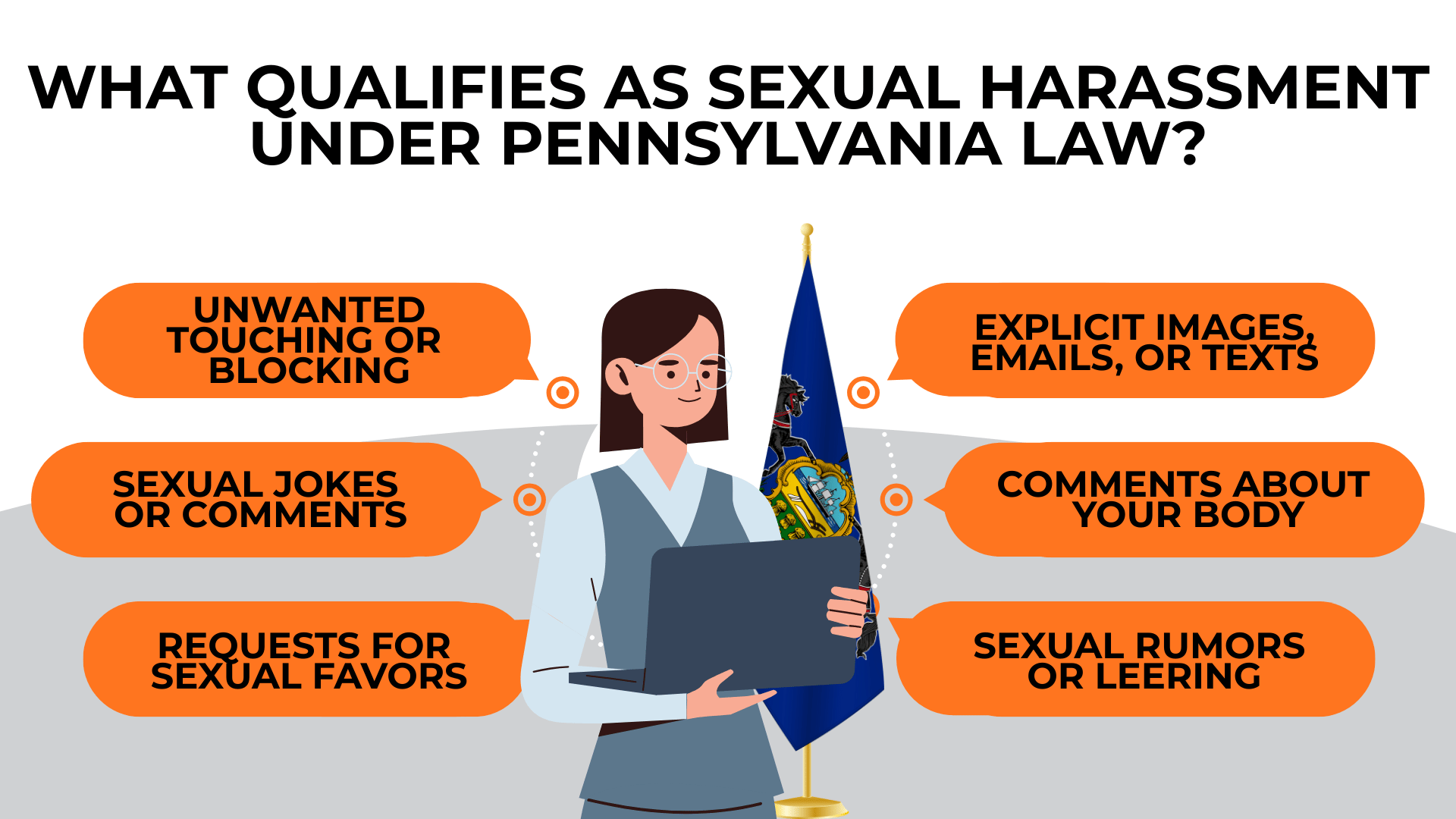
Sexual harassment can take many forms, including:
- Unwanted physical contact, such as touching, groping, or blocking movement
- Sexual comments, jokes, or innuendos directed at you or made in your presence
- Requests for sexual favors, whether explicit or implied
- Displaying sexually explicit images, emails, or text messages in the workplace
- Repeated comments about your body or appearance
- Spreading sexual rumors or making derogatory comments based on sex
- Staring, leering, or making suggestive gestures
The “unwelcome” requirement
A critical element of any harassment claim is that the conduct was unwelcome. This means you did not solicit or invite it, and you regarded it as undesirable or offensive. The focus is on your perception of the conduct, not the harasser’s intent. Even if a coworker claims they were “just joking,” the conduct may still be unlawful if you found it unwelcome and it meets the other legal requirements.
How Common Is Workplace Sexual Harassment?
If you’ve experienced harassment at work and haven’t reported it, you’re not alone. Many employees hesitate to come forward due to fear of retaliation, concerns about being believed, or uncertainty about whether what they experienced “counts.” Understanding how common workplace harassment is—and how often it goes unreported—can help put your experience in perspective.
Formal complaint rates and recent trends
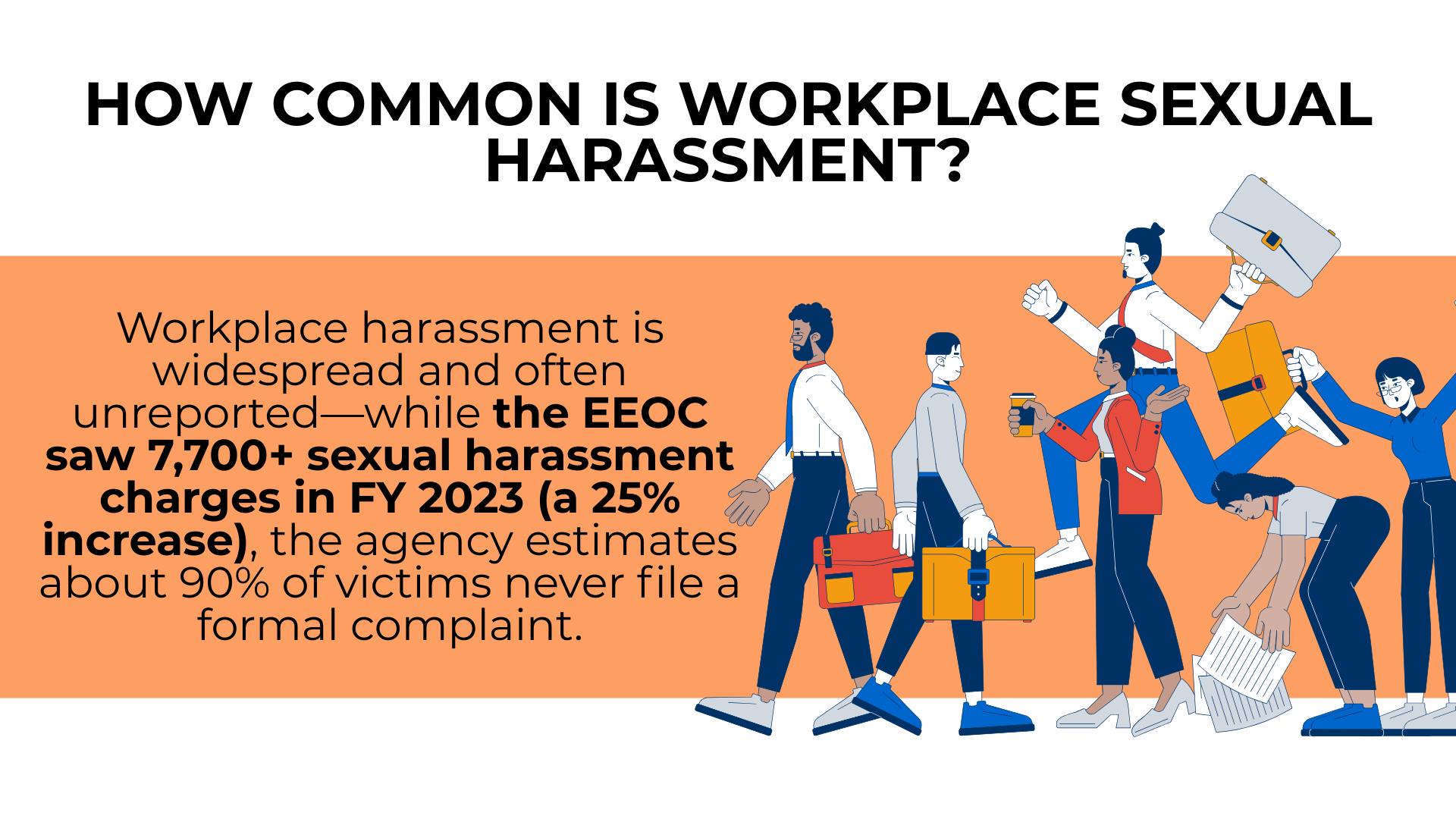
According to EEOC Enforcement and Litigation Statistics (FY 2023), more than 7,700 sexual harassment charges were filed with the Equal Employment Opportunity Commission in fiscal year 2023. This represented a 25% increase from the prior year and the highest number of harassment charges in 12 years. The increase suggests that more employees are coming forward and that agencies are taking these claims seriously.
Why most victims never report
Despite rising charge numbers, formal complaints represent only a fraction of actual workplace harassment. According to the EEOC Select Task Force on the Study of Harassment in the Workplace (2016), approximately 90% of individuals who experience workplace harassment never file a formal charge. Common reasons include fear of not being believed, concern about retaliation, and uncertainty about whether the behavior crosses a legal line.
Who experiences workplace harassment
Sexual harassment affects workers across all demographics. According to EEOC Data Highlight No. 2 (FY 2018-2021), women filed 78.2% of sexual harassment charges during that period, while men filed 21.8%. The same EEOC Select Task Force found that between 25% and 85% of women report experiencing workplace sexual harassment, with the wide range depending on how surveys define harassing behavior. When surveys ask about specific unwelcome behaviors rather than using the label “sexual harassment,” reported rates are significantly higher.
What Must You Prove for a Sexu
What Must You Prove for a Sexual Harassment Claim?
Not every unpleasant workplace interaction rises to the level of illegal harassment. Pennsylvania courts have established specific elements you must prove, and understanding these requirements can help you assess your situation.
The five-element test under Pennsylvania law
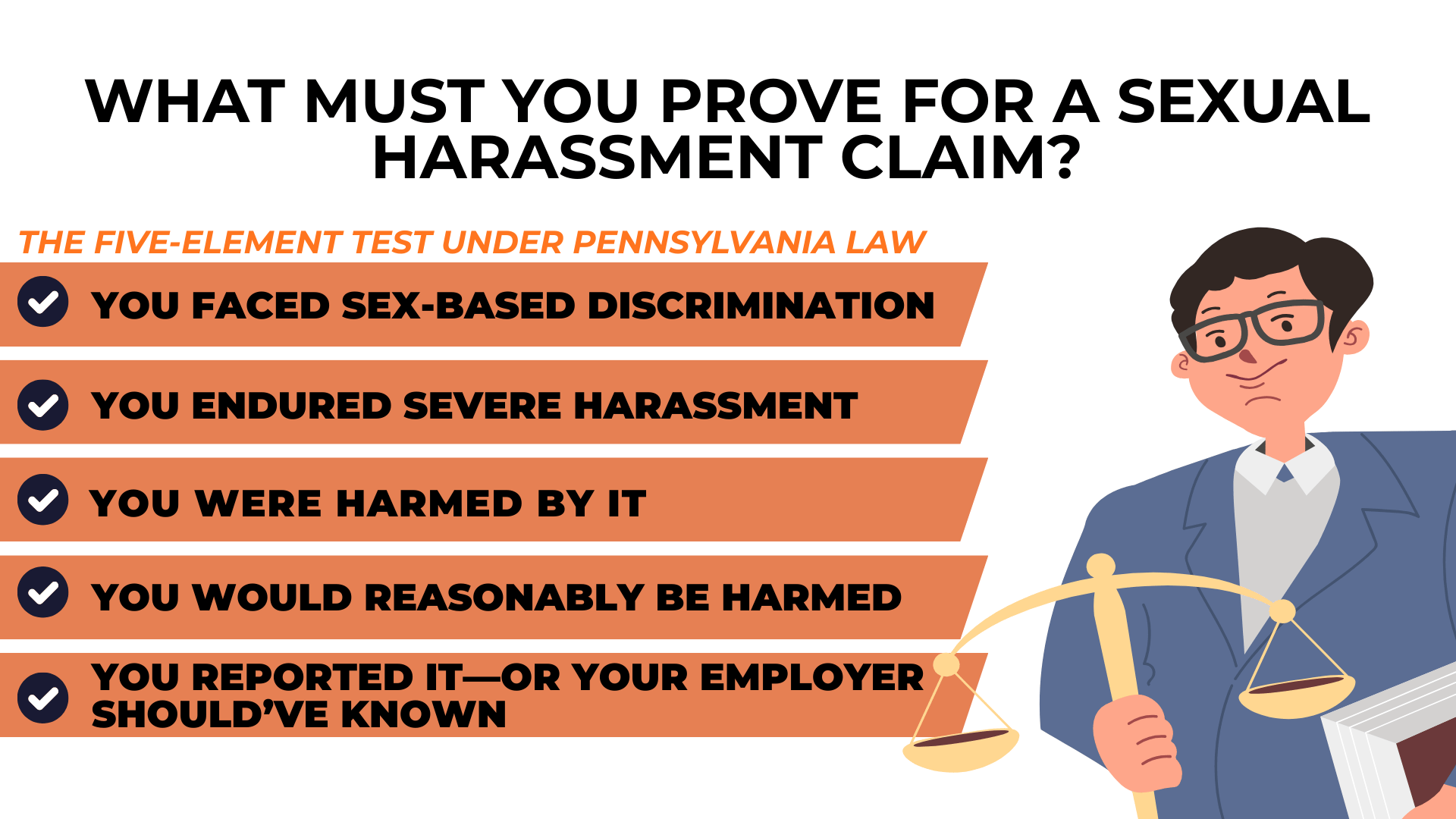
Under Pennsylvania law, as established in Hoy v. Angelone, 456 Pa. Super. 615 (Pa. Super. Ct. 1997), a hostile work environment claim requires proving five elements:
- You suffered intentional discrimination because of your sex
- The discrimination was regular and pervasive
- The discrimination detrimentally affected you
- The discrimination would detrimentally affect a reasonable person of the same protected class in the same position
- The employer knew or reasonably should have known of the discriminatory harassment
Understanding “severe or pervasive”
The “severe or pervasive” standard—established in Harris v. Forklift Systems, Inc., 510 U.S. 17 (1993)—requires courts to look at the totality of circumstances. Relevant factors include how frequently the conduct occurred, how severe it was, whether it was physically threatening or humiliating versus merely offensive, and whether it unreasonably interfered with your work performance. Importantly, you do not need to prove psychological injury—the Supreme Court made clear that the law does not require a showing of tangible harm beyond the hostile environment itself.
A single incident may be enough
While most hostile work environment claims involve a pattern of conduct, a single incident can be sufficient if it is severe enough. Physical assault, explicit threats conditioning employment on sexual submission, or other extreme conduct may constitute harassment even if it occurs only once. Understanding whether your situation meets these elements often requires reviewing the specific facts with someone familiar with Pennsylvania employment law.
Who Is Protected Under Federal and Pennsylvania Law?
The scope of protection against workplace sexual harassment depends on which laws apply to your employer. Pennsylvania law provides broader coverage than federal law, particularly for employees of smaller businesses.
Federal protections under Title VII
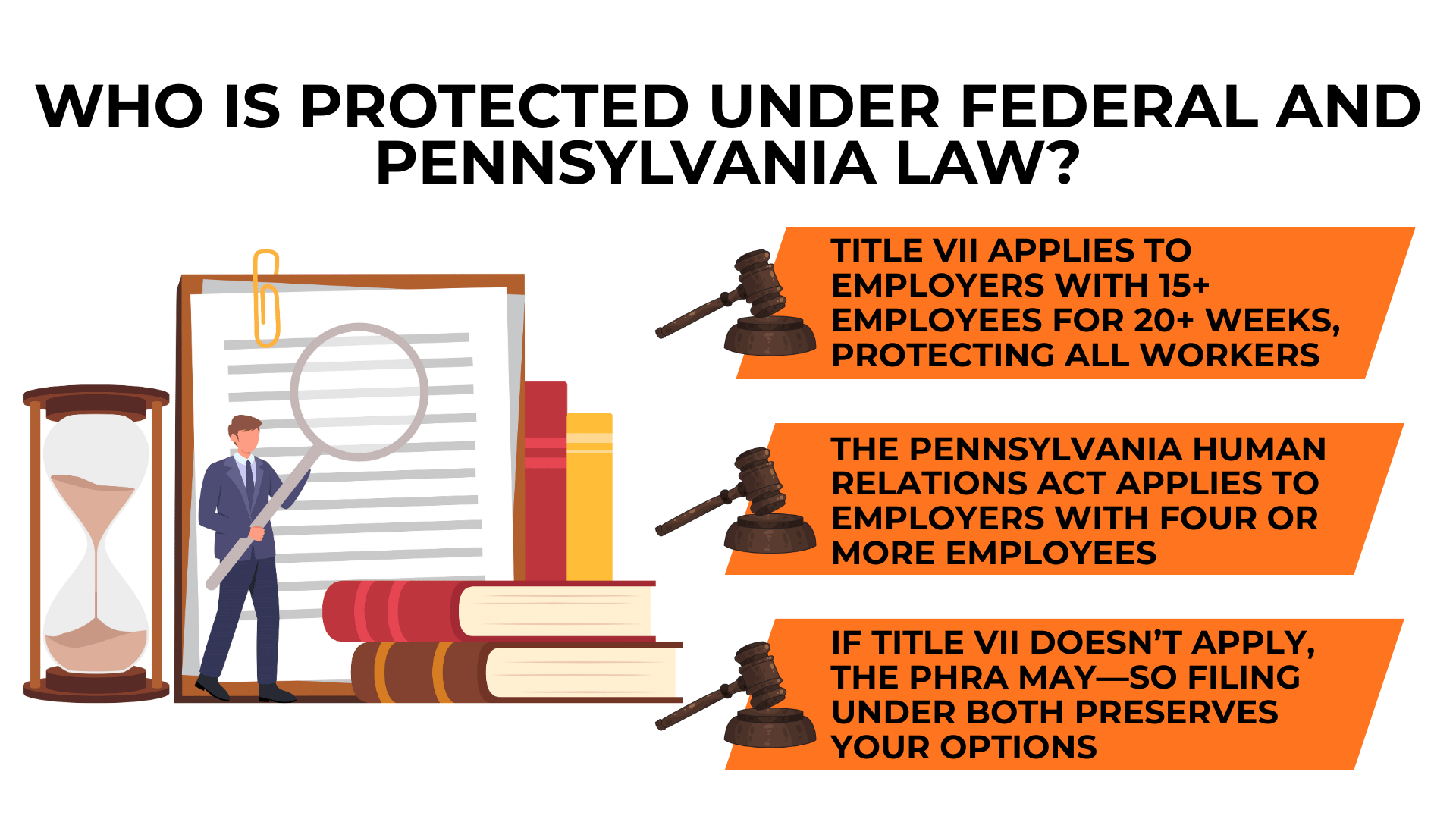
Title VII of the Civil Rights Act applies to employers with 15 or more employees for each working day in at least 20 calendar weeks. This means federal law does not protect workers at very small businesses. However, if your employer meets this threshold, you have federal protections regardless of your position, tenure, or employment status.
Pennsylvania’s broader PHRA coverage
The Pennsylvania Human Relations Act covers employers with four or more employees—significantly broader than the federal threshold. The exact statutory language in 43 P.S. § 954(b) defines “employer” to include any person employing four or more persons within the Commonwealth. This means workers at smaller Pennsylvania businesses have state law protections even when federal law does not apply.
Small business employees have options
If you work for a business with between 4 and 14 employees, you may not have federal Title VII protections, but you still have rights under the PHRA. This is a significant advantage of Pennsylvania law and one reason why filing under both statutes—when applicable—preserves maximum options. The following table summarizes key differences:
| Factor | Title VII (Federal) | PHRA (Pennsylvania) |
| Employer Coverage | 15+ employees | 4+ employees |
| Compensatory Damages | Capped ($50K-$300K) | No caps |
| Punitive Damages | Available | Not available |
| Individual Harasser Liability | No | Yes (aiding/abetting) |
| Filing Deadline | 300 days (PA) | 180 days |
When Is Your Employer Liable for Harassment?
Proving that harassment occurred is only part of the equation. You must also establish a basis for holding your employer responsible. The rules differ depending on who committed the harassment and whether it resulted in a tangible job consequence.
Supervisor harassment and employer responsibility
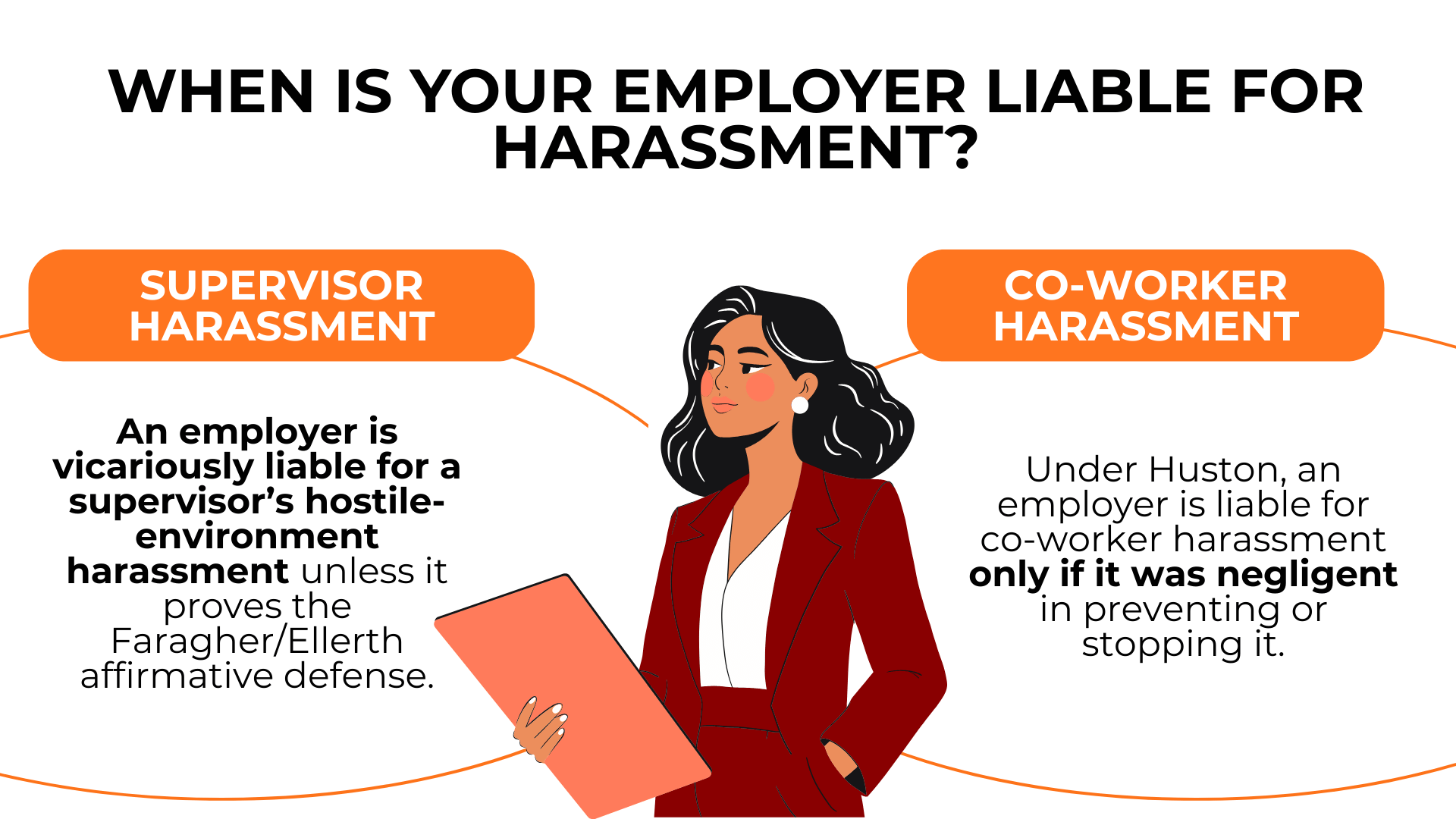
When harassment is committed by a supervisor—defined under federal law as someone with authority to take tangible employment actions like hiring, firing, or promoting—the employer faces heightened liability. Under the framework established in Faragher v. City of Boca Raton, 524 U.S. 775 (1998) and Burlington Industries, Inc. v. Ellerth, 524 U.S. 742 (1998), an employer is subject to vicarious liability for a hostile environment created by a supervisor. However, if no tangible employment action resulted from the harassment, the employer may raise an affirmative defense.
This affirmative defense has two prongs: the employer must prove (1) it exercised reasonable care to prevent and correct harassment, and (2) the employee unreasonably failed to take advantage of corrective opportunities the employer provided. Both prongs must be established for the defense to succeed.
Co-worker harassment and employer negligence
When harassment comes from a co-worker rather than a supervisor, the standard for employer liability is negligence. Under Huston v. P&G Paper Products Corp., 568 F.3d 100 (3d Cir. 2009), an employer is liable for co-worker harassment only if it was negligent in failing to provide a reasonable complaint avenue, failing to take prompt corrective action after learning of the harassment, or failing to discover the harassment when it reasonably should have known.
When employers cannot raise a defense
The affirmative defense is not available when supervisor harassment results in a tangible employment action—a significant change in employment status such as termination, demotion, undesirable reassignment, or a decision causing significant change in benefits. In those cases, the employer is strictly liable. This is a critical distinction because it means that if your supervisor’s harassment led to you being fired, demoted, or denied a promotion, your employer cannot escape liability by pointing to its anti-harassment policy.
What Damages Can You Recover?
Successful sexual harassment claims can result in significant financial recovery. The types and amounts of damages available depend on which laws apply and the specific facts of your case.
Federal damage caps by employer size
Under Title VII, compensatory and punitive damages combined are subject to caps based on employer size: $50,000 for employers with 15-100 employees; $100,000 for 101-200 employees; $200,000 for 201-500 employees; and $300,000 for employers with more than 500 employees. Importantly, back pay and front pay are not subject to these caps—they are considered equitable relief. Punitive damages are available under federal law when the employer acted with malice or reckless indifference to your rights.
Pennsylvania’s uncapped compensatory damages
One of the most significant advantages of the PHRA is that it has no caps on compensatory damages. This means that if you have substantial emotional distress damages or significant lost wages, Pennsylvania law may provide greater recovery potential than federal law. However, the PHRA does not allow punitive damages—as confirmed in Hoy v. Angelone, 554 Pa. 134 (Pa. 1998). This tradeoff means that egregious cases warranting punishment may benefit from federal claims, while cases with substantial compensatory damages may favor state claims.
Individual liability for harassers
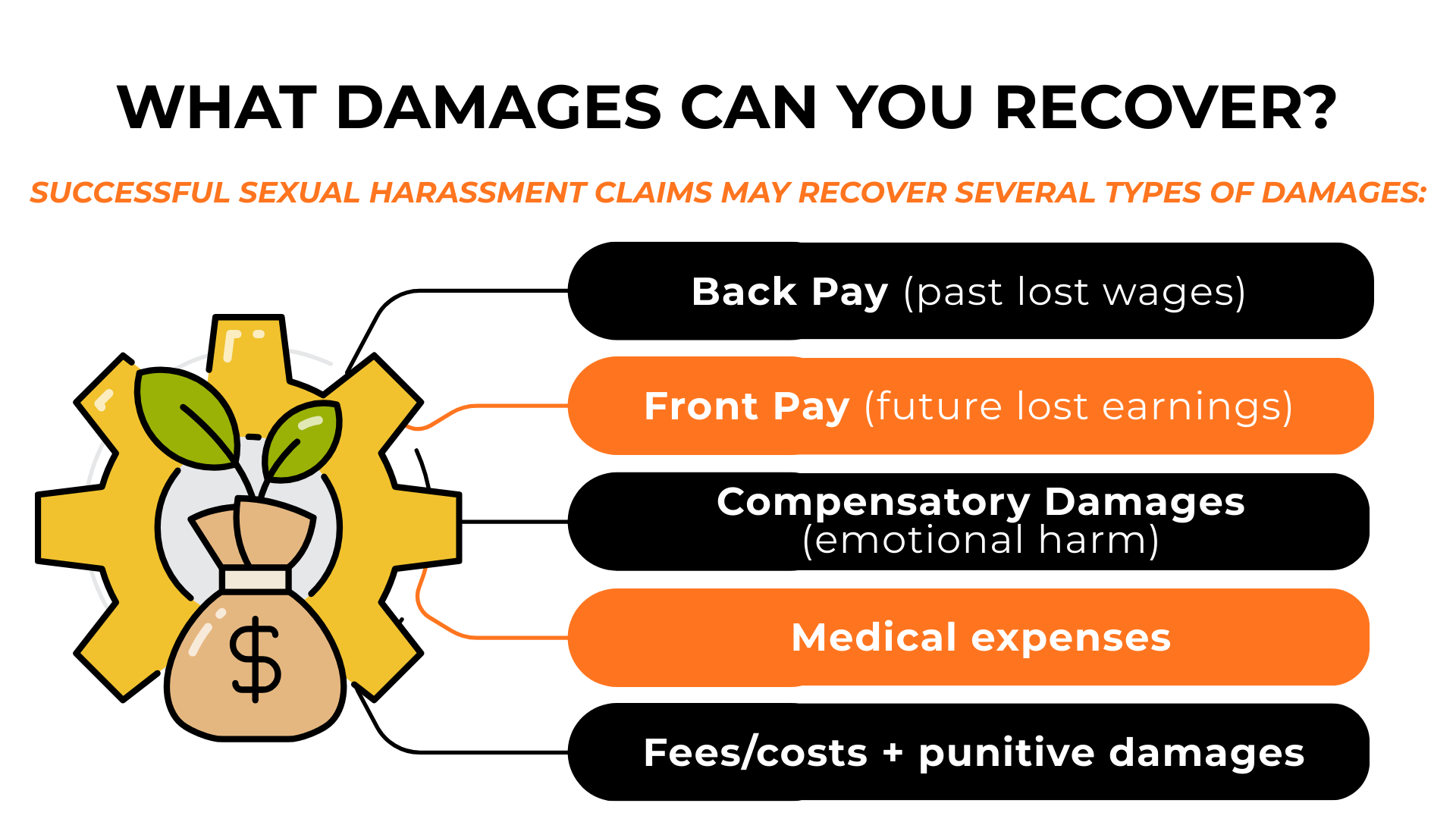
Unlike federal law, Pennsylvania’s PHRA allows individual liability under 43 P.S. § 955(e) for anyone who aids, abets, incites, compels, or coerces unlawful discrimination. This means the person who harassed you can potentially be held personally liable alongside your employer. Successful sexual harassment claims may recover several types of damages:
- Back pay for lost wages from the date of the discriminatory action
- Front pay for future lost earnings when reinstatement is not feasible
- Compensatory damages for emotional pain, mental anguish, and loss of enjoyment of life
- Medical expenses related to the harassment
- Attorney’s fees and costs (discretionary under PHRA)
- Punitive damages (federal claims only, for egregious employer conduct)
According to the EEOC 2024 Annual Performance Report, the agency recovered nearly $700 million for discrimination victims in fiscal year 2024—the highest monetary recovery in recent history, benefiting over 21,000 individuals.
What Are the Deadlines for Filing a Claim?
Sexual harassment claims are subject to strict filing deadlines. Missing these deadlines can permanently bar your claims, regardless of how strong your case might be. Understanding these time limits is critical to protecting your rights.
Pennsylvania’s 180-day filing deadline
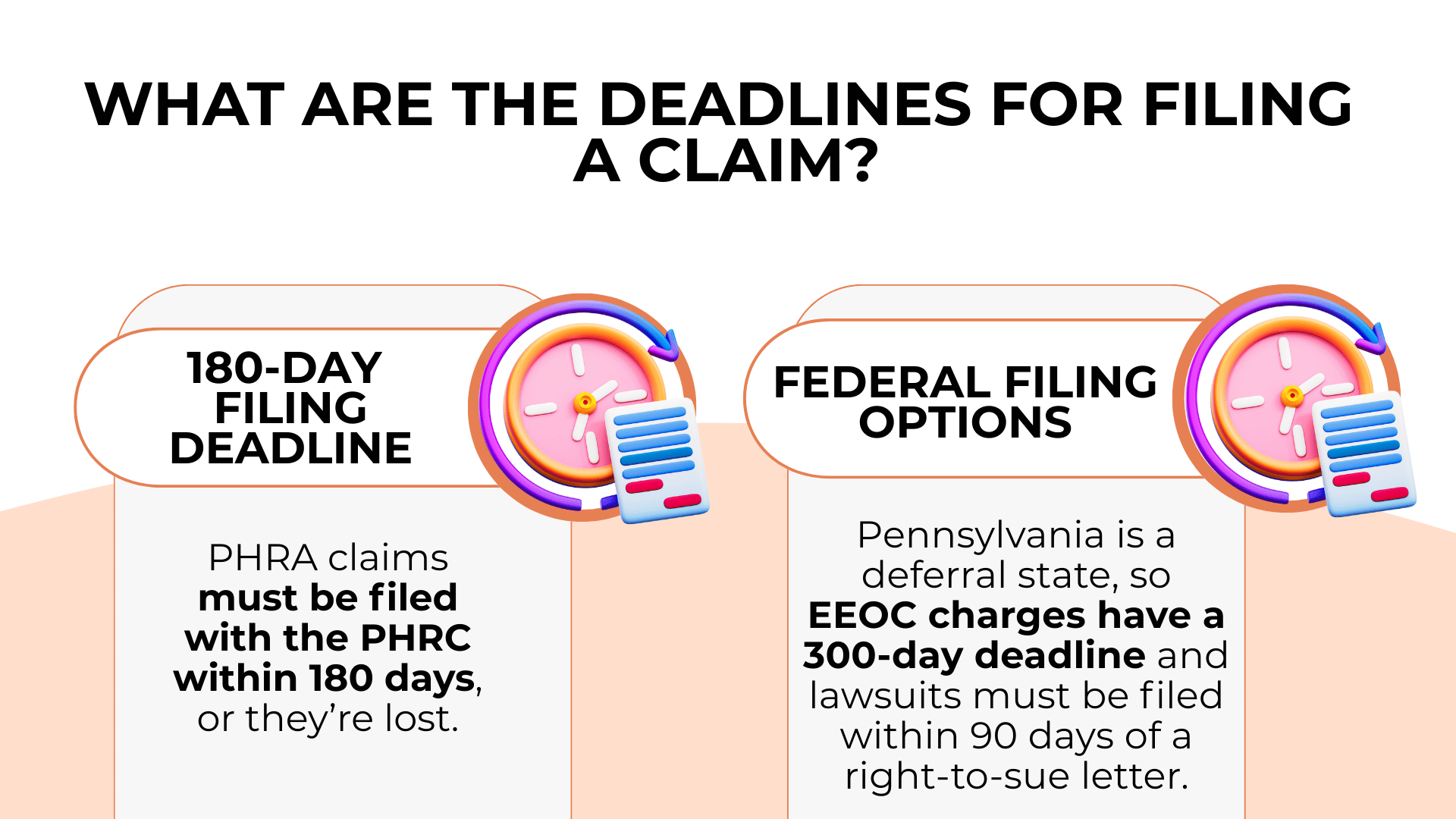
The Pennsylvania Human Relations Act requires administrative complaints to be filed with the Pennsylvania Human Relations Commission (PHRC) within 180 days of the alleged discriminatory act, per 43 P.S. § 959(h). This is significantly shorter than the federal deadline and represents a critical trap for Pennsylvania employees. Missing this deadline forfeits your state law claims entirely—even if you still have time to file federally.
Federal filing options in Pennsylvania
Because Pennsylvania has a state enforcement agency (the PHRC), the federal filing deadline is extended from 180 days to 300 days for filing with the EEOC. This means Pennsylvania employees have a longer window for federal claims than for state claims. After filing an EEOC charge, you must wait either 180 days or until the EEOC completes its investigation before requesting a right-to-sue letter. Once issued, you have 90 days to file suit in federal court.
Why timing matters
The strategic implication is clear: to preserve both federal and state claims, you should file within 180 days of the harassment. If you file between days 181 and 300, you preserve federal claims but lose access to the PHRA’s uncapped compensatory damages and individual liability provisions. Given these strict deadlines, speaking with an attorney promptly can help preserve your options.
| Action | Federal (Title VII) | Pennsylvania (PHRA) |
| Administrative Charge | 300 days (EEOC) | 180 days (PHRC) |
| Court Filing | 90 days after right-to-sue | 2 years after PHRC closure |
How Should You Document Workplace Harassment?
Strong documentation can make the difference between a successful claim and one that fails for lack of evidence. If you’re experiencing harassment, creating a thorough record protects your interests whether you ultimately file a formal complaint or not.
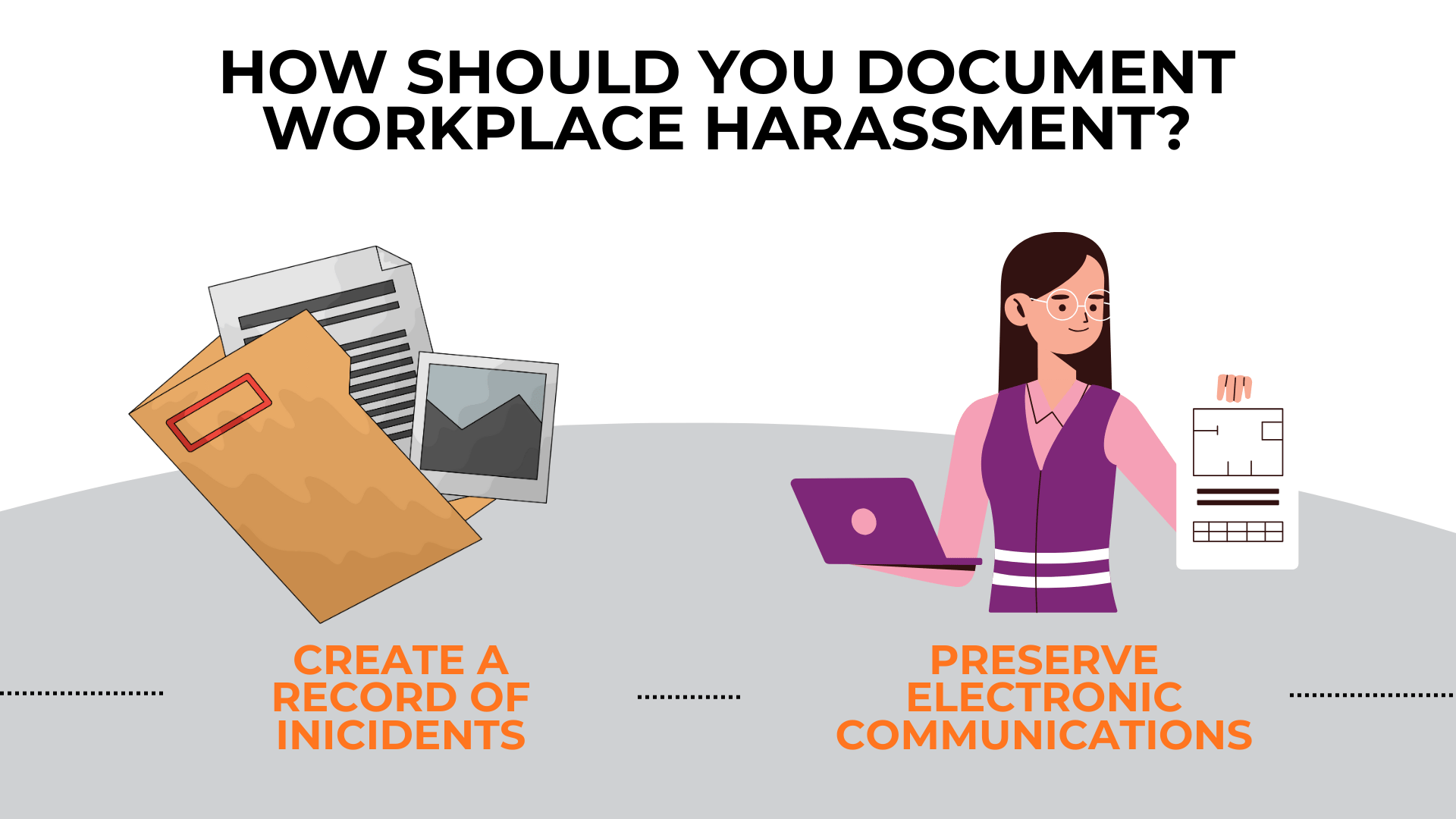
Creating a record of incidents
Effective documentation of workplace harassment should include:
- Contemporaneous records of each incident, written as soon as possible after it occurs
- Specific dates, times, and locations of harassing conduct
- The exact language used by the harasser, quoted as precisely as possible
- Names of any witnesses who saw or heard the conduct
- Your response to the conduct and how it affected you
- Any reports you made to supervisors or HR, and their responses
Preserving electronic communications
Emails, text messages, voicemails, and instant messages can provide powerful evidence of harassment. Save copies of any electronic communications from the harasser, including messages that may seem minor but establish a pattern. If harassment occurs through workplace systems, consider forwarding relevant messages to a personal email account to ensure you retain access if your employment ends.
What to do before filing
Before filing a formal complaint, note the timing of any changes in how you’re treated relative to when you reported harassment. Document all adverse employment actions and their proximity to your complaints. If your employer has an anti-harassment policy, obtain a copy and note whether the company followed its own procedures. According to the EEOC Office of General Counsel Fiscal Year 2024 Annual Report, the agency achieved a 97% favorable resolution rate in district court litigation—when cases are well-documented and properly pursued, outcomes can be very favorable.
Frequently Asked Questions
Can a single incident be enough for a sexual harassment claim?
Yes. While most hostile work environment claims involve repeated conduct, a single incident can be sufficient if it is severe enough. Physical assault or explicit threats to job security based on sexual demands may constitute harassment even if they occur only once.
Does Pennsylvania law protect employees at small businesses?
Yes. The Pennsylvania Human Relations Act covers employers with four or more employees, which is much broader than the federal Title VII threshold of 15 employees. This means workers at smaller Pennsylvania businesses have state law protections even if federal law does not apply.
Can I sue my harasser personally in Pennsylvania?
Yes. Unlike federal law, the PHRA allows individual liability for people who aid, abet, incite, compel, or coerce unlawful discrimination under 43 P.S. § 955(e). This means the person who harassed you can be held personally liable alongside your employer.
What happens if I miss the 180-day filing deadline with the PHRC?
Missing the 180-day Pennsylvania deadline forfeits your state law claims, even if you still have time to file federally. Pennsylvania residents have 300 days to file with the EEOC, so federal claims may survive, but the broader protections and uncapped damages under the PHRA would be lost.
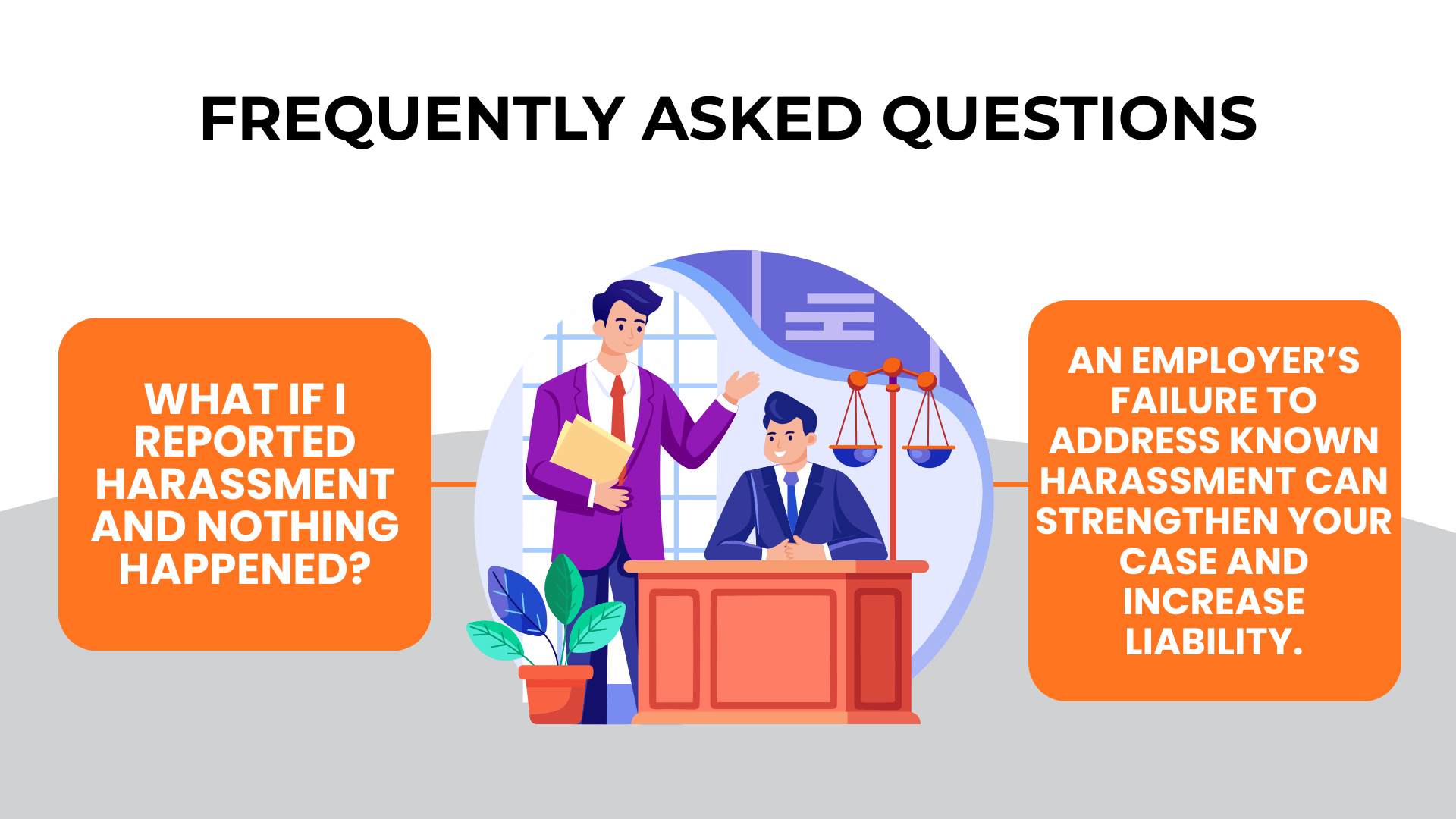
What if I reported harassment and nothing happened?
An employer’s failure to respond appropriately to a harassment complaint can strengthen your case. When employers know about harassment and fail to take prompt corrective action, they may lose the ability to assert certain defenses and can be held liable for the hostile work environment.
How much can I recover in a sexual harassment lawsuit?
Recovery depends on your specific circumstances and which laws apply. Federal damages are capped based on employer size, ranging from $50,000 to $300,000 for compensatory and punitive damages combined. Pennsylvania’s PHRA has no caps on compensatory damages but does not allow punitive damages.
Protecting Your Rights
Sexual harassment in the workplace is not something you have to tolerate. Pennsylvania employees have strong protections under both federal and state law, with the PHRA offering advantages like coverage for smaller employers, uncapped compensatory damages, and the ability to hold individual harassers personally liable. However, these protections come with strict time limits—particularly the 180-day PHRC filing deadline that is shorter than the federal window.
If you’re experiencing harassment, document what’s happening, preserve evidence, and understand that you’re not alone—the majority of harassment victims never file formal complaints, but those who do are increasingly finding that agencies and courts take their claims seriously. If you have questions about sexual harassment in your Pennsylvania workplace, contact The Lacy Employment Law Firm to discuss your situation.