You’ve worked for decades, built expertise, and contributed consistently to your employer. Then something shifts. Maybe it’s comments about “fresh perspectives” or being left off meeting invites. Perhaps you’re suddenly facing performance criticisms that never existed before, or you’re watching younger colleagues get promoted while you’re passed over. These experiences leave many workers wondering: is this age discrimination?
Age discrimination takes many forms in today’s workplace, ranging from blatant termination decisions to subtle daily marginalization. Understanding what discrimination looks like helps workers recognize when their treatment crosses legal lines. This article examines common examples of age discrimination across hiring, termination, harassment, and everyday workplace interactions—drawing on enforcement data and worker surveys to show how often these patterns occur.
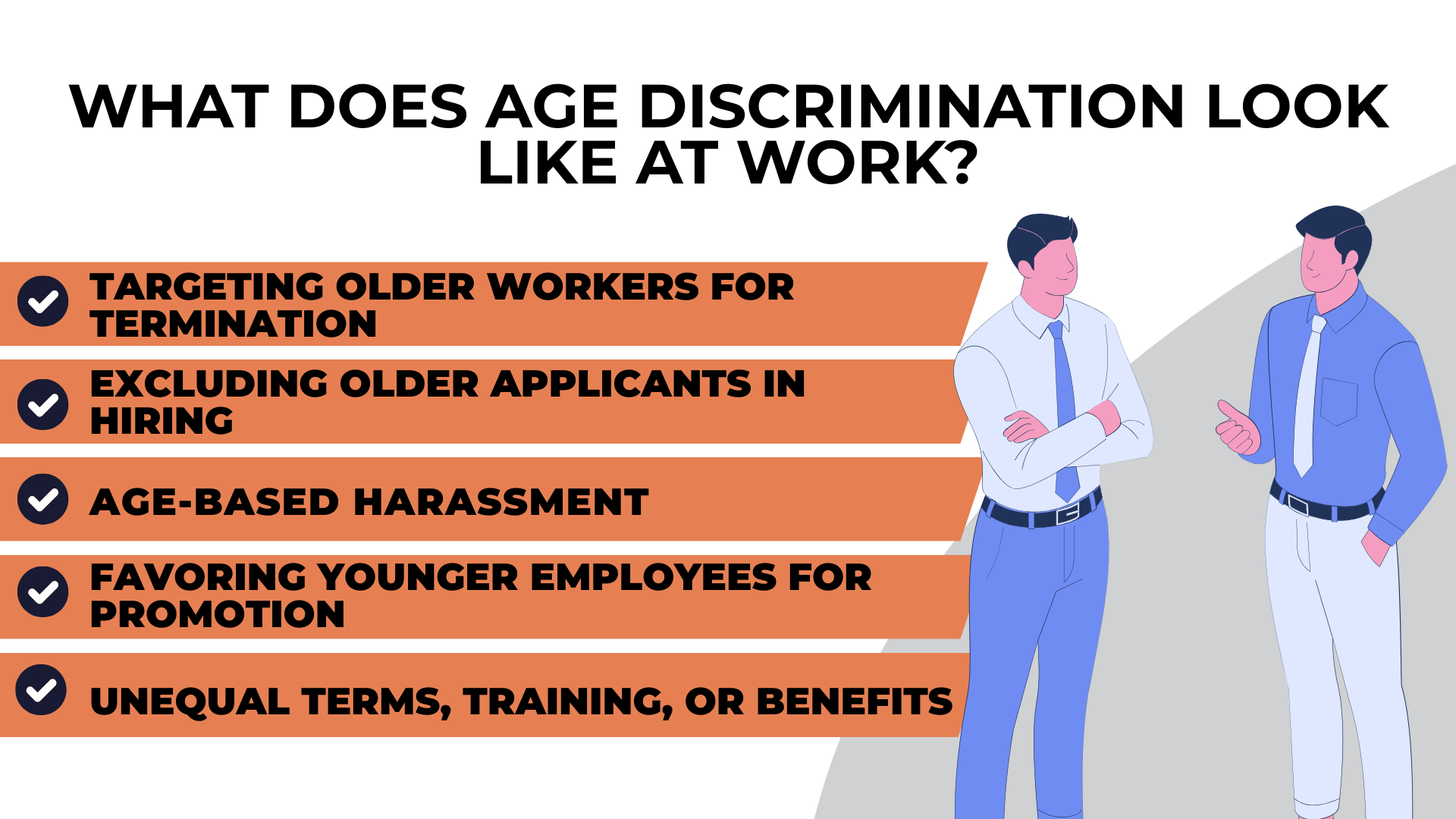
What Does Age Discrimination Look Like at Work?
Age discrimination occurs when an employer treats a worker less favorably because of their age. This can happen at any stage of employment—from the initial application to the final day of work. While some discrimination is obvious, much of it operates through coded language, pretextual justifications, and systemic patterns that disadvantage older workers.
The Prevalence of Age Discrimination
The scope of age discrimination in American workplaces is substantial. According to AARP Research (2025), 64% of workers age 50 and older have seen or experienced age discrimination in the workplace. This isn’t a problem affecting a small minority—it touches nearly two-thirds of older workers at some point in their careers.
The EEOC (2025) received 16,223 age discrimination charges in fiscal year 2024, representing a 41% increase from fiscal year 2022. This surge in formal complaints suggests that workers are increasingly recognizing and reporting discriminatory treatment.
Overt Versus Subtle Discrimination
Age discrimination manifests across a spectrum from obvious to nearly invisible. Understanding both ends helps workers identify discrimination in their own experiences. Common categories include:
- Termination and discharge decisions targeting older workers while retaining younger employees
- Hiring practices that screen out older applicants through resume filtering, interview bias, or “overqualified” rejections
- Harassment through ageist comments, jokes, and stereotyping that creates a hostile work environment
- Failure to promote patterns where younger, less experienced workers advance over qualified older candidates
- Discriminatory terms and conditions affecting training access, assignments, schedules, or benefits
According to the EEOC’s analysis of ADEA charges (2018), 55% allege discriminatory discharge, 25% allege discriminatory terms or conditions, and 21% allege age-based harassment. These categories often overlap—a worker may face harassment that escalates to termination, or discriminatory conditions that force resignation.
Why Age Discrimination Often Goes Unreported
Despite its prevalence, many instances of age discrimination never result in formal complaints. Workers may fear retaliation, believe they can’t prove what happened, or simply not recognize that their treatment was illegal. The subtle nature of much age discrimination—assumptions about technology skills, exclusion from opportunities, coded language—makes it harder to identify than more overt forms of workplace bias.
What Are Examples of Age Discrimination in Hiring?
Hiring discrimination prevents qualified older workers from even getting their foot in the door. Research shows this bias operates through multiple mechanisms, from automated resume screening to interviewer assumptions.
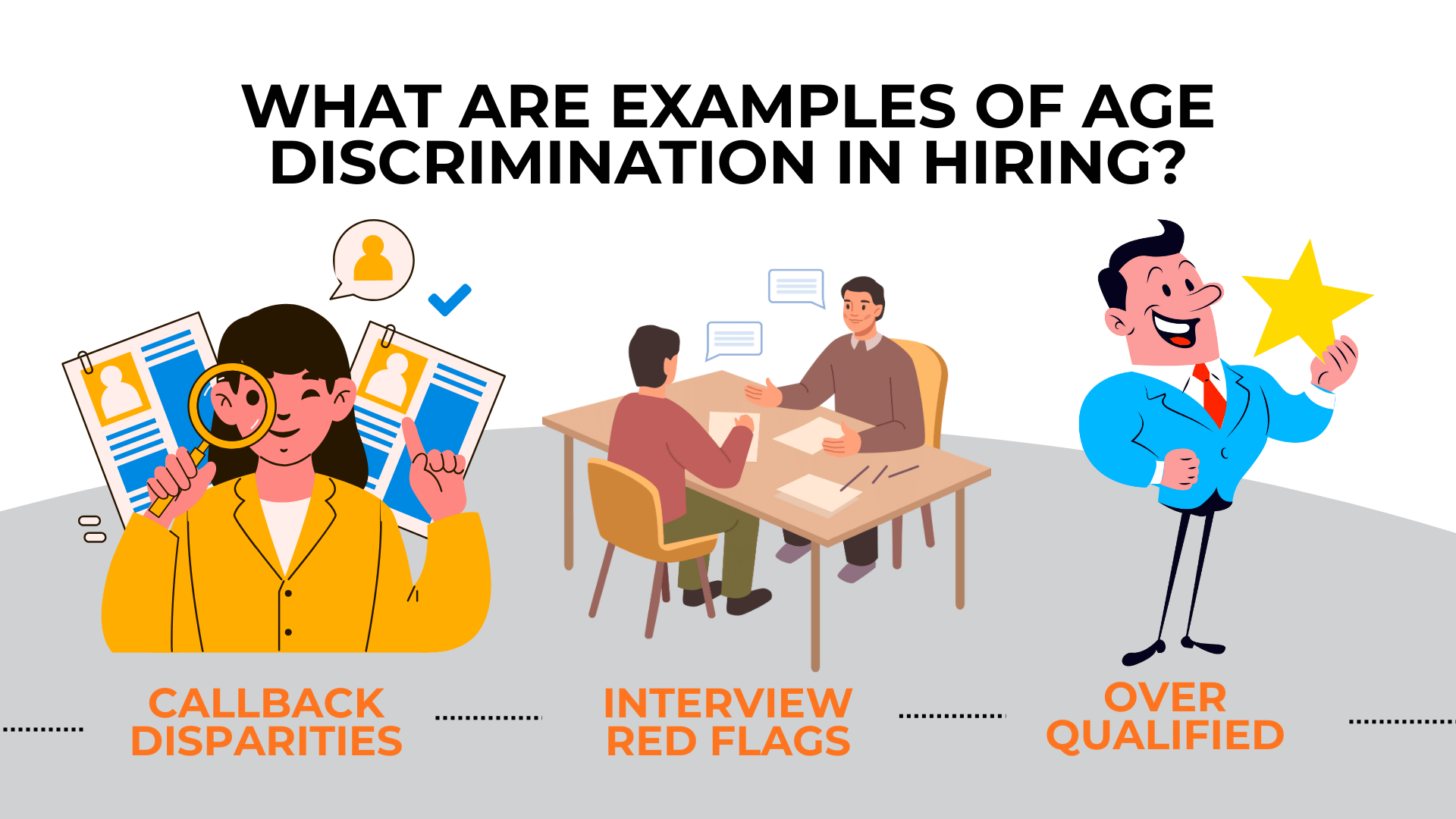
Callback Disparities and Resume Screening
The numbers reveal stark disparities in how employers respond to older applicants. According to the Federal Reserve Bank of San Francisco (2017), older female applicants ages 64-66 received 47% fewer callbacks than younger applicants ages 29-31 for administrative positions. This large-scale study sent over 40,000 job applications across 12 cities, controlling for qualifications.
The same research found a 36% callback rate gap between young and older women in retail sales positions. These disparities exist even when older applicants have equivalent or superior qualifications, suggesting that age itself—not capability—drives hiring decisions.
Interview Red Flags
Discriminatory intent often surfaces during interviews through questions and comments that focus on age rather than ability. Warning signs that an interview may involve age bias include:
- Questions about retirement plans, how long you intend to work, or your “five-year plan” framed around age
- Comments about whether you’d be comfortable reporting to a younger manager
- Concerns expressed about whether you can “keep up” with the pace or work well with a “young team”
- Questions about your graduation year, when you started your career, or how long you’ve been working
- Observations about your experience level framed as a negative rather than an asset
These inquiries signal that the employer is making decisions based on age-related assumptions rather than actual qualifications.
“Overqualified” and Other Coded Language
One of the most common masks for age discrimination is telling applicants they’re “overqualified.” This term rarely appears in rejections of younger candidates with strong credentials. When directed at older applicants, it often reflects assumptions that experienced workers will demand higher salaries, won’t stay long, or won’t accept direction from younger supervisors.
Other coded language includes references to seeking candidates with “digital native” skills, wanting someone who can “grow with the company,” or looking for people early in their careers. According to AARP Research (2024-2025), 74% of older job seekers believe their age will be considered a barrier by hiring managers—and callback data suggests this concern is well-founded.
What Are Examples of Age Discrimination in Termination?
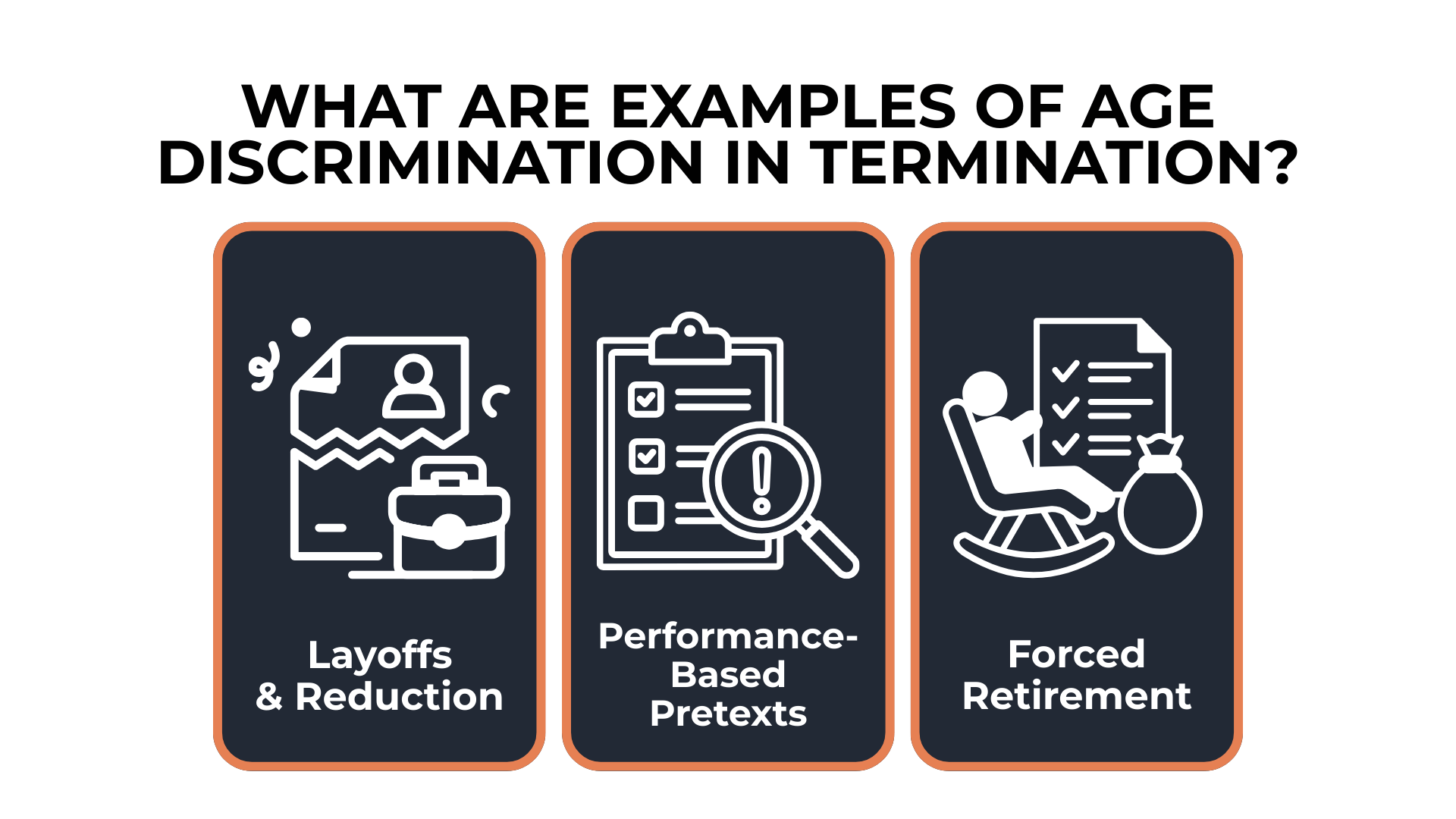
Termination is the most common allegation in age discrimination charges. According to the EEOC’s 50-year retrospective on the ADEA (2018), 55% of all age discrimination charges allege discriminatory discharge—up from 45% in 1992. These terminations often follow recognizable patterns.
Layoffs and Reduction in Force Patterns
Company restructurings and layoffs provide cover for age-based termination decisions. While employers may claim business necessity, the pattern of who gets cut often reveals discriminatory intent. Warning signs that a reduction in force may target older workers include:
- Disproportionate impact on workers over 40 compared to their representation in the workforce
- Retention of younger, less experienced employees in similar roles
- Elimination of positions held by older workers followed by hiring younger replacements
- Subjective selection criteria that disadvantage tenure and experience
- Decision-makers making comments about needing “new blood” or “fresh ideas”
- Older workers concentrated in eliminated positions while younger workers are transferred
Research from ProPublica and the Urban Institute (2018) found that 56% of workers in their 50s with stable, long-term jobs are pushed out or laid off at least once before reaching traditional retirement age. This involuntary separation pattern suggests systemic targeting rather than random business decisions.
Performance-Based Pretexts
Sudden performance problems after years of satisfactory or excellent reviews often signal pretextual termination. An employee with a strong track record may suddenly face negative evaluations, performance improvement plans, or disciplinary actions that appear designed to create documentation for termination.
These pretexts become more suspicious when younger employees with similar or worse performance aren’t subjected to the same scrutiny. The timing matters too—performance concerns that emerge shortly before planned restructuring or after an employee reaches certain age or tenure milestones warrant close examination.
Forced Retirement and Buyout Pressure
Some employers pressure older workers to retire through buyout offers, reduced responsibilities, or explicit suggestions that “it might be time.” While voluntary retirement incentives are legal when structured properly, pressure tactics that make continued employment untenable cross into discrimination.
According to the Urban Institute (2018), only 10% of displaced older workers ever again earn as much as they did before their employment setbacks. This economic reality makes forced separation particularly damaging—older workers often cannot simply find equivalent positions elsewhere.
What Does Age-Based Harassment Look Like?
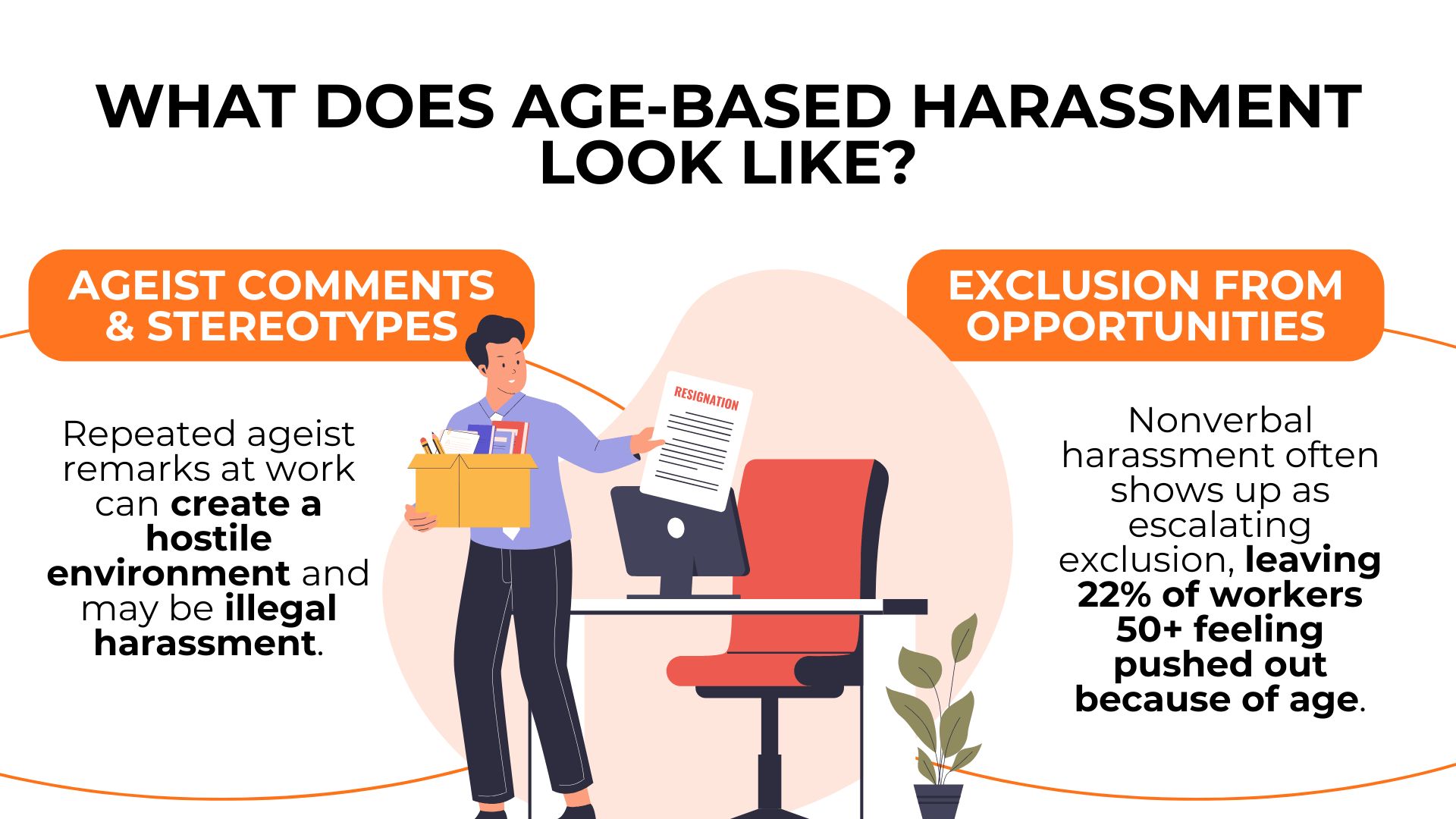
Age-based harassment has become increasingly common in discrimination charges. According to the EEOC (2018), 21% of ADEA charges alleged age-based harassment in 2017—more than triple the 6% in 1992. This dramatic increase reflects both growing awareness and persistent workplace ageism.
Ageist Comments and Stereotypes
Daily workplace interactions can create a hostile environment through comments that demean or stereotype older workers. Common examples of ageist remarks and behaviors include:
- Nicknames or references like “dinosaur,” “old timer,” “grandpa/grandma,” or “over the hill”
- Comments suggesting older workers can’t learn new skills or adapt to change
- Jokes about memory, hearing, physical appearance, or retirement
- Assumptions that older workers are “just marking time until retirement”
- Dismissive responses when older workers contribute ideas (“that’s how we used to do it”)
- Comments about “dead wood” or the need to “get rid of” long-tenured employees
When these comments come from supervisors or occur frequently enough to affect the work environment, they may constitute illegal harassment.
Exclusion From Meetings and Opportunities
Harassment isn’t always verbal. Systematic exclusion from meetings, projects, client interactions, and professional development opportunities can marginalize older workers and signal they’re no longer valued. This exclusion often escalates over time—first fewer meeting invitations, then removal from key projects, then reduced client contact.
According to AARP Research (2024-2025), 22% of workers age 50 and older feel they are being pushed out of their job because of their age. This perception often stems from exclusionary treatment that communicates the message without explicit words.
When Harassment Becomes Legally Actionable
Not every ageist comment creates legal liability. Under federal and state law, harassment must be severe or pervasive enough to create a hostile work environment—meaning it alters the conditions of employment and would be considered hostile by a reasonable person.
A single offhand comment typically won’t meet this standard. However, persistent stereotyping, regular ageist jokes, systematic exclusion, or a combination of these behaviors can create an actionable hostile environment. New Jersey courts have recognized that even a single incident can be sufficient in rare and extreme cases, particularly when it comes from a high-ranking official.
What Are Examples of Subtle Age Discrimination?
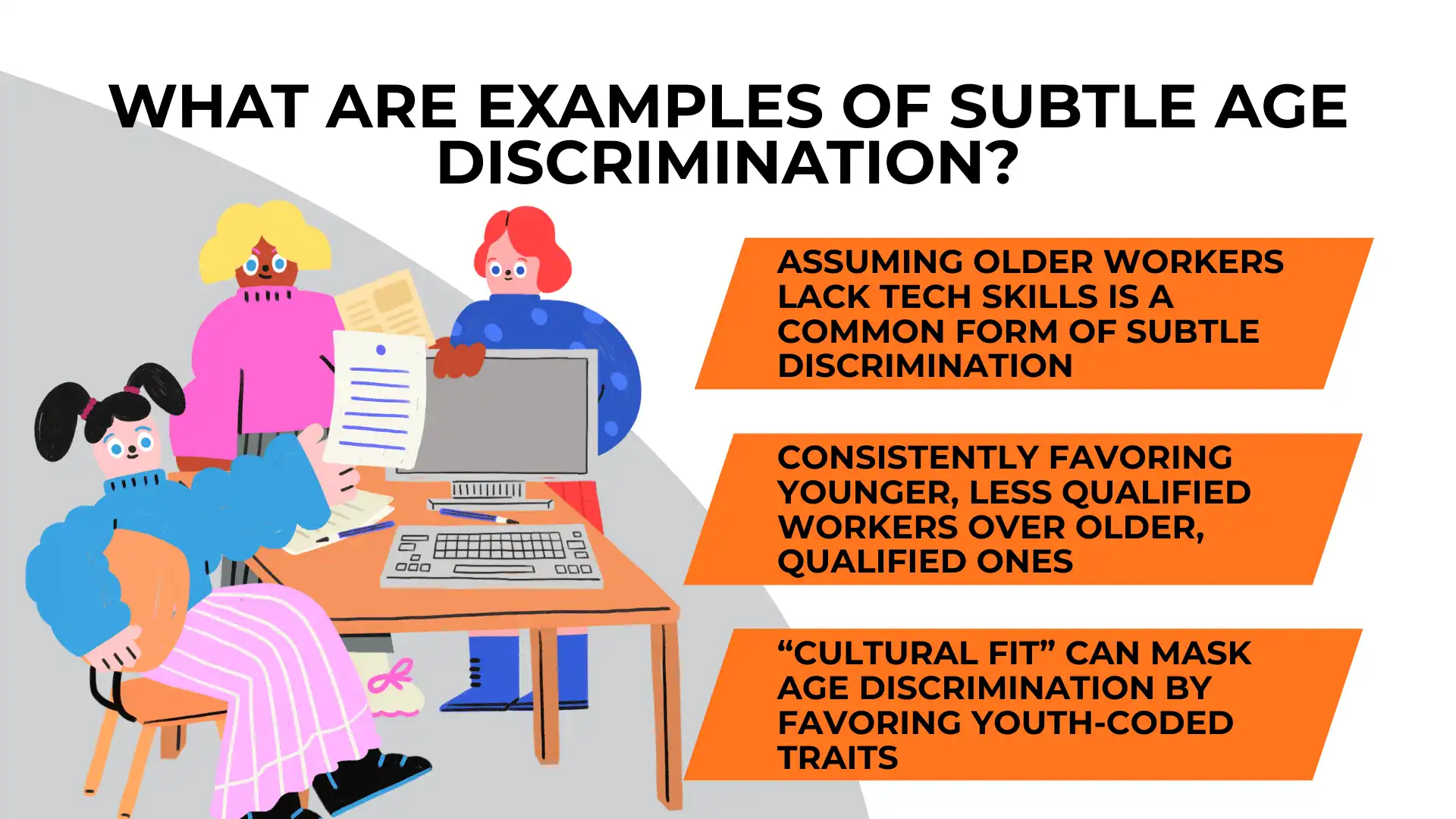
Beyond overt termination and harassment, age discrimination often operates through assumptions and microaggressions that accumulate over time. According to AARP Research (2024-2025), 60% of workers age 50 and older have experienced subtle forms of age discrimination.
Technology and Training Assumptions
One of the most common subtle discrimination patterns involves assumptions about older workers’ technology skills. AARP’s research found that 33% of workers 50 and older experienced assumptions about their ability to learn or use technology. These assumptions often become self-fulfilling when employers exclude older workers from technology training or automatically assign tech-related tasks to younger colleagues.
Similarly, 20% of workers 50 and older report receiving less access to training opportunities. This exclusion from professional development signals that employers don’t see value in investing in older workers’ continued growth—and it creates real disadvantages when skills requirements evolve.
Being Passed Over for Opportunities
Patterns of being passed over for promotions, high-profile projects, or leadership opportunities often reflect age-based assumptions about commitment, adaptability, or future tenure. When younger, less experienced colleagues consistently receive opportunities that more qualified older workers don’t, discrimination may be operating even without explicit age-based statements.
According to the EEOC (2018), charges alleging discriminatory terms and conditions of employment—which includes promotion and opportunity disparities—increased from 13% in 1992 to 25% in 2017.
The “Cultural Fit” Problem
Vague criteria like “cultural fit” can mask age discrimination in both hiring and advancement decisions. When employers describe their ideal candidate or promotion candidate in terms that correlate with youth—”high energy,” “digital native,” “startup mentality”—they may be filtering out qualified older workers without explicitly referencing age.
Research on the tech industry illustrates this pattern. According to the EEOC’s “High Tech, Low Inclusion” report (2024), workers age 40 and older in the high-tech workforce declined from 55.9% in 2014 to 52.1% in 2022. This declining representation suggests that older workers face barriers in an industry that often prizes youth-associated characteristics.
Who Is Protected From Age Discrimination?
Understanding who qualifies for protection helps workers assess whether their treatment may be actionable. Federal and state laws establish different thresholds.
Federal Protection Under the ADEA
The Age Discrimination in Employment Act protects workers age 40 and older from discrimination by employers with 20 or more employees, as established in 29 U.S.C. § 631(a) and § 630(b). This includes state and local government employers regardless of size, following the Supreme Court’s decision in Mount Lemmon Fire District v. Guido, 586 U.S. 1 (2018).
Federal protection covers discrimination in hiring, firing, pay, job assignments, promotions, layoffs, training, benefits, and any other term or condition of employment. The ADEA prohibits both intentional discrimination and policies that have a disproportionate adverse impact on older workers.
Broader Protection Under State Laws
State laws often provide stronger protections than federal law. Pennsylvania’s Human Relations Act (43 P.S. § 954(b) and § 955(a)) protects workers age 40 and older but covers employers with just four or more employees—reaching many workers who fall outside ADEA coverage.
New Jersey’s Law Against Discrimination (N.J.S.A. 10:5-5 and 10:5-12(a)) provides the broadest protection, covering workers age 18 and older with no minimum employer size. This means New Jersey workers can bring “reverse” age discrimination claims if they face bias for being too young, and workers at very small employers still have legal recourse.
How Do You Know If You Have a Valid Claim?
Recognizing discrimination patterns is the first step. Determining whether you have an actionable legal claim requires understanding what qualifies as an adverse employment action and when an attorney evaluation makes sense.
Recognizing Adverse Employment Actions
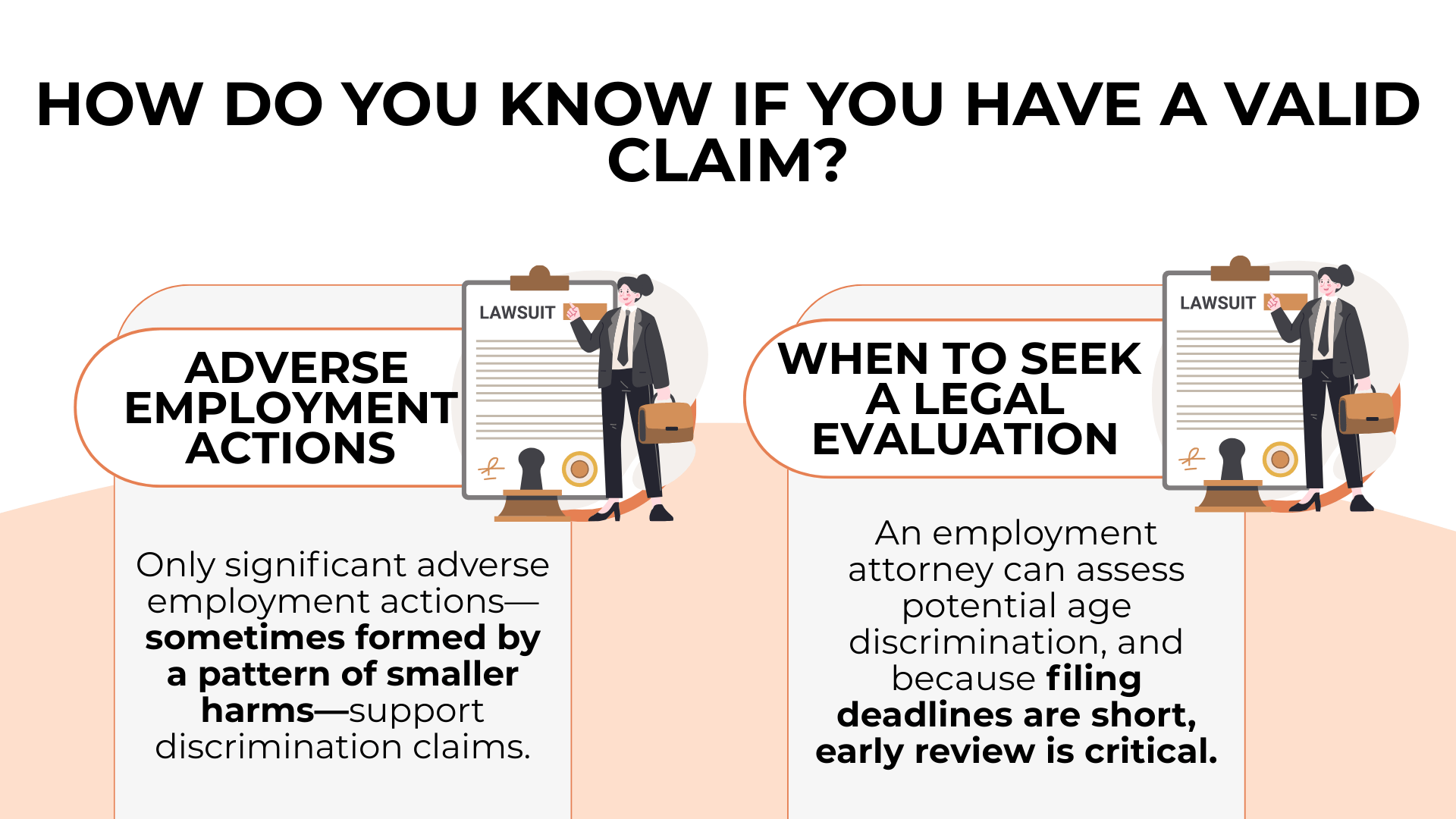
Not every unfair workplace experience constitutes illegal discrimination. Legal claims require an adverse employment action—a significant change in employment status or conditions. Clear adverse actions include termination, demotion with reduced pay or status, failure to hire, failure to promote, and significant reduction in responsibilities or pay.
Courts generally don’t consider minor inconveniences or interpersonal conflicts to be adverse actions. However, a pattern of individually small actions—exclusion, reduced responsibilities, negative evaluations—can sometimes amount to discrimination when considered together, particularly in constructive discharge situations where conditions become so intolerable that a reasonable person would feel compelled to resign.
When to Seek a Legal Evaluation
An employment attorney can help you assess whether your experience rises to the level of actionable discrimination. Consider seeking an evaluation when you observe patterns affecting you or other older workers, when your treatment changed significantly after reaching a certain age or tenure, or when explanations for adverse decisions don’t match the facts you’ve observed.
Time matters in discrimination claims. Federal charges must generally be filed within 300 days of the discriminatory act, while Pennsylvania requires complaints within 180 days. New Jersey allows two years for court filings. Early evaluation helps preserve your options.
Frequently Asked Questions
Can age discrimination happen to someone under 40?
Under federal law and Pennsylvania law, age discrimination protection begins at age 40. However, New Jersey’s Law Against Discrimination protects workers age 18 and older, meaning younger workers in New Jersey can bring age discrimination claims if they face bias for being “too young” as established in Bergen Commercial Bank v. Sisler, 157 N.J. 188 (1999).
Is being called “overqualified” a form of age discrimination?
“Overqualified” is often coded language for age bias, particularly when directed at older applicants. While employers can legitimately decline candidates they believe will be dissatisfied with a role, using “overqualified” as a pretext to reject older applicants violates anti-discrimination laws. The pattern of how an employer uses this term—whether it’s applied to younger candidates with similar credentials—can reveal discriminatory intent.
Does my employer need to say something about my age for it to be discrimination?
No. Age discrimination can be proven through circumstantial evidence without any explicit age-related statements. Patterns such as younger workers receiving preferential treatment, sudden negative performance reviews after years of good evaluations, or statistical disparities in layoffs can establish discrimination. Most successful claims rely on this type of circumstantial evidence rather than direct statements.
Are ageist jokes at work considered discrimination?
Ageist jokes can constitute discrimination when they’re severe or pervasive enough to create a hostile work environment. A single joke typically isn’t enough, but regular ageist humor—particularly from supervisors—can create legal liability. According to the EEOC, harassment claims in age discrimination charges have more than tripled since 1992, reflecting increased recognition of this problem.
How common is age discrimination in the workplace?
Age discrimination is widespread. AARP research shows that 64% of workers age 50 and older have seen or experienced age discrimination. The EEOC received over 16,000 age discrimination charges in fiscal year 2024, a 41% increase since 2022. These numbers likely underrepresent the problem, as many workers don’t file formal complaints.
Taking the Next Step
Age discrimination takes many forms—from blatant termination decisions to subtle daily marginalization. The examples discussed here represent patterns that employment attorneys see regularly: hiring callbacks that drop dramatically for older applicants, layoffs that disproportionately target workers over 40, ageist comments that accumulate into a hostile environment, and opportunity doors that close as workers age.
Recognizing these patterns is the first step toward addressing them. Federal law, Pennsylvania law, and New Jersey law all provide protections for workers who face age-based discrimination, though the specific requirements and remedies differ by jurisdiction.
If you have questions about age discrimination in your workplace, contact The Lacy Employment Law Firm to discuss your situation.