
If you are over 40 and have noticed a shift in how you are treated at work—fewer opportunities, pointed comments about your age, or a sudden termination after years of strong performance—you may be experiencing age discrimination. You are not alone. Federal data shows age discrimination charges have surged 41% in recent years, and nearly two-thirds of older workers report witnessing or experiencing age-based mistreatment.
This article explains what age discrimination looks like in practice, how common it is, who is protected under federal and state law, and what deadlines you face if you want to take action. Whether you work in Pennsylvania, New Jersey, or elsewhere, understanding your rights is the first step toward protecting your career and financial security.
What Does Age Discrimination in the Workplace Look Like?
Age discrimination takes many forms, from blatant terminations targeting older workers to subtle patterns of exclusion that accumulate over time. Recognizing these patterns is essential because discrimination is often disguised behind neutral-sounding justifications.
Termination and Forced Retirement
The most common form of age discrimination involves firing or forcing out older workers. According to EEOC enforcement data (2018), 55% of all age discrimination charges allege discriminatory discharge—making termination the dominant claim type. This figure has increased from 45% in 1992, reflecting a growing trend of employers targeting older workers for removal.
Forced retirement scenarios often involve pressure to “voluntarily” retire, elimination of positions held primarily by older workers, or sudden performance criticisms after years of positive reviews. When an employer replaces a terminated older worker with someone substantially younger, it raises a strong inference of discrimination.
Subtle Forms of Age Bias
Not all age discrimination is obvious. According to AARP research (2024-2025), 60% of workers age 50 and older have experienced subtle forms of age discrimination. These microaggressions often go unreported because workers do not recognize them as illegal or believe they cannot prove them.
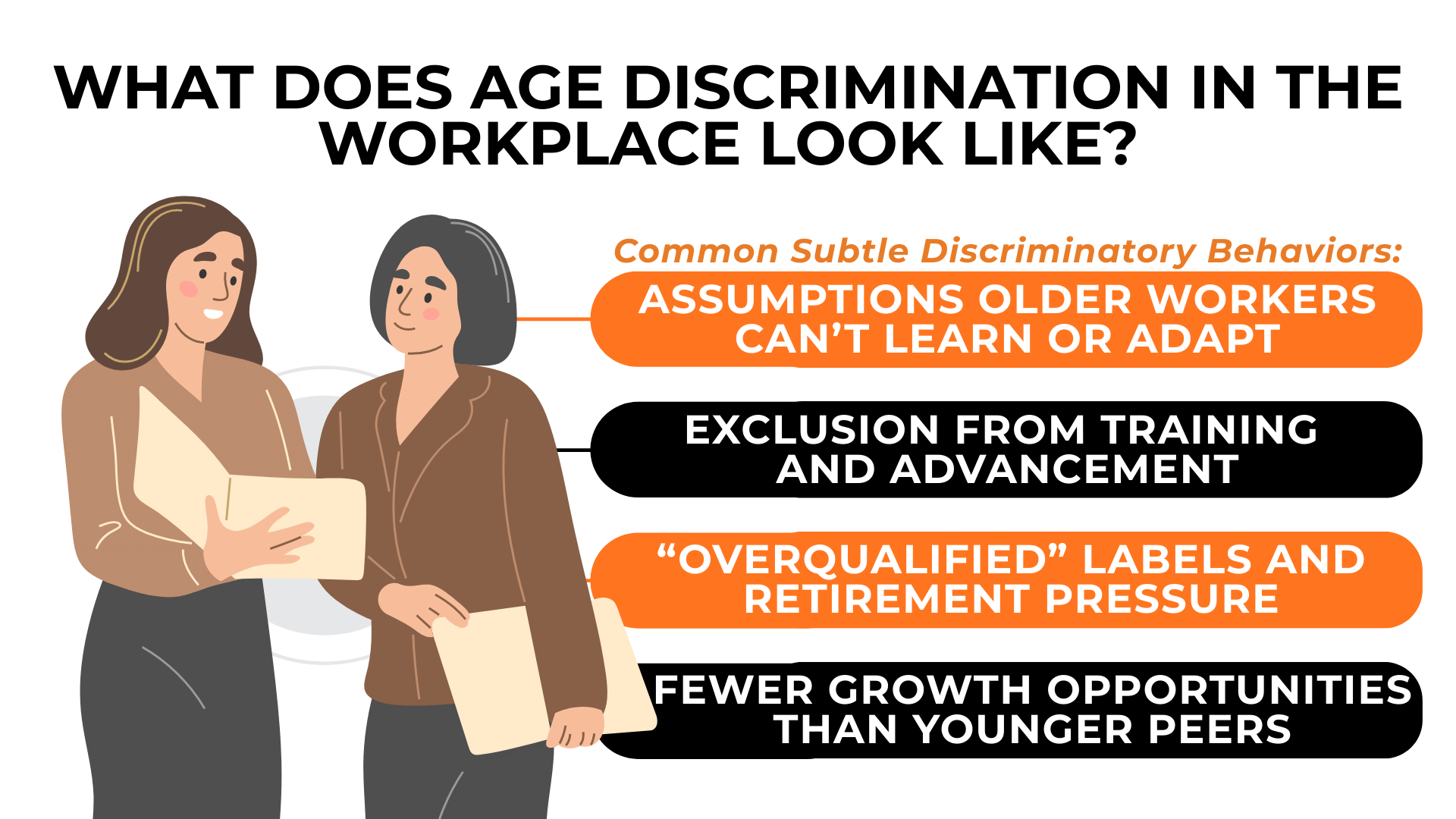
Common subtle discriminatory behaviors include:
- Assumptions that older workers cannot learn new technology, reported by 33% of workers surveyed
- Beliefs that older employees are resistant to change, cited by 24-25% of respondents
- Exclusion from training opportunities or professional development programs
- Comments about being “overqualified” during hiring or promotion decisions
- Repeated questions about retirement plans or timeline
- Assignment of less desirable projects while younger colleagues receive career-building opportunities
These patterns, when documented, can support a discrimination claim even without explicit age-based statements.
Harassment and Hostile Comments
Age-based harassment has become increasingly common. According to EEOC data (2018), 21% of age discrimination charges now allege harassment—more than triple the 6% rate in 1992. Comments like “dinosaur,” “over the hill,” or “too old to learn new tricks” can contribute to a hostile work environment when they are severe or pervasive enough to alter working conditions.
How Common Is Age Discrimination Today?
Age discrimination is not rare or isolated. Federal enforcement data and worker surveys reveal a significant and growing problem that affects millions of older Americans.
Federal Charge Statistics
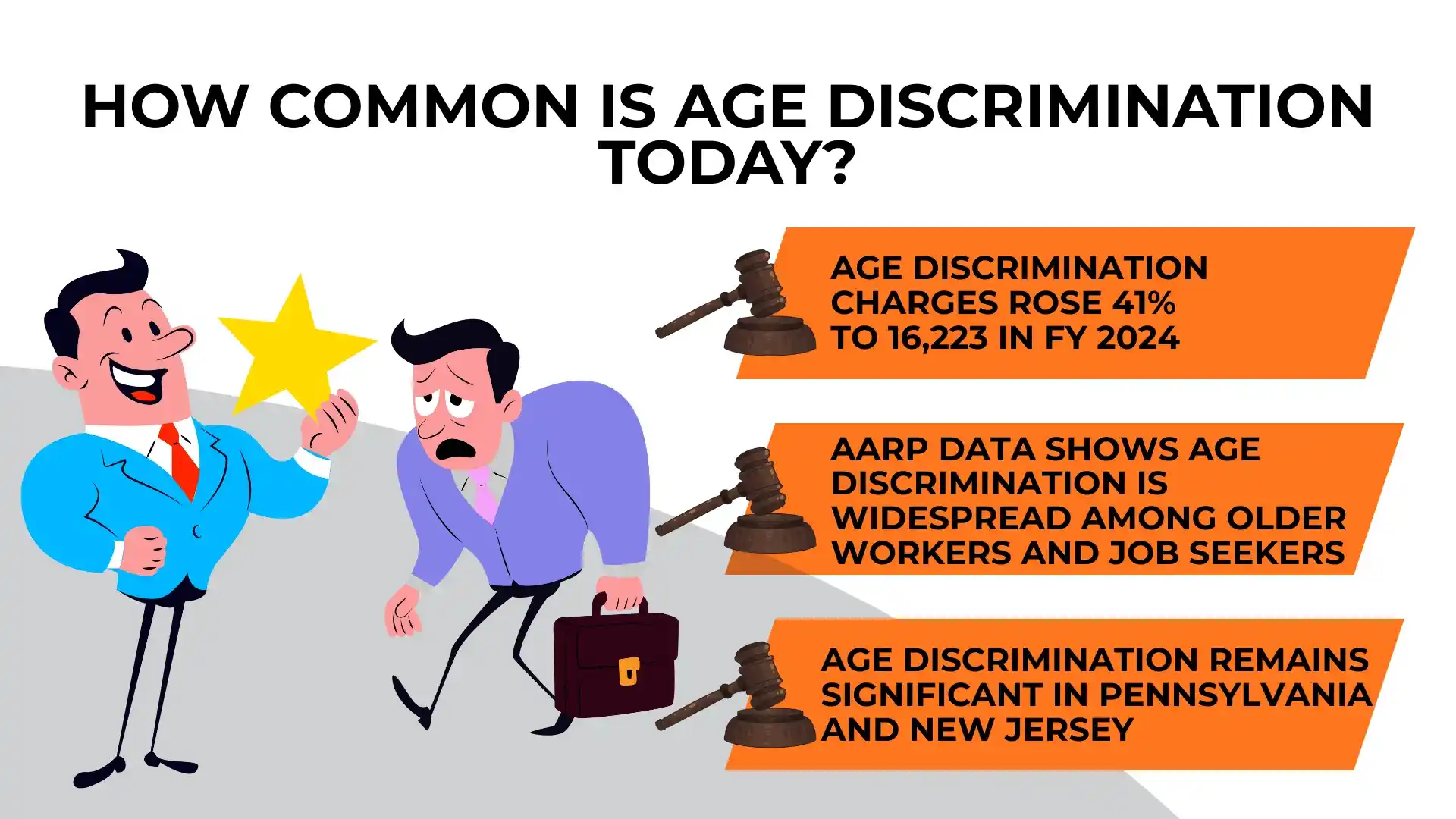
The number of age discrimination charges filed with the Equal Employment Opportunity Commission has increased dramatically in recent years. According to EEOC enforcement statistics (2025), 16,223 age discrimination charges were filed in fiscal year 2024. This represents a 41% increase from fiscal year 2022, when 11,500 charges were filed.
This surge occurred despite overall workforce conditions remaining relatively stable, suggesting that age-based employment practices have become more prevalent or that workers have become more willing to report them. Age discrimination charges now represent a significant portion of the 88,531 total discrimination charges the EEOC received in FY 2024.
What Workers Report Experiencing
Survey data paints an even broader picture than formal charge statistics. According to AARP research (2025), 64% of workers age 50 and older have seen or experienced age discrimination in the workplace. This figure suggests that the majority of older workers encounter age bias at some point in their careers.
The problem extends to hiring as well. According to AARP survey data (2024-2025), 74% of older job seekers believe their age will be considered a barrier by hiring managers. This perception is supported by audit studies showing measurable discrimination in callback rates for older applicants.
Pennsylvania and New Jersey Filing Trends
Workers in Pennsylvania and New Jersey file age discrimination charges at notable rates. According to EEOC state data (2022), Pennsylvania workers filed 695 age discrimination charges in FY 2022, representing 17.1% of all Pennsylvania discrimination charges. Pennsylvania accounted for 6.0% of all age discrimination charges filed nationally—significantly higher than its 3.9% share of the U.S. population.
In New Jersey, EEOC data (2022) shows 197 age discrimination charges filed in FY 2022, representing 15.5% of total New Jersey charges. While this represents a decline from the 2010 peak of 448 charges, age discrimination remains a significant portion of workplace complaints in the state.
Who Is Protected Under Age Discrimination Laws?
Protection against age discrimination depends on your age, your employer’s size, and which state you work in. Federal and state laws have different coverage thresholds that determine whether you have a legal claim.
Federal ADEA Protection
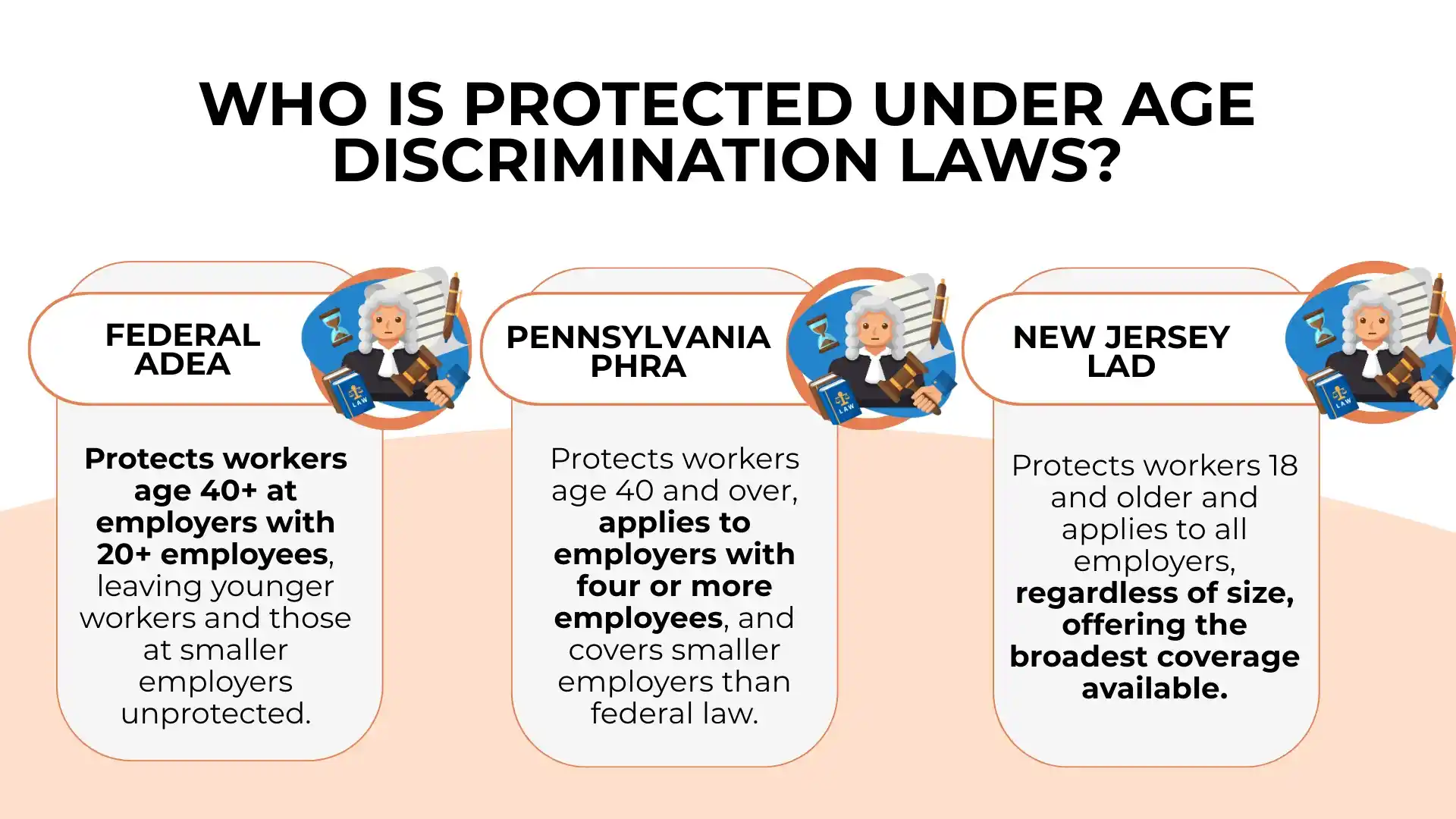
The Age Discrimination in Employment Act (ADEA), codified at 29 U.S.C. § 631(a), protects workers who are 40 years of age or older. The law applies to employers with 20 or more employees, including state and local governments. Under the Supreme Court’s decision in Mount Lemmon Fire District v. Guido, 586 U.S. 1 (2018), government employers are covered regardless of their employee count.
The ADEA prohibits discrimination in hiring, firing, compensation, and other terms and conditions of employment. However, it does not protect workers under 40, and it does not apply to small employers with fewer than 20 employees.
Pennsylvania PHRA Coverage
The Pennsylvania Human Relations Act (PHRA), 43 P.S. § 954(b), also protects workers age 40 and older but applies to a broader range of employers. The PHRA covers employers with four or more employees, extending protection to workers at smaller businesses who would not be covered under federal law.
This means a 52-year-old worker at a Pennsylvania company with 15 employees can file a state claim under the PHRA even though the federal ADEA would not apply. The PHRA provides an important alternative for workers at mid-sized employers.
New Jersey LAD Advantages
New Jersey’s Law Against Discrimination (LAD), N.J.S.A. 10:5-12(a), provides the broadest protection of the three jurisdictions. The LAD protects workers age 18 and older—not just those over 40—and applies to all employers regardless of size. As the New Jersey Supreme Court confirmed in Bergen Commercial Bank v. Sisler, 157 N.J. 188 (1999), even a 25-year-old can bring a “too young” discrimination claim under New Jersey law.
Key differences between the three jurisdictions:
- Federal ADEA: Protects workers 40+; requires employer to have 20+ employees; no protection for workers under 40 or at small employers
- Pennsylvania PHRA: Protects workers 40+; requires employer to have 4+ employees; extends coverage to smaller employers than federal law
- New Jersey LAD: Protects workers 18+; applies to all employers regardless of size; broadest coverage available
What Qualifies as Illegal Age Discrimination?
Not every unfair employment decision based on age is illegal. To have a valid claim, you must be able to establish specific legal elements and show that your employer took an action that the law recognizes as discriminatory.
The Four Elements of a Claim
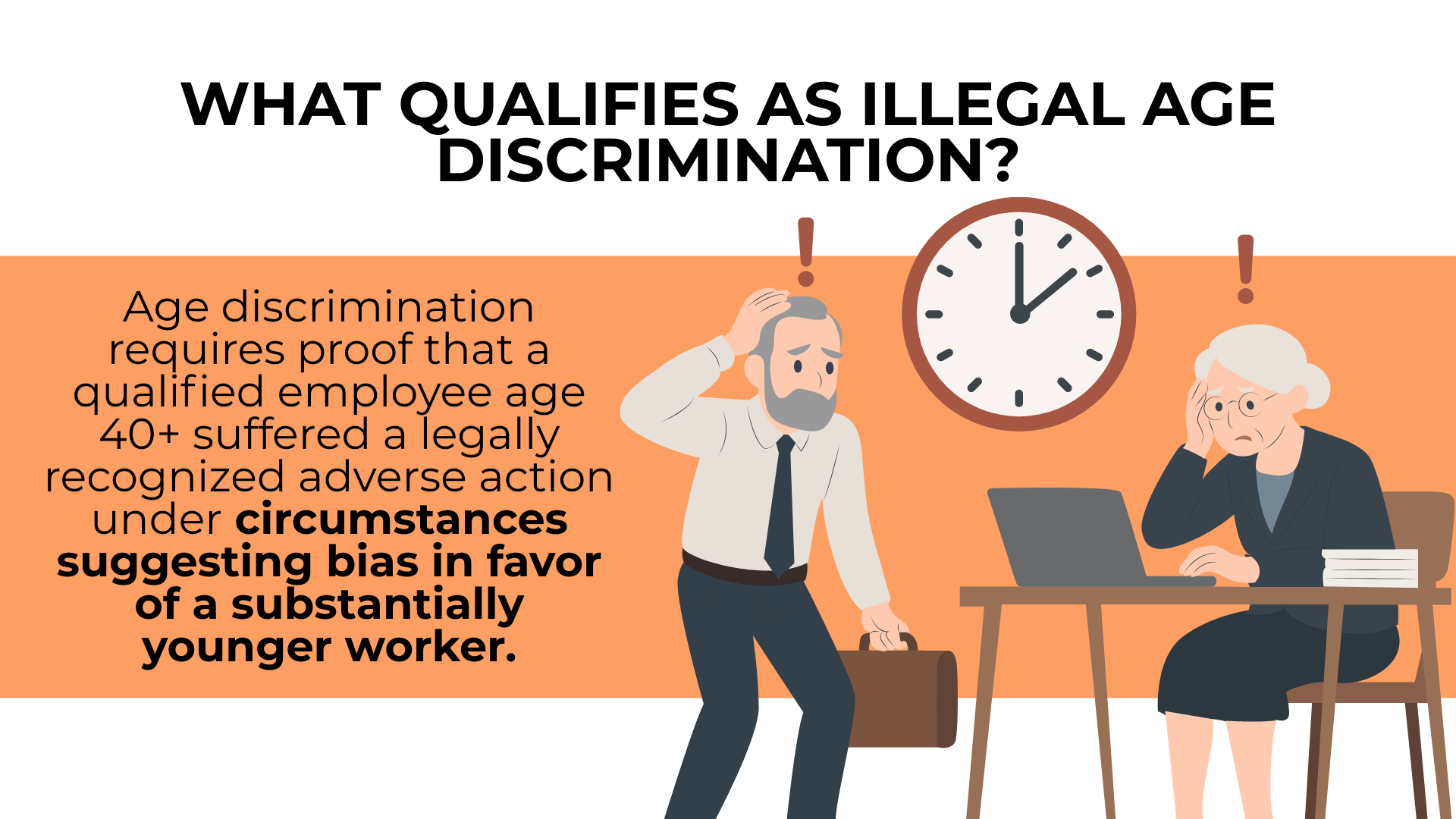
Under the framework established in McDonnell Douglas Corp. v. Green, 411 U.S. 792 (1973), and applied to age cases in the Third Circuit, a plaintiff must establish four elements to make out a prima facie case of age discrimination: (1) membership in the protected class (age 40 or older under federal law); (2) qualification for the position; (3) an adverse employment action; and (4) circumstances giving rise to an inference of discrimination.
The fourth element is typically satisfied by showing that the employer replaced you with someone “substantially younger” or treated younger employees more favorably under similar circumstances. As the Third Circuit explained in Fasold v. Justice, 409 F.3d 178 (3d Cir. 2005), the focus is on whether the age difference is significant enough to support an inference of discrimination.
What Counts as an Adverse Employment Action
An adverse employment action must involve a significant change in employment status. Under Burlington Industries, Inc. v. Ellerth, 524 U.S. 742 (1998), this includes termination, demotion with reduced pay or status, failure to promote, denial of merit increases, and significant changes in duties that reduce career prospects.
Courts generally reject claims based on minor inconveniences that do not affect pay, benefits, or job status. A lateral transfer that maintains your compensation typically does not qualify. However, constructive discharge—where conditions become so intolerable that a reasonable person would feel compelled to resign—can constitute an adverse action even though the employee technically quit.
The “Substantially Younger” Requirement
The Supreme Court clarified in O’Connor v. Consolidated Coin Caterers Corp., 517 U.S. 308 (1996), that your replacement does not need to be under 40 for you to have a claim. What matters is whether the replacement was “substantially younger” than you. A 60-year-old replaced by a 45-year-old may have a strong claim based on the 15-year age gap, even though both workers are in the protected class.
The Third Circuit does not apply a bright-line rule for what age gap is “substantial.” In Baron v. Abbott Laboratories, 672 Fed. Appx. 158 (3d Cir. 2016), the court found a one-year age gap insufficient. Courts examine the totality of circumstances, including the size of the age difference and other evidence suggesting age-based motivation.
What Are the Economic Consequences of Age Discrimination?
Age discrimination carries severe financial consequences for individual workers and imposes substantial costs on the broader economy. Understanding these impacts underscores why legal protections exist and why enforcement matters.
The Earnings Gap After Displacement
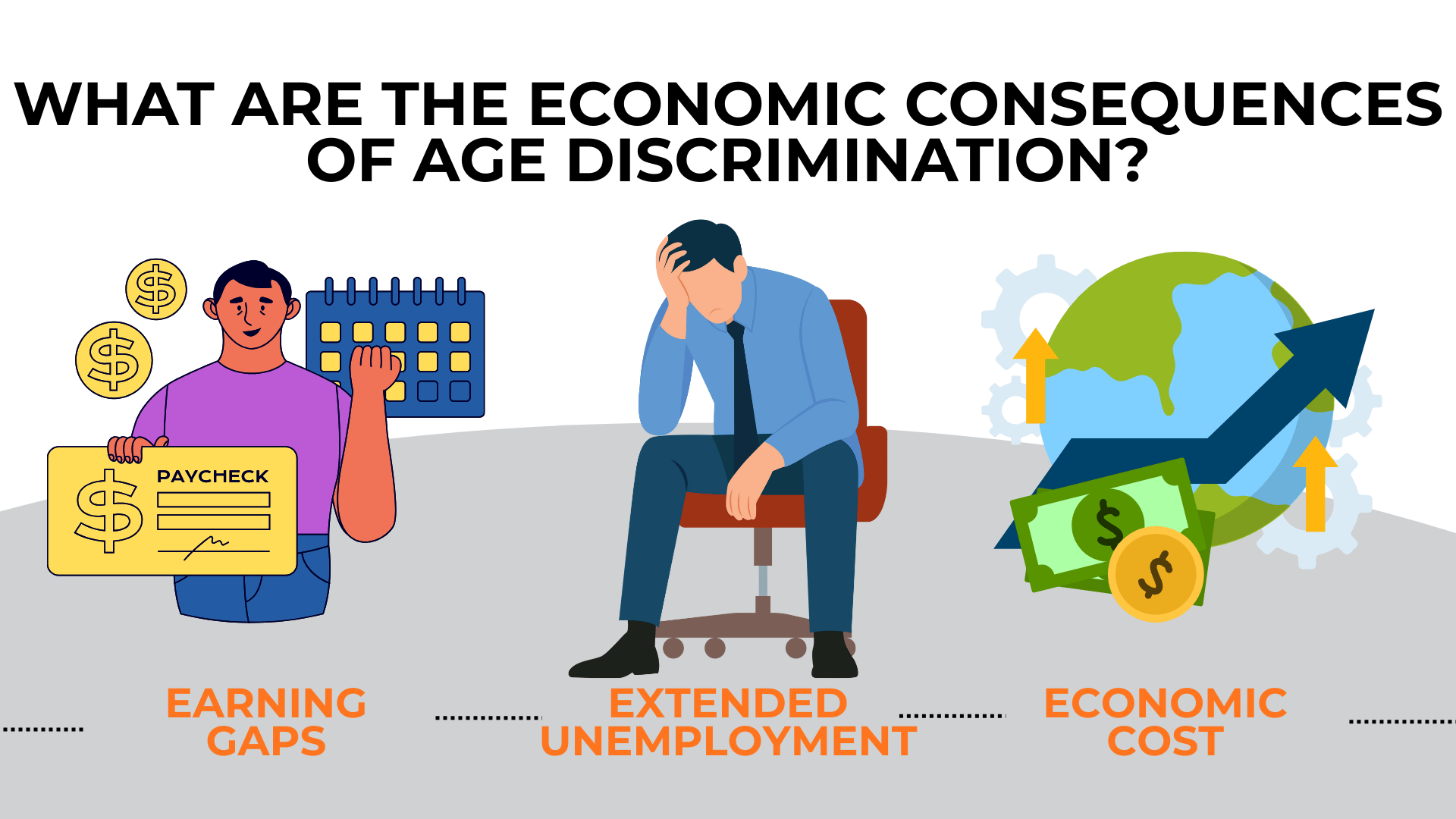
Older workers who lose their jobs face lasting financial harm that often never fully recovers. According to Urban Institute research (2018), only 10% of displaced older workers ever again earn as much as they did before their employment setback. The vast majority experience permanent income reductions.
This problem is widespread. According to a ProPublica and Urban Institute analysis (2018), 56% of workers in their 50s with stable, long-held jobs are pushed out or laid off at least once before they reach traditional retirement age. These involuntary separations often occur when workers are at their peak earning potential and have significant financial obligations.
Extended Unemployment for Older Workers
When older workers lose their jobs, they face significantly longer periods of unemployment than younger workers. According to Bureau of Labor Statistics data (2024), the median unemployment duration for workers ages 55-64 is 10.7 weeks—more than double the 5.2-week median for teenagers ages 16-19.
The problem is more severe for many older job seekers. According to AARP analysis of BLS data (2025), 28.2% of unemployed workers age 55 and older were long-term unemployed (seeking work for 27 weeks or more) as of December 2025. Extended unemployment depletes savings, affects retirement security, and can lead to permanent workforce exit.
The Broader Economic Cost
Age discrimination harms not just individual workers but the entire economy. According to AARP and The Economist Intelligence Unit (2020), age discrimination cost the U.S. economy an estimated $850 billion in lost GDP in 2018. This figure accounts for involuntary retirement, underemployment, and unemployment among workers who would otherwise contribute productively.
If current patterns continue, these losses will grow substantially. The same research projects annual economic losses of $3.9 trillion by 2050 if age discrimination persists at current levels.
What Are the Filing Deadlines for Age Discrimination Claims?
Strict time limits apply to age discrimination claims. Missing these deadlines can permanently bar your ability to seek legal relief, regardless of how strong your underlying case may be.
Federal EEOC Deadlines
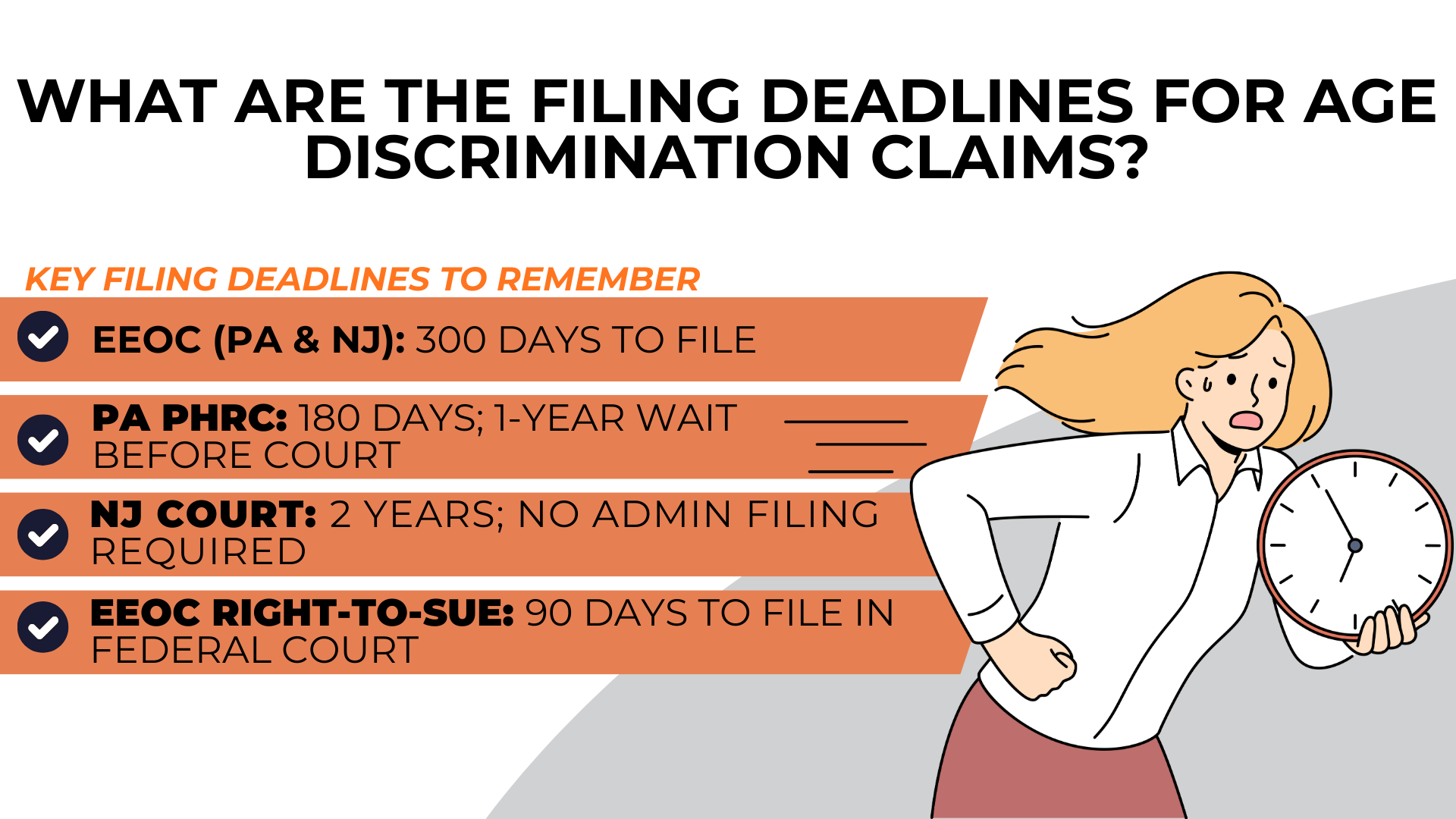
To file a federal age discrimination lawsuit, you must first file a charge with the Equal Employment Opportunity Commission. Under 29 U.S.C. § 626(d), the deadline is 180 days from the discriminatory act in most states. However, Pennsylvania and New Jersey are “deferral states” with their own enforcement agencies, which extends the federal deadline to 300 days.
After filing your EEOC charge, you may file a lawsuit in federal court 60 days later without waiting for a right-to-sue letter. Alternatively, you can wait for the EEOC to complete its investigation and issue a Notice of Dismissal and Right to Sue, then file within 90 days of receiving that notice. Courts enforce the 90-day deadline strictly.
Pennsylvania PHRC Requirements
Pennsylvania law requires filing with the Pennsylvania Human Relations Commission within 180 days of the discriminatory act under 43 P.S. § 959(h). This deadline is shorter than the 300-day EEOC deadline, creating a trap for workers who wait too long. Missing the 180-day PHRC deadline forfeits your state law claim, even if your federal claim remains viable.
After filing with the PHRC, you must generally wait one year for the agency to investigate or issue a right-to-sue letter before you can file in court. This waiting period can delay access to the courts and makes early filing particularly important.
New Jersey’s Direct Court Filing Option
New Jersey provides a significant advantage for discrimination plaintiffs. Under N.J.S.A. 10:5-12, workers can file a lawsuit directly in Superior Court without any administrative filing requirement. The statute of limitations under N.J.S.A. 2A:14-2(a) is two years from the discriminatory act.
This direct court access eliminates the administrative delays that Pennsylvania and federal plaintiffs face. Combined with New Jersey’s broader protections—coverage of all employer sizes and protection starting at age 18—the LAD provides the most plaintiff-friendly framework in the region.
Key filing deadlines to remember:
- EEOC (federal): 300 days in Pennsylvania and New Jersey (deferral states)
- Pennsylvania PHRC: 180 days; then one-year waiting period before court filing
- New Jersey Superior Court: 2 years; no administrative filing required
- After EEOC right-to-sue letter: 90 days to file federal lawsuit (strictly enforced)
Because these deadlines are strict and cannot be extended, consulting with an attorney promptly protects your options.
What Damages Can You Recover in an Age Discrimination Case?
The compensation available in an age discrimination case depends on which laws apply and how your employer behaved. Federal and state laws provide different remedies, with state claims often offering broader recovery options.
Federal ADEA Remedies
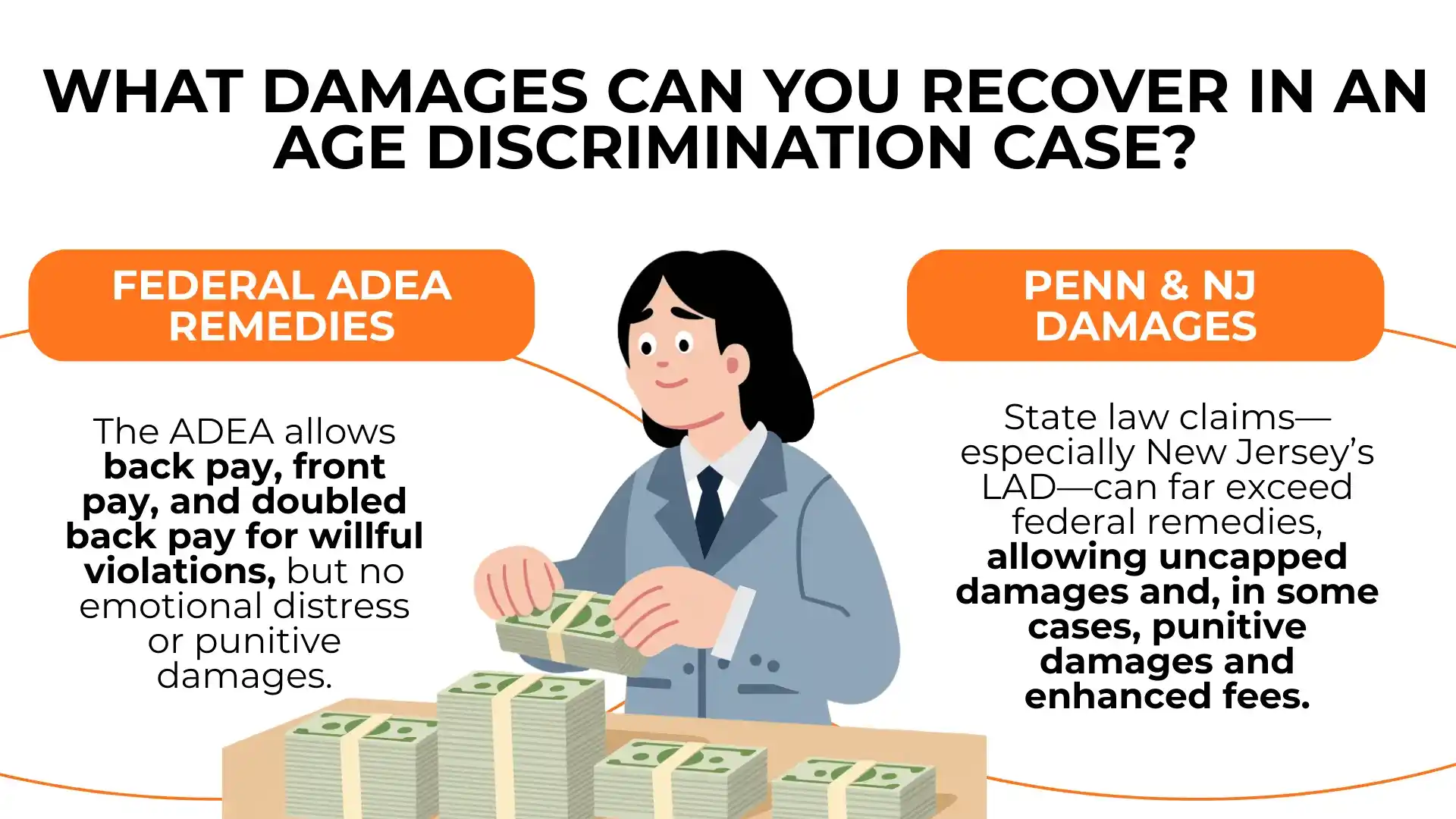
Under the ADEA, successful plaintiffs can recover back pay (lost wages from the date of discrimination to the date of judgment, minus earnings from other employment) and front pay (future lost earnings when reinstatement is not practical). The ADEA incorporates Fair Labor Standards Act remedies under 29 U.S.C. § 626(b).
For “willful” violations—where the employer knew its conduct violated the ADEA or acted with reckless disregard—the court may award liquidated damages equal to the back pay amount, effectively doubling the recovery. As the Supreme Court explained in Trans World Airlines, Inc. v. Thurston, 469 U.S. 111 (1985), willfulness requires more than mere negligence but does not require proof of malicious intent.
Importantly, the ADEA does not allow compensatory damages for emotional distress or punitive damages. This limitation makes federal claims less valuable than state claims in many cases.
Pennsylvania and New Jersey Damages
State law claims can provide significantly greater recovery than federal claims. Under the Pennsylvania Human Relations Act, plaintiffs can recover uncapped compensatory damages, including damages for emotional distress. However, as the Pennsylvania Supreme Court held in Hoy v. Angelone, 720 A.2d 745 (Pa. 1998), punitive damages are not available under the PHRA.
New Jersey’s Law Against Discrimination provides the broadest remedies. The LAD allows uncapped compensatory damages plus punitive damages in cases involving “especially egregious” conduct where upper management participated or showed willful indifference. Under Rendine v. Pantzer, 141 N.J. 292 (1995), New Jersey courts may also enhance attorney fee awards by 20-35% in typical cases and up to 100% in exceptional cases.
Real Settlement Examples
Age discrimination cases have resulted in substantial recoveries in Pennsylvania and New Jersey. According to New Jersey Attorney General records (2023), the Camden City School District paid $175,487 in back pay plus pension credits to resolve an age discrimination hiring complaint. A New Jersey nurse who alleged her termination in a reduction in force was pretext for age discrimination settled for $115,000 (2025).
The EEOC recovered $3.18 million through ADEA litigation in FY 2024 (2025), and total EEOC recoveries for all discrimination types approached $700 million—the highest in the agency’s recent history.
Frequently Asked Questions
Can I file an age discrimination claim if the person who replaced me is also over 40?
Yes. The law focuses on whether your replacement was “substantially younger” than you, not whether they are over or under 40. The Supreme Court clarified this in O’Connor v. Consolidated Coin Caterers Corp., 517 U.S. 308 (1996). A 58-year-old replaced by a 42-year-old may have a valid claim based on the 16-year age gap.
What if my employer says I was fired for performance reasons but I had good reviews?
A strong performance history that suddenly becomes “poor” near the adverse action is common evidence of pretext. Under the Third Circuit’s Fuentes v. Perskie standard, 32 F.3d 759 (3d Cir. 1994), courts look for weaknesses, implausibilities, inconsistencies, or contradictions in the employer’s stated reasons that suggest the real motivation was discriminatory.
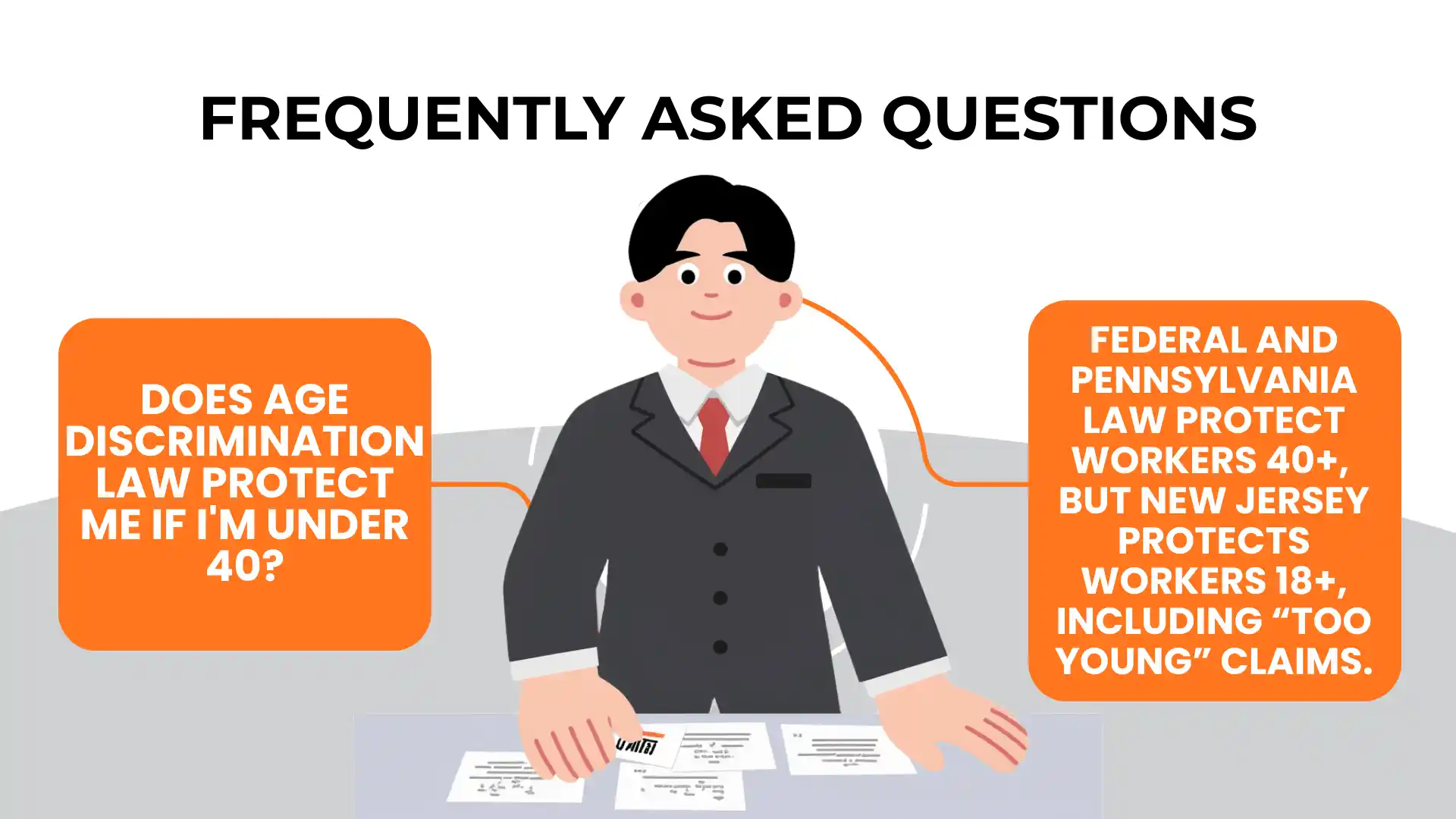
Does age discrimination law protect me if I’m under 40?
Federal law and Pennsylvania law protect only workers 40 and older. However, New Jersey’s Law Against Discrimination protects workers age 18 and older under N.J.S.A. 10:5-12(a). This means younger workers in New Jersey may have claims if they faced discrimination for being “too young,” as the New Jersey Supreme Court confirmed in Bergen Commercial Bank v. Sisler, 157 N.J. 188 (1999).
What counts as “subtle” age discrimination?
Subtle discrimination includes assumptions that older workers cannot learn new technology, exclusion from training opportunities, comments about being “overqualified” or questions about retirement plans, and being passed over for projects given to younger colleagues. AARP research shows these experiences are widespread, with 60% of workers 50 and older reporting subtle discrimination.
How long do I have to file a complaint after I’m fired?
Deadlines vary by jurisdiction. You have 300 days to file with the EEOC in Pennsylvania and New Jersey, but only 180 days to file with the Pennsylvania Human Relations Commission. New Jersey allows direct court filing within two years without any agency filing requirement. Missing these deadlines can permanently bar your claim.
Taking Action to Protect Your Rights
Age discrimination affects millions of workers, costs the economy hundreds of billions of dollars annually, and can permanently damage individual careers and retirement security. If you have experienced termination, demotion, harassment, or other adverse treatment that you believe was motivated by your age, the law provides remedies—but only if you act within the applicable deadlines.
Document what happened, preserve relevant communications, and understand which laws apply to your situation. Pennsylvania and New Jersey workers often have multiple legal options, and the differences between federal, Pennsylvania, and New Jersey law can significantly affect the strength and value of your claim.
If you believe you have experienced age discrimination in Pennsylvania or New Jersey, contact The Lacy Employment Law Firm to discuss your situation.