When sexual harassment disrupts your career and wellbeing, understanding your potential financial recovery becomes a pressing concern. Settlement amounts in workplace sexual harassment cases vary dramatically based on the severity of the conduct, the strength of evidence, and critically, whether you pursue your claim under federal law or New Jersey state law.
New Jersey’s Law Against Discrimination provides substantially better recovery potential than federal Title VII due to uncapped damages and broader employer coverage. This distinction often means the difference between a recovery limited to $300,000 and one that fully compensates you for economic losses and emotional harm.
What Factors Determine Workplace Sexual Harassment Settlement Amounts?
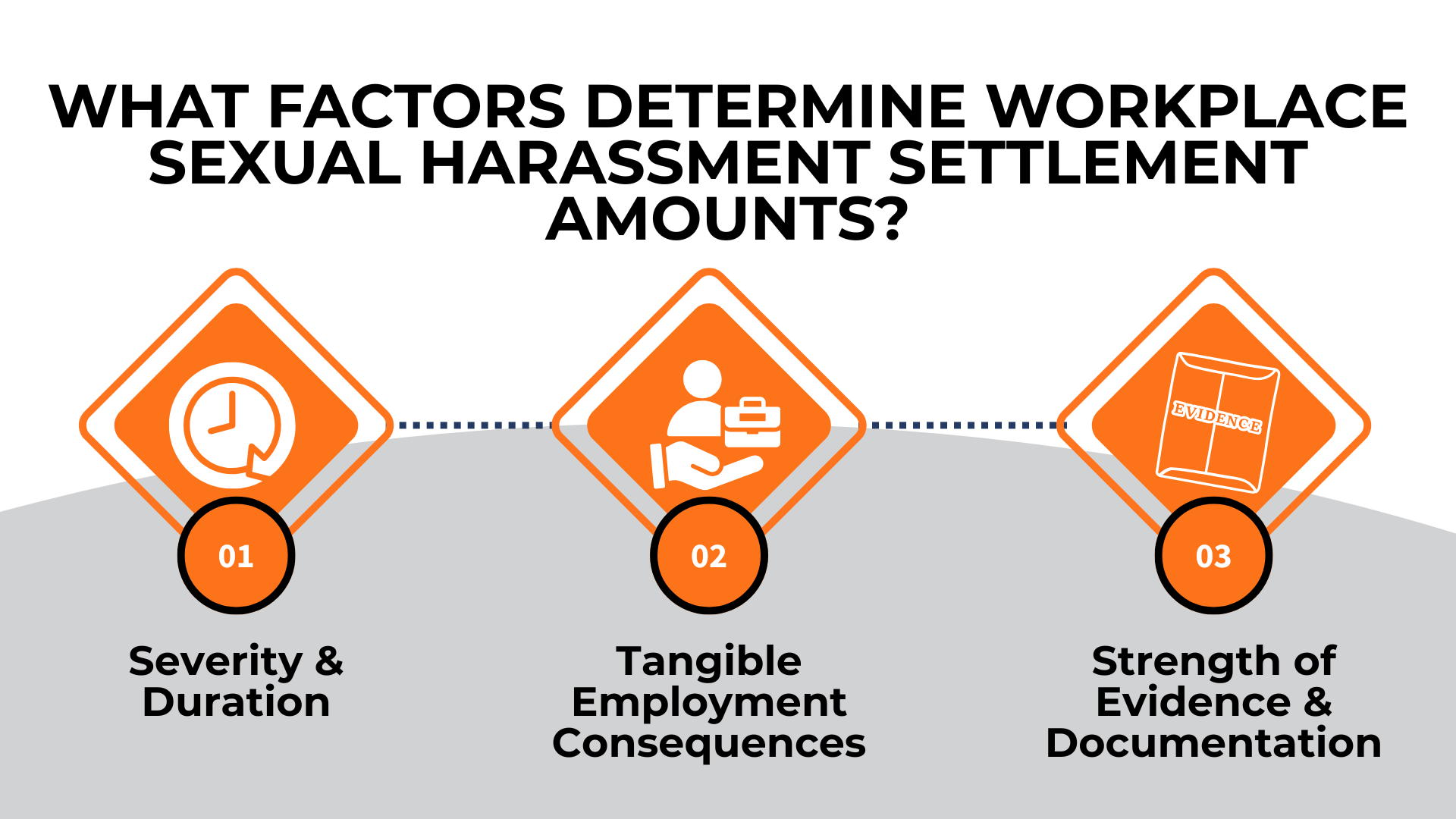
No fixed formula exists for calculating sexual harassment settlement values. Instead, several interconnected factors shape what your case might be worth.
Severity and duration of the harassment
Courts and settlement negotiations weigh both how severe the harassment was and how long it continued. A single incident of physical assault carries different weight than months of inappropriate comments. But duration isn’t everything—New Jersey courts have consistently held that even brief but severe conduct can be actionable. In Rios v. Meda Pharmaceutical, Inc., 247 N.J. 1 (2021), the New Jersey Supreme Court held that just two demeaning slurs from a supervisor could support a hostile work environment claim. Earlier, in Taylor v. Metzger, 152 N.J. 490 (1998), the court found a single racial epithet from a high-ranking official sufficient.
The nature of the conduct matters significantly. Physical touching or assault, explicit demands for sexual favors, and sustained campaigns of degrading comments typically command higher settlements than isolated inappropriate remarks. New Jersey also applies a “reasonable person of the same protected class” standard, meaning courts consider how a reasonable woman would perceive sexual harassment directed at a woman—not some generic reasonable person test. This subjective lens often works in plaintiffs’ favor when evaluating severity.
Whether you suffered tangible employment consequences
Cases involving concrete job consequences typically settle for more than those without visible employment changes. A tangible employment action includes being fired, demoted, denied a promotion, or having your responsibilities or benefits significantly reduced.
When a supervisor’s harassment results in a tangible employment action, the employer faces strict liability with no available defense under Burlington Industries, Inc. v. Ellerth, 524 U.S. 742 (1998). This automatic liability substantially strengthens settlement negotiations because employers cannot argue they took reasonable steps to prevent harassment.
The strength of your evidence and documentation
Strong documentation directly correlates with higher settlement values. Contemporaneous records, preserved communications, and identified witnesses create leverage that makes employers more willing to resolve claims favorably. Cases built on “he said, she said” alone face greater challenges than those supported by emails, text messages, or witness statements.
How Do Federal Damages Caps Limit Sexual Harassment Settlements?
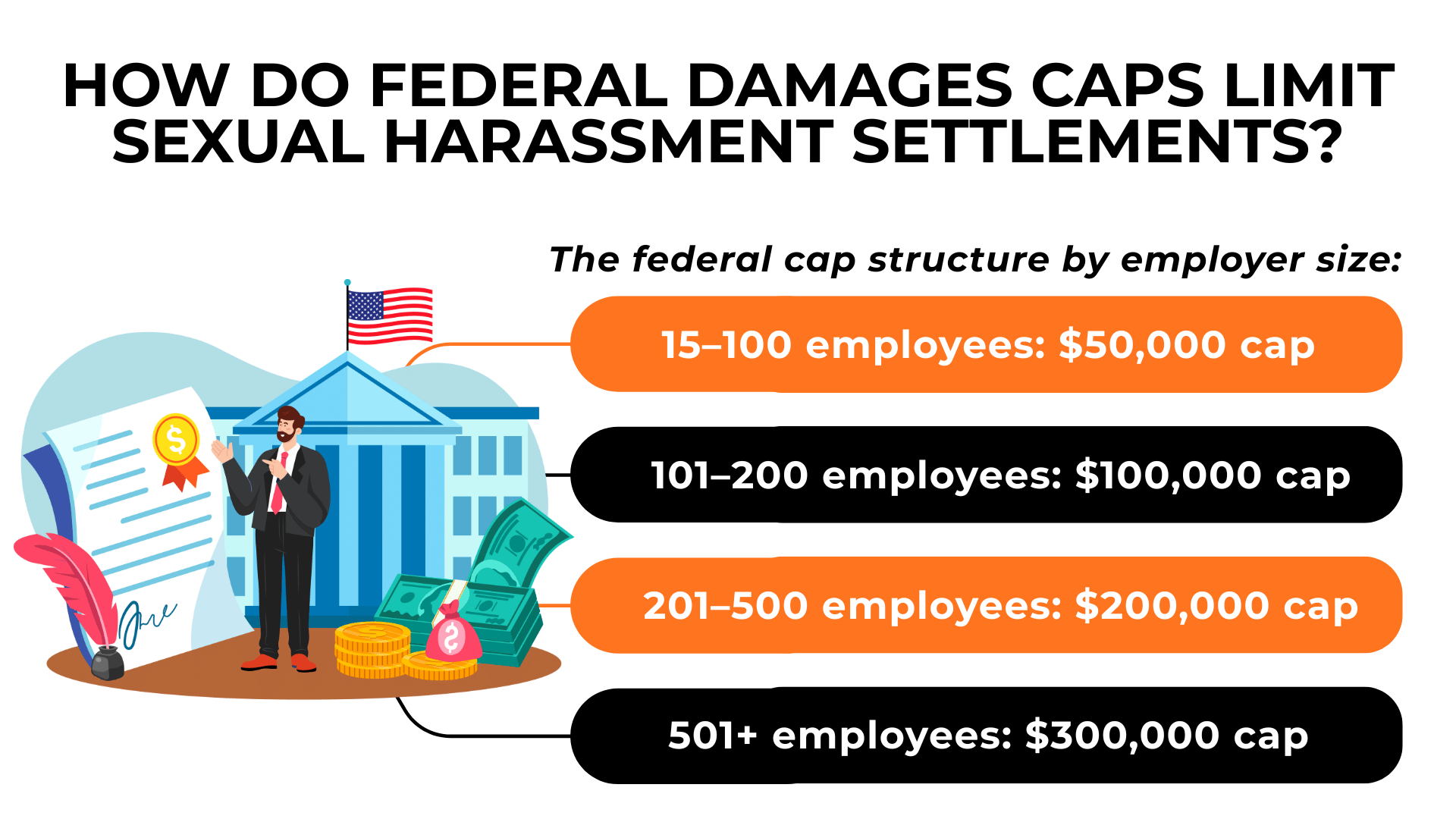
Federal law imposes strict limits on what you can recover in a Title VII sexual harassment case. Under 42 U.S.C. § 1981a(b)(3), combined compensatory and punitive damages cannot exceed caps tied to employer size.
The federal cap structure by employer size
The caps create a ceiling on non-economic damages regardless of how severe your harassment was:
- Employers with 15-100 employees: maximum combined compensatory and punitive damages of $50,000
- Employers with 101-200 employees: maximum combined damages of $100,000
- Employers with 201-500 employees: maximum combined damages of $200,000
- Employers with 501 or more employees: maximum combined damages of $300,000
These caps mean that even in egregious cases against large employers, federal law limits your emotional distress and punitive recovery to $300,000 combined. The jury deciding your case is never informed these caps exist under 42 U.S.C. § 1981a(c)(2).
What damages fall outside the caps
Not all damages count against federal caps. Back pay, which compensates for wages lost due to the harassment, is considered equitable relief and has no statutory limit. Front pay, which compensates for future lost earnings when reinstatement is not feasible, also falls outside the caps. The Supreme Court confirmed this in Pollard v. E.I. du Pont de Nemours & Co., 532 U.S. 843 (2001).
This means economic damages for lost income can exceed the caps, but compensation for emotional suffering remains strictly limited under federal law.
Why Does New Jersey Offer Better Settlement Potential Than Federal Law?
New Jersey’s Law Against Discrimination removes the obstacles that limit federal recoveries. For employees who experienced harassment in New Jersey, pursuing claims under NJLAD typically offers superior settlement potential.
Uncapped compensatory damages
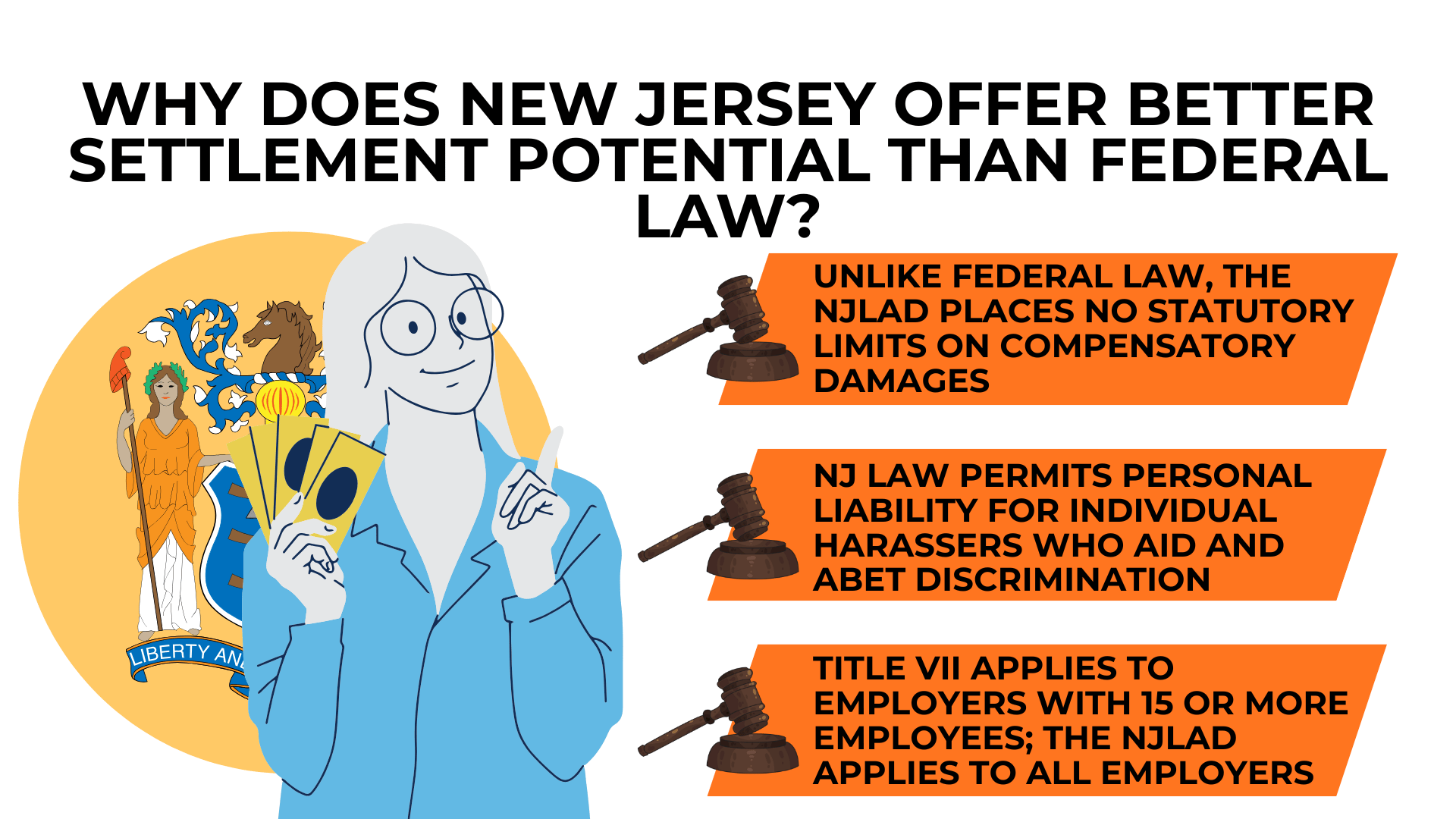
Unlike federal law, the NJLAD places no statutory limits on compensatory damages. This includes back pay, front pay, and emotional distress damages. The New Jersey Supreme Court upheld a $3.6 million front pay award in Quinlan v. Curtiss-Wright Corp., 204 N.J. 239 (2010), illustrating the potential scope of recovery under state law.
Punitive damages in New Jersey are subject to the Punitive Damages Act at N.J.S.A. 2A:15-5.9, which generally caps awards at five times compensatory damages or $350,000, whichever is greater. However, this still permits substantially larger punitive awards than federal caps allow in many cases.
Individual liability against the harasser
New Jersey law permits holding individual harassers personally liable under N.J.S.A. 10:5-12(e), which prohibits “aiding and abetting” discrimination. This means you can name your supervisor or harasser as a defendant alongside your employer. Federal Title VII provides no individual liability whatsoever.
This creates additional settlement leverage because individual defendants face personal financial exposure. A supervisor who harassed you may push for settlement to avoid personal judgment.
Coverage for employees at small businesses
Federal Title VII applies only to employers with 15 or more employees. The NJLAD applies to all employers regardless of size, including those with only one employee. This difference matters significantly because employees of small businesses have no federal remedy at all.
The following advantages make NJLAD the preferred vehicle for New Jersey harassment claims:
- No damages caps on compensatory damages including emotional distress
- Coverage for all employers regardless of size
- Individual liability against harassers personally
- No requirement to file an administrative complaint before suing
- Two-year statute of limitations for filing in Superior Court
- Broader definition of who qualifies as a “supervisor” for liability purposes
What Types of Damages Can You Recover in a Sexual Harassment Case?
Understanding the categories of available damages helps set realistic expectations for your potential recovery.
Economic damages: back pay and front pay
Back pay compensates you for wages and benefits lost due to the harassment. If you were fired, demoted, or forced to resign, back pay covers what you would have earned from the adverse action until resolution. This calculation includes salary, bonuses, health insurance, retirement contributions, and other employment benefits.
Front pay compensates for future lost earnings when returning to your job is not feasible. Courts award front pay when reinstatement would be impractical due to ongoing hostility, the employer’s demonstrated unwillingness to correct problems, or similar circumstances.
Compensatory damages for emotional harm
Compensatory damages address the non-economic harm harassment caused, including emotional distress, mental anguish, humiliation, loss of enjoyment of life, and damage to reputation. These damages recognize that harassment inflicts real psychological harm beyond lost wages.
Medical expenses for therapy, counseling, or treatment related to the harassment also fall within compensatory damages. Documenting treatment with mental health professionals strengthens claims for emotional distress compensation.
Punitive damages for egregious conduct
Punitive damages punish employers for particularly egregious conduct and deter future misconduct. Under federal law, punitive damages require proving the employer acted “with malice or with reckless indifference” to your rights under Kolstad v. American Dental Association, 527 U.S. 526 (1999).
Under New Jersey’s Lehmann v. Toys ‘R’ Us, Inc., 132 N.J. 587 (1993), punitive damages require showing the employer “authorized, participated in, or ratified” the harassment. This typically involves evidence that management knew about harassment and failed to act, or that company culture enabled the misconduct.
Prevailing plaintiffs are also entitled to recover reasonable attorney’s fees under both federal law and N.J.S.A. 10:5-27.1.

How Much Have Sexual Harassment Victims Recovered?
Enforcement data from the Equal Employment Opportunity Commission provides context for understanding realistic recovery potential.
EEOC recovery data for sexual harassment claims
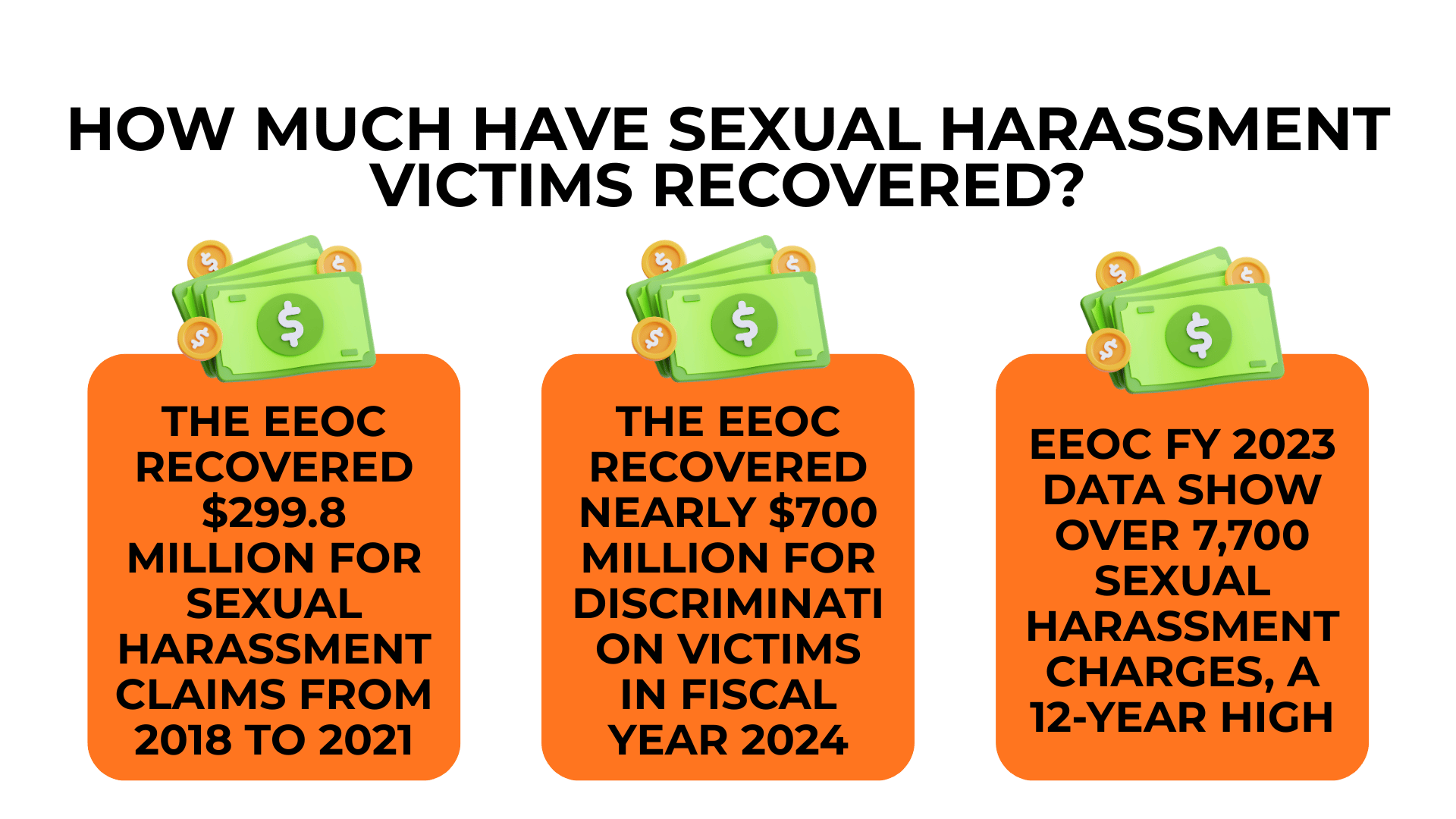
According to the EEOC Data Highlight (2022), the agency recovered $299.8 million specifically for sexual harassment claims between fiscal years 2018 and 2021. This included $251.8 million from resolved charges and $48 million from litigation, benefiting 8,147 individuals. This represented $104 million more than the prior four-year period.
More broadly, the EEOC’s 2024 Annual Performance Report documented nearly $700 million recovered for discrimination victims in fiscal year 2024 across all discrimination types. This represented the highest monetary recovery in the agency’s recent history, exceeding its $455 million budget and benefiting over 21,000 victims.
According to EEOC enforcement statistics (FY 2023), more than 7,700 sexual harassment charges were filed with the EEOC in fiscal year 2023, representing a 25% increase from the prior year and the highest number in 12 years.
Success rates when cases move forward
When the EEOC takes cases to litigation, outcomes are overwhelmingly favorable. According to the EEOC Office of General Counsel FY 2024 Report, the agency achieved a 97% favorable resolution rate in district court litigation, obtaining settlement or favorable judgment in 128 of 132 merits suits resolved.
However, context matters. According to EEOC resolution data (FY 2023), the overall merit resolution rate for harassment charges was 18.5%, with 8.2% resolved through settlements and 8.5% through withdrawals with benefits. This underscores that case strength and evidence significantly affect outcomes.
What Evidence Increases Sexual Harassment Settlement Value?
The evidence supporting your claim directly influences its settlement potential. Stronger documentation creates more leverage in negotiations.
Documentation that strengthens your case
Contemporaneous records carry significant weight because they were created at or near the time incidents occurred. A journal entry written the night harassment happened is more persuasive than recollections assembled months later. Dates, specific language used, locations, and witnesses present should all be documented.
Electronic communications often provide the strongest evidence. Emails, text messages, social media messages, and workplace chat applications may contain direct evidence of harassment or circumstantial evidence showing changed treatment. Courts recognize that harassers sometimes document their own misconduct.
Records you should preserve immediately
If you are experiencing or have experienced workplace sexual harassment, preserving the following evidence can significantly strengthen your potential recovery:
- All emails, texts, and messages from the harasser or discussing the harassment
- Your own contemporaneous notes with dates, times, specific words used, and witnesses
- Any documents showing changes in your job duties, schedule, or performance reviews
- Communications with HR, management, or anyone you reported the harassment to
- Records of any medical treatment or counseling related to the harassment
- Copies of your employer’s anti-harassment policy and any training materials
- Names and contact information for witnesses who observed harassment or its effects
Employers have obligations to preserve evidence once litigation is reasonably anticipated. However, taking steps to secure your own copies ensures documentation remains available.

How Does Employer Liability Affect Settlement Potential?
The legal framework for holding employers responsible affects both the likelihood of recovery and potential settlement amounts.
When employers face strict liability
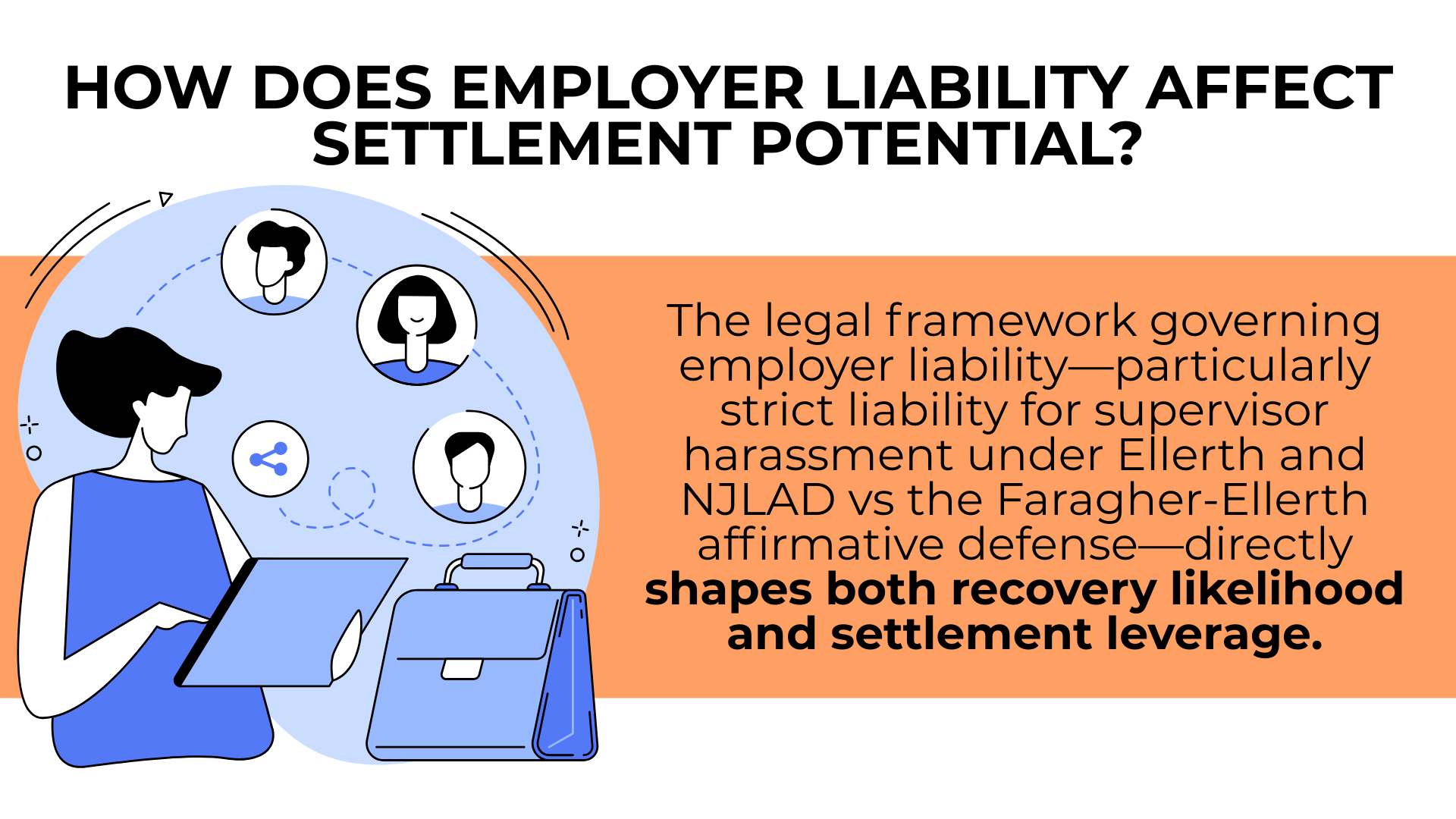
Under Burlington Industries v. Ellerth, when supervisor harassment results in a tangible employment action such as firing, demotion, or denial of promotion, the employer is strictly liable. No defense is available. This substantially increases settlement leverage because the employer cannot argue it took reasonable steps to prevent or correct harassment.
New Jersey applies a broader definition of “supervisor” than federal law. Under Aguas v. State, 220 N.J. 494 (2015), New Jersey adopted the EEOC’s standard: a supervisor includes employees who can make or recommend tangible employment actions or who direct the complainant’s daily work activities. This broader definition makes strict liability available in more cases under NJLAD.
The affirmative defense that can reduce recovery
When no tangible employment action occurred, employers can assert the Faragher-Ellerth affirmative defense. They must prove both that they exercised reasonable care to prevent and correct harassment and that the employee unreasonably failed to use available complaint procedures.
This defense affects settlement negotiations because employers with strong anti-harassment programs and documented complaint procedures have arguments that may reduce their exposure. However, the defense fails when evidence shows the policy was ineffective, the complaint procedure required reporting to the harasser, or prior complaints were ignored.
Frequently Asked Questions
Do I have to go to trial to get a settlement for sexual harassment?
Most sexual harassment cases resolve through settlement rather than trial. The EEOC achieved a 97% favorable resolution rate in cases it litigated in fiscal year 2024, and many of those resolutions were settlements reached before or during trial. Settlement allows both parties to avoid the uncertainty and expense of litigation while achieving a defined outcome.
Can I sue my harasser personally for damages in New Jersey?
Yes. Under N.J.S.A. 10:5-12(e), individuals who aid or abet discrimination can be held personally liable. This includes supervisors and harassers who engaged in the misconduct. Federal Title VII does not permit individual liability, making this a significant advantage of pursuing claims under New Jersey law.
How long do I have to file a sexual harassment claim in New Jersey?
For federal claims, you must file an EEOC charge within 300 days of the discriminatory act. For New Jersey state claims filed directly in Superior Court, you have two years from the date of the harassment. Filing with the New Jersey Division on Civil Rights requires action within 180 days. The longer Superior Court deadline provides more flexibility for NJLAD claims.
Will my employer’s size affect how much I can recover?
Under federal law, yes. Title VII damages caps range from $50,000 for employers with 15-100 employees to $300,000 for employers with 501 or more employees. Under New Jersey’s NJLAD, employer size does not cap your damages. Additionally, federal law only applies to employers with 15 or more employees, while NJLAD covers all employers regardless of size.
Are sexual harassment settlements taxable?
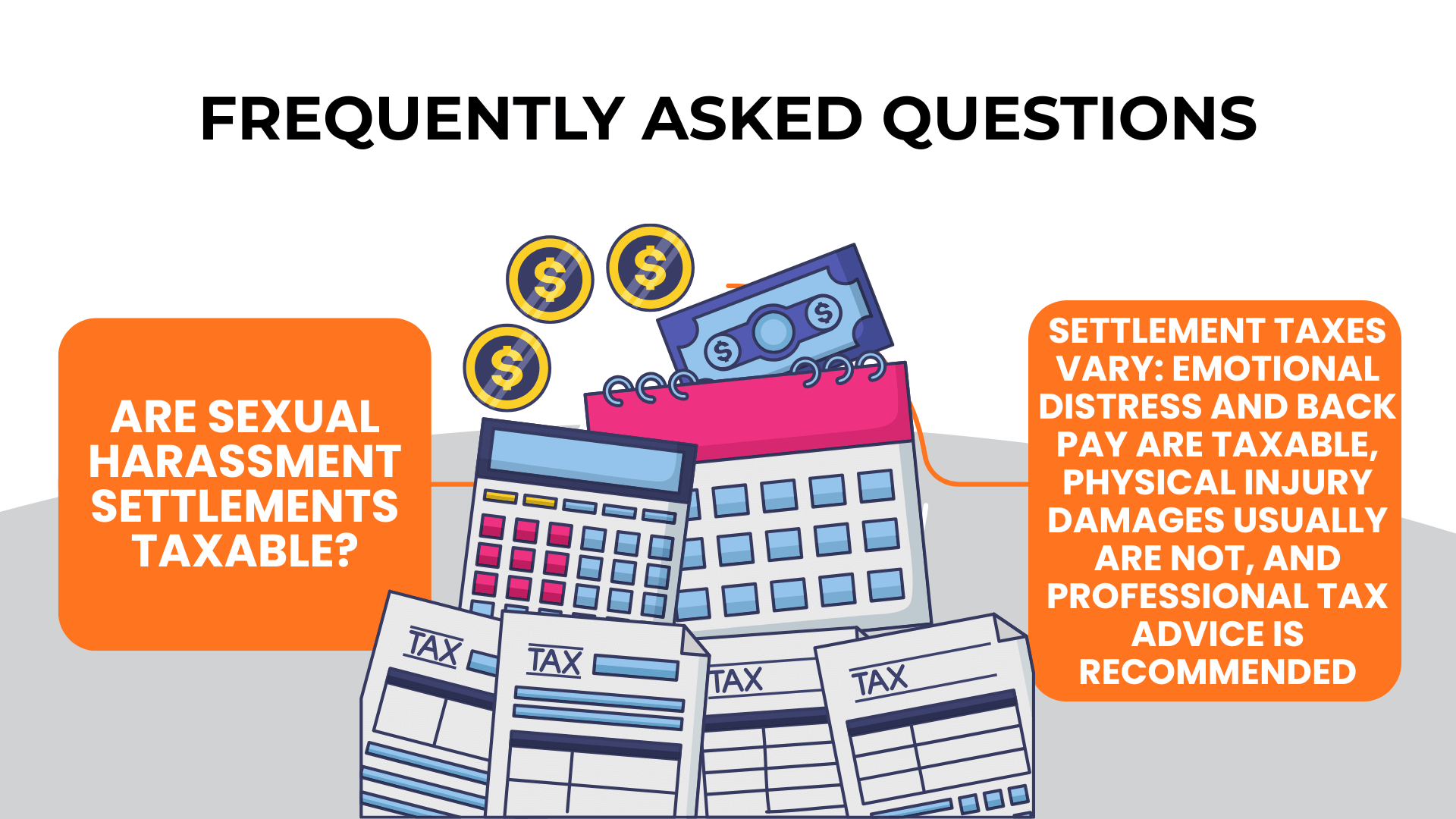
Generally, the portion of a settlement compensating for emotional distress is taxable as ordinary income. Damages for physical injury or physical sickness are typically not taxable. Back pay is taxable as wages. The tax treatment of settlements is complex, and consulting with a tax professional about your specific settlement structure is advisable.
Protecting Your Right to Fair Compensation
Workplace sexual harassment settlement amounts depend on multiple factors, but jurisdiction often matters most. New Jersey’s Law Against Discrimination provides significantly better recovery potential than federal law through uncapped damages, coverage for all employers, and individual liability for harassers.
Strong evidence and documentation directly increase settlement value. Preserving communications, maintaining contemporaneous records, and identifying witnesses all strengthen your position. The substantial recoveries documented by EEOC enforcement data demonstrate that meritorious claims can achieve meaningful compensation.
Understanding your options under both federal and state law helps you make informed decisions about pursuing your claim. The differences between Title VII’s capped damages and NJLAD’s uncapped recovery potential can mean hundreds of thousands of dollars in cases involving significant harm.
If you have questions about a workplace sexual harassment claim, contact The Lacy Employment Law Firm to discuss your situation.