When a coworker’s comments make you dread coming to work, or a supervisor’s behavior crosses professional boundaries, you may be unsure how to respond. Sexual harassment at work creates confusion, fear, and isolation—and many employees don’t know where to turn or what steps to take. This guide walks you through the practical and legal actions available to you as a New Jersey employee facing workplace sexual harassment.
You have more options than you might realize. Both federal law and New Jersey state law prohibit workplace sexual harassment, and New Jersey’s protections are among the strongest in the country. Understanding what to do now can help you protect your wellbeing, preserve your legal rights, and hold responsible parties accountable.
How Do You Know If What You’re Experiencing Is Sexual Harassment?
Sexual harassment is not always obvious. It can range from crude jokes to unwanted physical contact, and recognizing it is the first step toward addressing it.
Recognizing unwelcome sexual conduct
Under both federal and New Jersey law, sexual harassment includes unwelcome sexual advances, requests for sexual favors, and other verbal or physical conduct of a sexual nature that affects your employment or creates a hostile environment. The key word is “unwelcome”—conduct you did not invite and do not want.
According to the EEOC Select Task Force on the Study of Harassment in the Workplace (2016), between 25% and 85% of women report experiencing workplace sexual harassment, depending on how the question is asked. When surveys describe specific behaviors rather than using the legal term “harassment,” approximately 60% of women report experiencing such conduct. You are not alone in what you’re experiencing.
Behaviors that cross the line
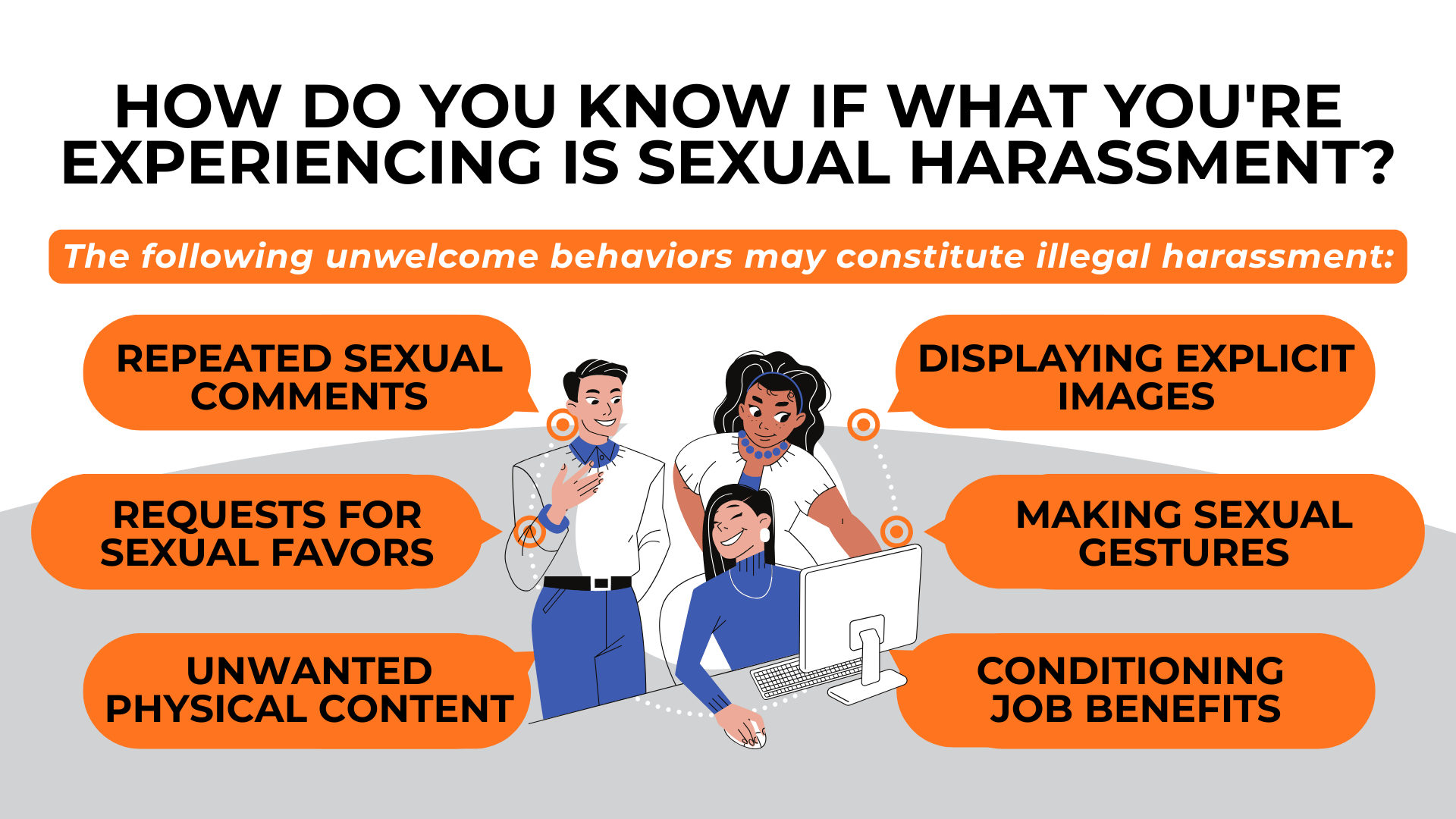
Sexual harassment takes many forms. The following behaviors may constitute illegal harassment when they are unwelcome:
- Repeated sexual comments, jokes, or innuendo directed at you or made in your presence
- Requests for dates or sexual favors, especially when refusal leads to negative treatment
- Unwanted physical contact such as touching, hugging, or blocking your path
- Displaying sexually explicit images, emails, or messages in the workplace
- Making sexual gestures or staring in a way that makes you uncomfortable
- Conditioning job benefits like promotions or favorable assignments on sexual compliance
A single incident can be enough if it is sufficiently severe. Two or three incidents can establish a pattern. Not every offensive comment rises to the level of illegal harassment, but persistent unwelcome conduct often does.
The “severe or pervasive” question
Legal claims for hostile work environment harassment require showing that the conduct was “severe or pervasive” enough to alter your working conditions. Courts look at the totality of circumstances: how often the conduct occurred, how serious it was, whether it was physically threatening or merely offensive, and whether it interfered with your ability to do your job.
New Jersey courts have been more willing than federal courts to find that single incidents can be actionable when sufficiently egregious. In Rios v. Meda Pharmaceutical, Inc., 247 N.J. 1 (2021), the New Jersey Supreme Court held that two demeaning slurs could be sufficient to create a hostile environment, reinforcing that severity can substitute for a lengthy pattern of conduct.
What Steps Should You Take to Document Sexual Harassment?
If you are being harassed, documentation is your most powerful tool. Creating a clear record protects you if you decide to report internally, file a formal complaint, or pursue legal action.
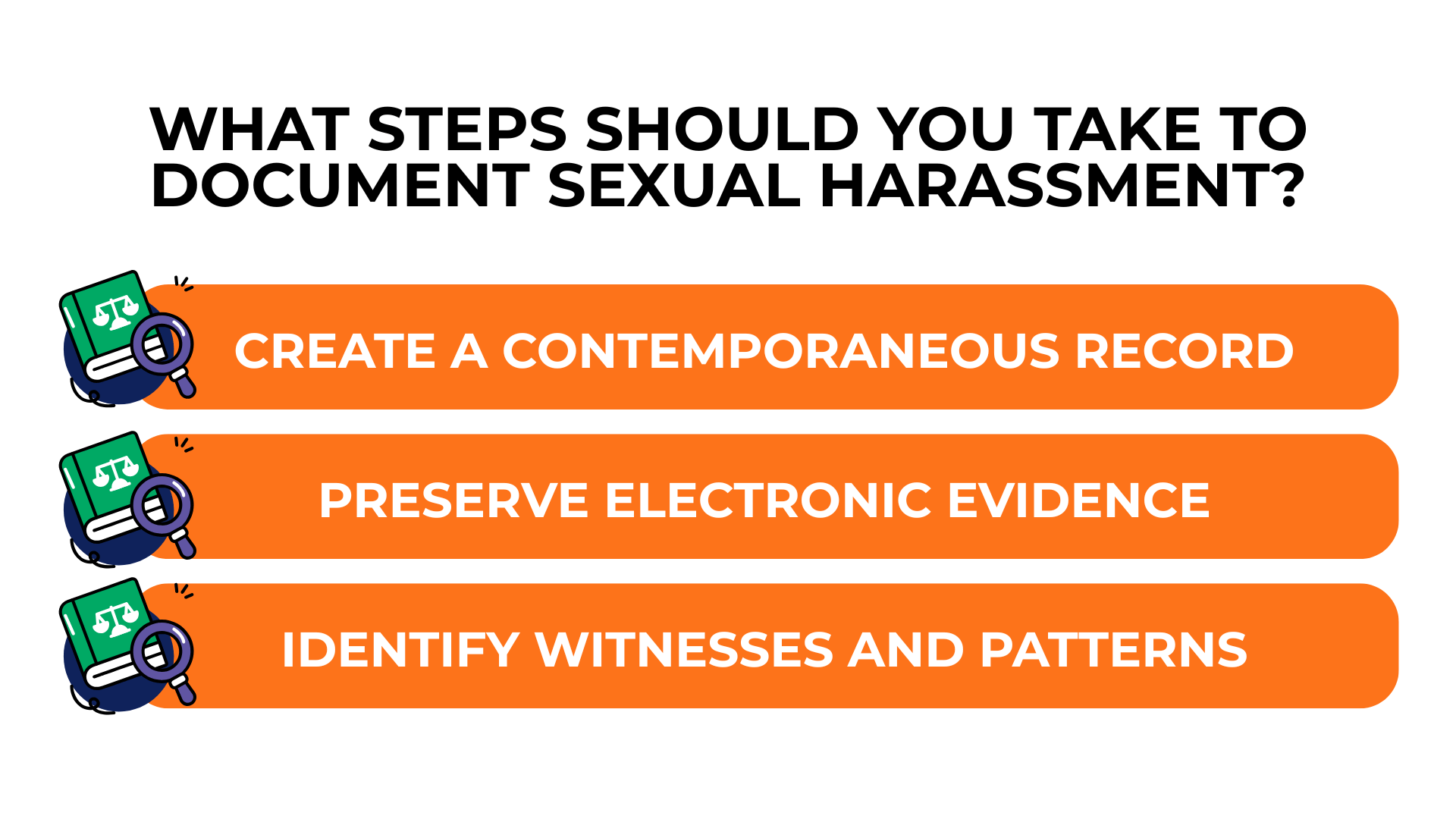
Creating a contemporaneous record
Start documenting immediately. Write down what happened as soon as possible after each incident while details are fresh. Your documentation should include:
- The date, time, and location of each incident
- Exactly what was said or done, using direct quotes when possible
- The names of anyone who witnessed the incident
- How the conduct made you feel and any impact on your work
- Any pattern you notice in the harasser’s behavior
Keep this record in a secure location outside your workplace—a personal email account or home computer that your employer cannot access. Contemporaneous notes created close in time to incidents carry significant weight if your case proceeds to litigation.
Preserving electronic evidence
Save any emails, text messages, voicemails, photos, or other electronic communications that relate to the harassment. Take screenshots of messages before they can be deleted. If the harasser sent you inappropriate content, preserve it even if your instinct is to delete it.
Forward relevant emails to your personal account. If your employer has policies restricting this, consider printing copies and keeping them at home. Do not alter any evidence—keep original messages intact with their headers and timestamps visible.
Identifying witnesses and patterns
Note who else may have observed the harassment or experienced similar treatment. Coworkers who witnessed specific incidents can corroborate your account. Others who have been targeted by the same person can establish a pattern of behavior.
Keep track of any changes in how you are treated at work, especially if those changes follow your rejection of advances or your complaints about harassment. Document schedule changes, assignment shifts, exclusion from meetings, or any other treatment that differs from before the harassment began.
Should You Report Sexual Harassment to HR or Management?
Deciding whether to report harassment internally is one of the most difficult choices you will face. There are benefits to reporting, but also legitimate concerns about how your employer will respond.
Why internal reporting matters for your legal claim
When you report harassment, you put your employer on notice that a problem exists. Under the Faragher-Ellerth framework established by the U.S. Supreme Court in 1998, employers can defend against harassment claims by showing they took reasonable steps to prevent and correct harassment—and that the employee unreasonably failed to use available complaint procedures.
This means that if you do not report harassment internally and your employer has a complaint procedure, a court may find that the employer is not liable. Reporting creates a record and triggers your employer’s duty to investigate and take corrective action. It also strengthens your position if you later pursue a formal legal claim.
What to expect after you report
Your employer has an obligation to investigate complaints of harassment promptly and take appropriate corrective action. A thorough investigation should include interviews with you, the accused, and witnesses, as well as review of relevant evidence.
However, the reality is that internal processes vary widely. Some employers take complaints seriously and respond effectively. Others conduct superficial investigations, fail to protect complainants from retaliation, or prioritize protecting the accused. According to the EEOC Select Task Force (2016), approximately 90% of individuals who experience harassment never file a formal complaint or charge—often because they fear retaliation or believe nothing will change.
When internal reporting may not be enough
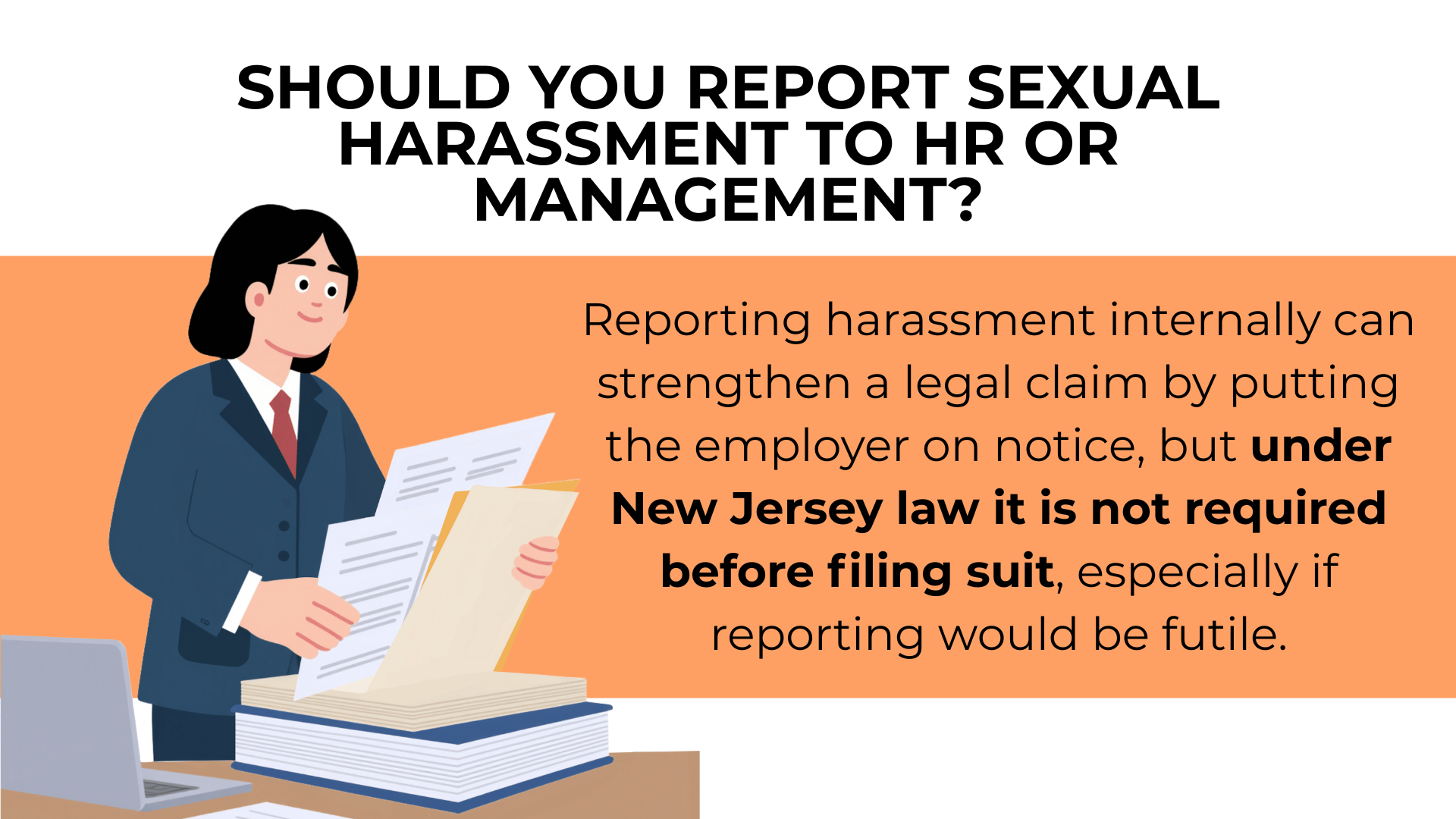
If your employer fails to act, or if the harassment continues or worsens after you report, internal processes have failed. You are not required to keep reporting to HR indefinitely if your complaints are ignored. Similarly, if the harasser is a high-level executive or the owner of the company, you may reasonably conclude that internal reporting would be futile.
New Jersey law does not require you to exhaust internal remedies before pursuing legal action. You can file directly in court without first going through your employer’s HR process—a significant advantage over federal law, which generally requires exhausting administrative procedures first.
What Legal Protections Do You Have Against Workplace Sexual Harassment?
Two primary laws protect New Jersey employees from sexual harassment: federal Title VII and the New Jersey Law Against Discrimination. Understanding both helps you make informed decisions about how to proceed.
Federal protection under Title VII
Title VII of the Civil Rights Act of 1964 prohibits employment discrimination based on sex, which courts have interpreted to include sexual harassment. Under 42 U.S.C. § 2000e-2, it is unlawful for employers to discriminate against employees with respect to compensation, terms, conditions, or privileges of employment because of sex.
To establish a hostile work environment claim under Title VII, you must show that unwelcome conduct occurred because of your sex, the conduct was severe or pervasive enough to alter your working conditions, and a basis exists for holding your employer liable. The landmark case Meritor Savings Bank v. Vinson, 477 U.S. 57 (1986), first recognized that hostile work environment harassment violates Title VII.
Title VII applies only to employers with 15 or more employees. If your employer is smaller, federal law may not cover you—but New Jersey law will.
New Jersey’s stronger protections under the LAD
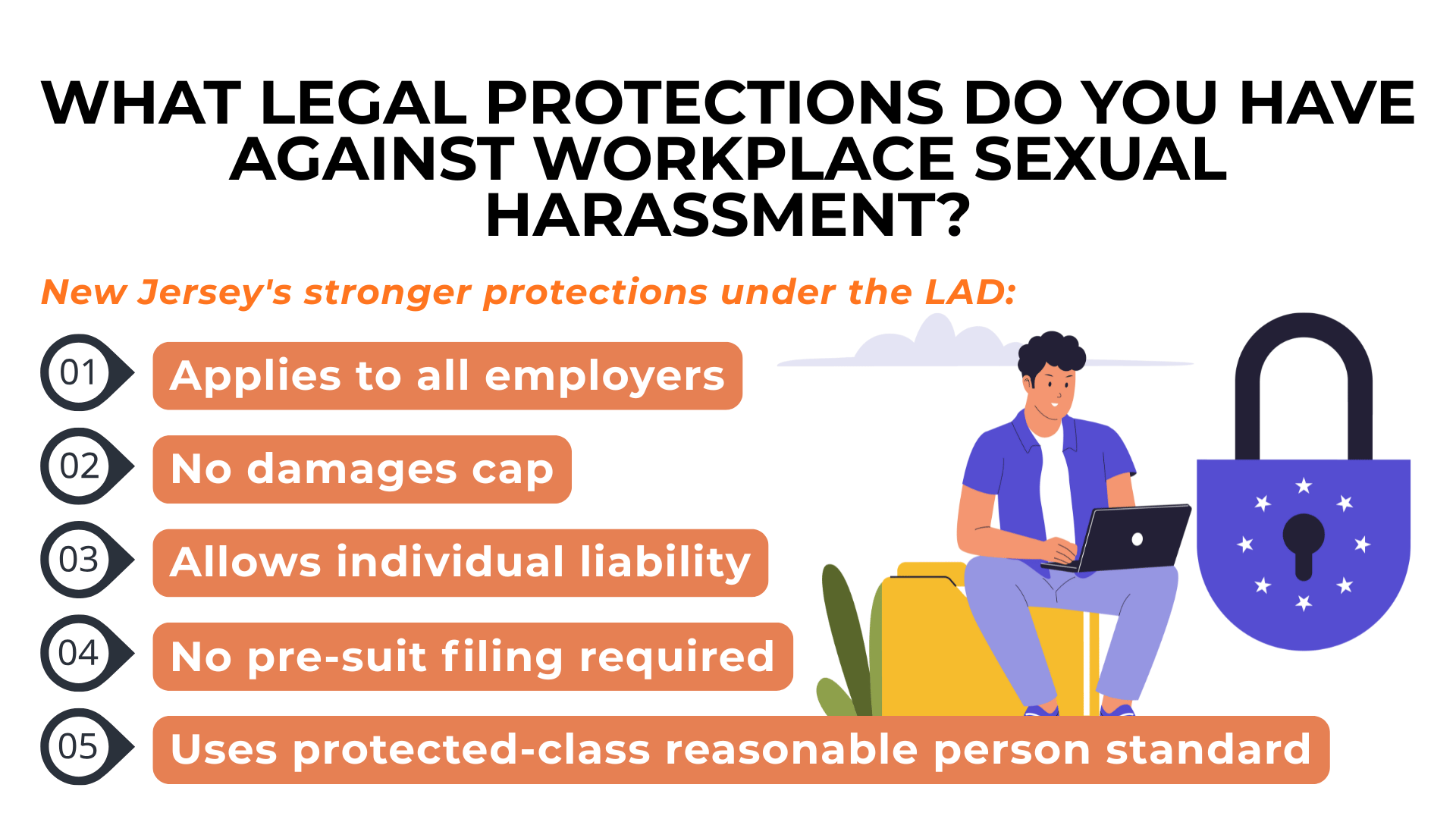
The New Jersey Law Against Discrimination, N.J.S.A. 10:5-1 et seq., provides substantially broader protections than federal law. If you work in New Jersey, NJLAD offers several critical advantages:
- Covers all employers regardless of size, including those with only one employee
- Places no caps on compensatory damages, unlike federal law’s limits of $50,000 to $300,000
- Allows individual liability against the harasser personally, not just the employer
- Does not require filing an administrative charge before going to court
- Applies a “reasonable person of the same protected class” standard, meaning courts consider how a reasonable woman (or man) in your position would perceive the conduct
The New Jersey Supreme Court established the state standard in Lehmann v. Toys ‘R’ Us, Inc., 132 N.J. 587 (1993), requiring proof that a reasonable person of the plaintiff’s sex would find the conduct sufficiently severe or pervasive to alter employment conditions and create a hostile environment.
Recent legal developments in your favor
New Jersey courts have continued strengthening protections. In Savage v. Township of Neptune (N.J. May 7, 2024), the state Supreme Court held that non-disparagement provisions in settlement agreements are unenforceable if they conceal details about harassment claims, ensuring that plaintiffs retain the right to speak about their experiences.
How Do You File a Formal Sexual Harassment Complaint?
If internal reporting has not resolved the harassment, or if you prefer to pursue legal remedies directly, you have several options for filing a formal complaint.
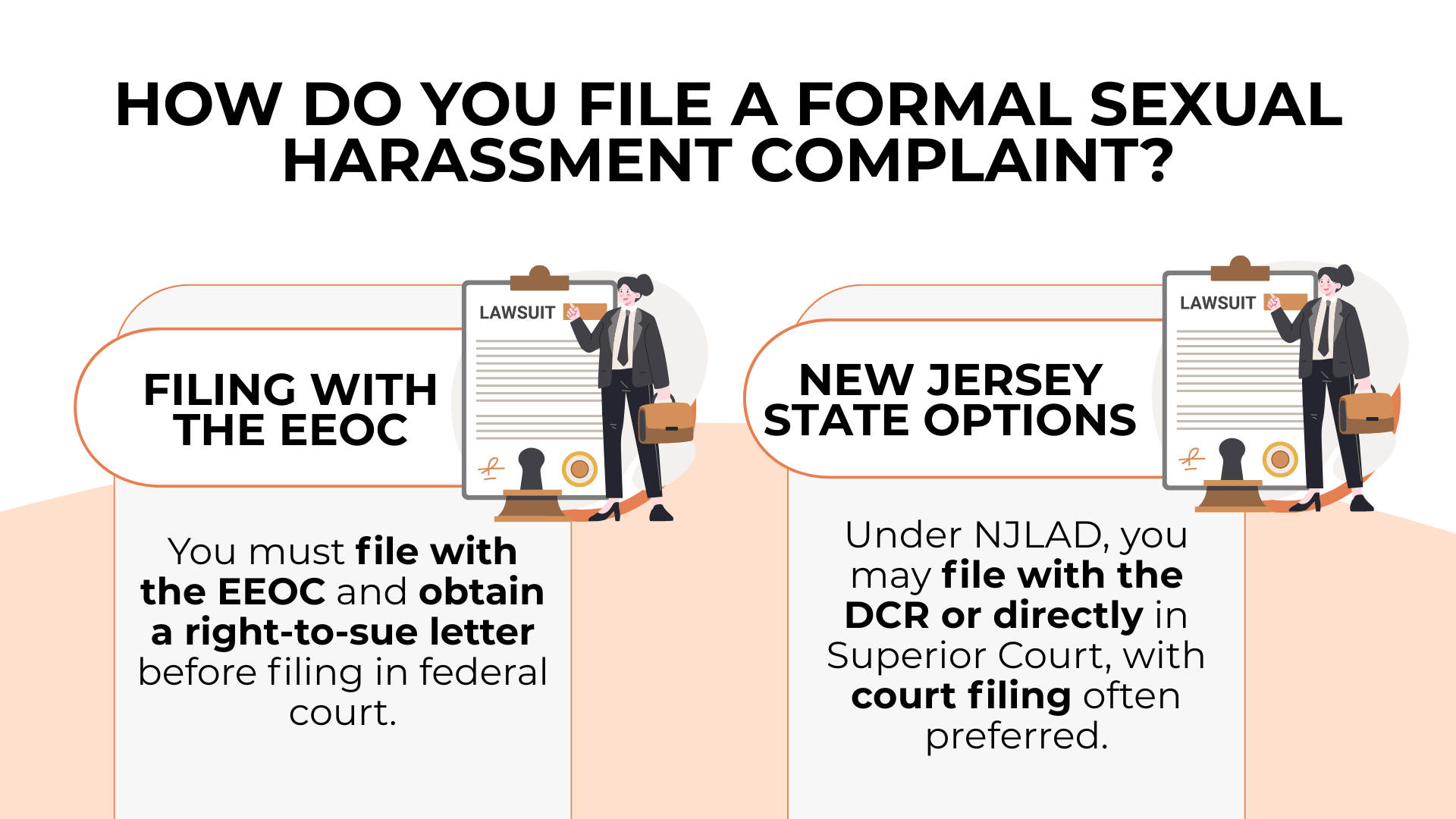
Filing with the EEOC
The Equal Employment Opportunity Commission handles federal employment discrimination claims, including sexual harassment. In FY 2023, more than 7,700 sexual harassment charges were filed with the EEOC, according to EEOC Enforcement and Litigation Statistics (FY 2023)—a 25% increase from the prior year and the highest number in 12 years.
To file a federal claim, you must first submit a charge with the EEOC. After the EEOC investigates or after 180 days pass, you can request a “right-to-sue” letter allowing you to file in federal court. When the EEOC takes cases to court, outcomes are favorable for employees: the agency achieved a 97% favorable resolution rate in district court litigation in FY 2024, according to the EEOC Office of General Counsel Annual Report (FY 2024).
New Jersey state options
Under NJLAD, you have two paths: file with the New Jersey Division on Civil Rights (DCR) or file directly in New Jersey Superior Court. Filing directly in court is often preferable because it provides access to full discovery, jury trials, and avoids the election-of-remedies complications that can arise from DCR filings.
If you file with DCR and receive a “no probable cause” finding, you cannot then file in court—you can only appeal to the Appellate Division within 45 days. However, an adverse EEOC determination does not bar your NJLAD claims. The New Jersey Supreme Court held in Hernandez v. Region Nine Housing Corp., 146 N.J. 645 (1996), that EEOC determinations are “non-final and non-binding” for state law purposes.
Critical deadlines you cannot miss
Filing deadlines are strict, and missing them can permanently bar your claims. The key deadlines are:
- 300 days from the discriminatory act to file an EEOC charge (for New Jersey residents)
- 90 days from receiving your right-to-sue letter to file in federal court
- 180 days to file with the NJ Division on Civil Rights
- 2 years from the discriminatory act to file directly in NJ Superior Court
The two-year Superior Court deadline provides more time than the administrative options and preserves your strongest remedies under state law. Many attorneys recommend filing directly in Superior Court to maximize flexibility and avoid procedural complications.
What Damages Can You Recover in a Sexual Harassment Case?
Understanding potential recovery helps you evaluate whether pursuing a claim is worthwhile. Both federal and state law provide for significant damages, though New Jersey law offers superior recovery potential.
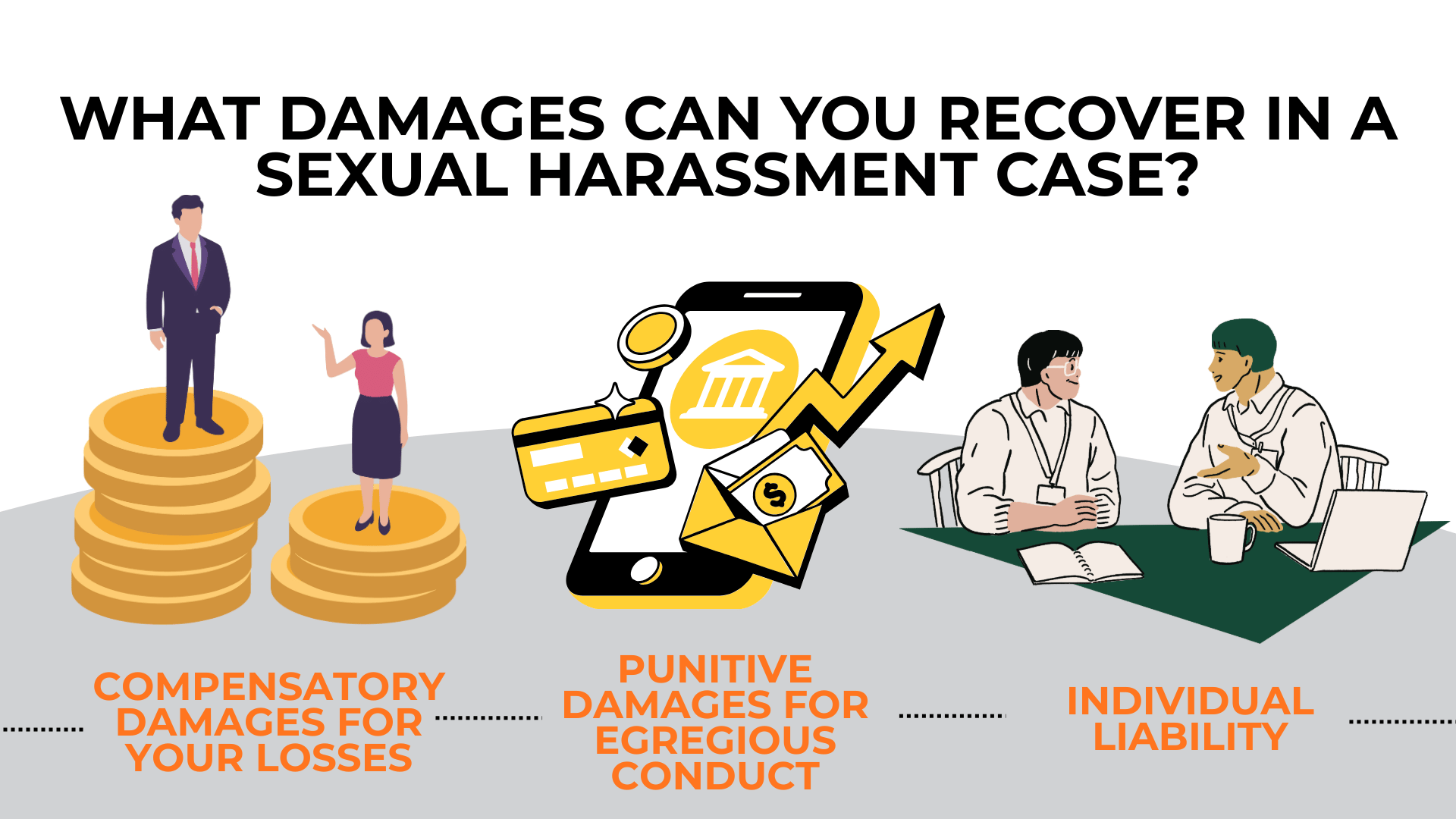
Compensatory damages for your losses
Compensatory damages cover the actual harm you suffered. This includes back pay if you lost income due to the harassment, front pay for future lost wages if you cannot return to your position, and compensation for emotional distress, mental anguish, and loss of enjoyment of life. Medical expenses related to the harassment may also be recoverable.
The EEOC 2024 Annual Performance Report shows that nearly $700 million was recovered for discrimination victims in FY 2024—the highest in the agency’s recent history. Between FY 2018 and FY 2021, $299.8 million was recovered specifically for sexual harassment claims, according to the EEOC Data Highlight on Sexual Harassment (2022).
Punitive damages for egregious conduct
Punitive damages punish employers for particularly bad conduct and deter future violations. Under federal law, punitive damages are available when the employer acted with malice or reckless indifference to your rights. However, federal law caps combined compensatory and punitive damages at $50,000 to $300,000 depending on employer size.
New Jersey has no statutory cap on compensatory damages, including emotional distress. Punitive damages under NJLAD require showing the employer authorized, participated in, or ratified the harassment. While New Jersey’s Punitive Damages Act generally caps punitive awards at five times compensatory damages or $350,000 (whichever is greater), the absence of caps on compensatory damages means total recovery potential far exceeds federal limits.
Holding individual harassers accountable
Under N.J.S.A. 10:5-12(e), individuals who aid and abet discriminatory conduct can be held personally liable. This means the person who harassed you—not just your employer—can be required to pay damages. Federal law provides no individual liability; only the employer entity can be held responsible.
Individual liability creates additional pressure for resolution and can be particularly meaningful when the harasser is the company owner or a high-level executive who might otherwise escape personal consequences.
Frequently Asked Questions About Workplace Sexual Harassment
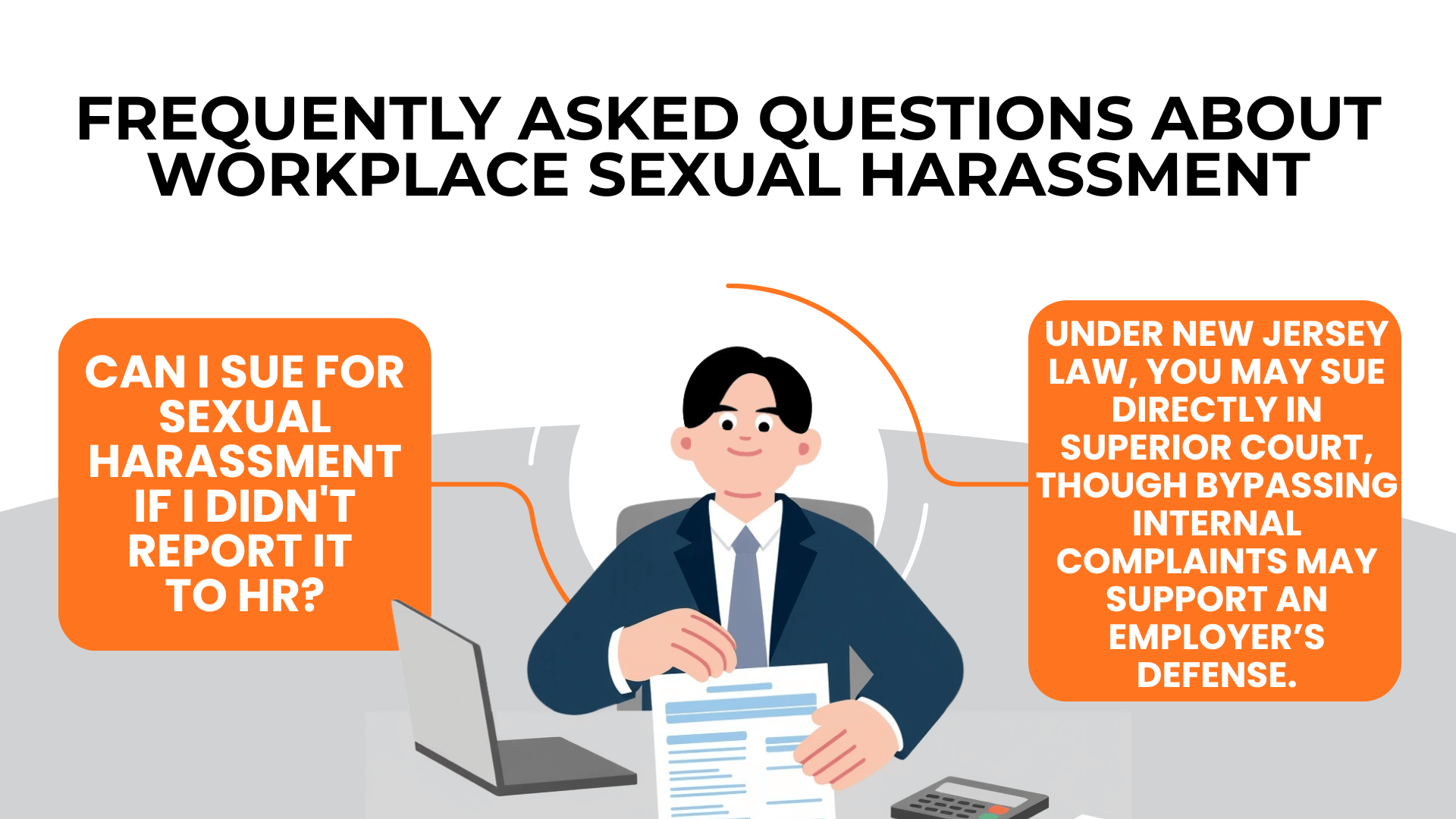
Can I sue for sexual harassment if I didn’t report it to HR?
Under New Jersey law, you can file a lawsuit without first reporting to HR or exhausting any internal complaint process. You can proceed directly to Superior Court. However, failing to use available complaint procedures may allow your employer to raise an affirmative defense arguing that you unreasonably failed to take advantage of preventive or corrective opportunities. The strength of this defense depends on the specific circumstances, including whether internal reporting would have been futile.
How long do I have to file a sexual harassment complaint in New Jersey?
You have 300 days from the harassment to file an EEOC charge, which preserves your federal claims. For state law claims, you have 180 days to file with the Division on Civil Rights, but you have a full two years to file directly in New Jersey Superior Court. The two-year court deadline provides the most flexibility and preserves access to NJLAD’s stronger remedies.
Does sexual harassment have to be physical to be illegal?
No. Sexual harassment includes verbal conduct such as sexual comments, jokes, and requests for dates, as well as visual harassment like displaying explicit images or making sexual gestures. Physical touching is one form of harassment, but verbal and visual harassment can be equally actionable if sufficiently severe or pervasive to create a hostile work environment.
Can my employer be held responsible for a coworker’s harassment?
Yes, but under a different standard than supervisor harassment. For coworker harassment, your employer is liable if it knew or should have known about the harassment and failed to take prompt and appropriate corrective action. This is why reporting to HR or management is important—it puts your employer on notice and creates a duty to respond.
What if my employer has fewer than 15 employees?
Federal Title VII only applies to employers with 15 or more employees, which means very small employers are exempt from federal coverage. However, the New Jersey Law Against Discrimination applies to all employers regardless of size—even those with just one employee. If you work for a small employer in New Jersey, you still have full legal protection under state law.
Taking the Next Step
Experiencing sexual harassment at work is disorienting and stressful. You may worry about your job, your reputation, or whether anyone will believe you. These concerns are understandable, but they should not stop you from learning about your rights and options.
The law provides meaningful protections. New Jersey employees benefit from some of the strongest harassment laws in the country, with no employer-size exemptions, no damage caps on compensatory awards, and the ability to hold individual harassers personally accountable. Courts have continued to strengthen these protections, making it easier to pursue claims and harder for employers to avoid responsibility.
Start by documenting what is happening. Consider your reporting options carefully. Pay attention to filing deadlines, especially the 300-day EEOC deadline and the two-year Superior Court deadline for state claims. If you have questions about what to do after experiencing workplace sexual harassment, contact The Lacy Employment Law Firm to discuss your situation.