Many employees are told they’re “exempt” from overtime pay, only to discover later that their employer misapplied the law. In fiscal year 2024, the Department of Labor’s Wage and Hour Division recovered $126,967,097 in overtime back wages for more than 101,000 workers—and improper exemption classifications drive a substantial portion of those violations, according to DOL enforcement data (2024). If you’re working more than 40 hours per week without overtime compensation because your employer classified you as exempt, understanding the FLSA exemption test can help you determine whether that classification is legally valid.
The Fair Labor Standards Act requires employers to pay overtime at 1.5 times your regular rate for all hours worked beyond 40 in a workweek. But the law carves out exemptions for certain employees. Employers who claim these exemptions must satisfy specific legal tests—and when they get it wrong, affected employees can recover years of unpaid overtime plus significant additional damages.
What Is the FLSA Exemption Test?
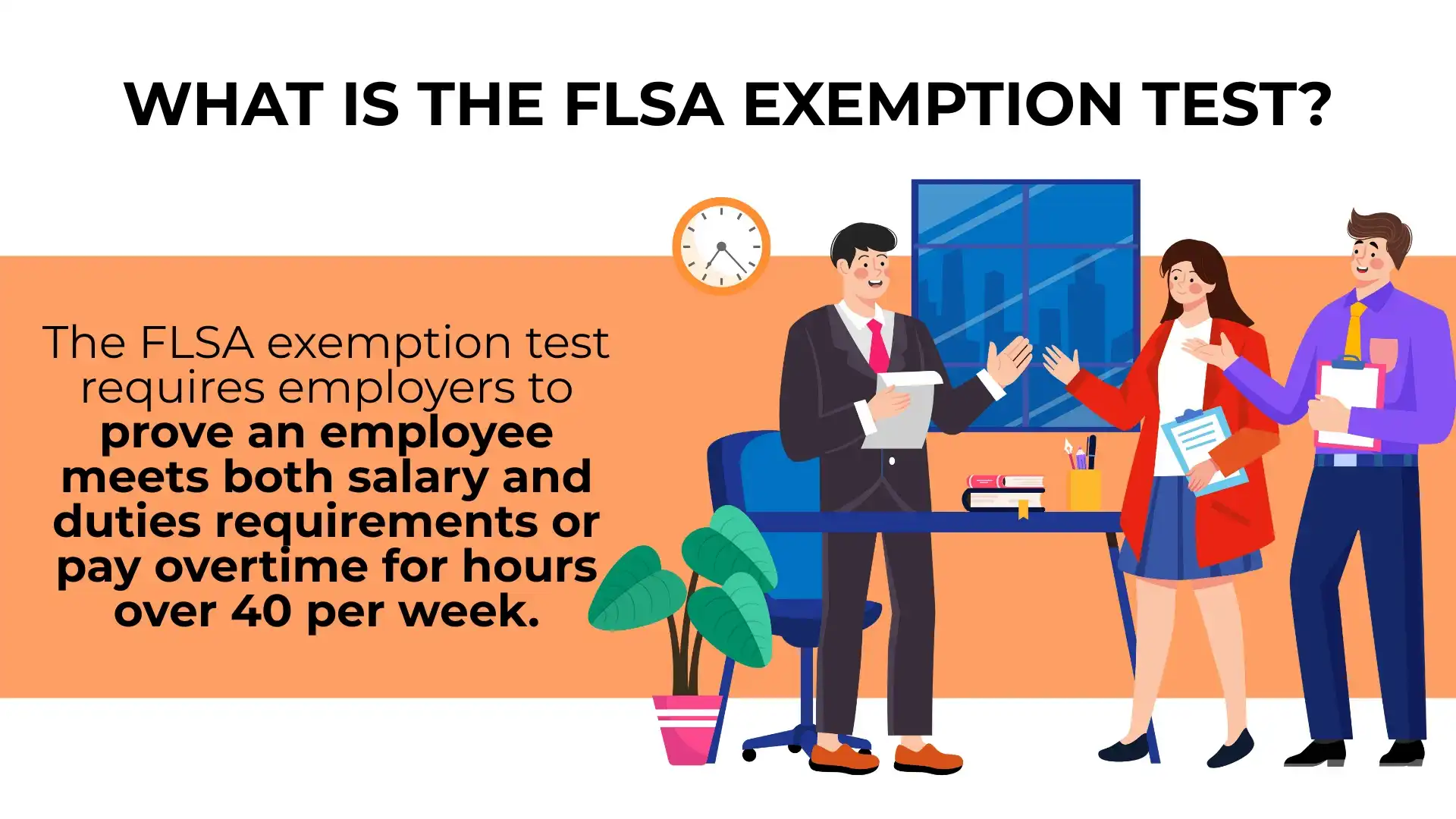
The FLSA exemption test is the legal standard employers must meet to classify an employee as exempt from overtime requirements. This isn’t a single question but a two-part analysis: the salary basis test and the duties test. Both parts must be satisfied for an exemption to apply.
Why does the exemption test matter for overtime pay?
Without a valid exemption, federal law requires overtime pay for every hour worked beyond 40 in a workweek. Overtime violations represent approximately 85% of all FLSA back wage amounts recovered by the Department of Labor, according to WHD enforcement data (2024). When employers improperly classify employees as exempt, they avoid paying legally required overtime—sometimes for years.
The exemptions exist for employees in bona fide executive, administrative, professional, outside sales, and computer positions under 29 C.F.R. § 541. These are often called “white-collar exemptions.” But the exemption categories are specific and technical. Many employees who think they’re exempt actually qualify for overtime protection.
Who has to prove the exemption applies?
The employer bears the burden of proving that an exemption applies. In Encino Motorcars, LLC v. Navarro, 584 U.S. 79 (2018), the Supreme Court clarified that FLSA exemptions should receive a “fair reading”—not an artificially narrow one, but also not an expansive interpretation that swallows the overtime rule. If there’s doubt about whether an employee’s job satisfies an exemption, courts resolve that doubt in the employee’s favor.
This means your employer can’t simply declare you exempt. They must demonstrate that your actual job duties and compensation structure meet every element of a specific exemption category.
What Is the Salary Basis Test?
The first part of the FLSA exemption test is the salary basis requirement. To qualify as exempt, an employee must be paid on a salary basis at a rate that meets or exceeds the minimum threshold.
What is the current federal salary threshold?
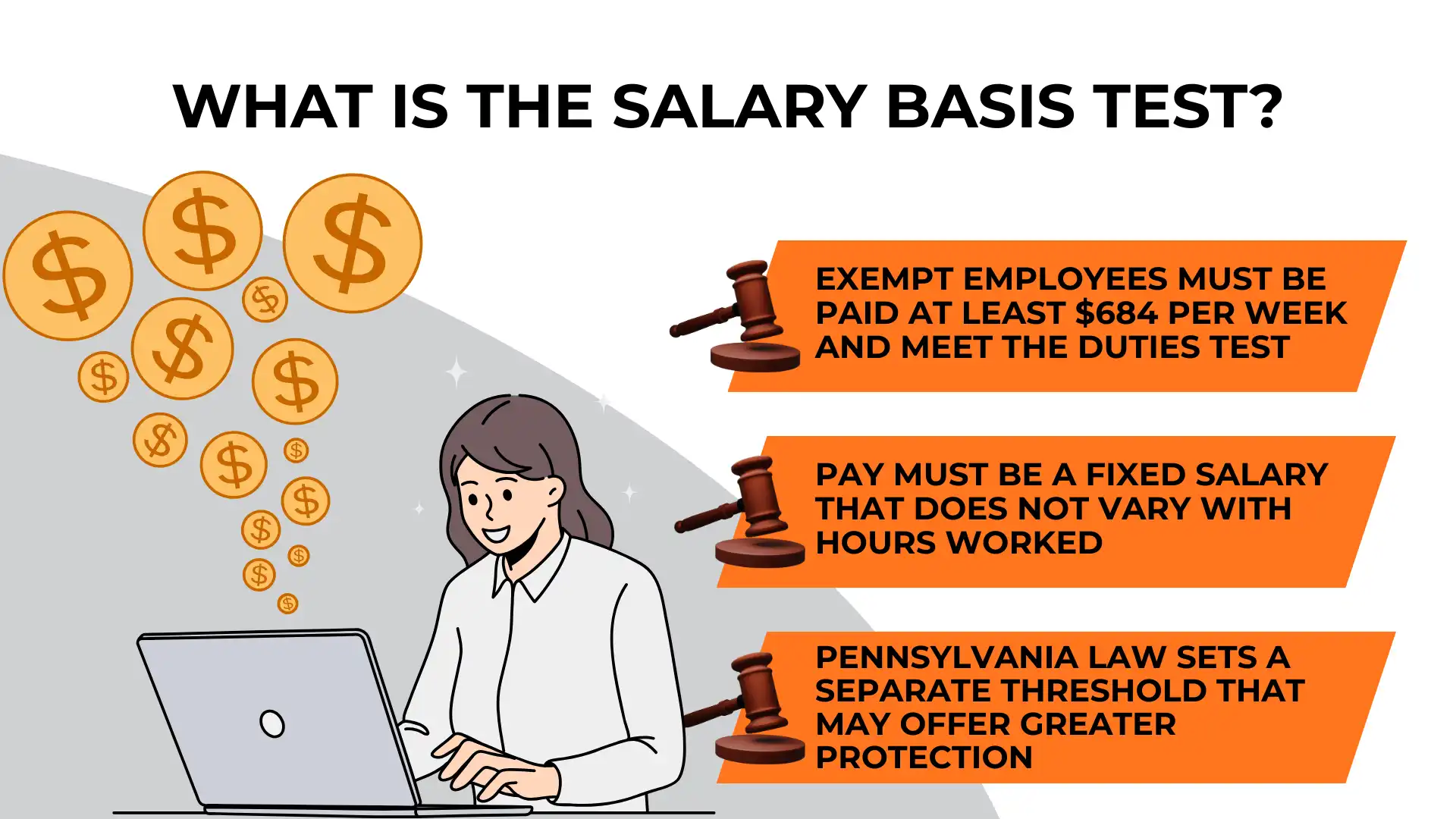
Under federal law, exempt employees must earn at least $684 per week ($35,568 annually) to satisfy the salary threshold. This amount was set by DOL regulations and represents the floor—not a guarantee of exempt status. Earning above this threshold doesn’t automatically make you exempt; you must still satisfy the duties test.
The salary must also be paid on a true salary basis, meaning you receive a predetermined amount each pay period regardless of the quantity or quality of work performed. If your employer reduces your pay based on the number of hours you work or docks your salary for partial-day absences, you may not actually be paid on a salary basis—even if your stated salary exceeds the threshold.
Does Pennsylvania have a different salary requirement?
Pennsylvania maintains its own salary threshold for overtime exemptions under the Pennsylvania Minimum Wage Act, and that threshold operates independently of the federal standard. In Chevalier v. General Nutrition Centers, Inc., 656 Pa. 296 (Pa. 2019), the Pennsylvania Supreme Court confirmed that Pennsylvania’s salary threshold test is separate from the FLSA threshold and may provide greater protection for employees.
This independence matters because Pennsylvania employees may qualify for overtime under state law even if they meet the federal salary threshold. The Pennsylvania Supreme Court in Bayada Nurses, Inc. v. Commonwealth, 607 Pa. 527 (Pa. 2010), also emphasized that PMWA overtime provisions should be construed liberally in favor of employees.
What happens if my salary fluctuates?
If your compensation varies based on hours worked, productivity, or other factors, you may not satisfy the salary basis requirement. The salary basis test requires a fixed, predetermined amount that doesn’t change based on work quantity. Employers who manipulate pay structures to avoid overtime obligations while maintaining the appearance of a salary may be violating the law.
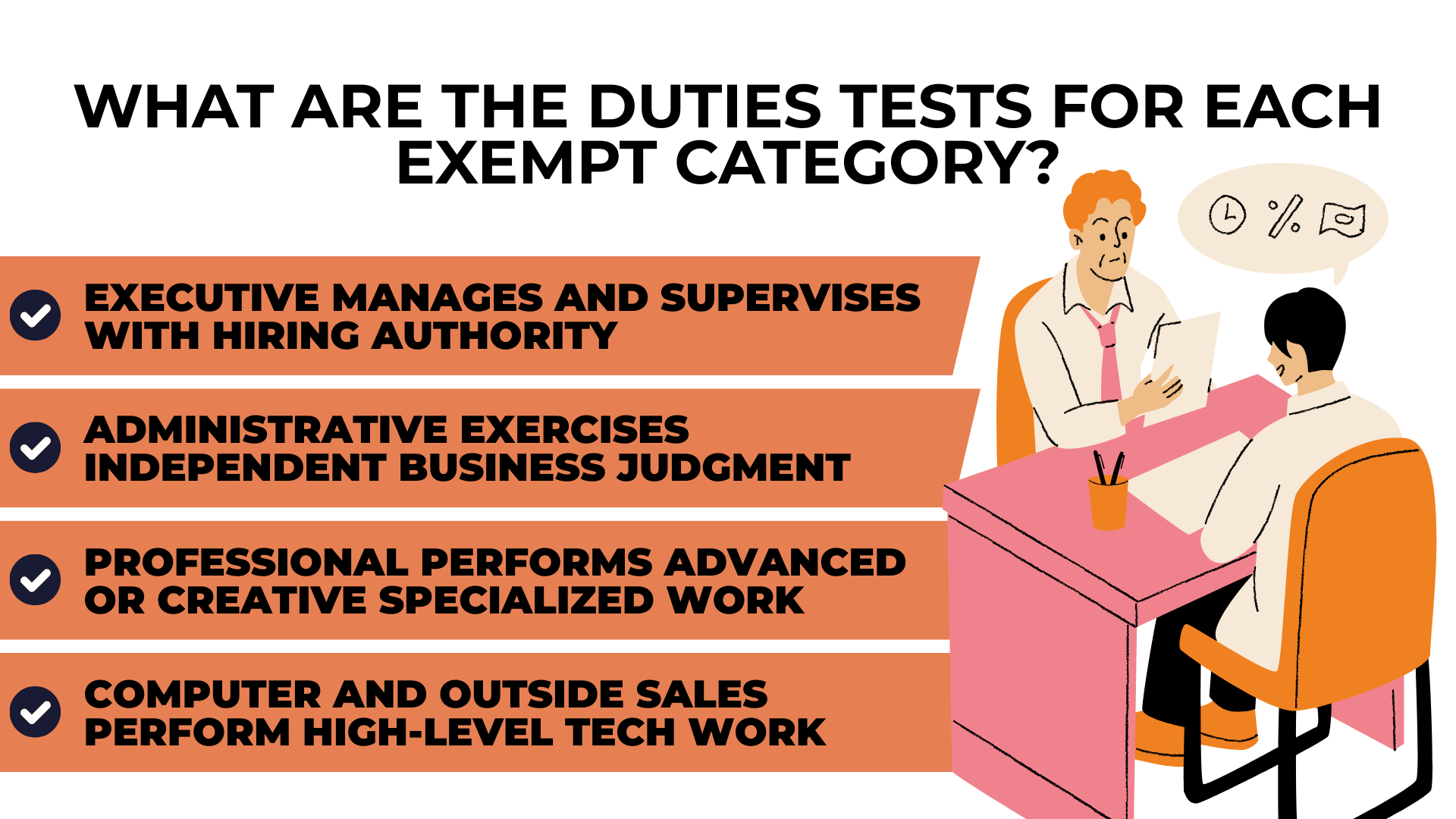
What Are the Duties Tests for Each Exempt Category?
Meeting the salary threshold is only half the analysis. The employee’s actual job duties—not their job title or job description—must satisfy the specific requirements for one of the recognized exemption categories.
What qualifies as an executive exemption?
The executive exemption applies to employees whose primary duty is managing the enterprise or a recognized department. To qualify, an employee must satisfy all of the following:
- Primary duty must be management of the enterprise or a customarily recognized department
- Must customarily and regularly direct the work of at least two full-time employees (or equivalent)
- Must have authority to hire or fire other employees, or their recommendations on hiring, firing, and promotion must be given particular weight
- Must be paid on a salary basis at or above the threshold
Simply having “manager” or “supervisor” in your title doesn’t make you exempt. If you spend most of your time performing the same work as non-exempt employees—stocking shelves, serving customers, processing transactions—you likely don’t satisfy the executive exemption regardless of your title.
What is the administrative exemption duties test?
The administrative exemption is one of the most commonly misapplied categories. To qualify, an employee must meet these requirements:
- Primary duty must be office or non-manual work directly related to the management or general business operations of the employer or the employer’s customers
- Must exercise discretion and independent judgment with respect to matters of significance
- Must be paid on a salary basis at or above the threshold
The key phrase is “discretion and independent judgment.” This means the employee must have authority to make significant decisions, not simply follow established procedures or apply clear rules. An employee who processes paperwork according to set guidelines typically doesn’t exercise the kind of independent judgment the exemption requires.
How does the professional exemption work?
The professional exemption covers two categories: learned professionals and creative professionals. The requirements include:
- For learned professionals: primary duty must require advanced knowledge in a field of science or learning, customarily acquired through prolonged specialized intellectual instruction
- For creative professionals: primary duty must require invention, imagination, originality, or talent in a recognized field of artistic or creative endeavor
- Must exercise discretion and independent judgment in performing professional duties
- Must be paid on a salary basis at or above the threshold
Jobs requiring only general knowledge, mechanical application of procedures, or training that doesn’t require specialized academic study typically don’t qualify for the learned professional exemption.
What about computer employees and outside sales?
Two additional exemption categories have unique requirements:
Computer employee exemption applies to employees whose primary duty involves:
- Application of systems analysis techniques and procedures
- Design, development, documentation, or testing of computer systems or programs
- Combination of the above requiring the same level of skill
- Must earn at least $684/week on salary basis OR $27.63/hour if paid hourly
Outside sales exemption applies to employees who:
- Have a primary duty of making sales or obtaining orders or contracts for services
- Are customarily and regularly engaged away from the employer’s place of business while performing this primary duty
- No minimum salary requirement applies to outside sales employees
Inside sales representatives, customer service staff, and employees who make sales primarily by phone or computer from the employer’s premises generally don’t qualify for the outside sales exemption.
How Do Employers Misapply the Exemption Test?
Exemption misclassification is widespread. According to National Employment Law Project research (2009), 76% of surveyed low-wage workers who worked more than 40 hours per week were not paid the overtime wages they earned. The average worker experiencing an overtime violation lost pay for 11 hours of overtime per week—either underpaid or completely unpaid.
Does my job title determine my exempt status?
No. Your job title has no legal significance in determining exempt status. What matters is your actual job duties—the work you actually perform day to day, not what your job description says or what your employer calls your position.
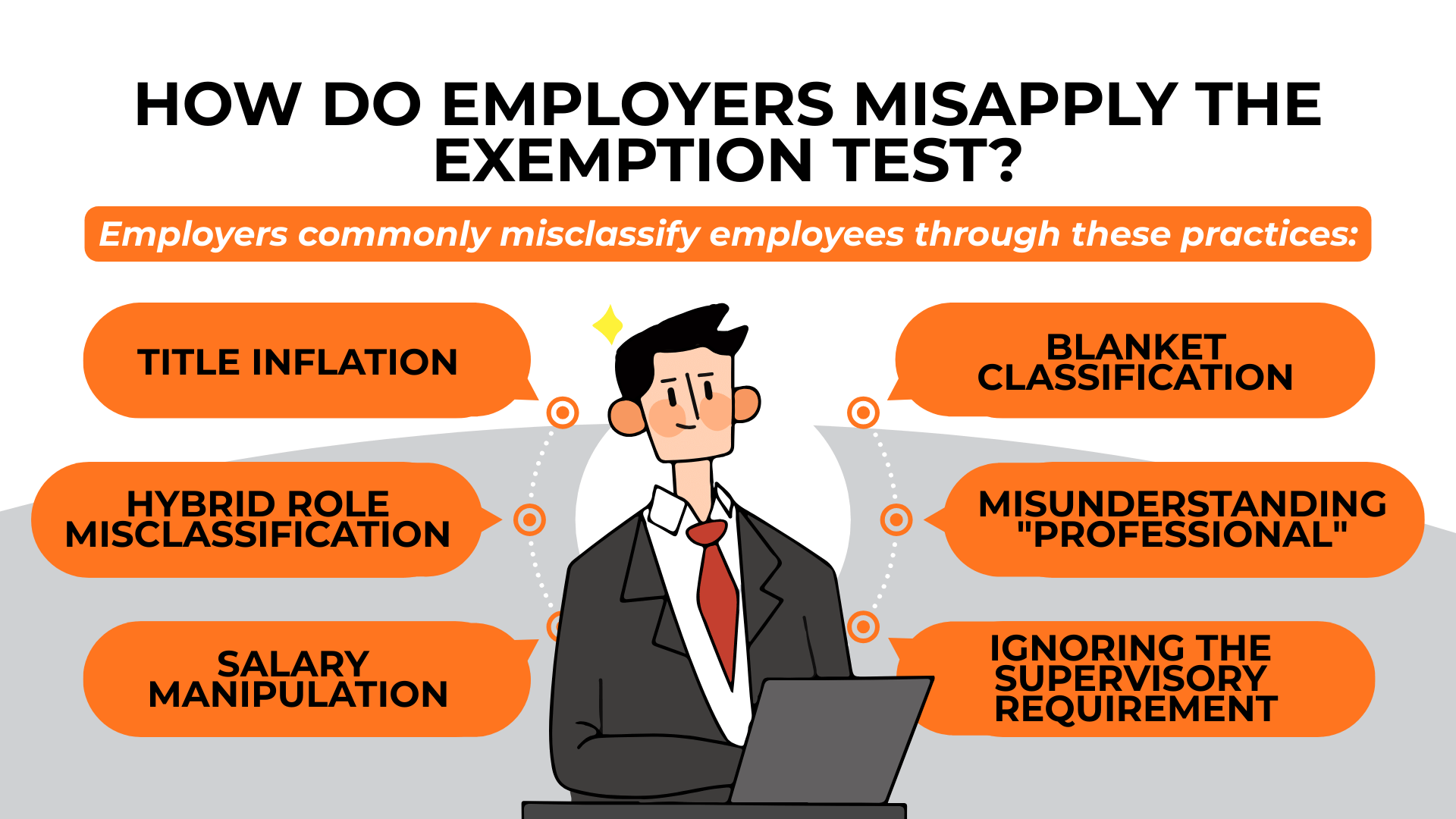
Employers commonly misclassify employees through these practices:
- Title inflation: Calling employees “managers” or “directors” when they perform primarily non-managerial work
- Hybrid role misclassification: Classifying employees as exempt based on occasional administrative tasks while ignoring that most work is non-exempt
- Salary manipulation: Setting salary just above the threshold while assigning duties that don’t meet any exemption’s requirements
- Blanket classification: Applying exempt status to entire job categories without individual duties analysis
- Misunderstanding “professional”: Treating any white-collar office work as professionally exempt without analyzing whether it requires advanced specialized knowledge
- Ignoring the supervisory requirement: Claiming executive exemption for employees who don’t actually supervise two or more full-time workers
What if I do both exempt and non-exempt work?
The exemption analysis focuses on your “primary duty”—the principal, main, or most important duty you perform. If you spend significant time on non-exempt work, you may not satisfy the duties test even if you occasionally perform exempt-level tasks.
Courts examine the realistic assessment of all relevant factors, including time spent on various duties, the relative importance of exempt versus non-exempt tasks, and the employee’s freedom from direct supervision.
Which industries have the highest misclassification rates?
Certain industries show patterns of exemption misclassification, particularly in healthcare, retail management, financial services, and technology. In 2024, the Department of Labor obtained a $35.8 million judgment against 15 Pennsylvania nursing facilities for willful overtime violations affecting 6,000 employees, according to DOL enforcement records (2024). Many of those violations involved improper exempt classifications for nursing staff and supervisors.
What Can I Recover If I Was Wrongly Classified as Exempt?
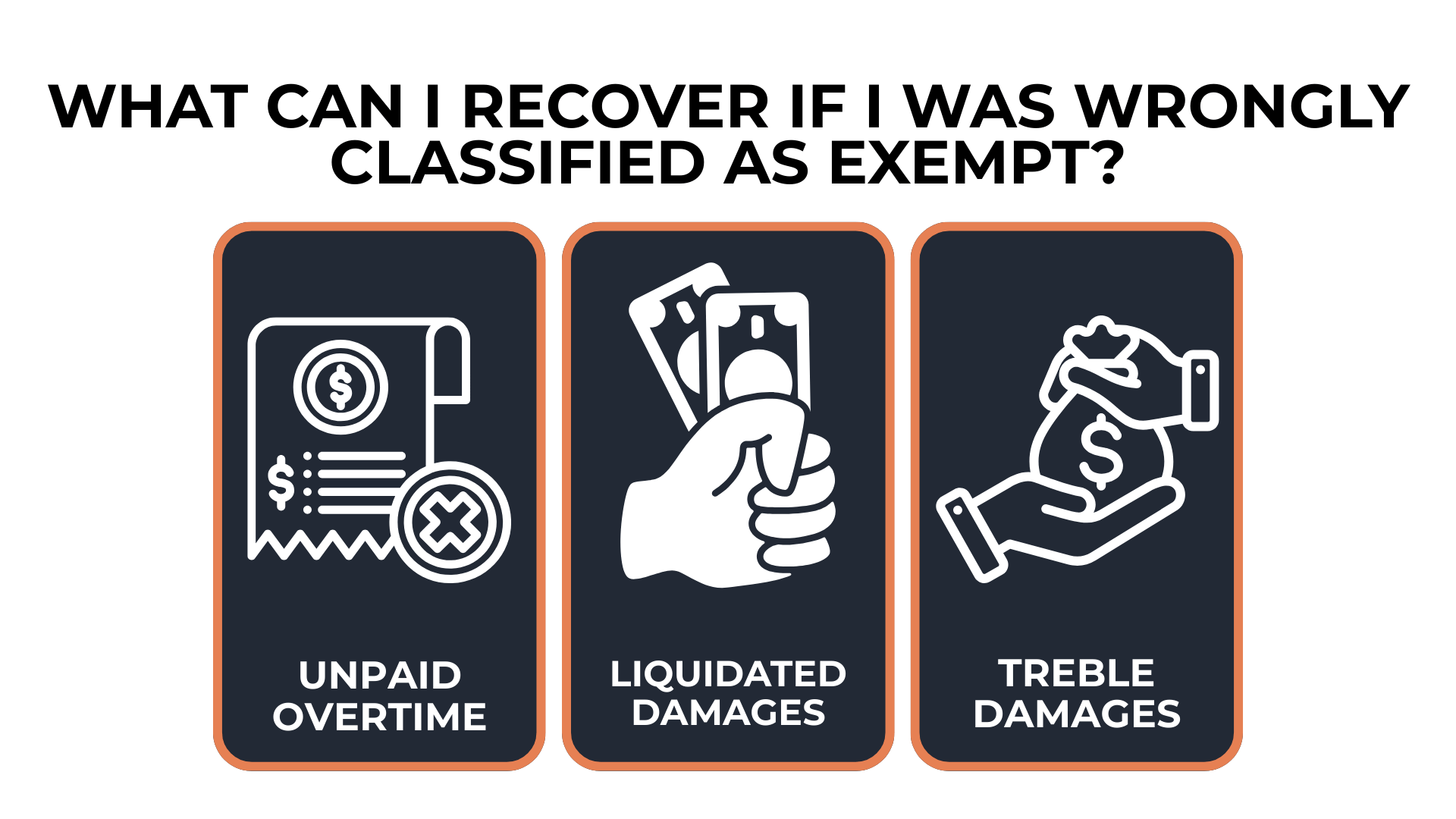
Employees who were improperly denied overtime can recover substantial compensation. Federal and state laws provide not only back wages but also enhanced damages designed to punish violations and deter future misconduct.
How much can I recover in unpaid overtime?
You can recover all unpaid overtime wages for the period covered by the applicable statute of limitations. This includes 1.5 times your regular rate for every hour worked beyond 40 per week that went uncompensated.
In 2023, Seyfarth Shaw’s litigation analysis (2023) documented $493,571,392 in total FLSA collective action settlements across 423 cases—averaging approximately $1.17 million per case. Individual recoveries depend on hours worked, duration of misclassification, and applicable damages multipliers.
What are liquidated damages?
Under the FLSA, employees can recover liquidated damages equal to the amount of unpaid wages—effectively doubling the recovery. In Souryavong v. Lackawanna County, 872 F.3d 122 (3d Cir. 2017), the Third Circuit confirmed that liquidated damages under the FLSA are “the norm rather than the exception.” The employer bears the burden of proving both good faith and objectively reasonable grounds to reduce or eliminate them.
How do New Jersey’s treble damages work?
New Jersey’s Wage Theft Act provides even stronger remedies. Under N.J. Stat. Ann. § 34:11-4.10, employees can recover treble damages—three times the unpaid wages—plus attorney fees and costs. This means a New Jersey employee owed $10,000 in unpaid overtime could potentially recover $30,000 plus their attorney’s fees.
The damages available include:
- Unpaid overtime wages for all hours worked beyond 40 per week
- Liquidated damages equal to unpaid wages (FLSA) or 200% additional (NJ treble damages)
- Prejudgment interest on unpaid amounts
- Attorney fees and costs shifted to the employer if you prevail
- Penalties in some circumstances
Pennsylvania’s Wage Payment and Collection Law provides 25% liquidated damages plus attorney fees under 43 Pa. Stat. § 260.10—less than New Jersey but still significant enhancement beyond the base wages owed.
How Long Do I Have to File an Exemption Misclassification Claim?
Time limits apply to overtime claims. The longer you wait, the more potential recovery you may forfeit. Understanding these deadlines is critical to protecting your rights.
What is the federal statute of limitations?
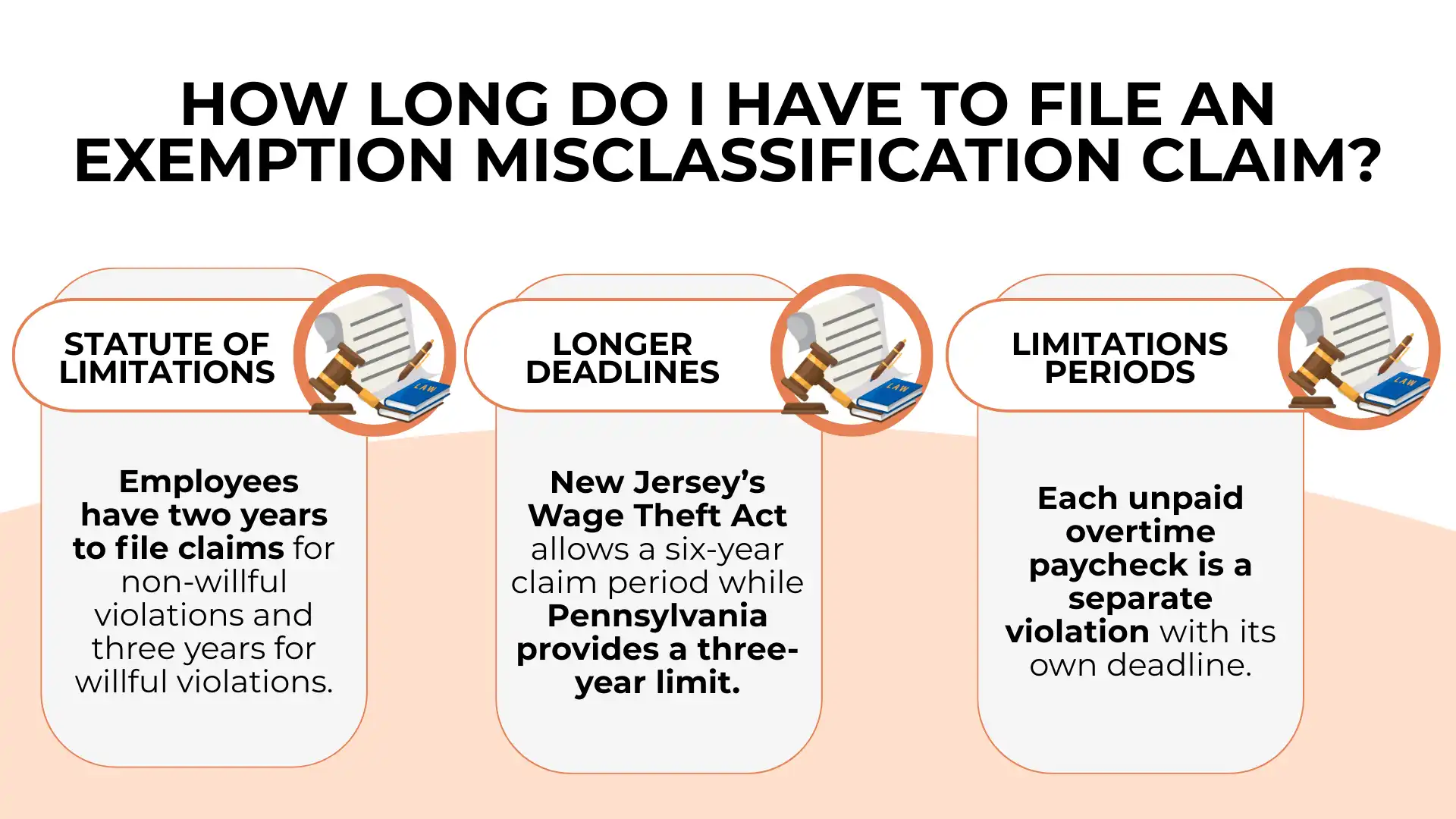
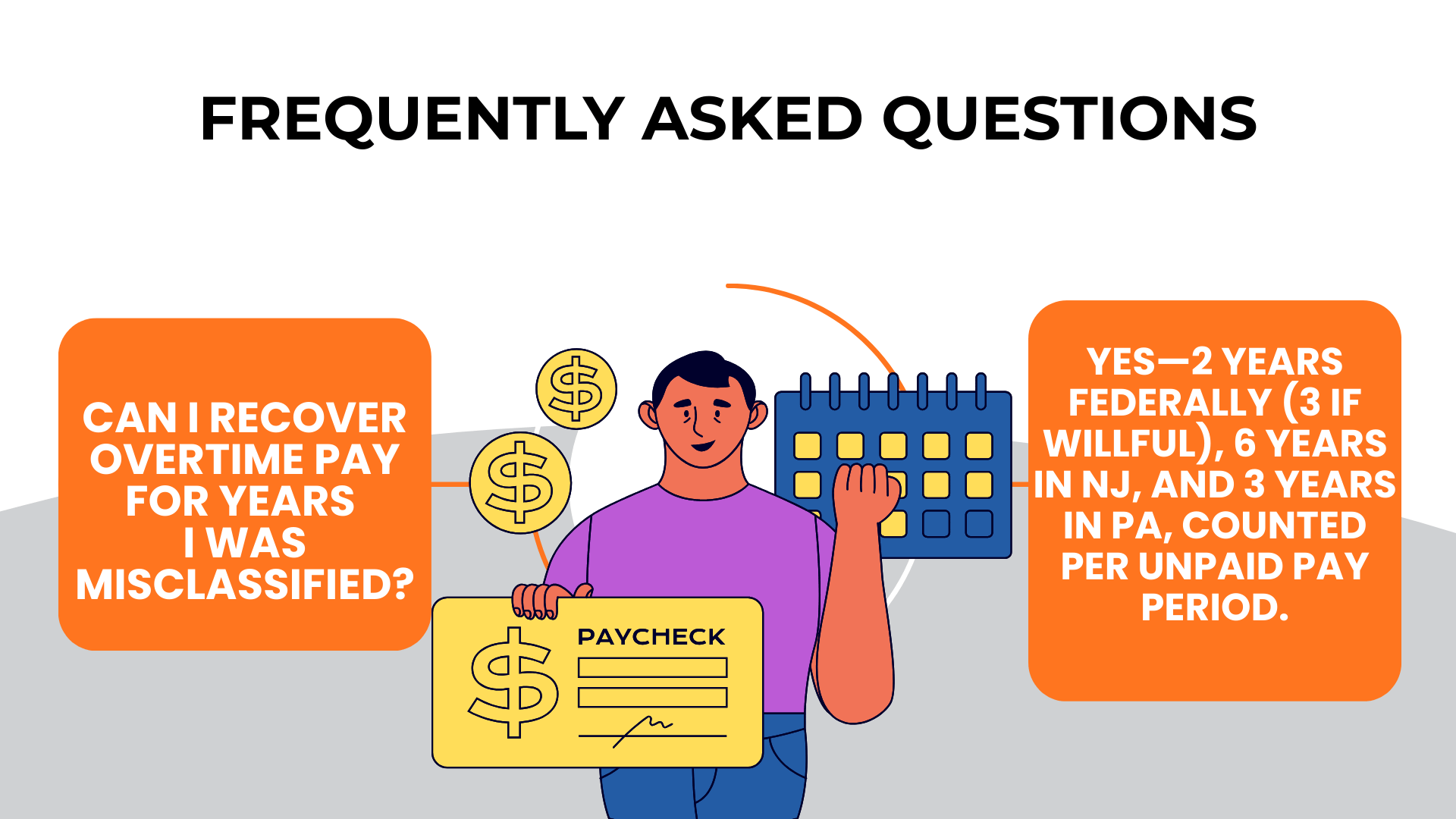
Under the FLSA, employees have two years to file claims for non-willful violations and three years for willful violations under 29 U.S.C. § 255(a). A violation is willful if the employer knew or showed reckless disregard for whether its conduct violated the law.
Do New Jersey and Pennsylvania have longer deadlines?
Yes. New Jersey’s Wage Theft Act provides a six-year statute of limitations under N.J. Stat. Ann. § 34:11-56a25.1—twice as long as the longest federal period. This extended window allows employees to recover more years of unpaid overtime. Pennsylvania provides a three-year limitations period for wage claims.
Does each paycheck start a new limitations period?
Yes. Each pay period in which you should have received overtime but didn’t constitutes a separate violation that starts its own limitations clock. This means even if your misclassification began years ago, you can still recover for violations within the limitations period. But unpaid overtime from older pay periods will eventually become time-barred as each paycheck ages past the deadline.
How Do I Challenge My Exempt Classification?
If you believe your employer wrongly classified you as exempt, taking organized steps can strengthen any potential claim.
What evidence should I gather?
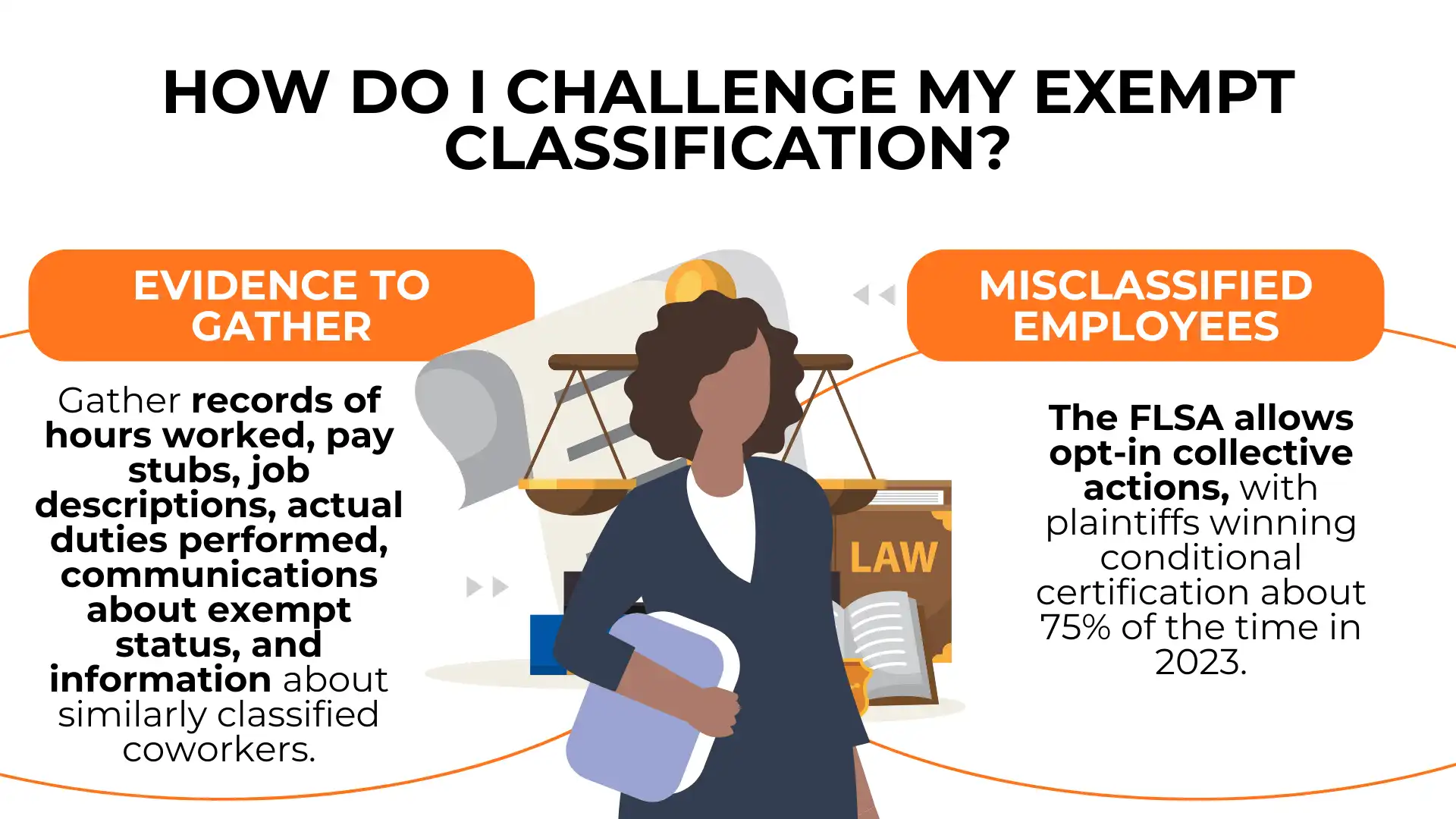
Documentation is essential for overtime claims. Before taking formal action, consider gathering:
- Records of hours actually worked, including start times, end times, and work performed outside normal hours
- Pay stubs and wage statements showing your salary, hours recorded, and payment history
- Job descriptions and any written materials describing your position’s duties and responsibilities
- Evidence of actual duties performed, which may differ from official job descriptions
- Communications about your exempt status, overtime expectations, or work hours
- Information about similarly situated coworkers who may also be misclassified
Can I join with other misclassified employees?
Yes. The FLSA allows collective actions where employees with similar claims join together, strengthening their position and sharing litigation costs. According to Seyfarth Shaw’s analysis (2023), plaintiffs achieved a 75% success rate on conditional certification motions in FLSA collective actions in 2023.
Collective actions work through an opt-in process—employees must affirmatively consent to participate. State law claims may proceed as class actions with different procedural rules. An employment attorney can evaluate which approach best fits your circumstances.
Frequently Asked Questions
Can my employer make me exempt just by calling me a manager?
No. Job titles have no legal effect on exempt status. What matters is whether your actual job duties satisfy all elements of a recognized exemption category. An employee titled “manager” who spends most of their time performing non-managerial work like stocking inventory, serving customers, or processing routine paperwork likely doesn’t qualify as exempt regardless of their title.
What if I earn more than the salary threshold but don’t supervise anyone?
Earning above the salary threshold is necessary but not sufficient for exempt status. You must also satisfy the duties test for a specific exemption category. The executive exemption requires supervising at least two full-time employees. If you don’t meet this requirement, you’d need to satisfy a different exemption’s duties test—otherwise you’re entitled to overtime despite your salary level.
Does being paid salary automatically make me exempt from overtime?
No. Salary payment is only one component of the exemption test. Many non-exempt employees are paid salaries rather than hourly wages. To be exempt, you must be paid on a salary basis at or above the threshold AND your actual duties must satisfy a specific exemption category’s requirements. Both conditions must be met.
Can I recover overtime pay for years I was misclassified?
Yes, subject to the applicable statute of limitations. Under federal law, you can recover two years of unpaid overtime (or three years for willful violations). New Jersey provides a six-year limitations period, and Pennsylvania provides three years. Each pay period you should have received overtime but didn’t is a separate violation, so you can recover for all qualifying pay periods within the limitations window.
What if my employer retaliates against me for questioning my exempt status?
Federal and state anti-retaliation provisions protect employees who assert their wage and hour rights. Under 29 U.S.C. § 215(a)(3), it’s illegal for employers to discharge or discriminate against employees who file complaints or participate in proceedings under the FLSA. New Jersey law creates a presumption of retaliation if adverse action occurs within 90 days of protected activity. These protections apply whether your underlying wage claim ultimately succeeds or not.
Protect Your Right to Overtime Pay
The FLSA exemption test exists to identify a narrow category of employees whose job responsibilities and compensation genuinely place them outside the overtime system. When employers misapply these tests—whether through ignorance, confusion, or deliberate cost-cutting—affected employees lose wages they’re legally entitled to receive.
If you’re classified as exempt but your actual duties don’t match the exemption requirements, or if your salary has been manipulated to avoid overtime obligations, you may have a claim for back wages, liquidated or treble damages, and attorney fees. The longer you wait, the more potential recovery becomes time-barred.
Contact The Lacy Employment Law Firm to discuss your situation.