If you’re wondering whether your age makes you eligible for protection under employment discrimination laws, you’re asking the right question. Age discrimination laws don’t protect everyone equally—the threshold age and scope of protection varies significantly depending on whether your claim falls under federal, Pennsylvania, or New Jersey law. Understanding these distinctions can determine whether you have a viable legal claim and which laws provide the strongest protection for your situation.
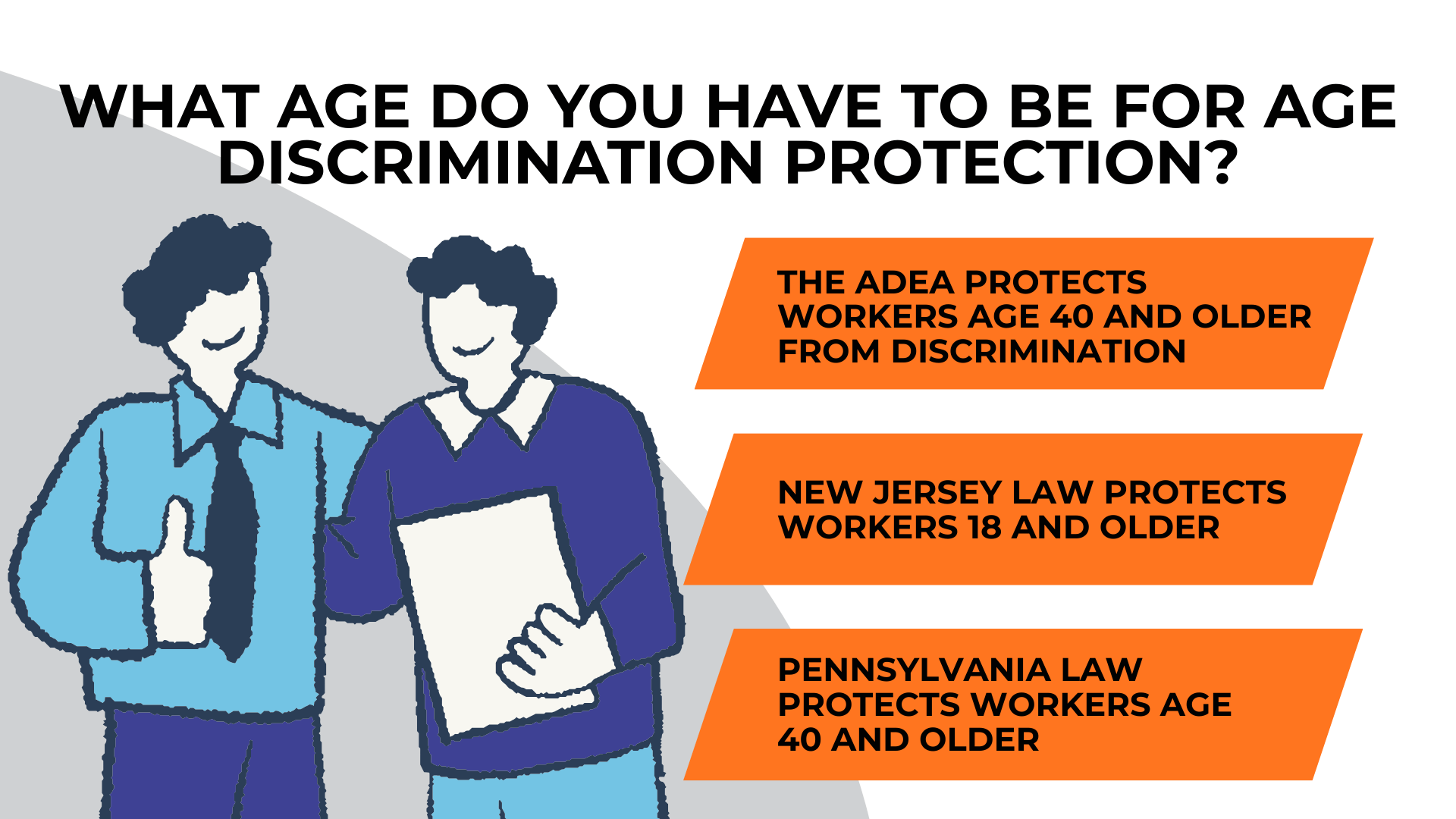
The short answer: federal law and Pennsylvania law protect workers 40 and older, while New Jersey law protects workers 18 and older. But the differences go far beyond age thresholds. Employer size requirements, available remedies, and filing procedures all vary by jurisdiction, creating meaningful strategic choices for workers who may qualify under multiple laws.
What Age Do You Have to Be for Age Discrimination Protection?
The age at which discrimination protection begins depends entirely on which law applies to your situation. Each jurisdiction has established its own threshold, and workers in Pennsylvania and New Jersey may have access to protections that federal law doesn’t provide.
Federal Protection Under the ADEA (40 and Older)
The Age Discrimination in Employment Act (ADEA), codified at 29 U.S.C. § 631(a), protects individuals age 40 and older from employment discrimination. This federal law covers hiring, firing, promotions, compensation, and other terms and conditions of employment. If you’re 39 or younger, federal age discrimination law does not apply to you—regardless of how clearly age motivated your employer’s decision.
Importantly, the ADEA does not prohibit employers from favoring older workers over younger ones within the protected class. In O’Connor v. Consolidated Coin Caterers Corp., 517 U.S. 308 (1996), the Supreme Court clarified that a 56-year-old replaced by a 40-year-old may still have a valid claim—what matters is the age gap, not whether the replacement falls outside the protected class.
New Jersey’s Broader Protection (18 and Older)
New Jersey’s Law Against Discrimination (N.J.S.A. 10:5-12(a)) provides significantly broader protection, covering workers 18 and older. This means a 25-year-old passed over for a job in favor of a 22-year-old may have a valid age discrimination claim under NJ LAD—a claim that would be impossible under federal or Pennsylvania law.
The New Jersey Supreme Court confirmed this broad interpretation in Bergen Commercial Bank v. Sisler, 157 N.J. 188, 723 A.2d 944 (1999), holding that the LAD’s protections extend to workers of any age within the workforce. This makes New Jersey one of the most protective jurisdictions in the country for age-based employment claims.
Pennsylvania’s Age Threshold (40 and Older)
Pennsylvania’s Human Relations Act (43 P.S. § 955(a)) follows the federal model, protecting workers age 40 and older. Like the ADEA, Pennsylvania law does not extend protection to workers under 40, regardless of how obvious the age-based treatment may be.
However, Pennsylvania law offers one significant advantage over federal law: it covers smaller employers. While federal ADEA applies only to employers with 20 or more employees, Pennsylvania’s PHRA covers employers with 4 or more employees, expanding protection to workers at small businesses who have no federal remedy.
Does Your Employer’s Size Affect Your Age Discrimination Rights?
Your employer’s size can determine whether you have any legal claim at all. Federal, Pennsylvania, and New Jersey law each set different thresholds for employer coverage.
Federal Employer Size Requirements
The ADEA applies to employers with 20 or more employees, including state and local government employers regardless of size under Mount Lemmon Fire District v. Guido, 586 U.S. 1 (2018). Private employers with fewer than 20 employees are not covered by federal age discrimination law.
Courts count employees who worked each working day for 20 calendar weeks in the current or preceding year. Independent contractors generally do not count toward this threshold.
State Law Coverage Differences
Pennsylvania’s PHRA covers employers with 4 or more employees (43 P.S. § 954(b)), providing a critical safety net for workers at small businesses. If you work for an employer with 4-19 employees, Pennsylvania law is your only age discrimination remedy—federal law doesn’t apply.
New Jersey’s LAD goes further: no minimum employer size is required. Even single-employee businesses fall under NJ LAD coverage, making it the broadest employment discrimination law in the region.
How Employee Count Is Calculated
Employers sometimes dispute whether they meet coverage thresholds. Courts examine payroll records, W-2 forms, and organizational charts to determine actual employee counts. The relevant period is the 20 calendar weeks in the current or preceding year when employees worked each working day.
How Many Workers Face Age Discrimination?
Age discrimination is not a rare or isolated problem. Federal enforcement data and worker surveys reveal that millions of older Americans experience age-based treatment in the workplace, and formal charge filings have surged in recent years.
Federal Charge Filing Statistics
According to the EEOC Enforcement and Litigation Statistics (2025), 16,223 age discrimination charges were filed with the EEOC in FY 2024. This represents a 41% increase from FY 2022 (11,500 charges), signaling a significant resurgence in workplace age bias complaints after pandemic-era declines.
Age discrimination charges now constitute a substantial portion of all EEOC filings. The agency’s FY 2024 Annual Performance Report documented 88,531 total discrimination charges in FY 2024—meaning age claims represented approximately 18% of all charges filed.
Worker Experiences and Survey Data
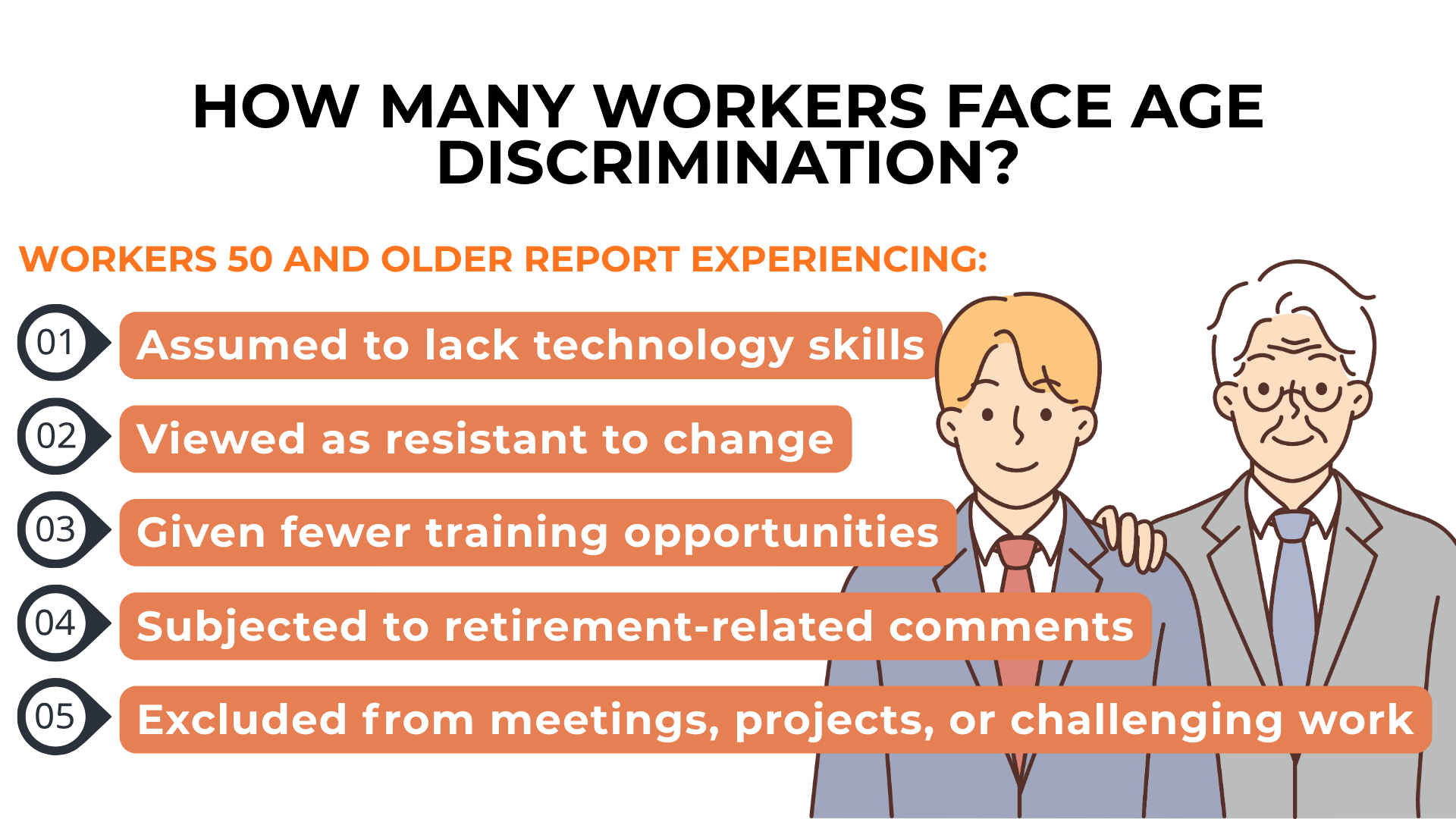
Formal charge filings capture only a fraction of the discrimination workers experience. According to AARP Research (2025), 64% of workers age 50 and older have seen or experienced age discrimination in the workplace.
The same research reveals that subtle forms of discrimination are pervasive. Workers 50 and older report experiencing:
- Assumptions that they lack technology skills (33%)
- Perceptions that they resist change (24-25%)
- Receiving less access to training opportunities (20%)
- Being excluded from meetings or projects
- Hearing comments suggesting they should retire
- Being passed over for challenging assignments given to younger colleagues
These experiences affect a large and growing workforce. According to the Bureau of Labor Statistics (2025), 38.8 million workers age 55 and older participate in the U.S. labor force—representing 23.1% of all workers.
What Must You Prove in an Age Discrimination Claim?
Successfully pursuing an age discrimination claim requires more than showing you’re over 40 and were treated unfairly. Courts apply a structured framework that requires plaintiffs to establish specific elements and meet particular causation standards.
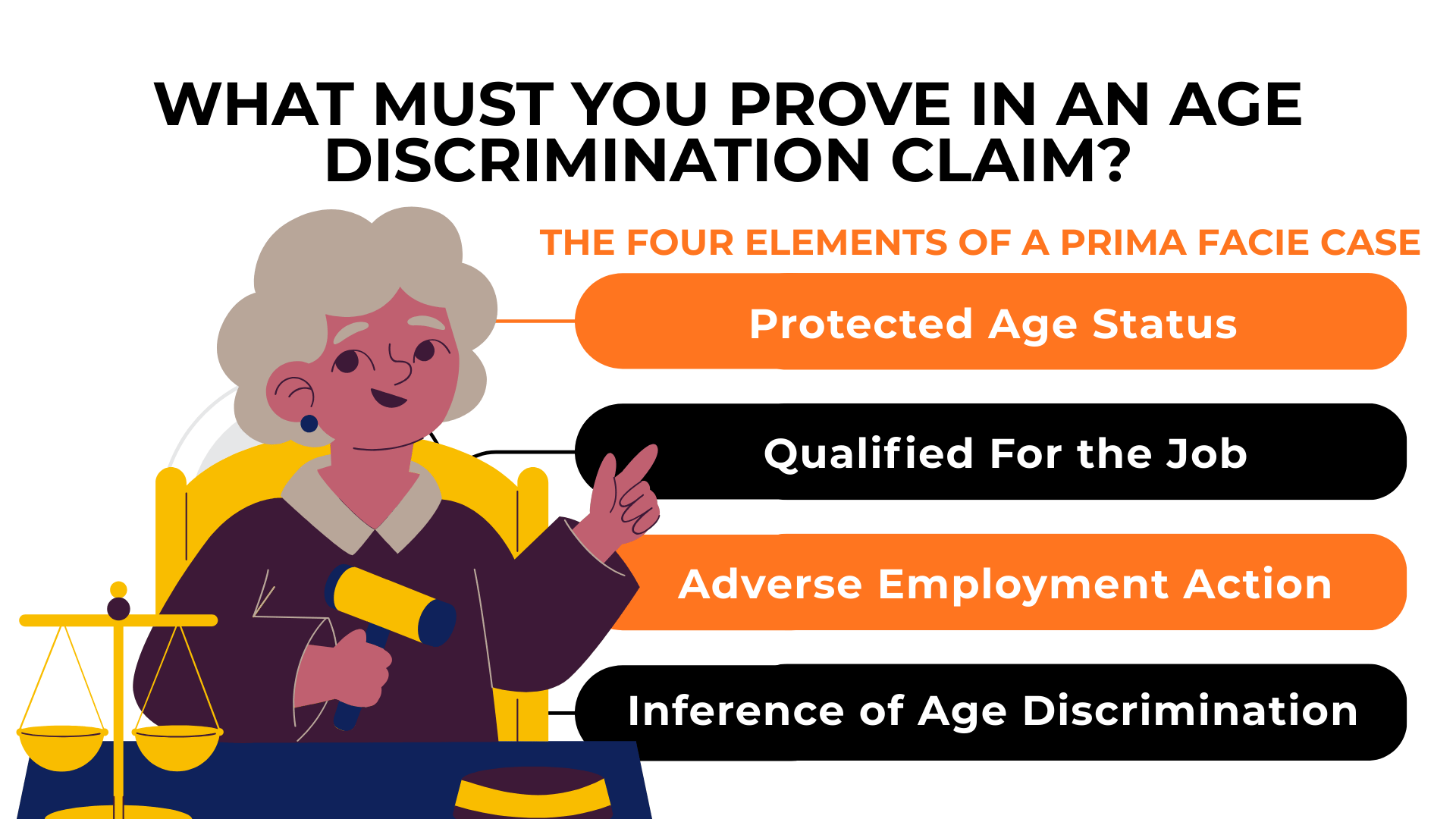
The Four Elements of a Prima Facie Case
Under the McDonnell Douglas burden-shifting framework, plaintiffs must establish four elements to create a presumption of discrimination:
- Membership in the protected class (age 40 or older under federal/PA law; 18 or older under NJ law)
- Qualification for the position held or sought
- An adverse employment action (termination, demotion, failure to promote, significant reduction in pay)
- Circumstances giving rise to an inference of discrimination—typically that the plaintiff was replaced by or treated less favorably than someone substantially younger
If you establish these elements, the burden shifts to your employer to articulate a legitimate, nondiscriminatory reason for the adverse action. If they do, you must then prove that reason is a pretext for discrimination.
What “Substantially Younger” Means
Courts examine the age gap between the plaintiff and their replacement or comparator rather than focusing on whether the replacement is under 40. In Baron v. Abbott Laboratories, 672 Fed. Appx. 158 (3d Cir. 2016), the Third Circuit held that a one-year age gap was insufficient to support an inference of discrimination. While no bright-line rule exists, courts generally look for meaningful age differences that make discrimination a plausible explanation.
The But-For Causation Standard
Federal ADEA claims face a demanding causation standard. In Gross v. FBL Financial Services, Inc., 557 U.S. 167 (2009), the Supreme Court held that plaintiffs must prove age was the “but-for” cause of the adverse action—meaning the action would not have occurred absent the discriminatory motive.
This standard is more stringent than Title VII’s “motivating factor” test. Under Gross, mixed-motive jury instructions are not available in ADEA cases. State laws may apply more favorable standards—New Jersey courts have interpreted LAD to require only that discrimination was a “determinative factor.”
What Are the Deadlines for Filing an Age Discrimination Claim?
Filing deadlines vary significantly by jurisdiction and the administrative agency involved. Missing a deadline can permanently bar your claim, making early action essential.
Federal EEOC Filing Deadlines
Because Pennsylvania and New Jersey are “deferral states” with their own age discrimination laws and enforcement agencies, workers have 300 days from the discriminatory act to file a charge with the EEOC under 29 U.S.C. § 626(d). In non-deferral states, this deadline is only 180 days.
After filing with the EEOC, you may file a federal lawsuit 60 days after submitting your charge, even without receiving a right-to-sue letter. Alternatively, you can wait for the EEOC to complete its investigation and file within 90 days of receiving the Notice of Dismissal or Right to Sue.
Pennsylvania PHRC Requirements
Pennsylvania’s Human Relations Commission requires that complaints be filed within 180 days of the alleged discriminatory act (43 P.S. § 959(h)). After filing, you must generally wait one year for the PHRC to investigate before filing a court action, unless the PHRC dismisses your complaint earlier.
This creates a timing trap: the PHRC’s 180-day deadline is shorter than the EEOC’s 300-day deadline. Missing the PHRC deadline forfeits your state claim even if your federal claim remains viable.
New Jersey’s Direct Court Filing Option
New Jersey provides a significant procedural advantage: no administrative exhaustion is required for NJ LAD claims. You may file directly in Superior Court within 2 years of the discriminatory act (N.J.S.A. 2A:14-2(a)), bypassing the EEOC and state agency process entirely.
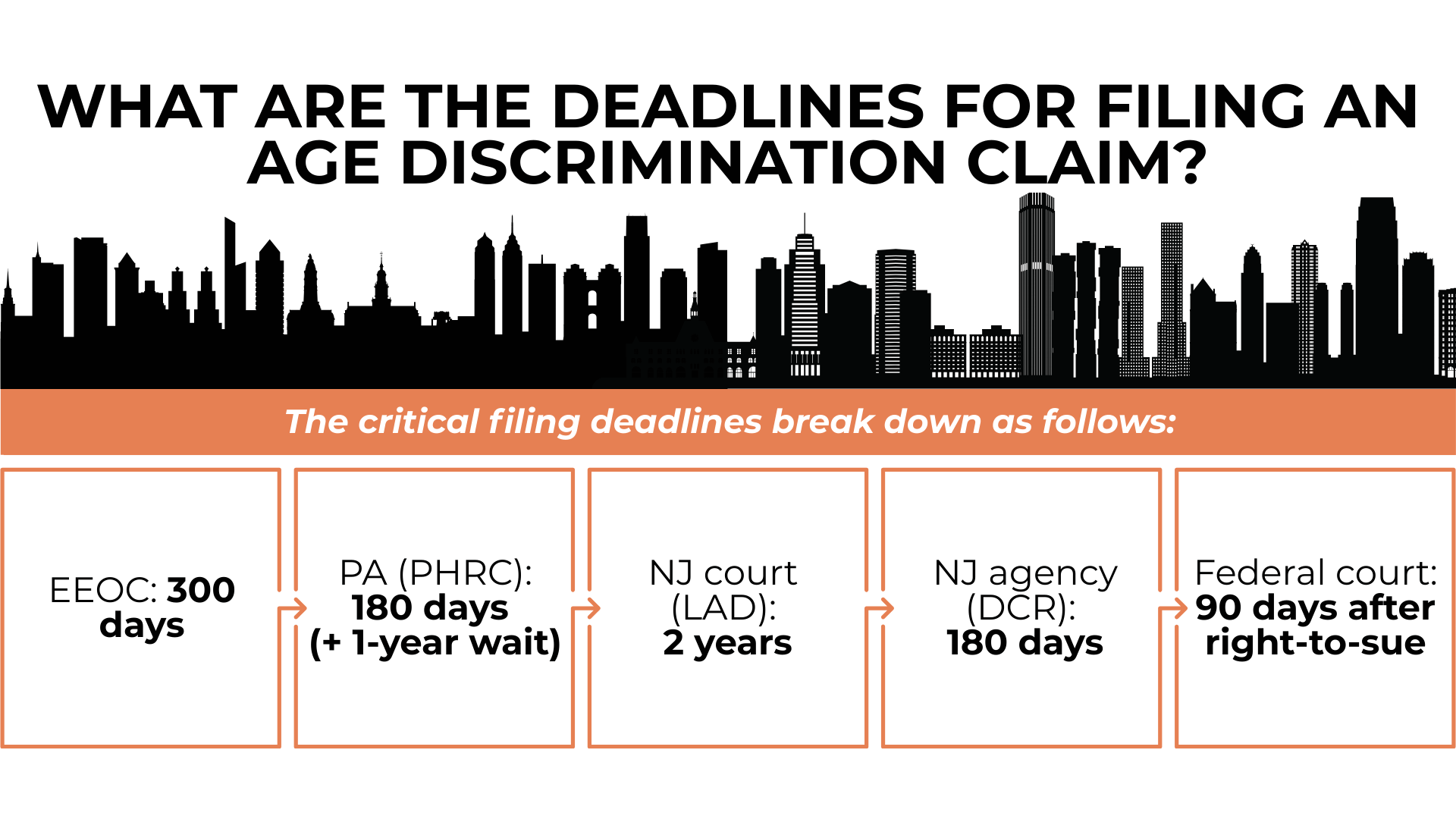
The critical filing deadlines break down as follows:
- EEOC (federal): 300 days from discriminatory act
- PHRC (Pennsylvania): 180 days from discriminatory act, plus 1-year waiting period
- NJ LAD (court filing): 2 years from discriminatory act, no administrative filing required
- NJ DCR (administrative): 180 days if choosing administrative route
- Federal court after EEOC: 90 days from receipt of right-to-sue letter
What Can You Recover in an Age Discrimination Case?
The remedies available in an age discrimination case vary dramatically depending on which law applies. This can significantly affect case value and litigation strategy.
Federal ADEA Remedies
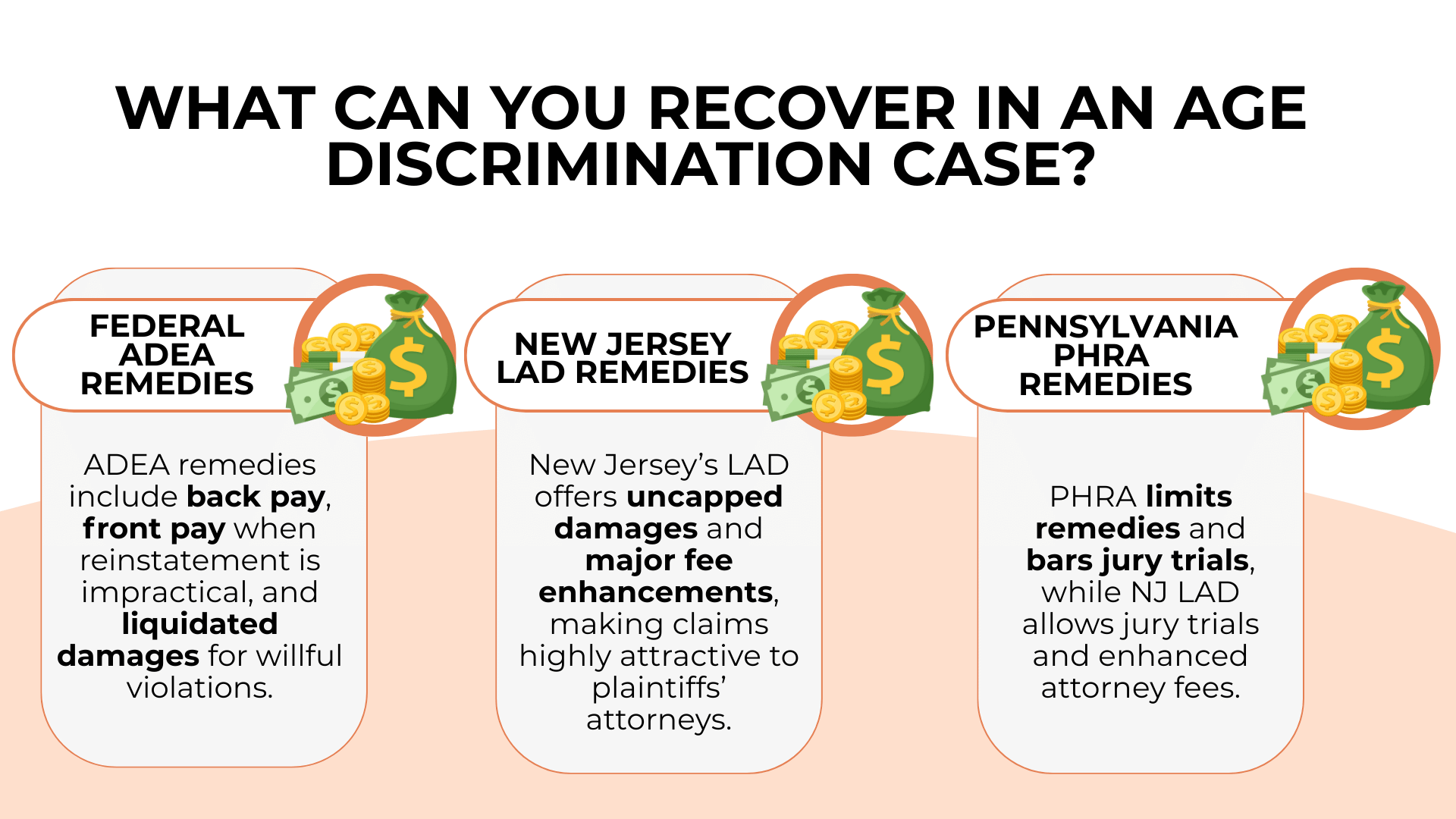
Under the ADEA, available remedies include back pay (lost wages minus mitigation), front pay (future lost earnings when reinstatement is not feasible), and liquidated damages equal to back pay for “willful” violations. In Trans World Airlines, Inc. v. Thurston, 469 U.S. 111 (1985), the Supreme Court held that willfulness requires the employer to have known or shown reckless disregard for whether its conduct violated the ADEA.
Critically, the ADEA does not allow compensatory damages for emotional distress or punitive damages. This limitation significantly reduces potential recovery compared to state law claims.
New Jersey LAD Remedies
New Jersey’s LAD provides the most comprehensive remedies in the region. Successful plaintiffs may recover back pay, front pay, uncapped compensatory damages including emotional distress, and punitive damages where the employer’s conduct was “especially egregious” and upper management showed “actual participation or willful indifference.”
Additionally, NJ LAD allows attorney fee enhancement of 20-35% for typical cases and up to 100% for exceptional cases under Rendine v. Pantzer, 141 N.J. 292 (1995). This makes pursuing NJ LAD claims financially viable for plaintiffs’ attorneys.
Pennsylvania PHRA Remedies
Pennsylvania’s PHRA provides back pay, front pay, and uncapped compensatory damages including emotional distress. However, under Hoy v. Angelone, 720 A.2d 745 (Pa. 1998), punitive damages are not available under the PHRA.
Another significant limitation: PHRA claims in Pennsylvania state court have no jury trial right—cases are tried to the bench. This can affect case outcomes, as juries may be more sympathetic to discrimination plaintiffs.
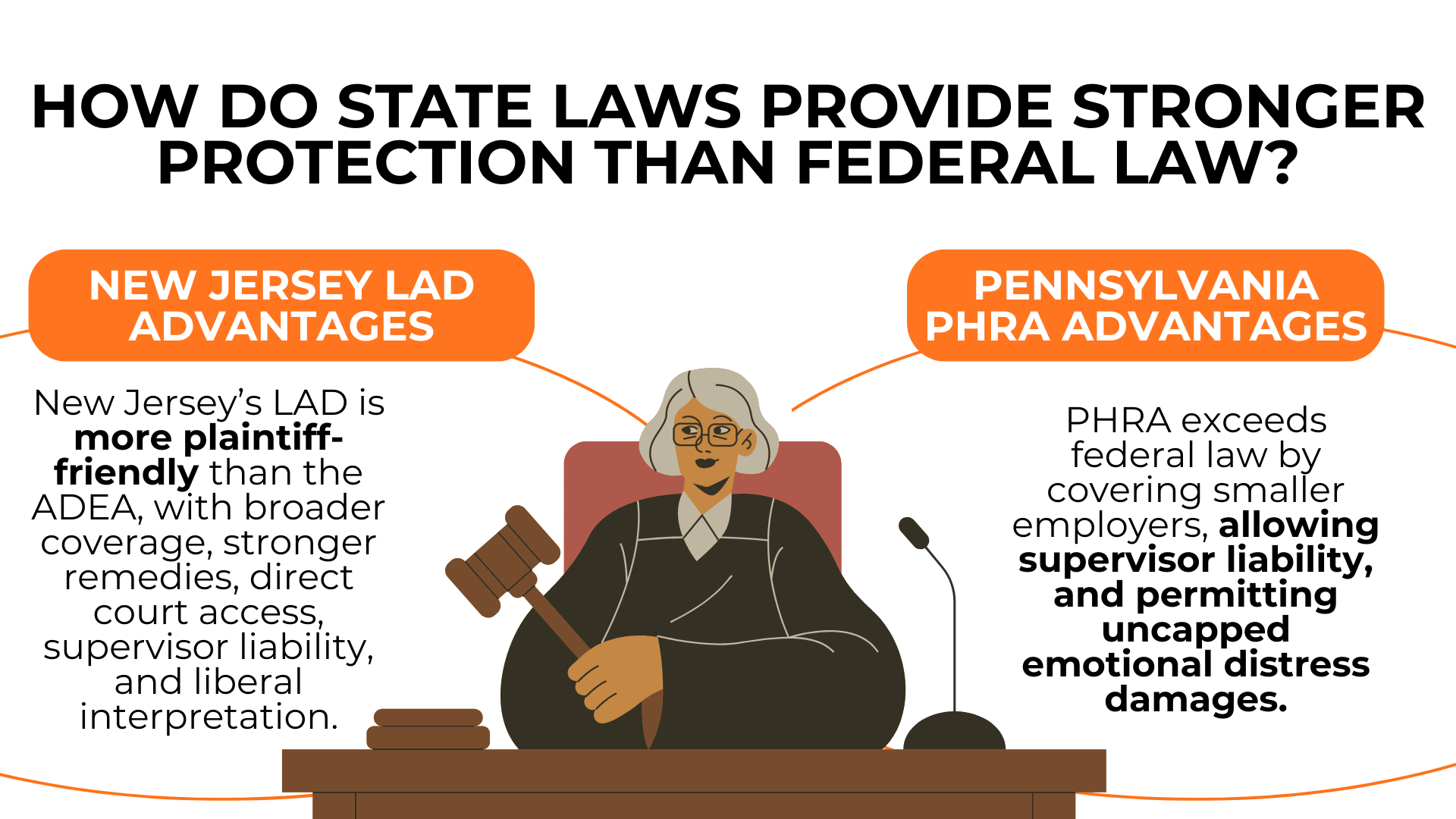
How Do State Laws Provide Stronger Protection Than Federal Law?
Workers in Pennsylvania and New Jersey often have access to state law protections that exceed what federal law provides. Understanding these advantages can shape litigation strategy and maximize recovery.
New Jersey LAD Advantages
New Jersey’s Law Against Discrimination offers multiple advantages over federal ADEA:
Broader protected class: Workers 18 and older are protected, not just those 40 and older. No employer size minimum: Even single-employee businesses are covered. Enhanced remedies: Uncapped compensatory damages plus punitive damages. No administrative exhaustion: File directly in court within 2 years. Fee enhancement: Attorney fee multipliers incentivize representation. Individual supervisor liability: Supervisors can be personally liable under N.J.S.A. 10:5-12(e).
Courts interpret the LAD “liberally” as remedial legislation. As the New Jersey Supreme Court explained in Andersen v. Exxon Co., U.S.A., 89 N.J. 483 (1982), the more broadly the LAD is applied, the greater its anti-discriminatory impact.
Pennsylvania PHRA Advantages
While more limited than NJ LAD, Pennsylvania’s PHRA still offers meaningful advantages over federal law:
Smaller employer coverage: Employers with 4 or more employees are covered, compared to ADEA’s 20-employee threshold. Individual liability: Supervisors can be held personally liable under the aiding and abetting provision (43 P.S. § 955(e)). Uncapped compensatory damages: No statutory cap on emotional distress recovery.
Choosing the Right Law for Your Claim
Workers with valid claims under multiple laws face strategic choices. For maximum recovery, NJ LAD typically provides the strongest remedies due to punitive damages and fee enhancement. For workers at small employers (4-19 employees), PHRA may be the only option. For workers seeking jury trials in Pennsylvania, federal court may be preferable despite ADEA’s more limited remedies.
Frequently Asked Questions
Can someone under 40 file an age discrimination claim?
Under federal law (ADEA) and Pennsylvania law (PHRA), only workers 40 and older are protected. However, New Jersey’s Law Against Discrimination protects workers 18 and older, meaning younger workers in NJ can file age discrimination claims if they were treated unfavorably because of their age—including “too young” claims where an employer favors older workers.
Does my employer have to be a certain size for age discrimination laws to apply?
Federal ADEA coverage requires employers with 20 or more employees. Pennsylvania’s PHRA covers employers with 4 or more employees. New Jersey’s LAD has no minimum employer size—even single-employee businesses are covered, making it the broadest protection available.
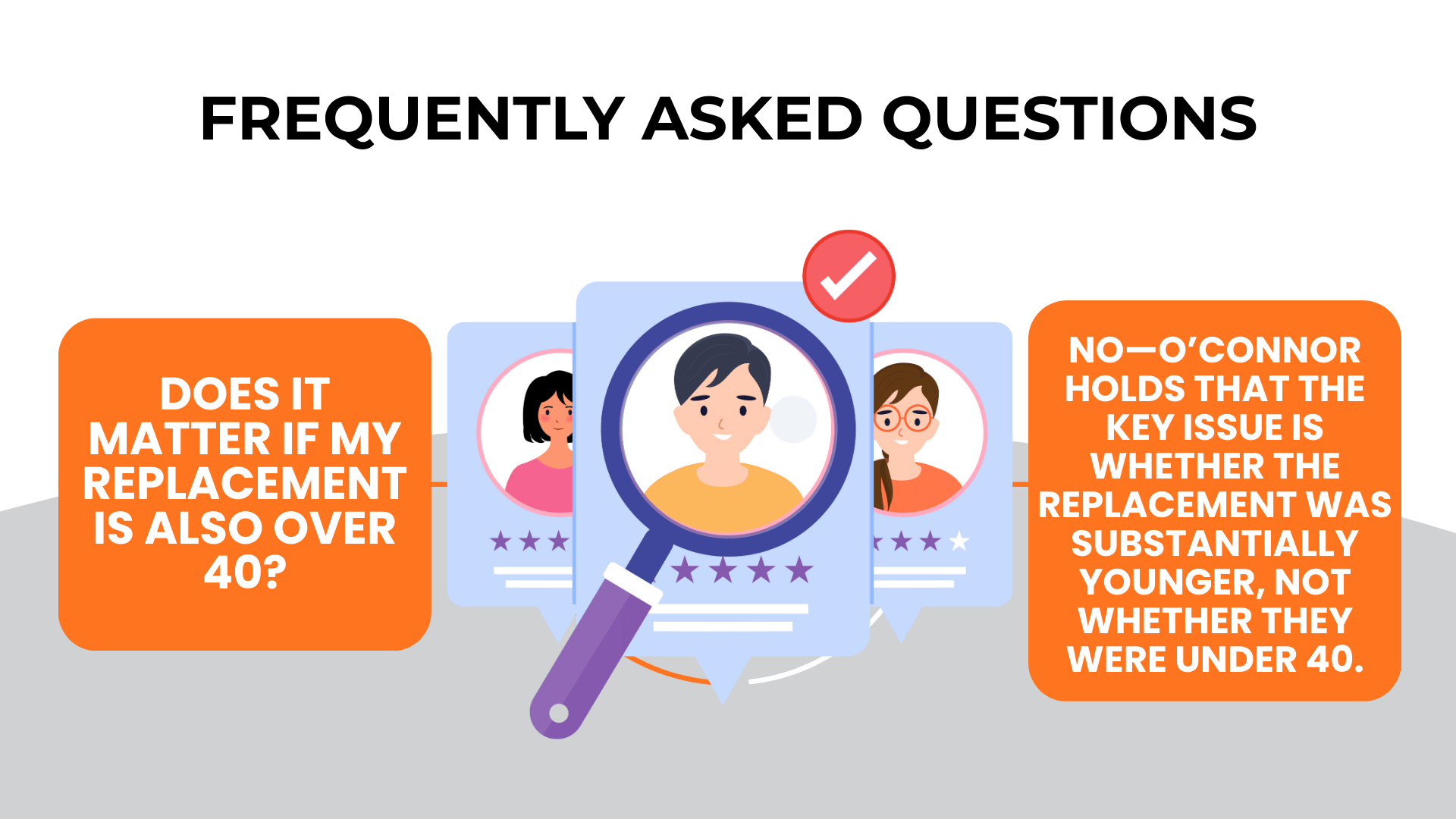
Does it matter if my replacement is also over 40?
No. Under O’Connor v. Consolidated Coin Caterers Corp., 517 U.S. 308 (1996), the Supreme Court held that a replacement does not need to be under 40. What matters is whether the replacement was “substantially younger” than you. Courts focus on the age gap between you and your replacement, not whether the replacement falls outside the protected class.
How long do I have to file an age discrimination claim?
In Pennsylvania and New Jersey (deferral states), you have 300 days to file a charge with the EEOC. Pennsylvania PHRC complaints must be filed within 180 days. New Jersey LAD claims can be filed directly in court within 2 years, with no administrative filing required—providing the longest deadline and most flexibility.
Can I recover damages for emotional distress in an age discrimination case?
Under federal ADEA, emotional distress damages are not available separately—remedies are limited to back pay, front pay, and liquidated damages for willful violations. However, New Jersey LAD and Pennsylvania PHRA both allow uncapped compensatory damages, including emotional distress. NJ LAD also permits punitive damages; PHRA does not.
Protecting Your Rights Under Age Discrimination Laws
Understanding the age thresholds and coverage requirements under federal, Pennsylvania, and New Jersey law is the first step in evaluating whether you have a viable age discrimination claim. The key distinctions—40 versus 18 for protected age, employer size requirements, and available remedies—can significantly affect both whether you can pursue a claim and what you might recover.
Time limits are strict across all jurisdictions. The 180-day PHRC deadline in Pennsylvania is particularly unforgiving, and missing any applicable deadline can permanently bar your claim. If you believe you’ve experienced age-based discrimination, documenting the facts and understanding your options early provides the best foundation for protecting your rights.
If you have questions about whether your age qualifies you for protection under age discrimination laws, contact The Lacy Employment Law Firm to discuss your situation.