
When your workplace becomes a source of dread rather than productivity, every day feels like a test of endurance. A hostile work environment doesn’t just affect your job performance—it affects your health, your relationships, and your sense of self-worth. If you’re dealing with ongoing harassment, inappropriate comments, or conduct that makes it impossible to do your job, you need practical strategies to protect yourself and understand your options.
This guide explains how to cope with a hostile work environment in New Jersey, from documenting what’s happening to understanding when the law is on your side. You don’t have to navigate this alone, and you don’t have to accept that this is just how work is supposed to be.
What Makes a Work Environment Legally “Hostile”?
Not every unpleasant workplace rises to the level of illegal harassment. Understanding what the law actually requires helps you assess whether your situation crosses the line from difficult to actionable.
The severe or pervasive standard
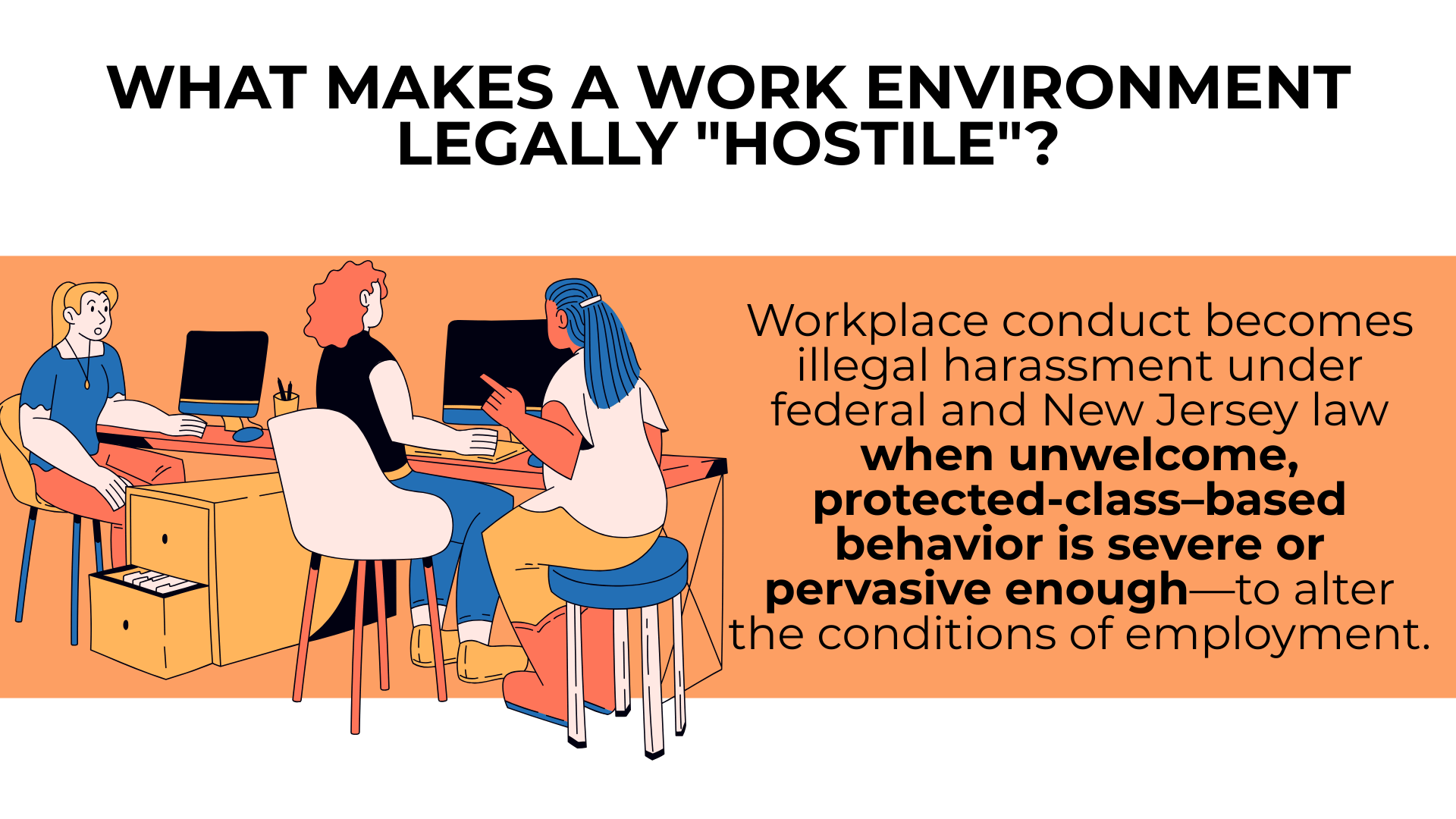
Both federal and New Jersey law require that harassing conduct be “severe or pervasive” enough to alter the conditions of your employment. This means the behavior must either be extremely serious or occur repeatedly over time. Courts look at the totality of circumstances: how often the conduct occurred, how severe it was, whether it was physically threatening or merely offensive, and whether it interfered with your ability to do your job.
The word “or” matters here. A pattern of lesser incidents can be just as actionable as a single extreme event. The harassment must also be unwelcome and based on a protected characteristic like sex.
New Jersey’s lower threshold for single incidents
New Jersey courts have shown greater willingness to find single incidents actionable when sufficiently severe. In Taylor v. Metzger, 152 N.J. 490 (1998), the New Jersey Supreme Court held that a single racial slur by a supervisor created an actionable hostile environment. More recently, in Rios v. Meda Pharmaceutical, Inc., 247 N.J. 1 (2021), the court found that just two demeaning slurs could be “sufficiently severe or pervasive” to support a claim.
New Jersey also applies a “reasonable person of the same protected class” standard rather than a generic reasonable person test. This means courts consider how a reasonable woman would perceive sexual harassment directed at a woman, rather than applying a one-size-fits-all standard.
Why Do So Many People Stay Silent About Workplace Harassment?
If you’ve been hesitating to take action, you’re far from alone. The gap between experiencing harassment and reporting it is enormous.
The gap between experiencing harassment and reporting it
According to the EEOC Select Task Force on the Study of Harassment in the Workplace (2016), approximately 90% of individuals who experience workplace harassment never file a formal charge. This isn’t because harassment is rare—studies show that between 25% and 85% of women report experiencing workplace sexual harassment, depending on how the question is asked.
Common reasons employees hesitate
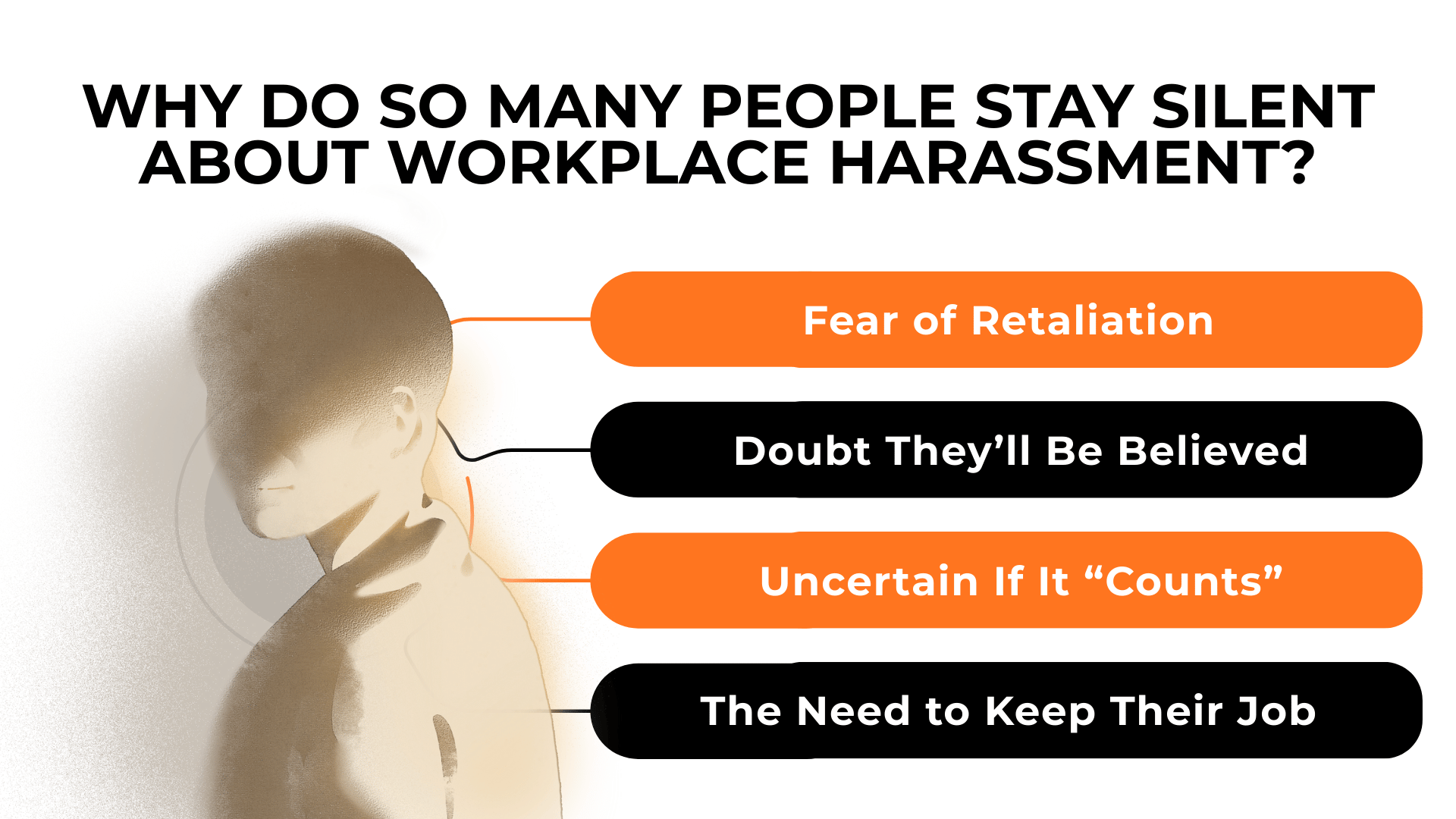
People stay silent for understandable reasons. They fear retaliation. They worry no one will believe them. They’re uncertain whether what they experienced “counts” as harassment. They need their job and can’t afford to rock the boat. They’ve seen what happened to others who complained. These fears are real, but they shouldn’t prevent you from at least understanding your options.
You are not alone in this experience
The EEOC reported (FY 2023) that more than 7,700 sexual harassment charges were filed that year alone—a 25% increase from the prior year and the highest number in 12 years. According to the EEOC’s Data Highlight (FY 2018-2021), women filed 78.2% of these charges, while men filed 21.8%. Harassment affects workers of all genders, industries, and backgrounds.
How Should You Document a Hostile Work Environment?
Documentation is your most powerful tool. What you record now could determine whether you have a viable claim later.
Creating contemporaneous records
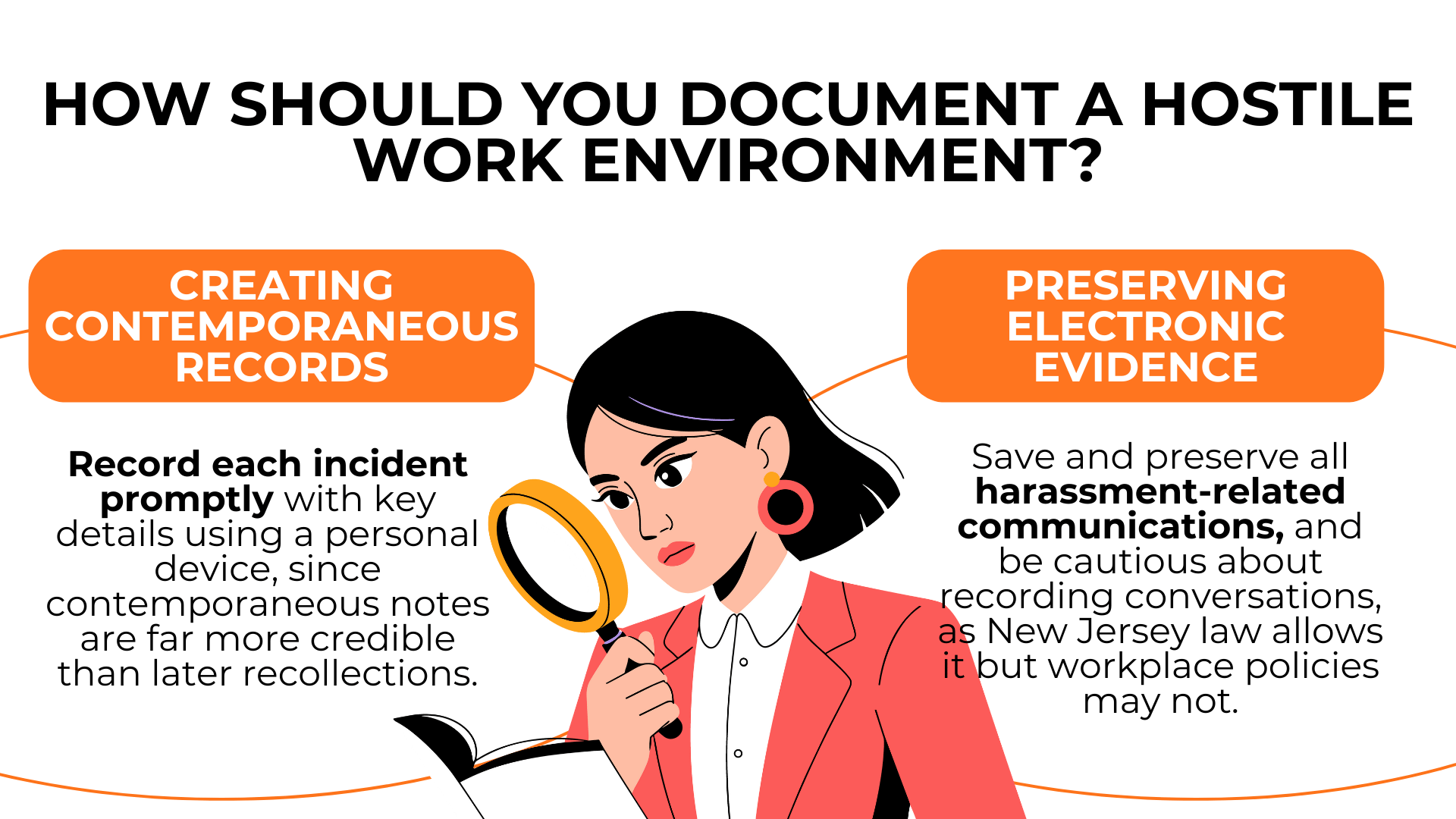
Write down what happened as soon as possible after each incident. Include the date, time, location, what was said or done, and who witnessed it. Use your personal phone or email—not your work devices—to create these records. The closer in time to the event, the more credible your account will be.
Contemporaneous records carry significant weight because they’re created before you have any reason to exaggerate or misremember. A journal entry written the night of an incident is far more persuasive than a recollection constructed months later.
Preserving electronic evidence
Save every email, text message, instant message, and voicemail related to the harassment. Forward work emails to your personal account. Screenshot messages that could be deleted. If your company uses a messaging platform like Slack or Teams, take screenshots of relevant conversations.
Be careful about recording conversations. New Jersey is a one-party consent state, meaning you can legally record a conversation you’re part of without telling the other person. However, company policies may prohibit recording, so consider the risks.
What details matter most for your case
Effective documentation includes specific elements that strengthen your legal position. Keep records of:
- Exact dates and times of each incident, not approximations
- Specific words used by the harasser, quoted as precisely as possible
- Names of anyone who witnessed the conduct or whom you told about it
- How the harassment affected your work performance or emotional state
- Any reports you made to supervisors, HR, or management and their responses
- Copies of your employer’s anti-harassment policy and any training materials
- Changes in your treatment, assignments, or evaluations after incidents began
Should You Report Harassment to HR or Management?
Deciding whether to report internally is one of the most difficult choices you’ll face. There are legal and practical implications either way.
How internal reporting affects employer liability
Under the framework established by Faragher v. City of Boca Raton, 524 U.S. 775 (1998), and Burlington Industries, Inc. v. Ellerth, 524 U.S. 742 (1998), employers can sometimes avoid liability for supervisor harassment if they prove they took reasonable steps to prevent and correct harassment, and that the employee unreasonably failed to use available complaint procedures.
This means your decision not to report could be used against you later. However, this defense is not available when the harassment resulted in a tangible employment action like termination, demotion, or denial of a promotion—in those cases, the employer is strictly liable.
Weighing the risks and benefits
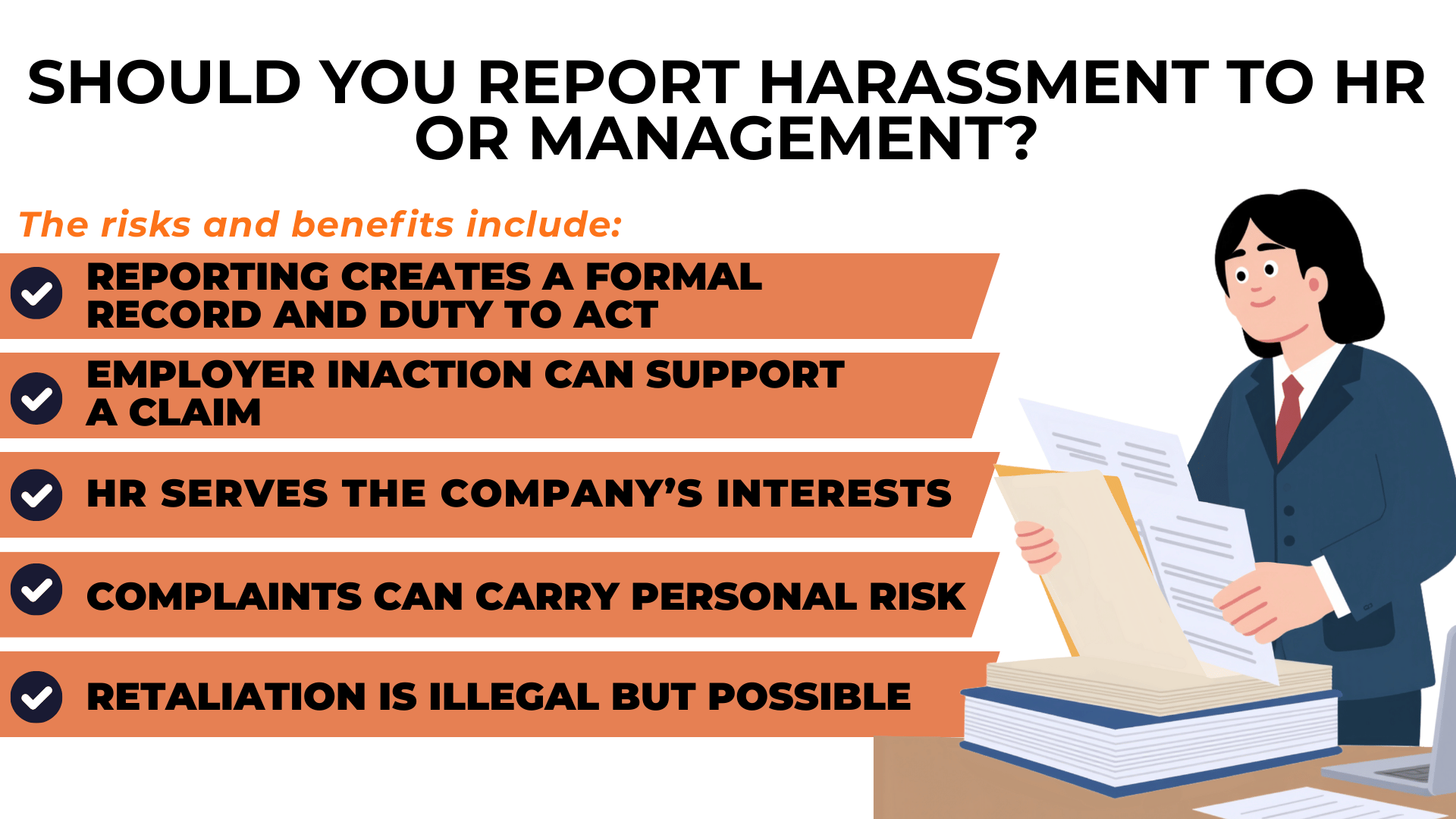
Reporting creates a formal record that you complained and gives your employer a chance to fix the problem. If they fail to act, that failure becomes evidence of their negligence. Reporting also starts the clock on their obligation to respond promptly.
The risks are real, too. Internal investigations don’t always go well for complainants. HR departments serve the company’s interests, not yours. Retaliation—though illegal—does happen. Only you can weigh these factors for your situation.
What to do if HR fails to act
If you report harassment and your employer does nothing, or if the harassment continues, you haven’t lost your options. Their failure to respond appropriately strengthens your case by demonstrating that they didn’t exercise reasonable care to correct the problem. Document their response—or lack of response—just as carefully as you documented the harassment itself.
What Are Your Options for Taking Legal Action?
Understanding your legal pathways helps you make informed decisions about protecting your rights. New Jersey provides options that are often more favorable than federal law.
Federal filing requirements and deadlines
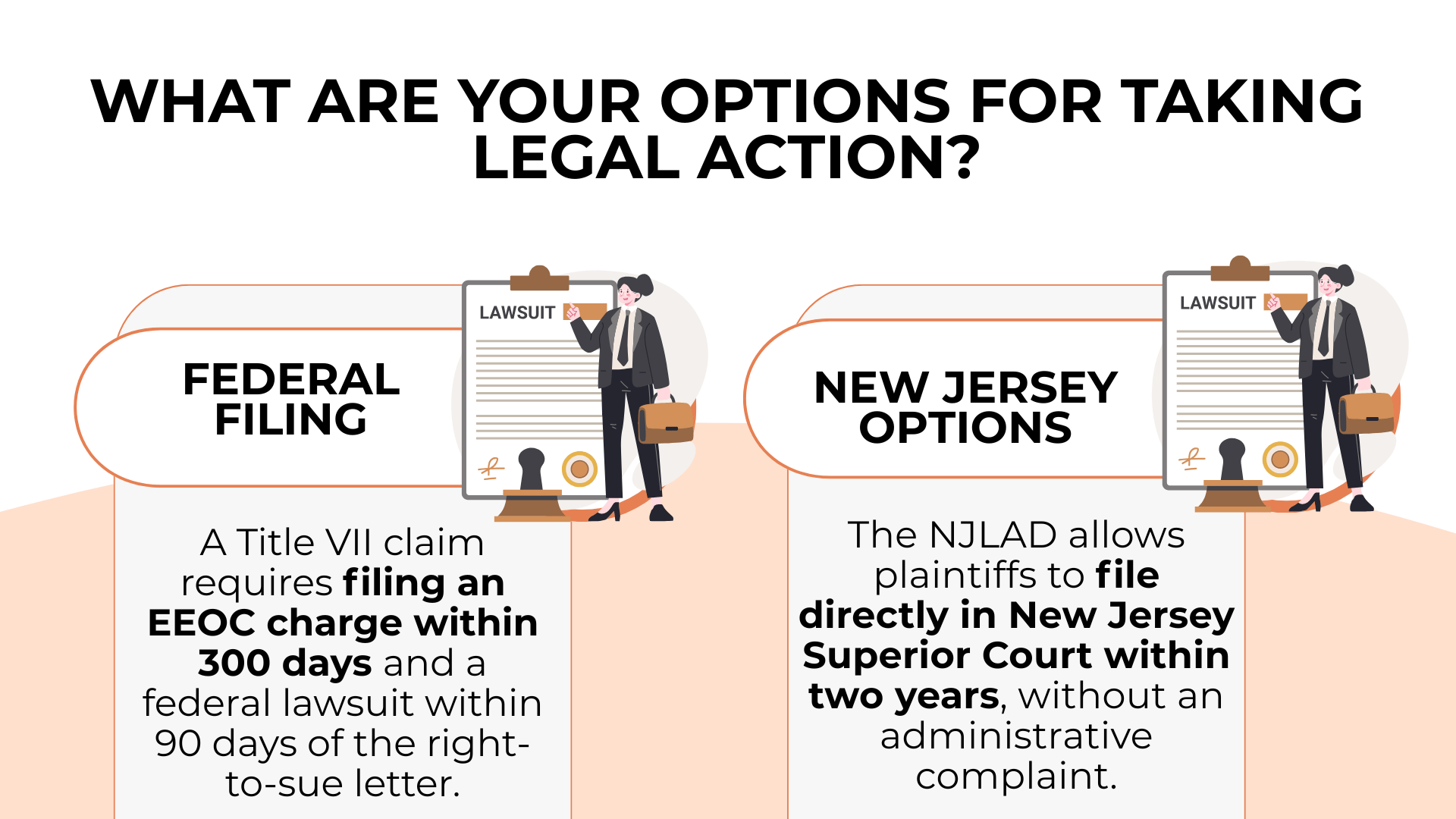
To pursue a claim under Title VII, you must first file a charge with the Equal Employment Opportunity Commission. In New Jersey, you have 300 days from the discriminatory act to file this charge. After filing, you’ll eventually receive a “right-to-sue” letter, and you then have just 90 days to file a lawsuit in federal court. Missing these deadlines can be fatal to your federal claims.
New Jersey’s more flexible options
The New Jersey Law Against Discrimination (NJLAD) offers a different path. Unlike federal law, NJLAD does not require you to file an administrative complaint before going to court. You can file directly in New Jersey Superior Court within two years of the harassment. Key differences include:
- No administrative exhaustion required—file directly in court
- Two-year statute of limitations for court filing under N.J.S.A. 2A:14-2(a)
- All employers covered regardless of size, including those with just one employee
- Individual harassers can be held personally liable under N.J.S.A. 10:5-12(e)
- No caps on compensatory damages
- You can still file with the EEOC within 300 days to preserve federal claims
Why NJLAD often provides stronger protections
NJLAD applies to every employer in New Jersey, while Title VII only covers employers with 15 or more employees. This means workers at small businesses have state law protection even when federal law doesn’t apply. New Jersey also allows you to sue individual harassers personally under an “aiding and abetting” theory—something federal law doesn’t permit.
What Results Can You Expect if You Pursue a Claim?
Knowing what outcomes are realistic helps you make informed decisions. The data shows that employees who pursue meritorious claims often succeed.
EEOC success rates when cases go to court
When the EEOC believes a case has merit and takes it to court, outcomes are overwhelmingly favorable for employees. According to the EEOC Office of General Counsel Fiscal Year 2024 Annual Report, the agency achieved a 97% favorable resolution rate in district court litigation, obtaining settlement or favorable judgment in 128 of 132 cases resolved.
The same report shows that 39 lawsuits—35.1% of all EEOC-filed cases in FY 2024—included harassment claims, making harassment the second most commonly litigated issue.
Monetary recoveries for harassment victims
According to the EEOC 2024 Annual Performance Report, the agency recovered nearly $700 million for discrimination victims in FY 2024—the highest monetary recovery in recent history. This amount benefited more than 21,000 individuals.
The EEOC’s Data Highlight (FY 2018-2021) found that $299.8 million was recovered specifically for sexual harassment claims during that four-year period, benefiting 8,147 individuals. This represented $104 million more than the prior four-year period.
New Jersey’s uncapped damages advantage
Federal law caps compensatory and punitive damages at $300,000 for the largest employers under 42 U.S.C. § 1981a(b)(3). New Jersey has no such caps. NJLAD allows full recovery for emotional distress, lost wages, and other harms without artificial limits. In Quinlan v. Curtiss-Wright Corp., 204 N.J. 239 (2010), a New Jersey court upheld a $3.6 million front pay award—an amount that would be impossible under federal caps.
How Can You Protect Your Well-Being While Dealing With This?
Coping with a hostile work environment takes a toll that extends far beyond your job. Protecting your mental and physical health matters just as much as protecting your legal rights.
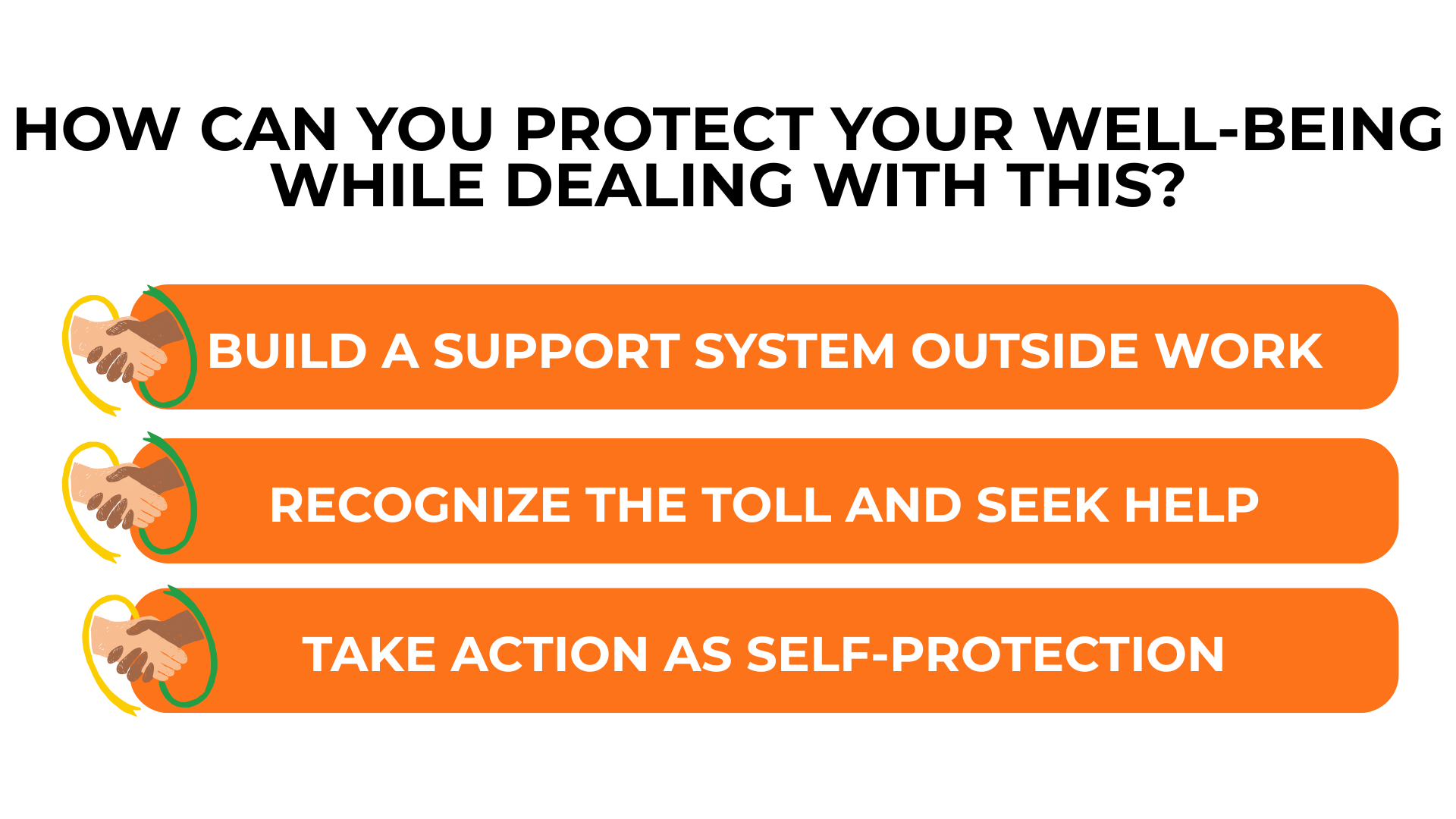
Building a support system outside work
Isolation makes everything harder. Talk to trusted friends, family members, or a therapist about what you’re experiencing. Having people who believe you and support you provides emotional resilience that helps you make clear-headed decisions. Consider these strategies:
- Confide in trusted people outside your workplace who can offer perspective
- Consult with an employment attorney early, even before deciding to take action
- Seek counseling or therapy to process the emotional impact
- Connect with support groups for workplace harassment survivors
- Maintain activities and relationships outside work that sustain you
- Keep records of medical or mental health treatment related to the harassment
Recognizing the toll and seeking help
Workplace harassment causes real psychological harm. Anxiety, depression, sleep problems, and difficulty concentrating are common responses to ongoing harassment. These effects don’t make you weak—they make you human. Seeking professional help isn’t just good self-care; it also creates documentation of the harm you’ve suffered, which is relevant if you pursue a legal claim.
Taking action as a form of self-protection
Understanding your rights and options is itself a coping strategy. When you know you have choices, you reclaim some of the power that harassment takes away. Whether you ultimately decide to file a complaint, consult an attorney, or simply document everything while you look for a new job, taking deliberate action replaces helplessness with purpose.
Frequently Asked Questions
How do I know if my situation qualifies as a hostile work environment?
Your situation may qualify if the conduct is based on a protected characteristic like sex, is unwelcome, and is severe enough or happens frequently enough to alter the conditions of your employment. A single extremely serious incident can qualify, particularly in New Jersey, or a pattern of lesser incidents that together create an abusive environment. An employment attorney can evaluate the specific facts of your situation.
Can a single incident create a hostile work environment in New Jersey?
Yes. While federal courts typically require a pattern of conduct, New Jersey courts have found that a single severe incident can be actionable. The New Jersey Supreme Court has held that even one or two demeaning slurs can be sufficiently severe to support a hostile work environment claim, particularly when the conduct comes from a supervisor.
How long do I have to file a hostile work environment claim in New Jersey?
Under federal law, you must file an EEOC charge within 300 days of the harassment. Under NJLAD, you can file directly in New Jersey Superior Court within two years. Because these deadlines run from the last act of harassment, ongoing conduct may extend your filing window. Consulting an attorney promptly helps ensure you don’t miss critical deadlines.
What if my employer has fewer than 15 employees?
Federal Title VII only covers employers with 15 or more employees. However, the New Jersey Law Against Discrimination covers all employers regardless of size—even those with just one employee. This means New Jersey workers at small businesses have state law protections even when federal law doesn’t apply.
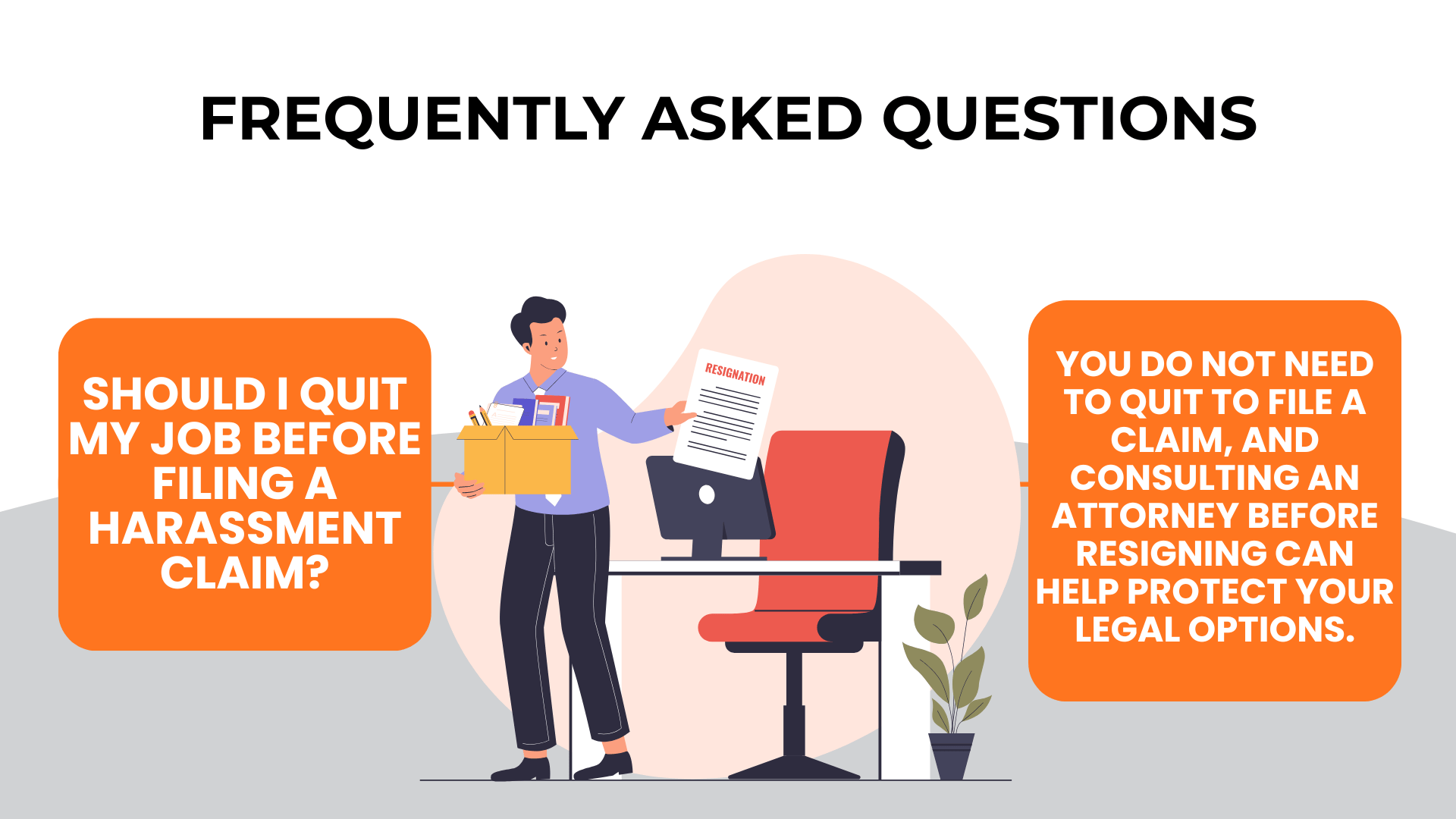
Should I quit my job before filing a harassment claim?
You are not required to quit before filing a claim, and quitting may complicate your case. However, if the harassment is severe enough that a reasonable person would feel compelled to resign, you may have a constructive discharge claim. This is a fact-specific determination. Generally, consulting an attorney before resigning helps you understand how your decision might affect your legal options.
What damages can I recover in a hostile work environment case?
Available damages include back pay, front pay, compensatory damages for emotional distress, and in some cases punitive damages. Federal law caps compensatory and punitive damages at $300,000 for the largest employers. New Jersey law has no such caps, allowing full recovery for your actual harms. New Jersey also allows you to recover attorney’s fees if you prevail.
Taking the Next Step
Dealing with a hostile work environment is exhausting, but you have more power than you might realize. By documenting what’s happening, understanding your legal options, and protecting your well-being, you’re taking meaningful steps toward resolving your situation.
Time limits matter in employment law. The 300-day EEOC deadline and two-year NJLAD statute of limitations run whether you’re ready or not. Even if you’re unsure what you want to do, consulting an attorney helps you understand your options before they expire.
If you have questions about a hostile work environment, contact The Lacy Employment Law Firm to discuss your situation.