When a manager engages in sexual harassment, the experience carries a weight that differs fundamentally from misconduct by a peer. The person who controls your schedule, evaluates your performance, and influences your career trajectory is also the person making you uncomfortable, scared, or unsafe. Sexual harassment by a manager exploits a power imbalance that the law recognizes and addresses with heightened protections.
This guide explains what constitutes manager harassment, why the law treats it more seriously, and what options exist for employees in New Jersey who find themselves targeted by someone in authority.
What Counts as Sexual Harassment When Your Manager Is the Harasser?
Sexual harassment occurs when unwelcome conduct of a sexual nature affects your employment or creates a hostile work environment. When that conduct comes from a manager, the dynamics shift considerably. A supervisor’s authority over your job amplifies every comment, gesture, and request.
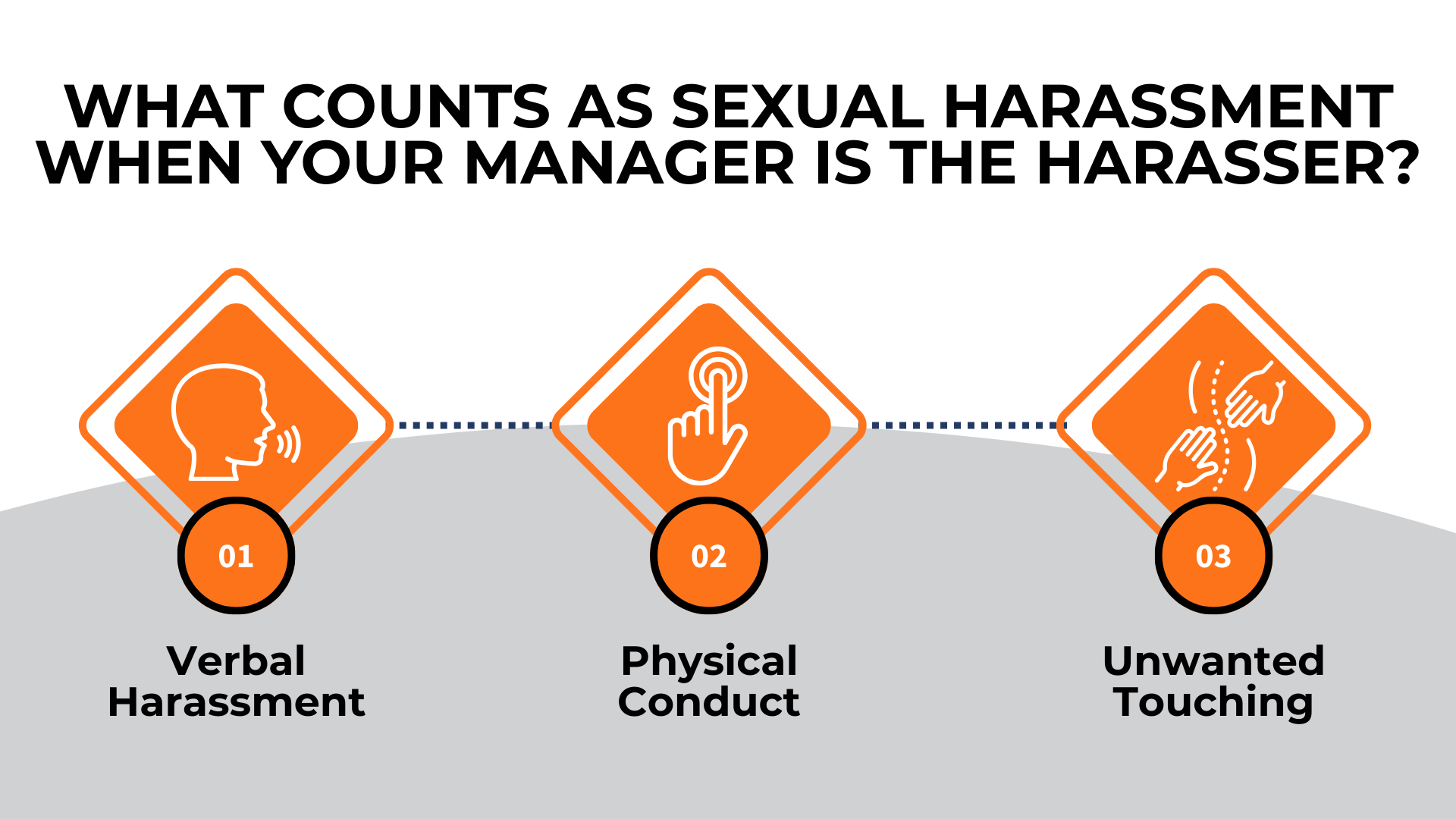
Verbal harassment from managers
Verbal harassment from a manager can take many forms, and the harasser’s position of power makes even seemingly minor comments more significant. The law looks at whether the conduct was unwelcome and whether it was based on sex.
Common forms of verbal harassment by managers include:
- Sexual comments about your appearance, body, or clothing
- Repeated requests for dates after you have declined
- Sexual jokes directed at you or made in your presence
- Questions about your sex life or romantic relationships
- Propositions or suggestions of sexual activity
- Threats or implications that your job depends on your response to advances
A manager does not need to explicitly threaten your job for comments to constitute harassment. The power imbalance means employees reasonably perceive pressure even when threats remain unspoken.
Physical conduct and unwanted touching
Physical harassment ranges from blocking your path to deliberate touching. A manager who stands too close, places hands on your shoulders, brushes against you unnecessarily, or engages in any unwanted physical contact creates a hostile environment. The key question is whether the contact was unwelcome and sexual in nature.
Even brief physical contact can be actionable when committed by a supervisor. New Jersey courts have held that supervisor conduct “greatly magnifies the gravity” of harassment because of the authority relationship involved.
Why supervisor harassment is treated differently
The law distinguishes between harassment by supervisors and harassment by co-workers because the power dynamics differ fundamentally. Under the standard established in Lehmann v. Toys ‘R’ Us, Inc., 132 N.J. 587 (1993), New Jersey evaluates whether a reasonable person in the plaintiff’s position would find the environment hostile. When the harasser is a manager, that reasonable person understands their job may depend on tolerating the conduct.
New Jersey courts have found that even a single severe incident by a supervisor can create an actionable hostile work environment. In Taylor v. Metzger, 152 N.J. 490 (1998), the court emphasized that supervisor status magnifies the impact of harassment and that discrimination itself is the harm the law seeks to eliminate.
How Common Is Sexual Harassment by Managers and Supervisors?
Sexual harassment remains pervasive in American workplaces, and the formal charges filed each year represent only a fraction of actual incidents.
National filing trends and recent increases
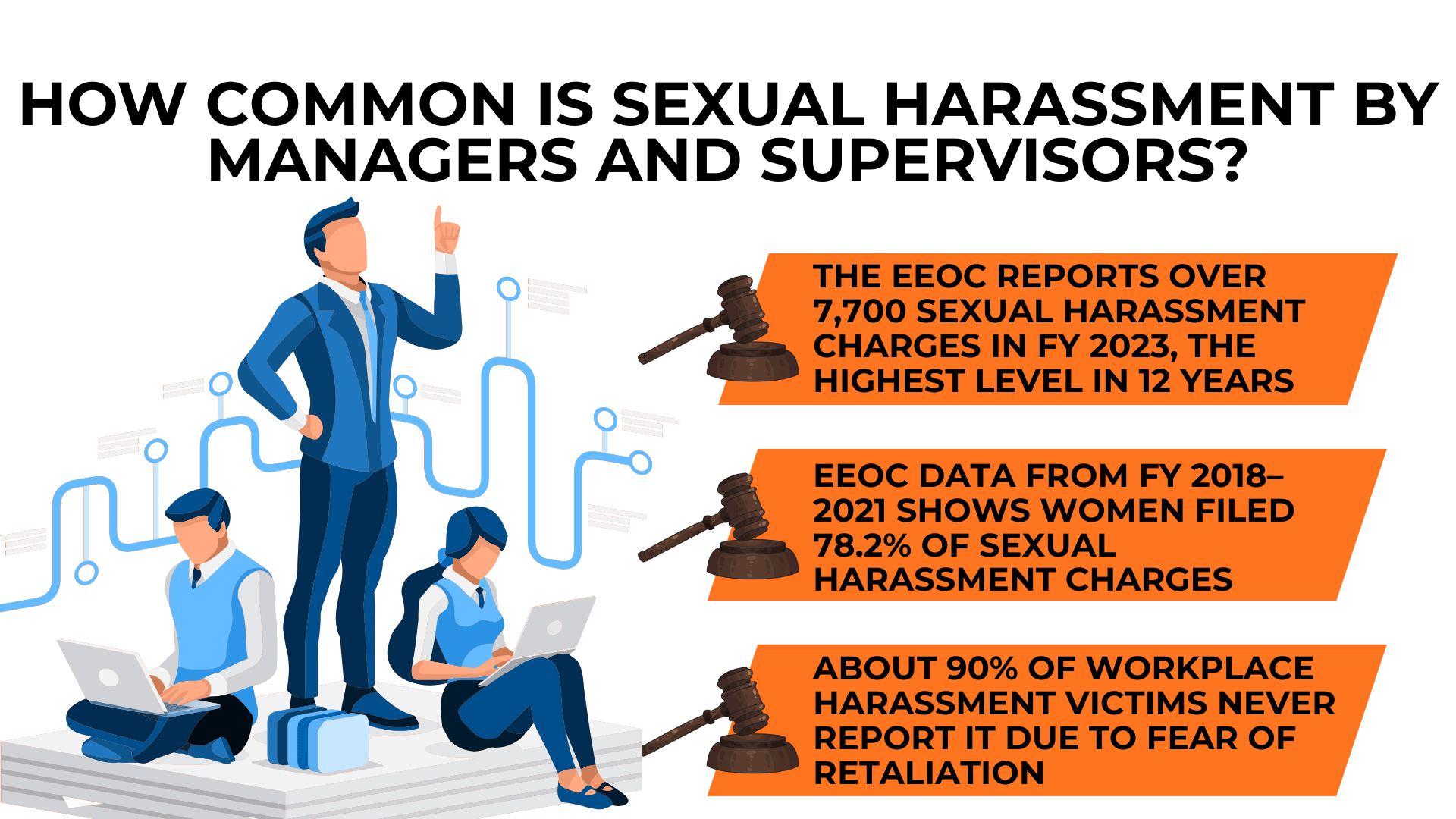
According to the EEOC (FY 2023), more than 7,700 sexual harassment charges were filed in fiscal year 2023—a 25% increase from the prior year and the highest number in 12 years. This surge indicates that more employees are coming forward despite the challenges involved in reporting.
The broader context shows continued growth in discrimination filings overall. The EEOC’s 2024 Annual Performance Report documented 88,531 total discrimination charges filed in FY 2024, a 9.2% increase over the previous year.
Who files harassment charges
Data from the EEOC Data Highlight on Sexual Harassment (FY 2018-2021) shows that women filed 78.2% of sexual harassment charges during that period, while men filed 21.8%. Sexual harassment affects workers of all genders, though women bear a disproportionate share.
The EEOC Select Task Force on Harassment (2016) found that between 25% and 85% of women report experiencing workplace sexual harassment, with the variation depending on how surveys frame the questions. When asked about specific behaviors like unwanted sexual attention or coercion, approximately 60% of women report experiencing harassment.
The underreporting problem
Perhaps the most significant statistic is this: according to the EEOC Select Task Force (2016), approximately 90% of individuals who experience workplace harassment never file a formal charge. Fear of retaliation, concern about being believed, and worry about career consequences keep most victims silent.
This means the thousands of charges filed annually represent only about 10% of actual harassment incidents. If you have experienced harassment and have not reported it, you are not alone.
Why Does the Law Treat Manager Harassment More Seriously?
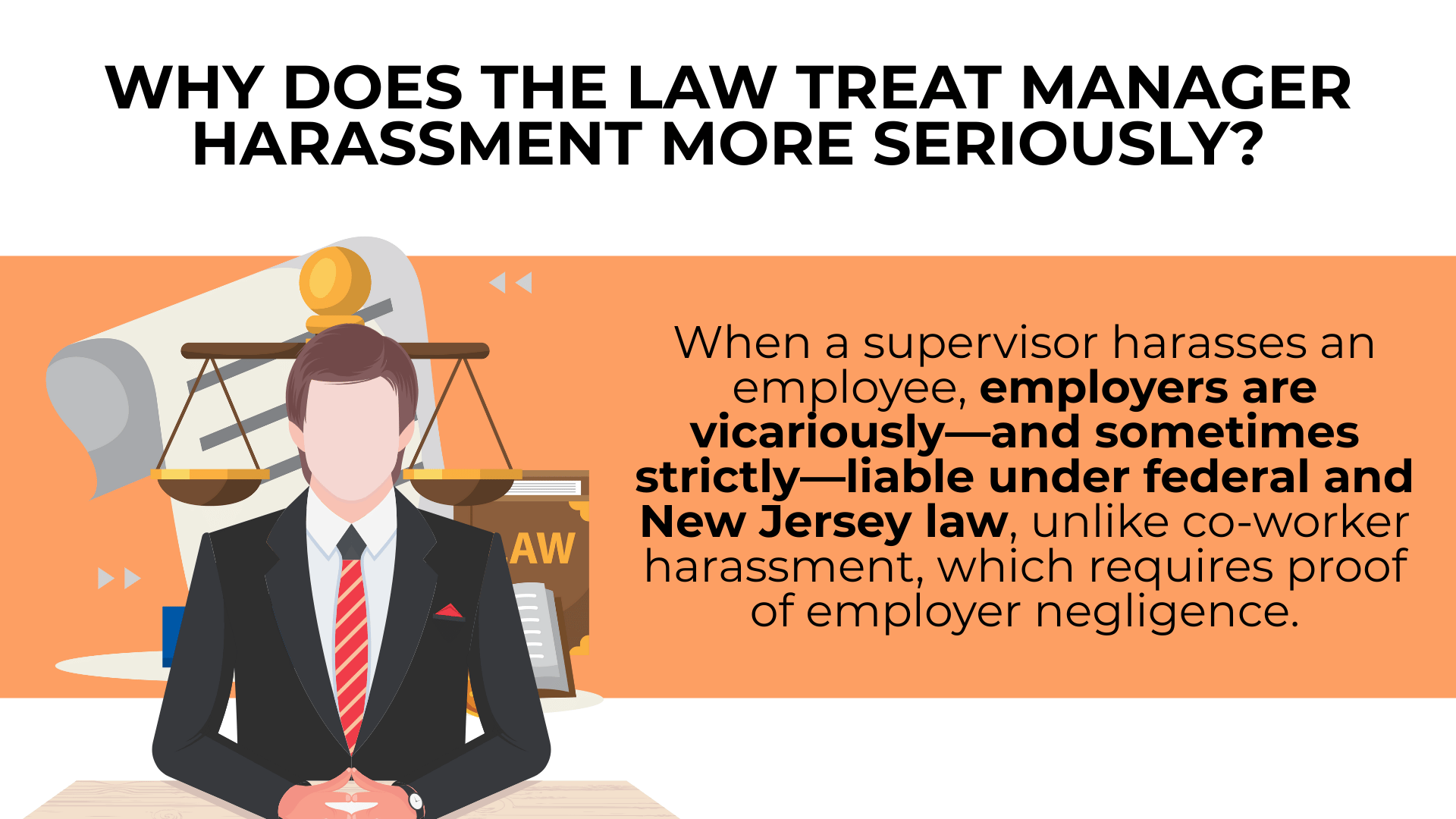
When a supervisor sexually harasses an employee, the employer faces a different—and stricter—liability standard than when a co-worker is responsible.
Vicarious liability for supervisor conduct
Under the framework established in Faragher v. City of Boca Raton, 524 U.S. 775 (1998), and Burlington Industries, Inc. v. Ellerth, 524 U.S. 742 (1998), employers are vicariously liable for hostile work environments created by supervisors. This means the employer is responsible for the supervisor’s conduct without the employee needing to prove the employer was negligent.
When a supervisor’s harassment results in a tangible employment action—such as firing, demotion, or denial of a promotion—the employer is strictly liable with no defense available. When no tangible employment action occurs, the employer may raise an affirmative defense, but must prove both that it exercised reasonable care to prevent harassment and that the employee unreasonably failed to use available complaint procedures.
New Jersey’s broader definition of “supervisor”
Federal and New Jersey law define “supervisor” differently, and New Jersey’s definition is more favorable to employees. Under the federal standard from Vance v. Ball State University, 570 U.S. 421 (2013), only employees who can take tangible employment actions qualify as supervisors.
New Jersey rejected this narrow approach. In Aguas v. State, 220 N.J. 494 (2015), the New Jersey Supreme Court adopted the EEOC’s broader standard: a supervisor includes anyone who can make or recommend tangible employment actions, or who is placed in charge of the complainant’s daily work activities. This means more authority figures qualify as supervisors under New Jersey law, making vicarious liability available in more cases.
How this differs from co-worker harassment
For harassment by co-workers rather than supervisors, employers face liability only under a negligence standard. The employee must prove the employer “knew or should have known” about the harassment but failed to take prompt corrective action.
This distinction matters significantly. Supervisor harassment triggers automatic employer responsibility through vicarious liability. Co-worker harassment requires proving employer negligence. When your harasser is a manager, the path to holding your employer accountable is more direct.
What Evidence Helps Prove Sexual Harassment by a Manager?
Building a strong harassment case requires documentation. The more contemporaneous and specific your records, the more persuasive your claim becomes.
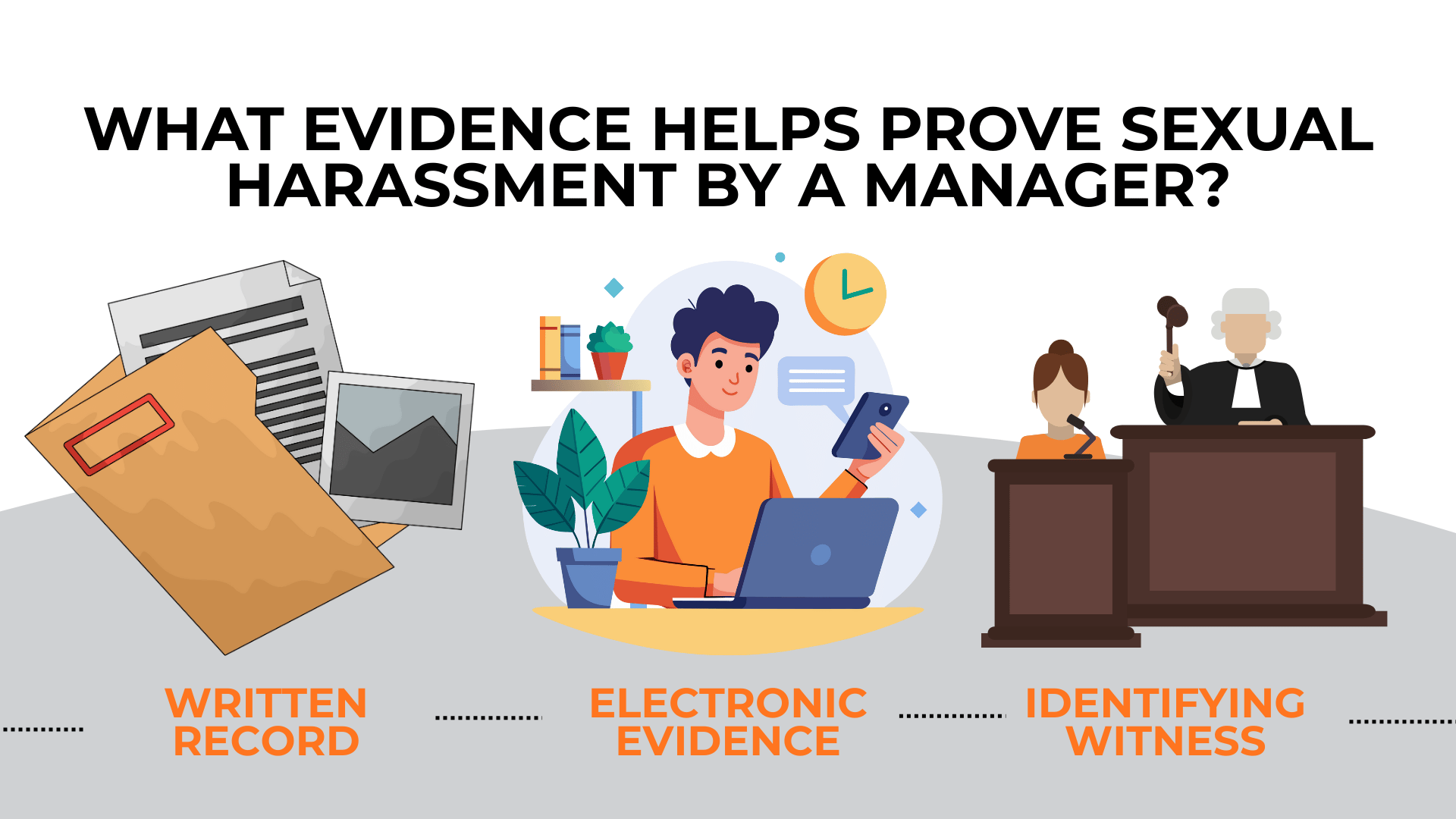
Creating a written record of incidents
Document each incident as close to the time it occurs as possible. Memory fades, and contemporaneous records carry more weight than recollections assembled months later.
Your documentation should include:
- The date, time, and location of each incident
- Exactly what was said or done, using the harasser’s actual words when possible
- Names of anyone who witnessed the incident
- How you responded and how the harasser reacted
- How the incident made you feel and any impact on your work
- Any pattern connecting incidents over time
Keep this documentation somewhere your employer cannot access, such as a personal email account or physical notebook at home.
Preserving electronic evidence
Electronic communications often provide the most concrete evidence of harassment. Save all emails, text messages, instant messages, and voicemails from the harasser. Screenshot messages before deleting them from your devices.
If the harasser sent inappropriate images, made comments through workplace messaging systems, or left voicemails, preserve these immediately. Forward work emails to a personal account if your employer’s policies permit, or take screenshots with timestamps visible.
Identifying witnesses and documenting reports
Note the names of colleagues who witnessed harassment or to whom you described incidents at the time. These contemporaneous disclosures can corroborate your account even if the witnesses did not see the harassment directly.
Document every report you make to HR, management, or any supervisor. Record the date, who you spoke with, what you reported, and how they responded. If you make written complaints, keep copies. If you reported verbally, send a follow-up email summarizing the conversation to create a written record.
What Outcomes Can Sexual Harassment Victims Expect?
Understanding potential outcomes helps set realistic expectations about what pursuing a claim can achieve.
EEOC litigation success rates
When the EEOC takes a sexual harassment case to federal court, outcomes are overwhelmingly favorable to victims. According to the EEOC Office of General Counsel FY 2024 Annual Report, the agency achieved a 97% favorable resolution rate in district court litigation, obtaining settlement or favorable judgment in 128 of 132 cases resolved.
The same report indicates that 39 lawsuits filed by the EEOC in FY 2024—representing 35.1% of all suits filed—included harassment claims. Harassment remains a top enforcement priority for the agency.
Monetary recovery in harassment cases
The financial recovery in discrimination cases has reached historic levels. The EEOC’s 2024 Annual Performance Report documented nearly $700 million recovered for discrimination victims in FY 2024, benefiting over 21,000 individuals.
Specifically for sexual harassment, the EEOC Data Highlight (FY 2018-2021) shows $299.8 million recovered through charge resolutions and litigation between fiscal years 2018 and 2021—$104 million more than the preceding four-year period. This recovery benefited 8,147 individuals.
At the administrative level, the EEOC Table E2a (FY 2023) shows an 18.5% merit resolution rate for harassment charges, with 8.2% ending in settlements and 8.5% in withdrawals with benefits.
What damages are available
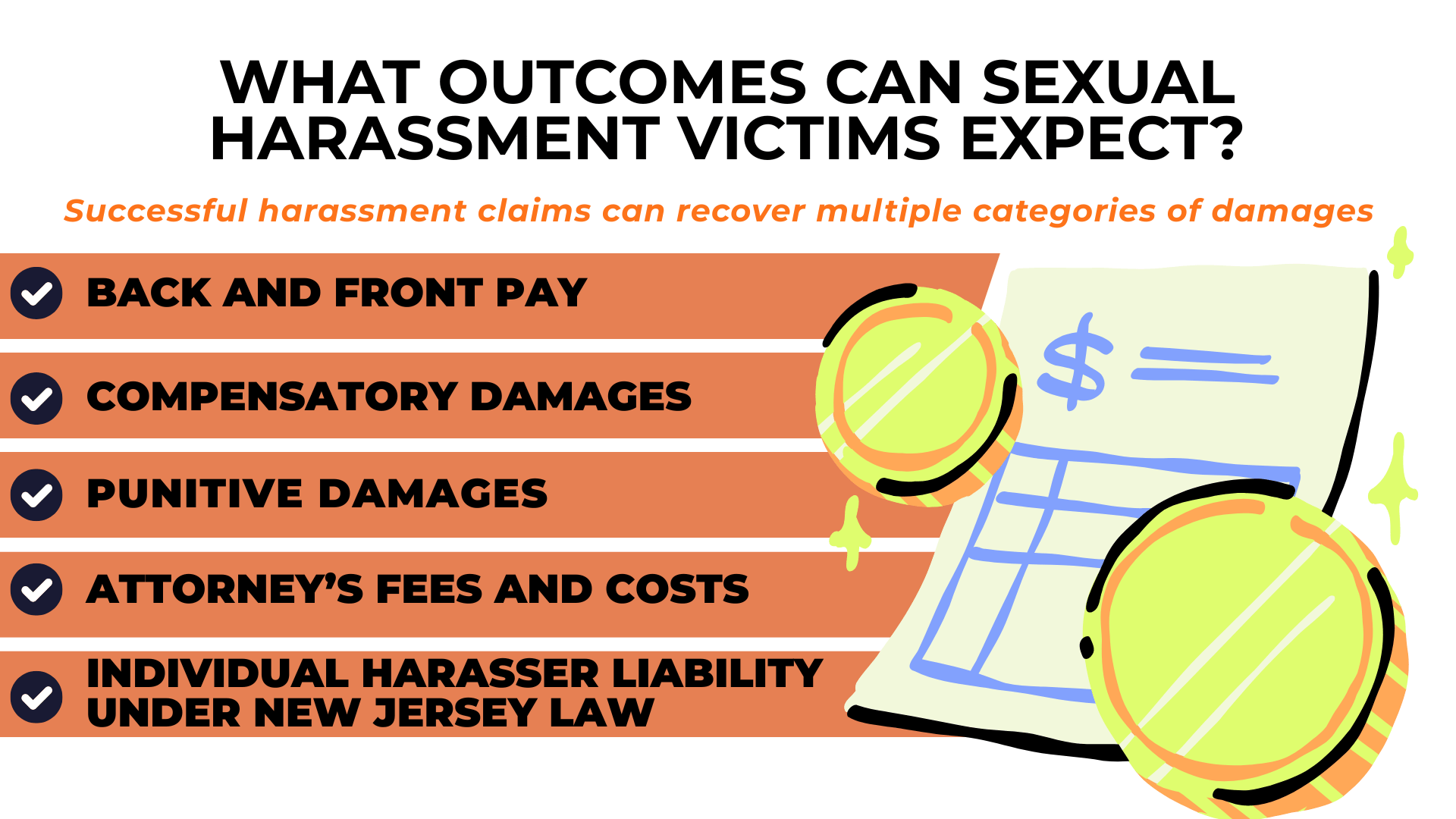
Successful harassment claims can recover multiple categories of damages. The specific damages available depend on whether you pursue federal or state claims:
- Back pay for wages lost due to harassment or resulting termination
- Front pay for future lost earnings when reinstatement is not feasible
- Compensatory damages for emotional distress, pain and suffering, and mental anguish
- Punitive damages when the employer acted with malice or reckless indifference
- Attorney’s fees and costs under both federal law and NJLAD
- Individual liability against the harasser personally under New Jersey law
New Jersey law provides significantly broader remedies than federal law, including uncapped compensatory damages and the ability to hold individual harassers personally liable.
What Are the Deadlines for Filing a Sexual Harassment Claim in New Jersey?
Missing a filing deadline can eliminate your claims entirely, making these dates among the most important information for any harassment victim.
Federal filing deadlines
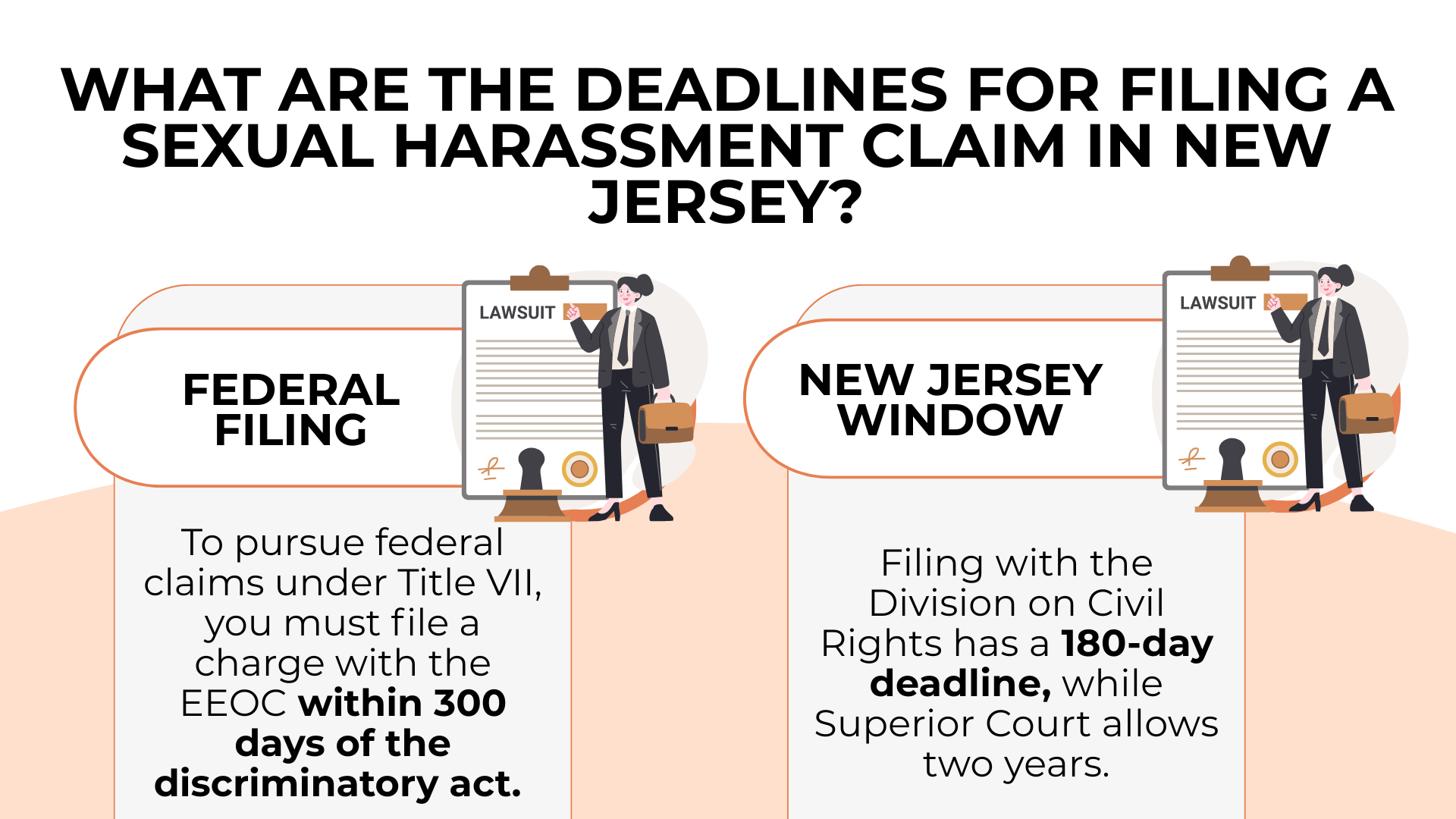
To pursue federal claims under Title VII, you must file a charge with the EEOC within 300 days of the discriminatory act. This deadline applies in New Jersey because the state has its own enforcement agency, the Division on Civil Rights.
After filing an EEOC charge, you must wait for either the agency to complete its investigation or request a right-to-sue letter after 180 days. Once you receive the right-to-sue letter, you have only 90 days to file suit in federal court.
New Jersey’s longer window
New Jersey law provides more time and flexibility. Under NJLAD, you can file a lawsuit directly in New Jersey Superior Court without first filing an administrative complaint. The statute of limitations for court filing is two years from the discriminatory act under N.J.S.A. 2A:14-2(a).
If you choose to file with the New Jersey Division on Civil Rights instead, that deadline is 180 days. However, the two-year court deadline makes direct Superior Court filing attractive for many plaintiffs.
When the clock starts running
For ongoing harassment, the continuing violation doctrine may extend your filing deadline. If at least one act contributing to the hostile environment occurred within the limitations period, the entire course of conduct may be considered. This means earlier incidents of harassment can be included in your claim if the pattern continued into the limitations period.
Because filing deadlines vary and missing them can eliminate your claims, consulting with an attorney early protects your options.
How Does New Jersey Law Provide Stronger Protections Than Federal Law?
New Jersey employment discrimination law is among the most protective in the nation. Understanding these advantages helps employees make informed decisions about how to pursue their claims.
Coverage and employer size
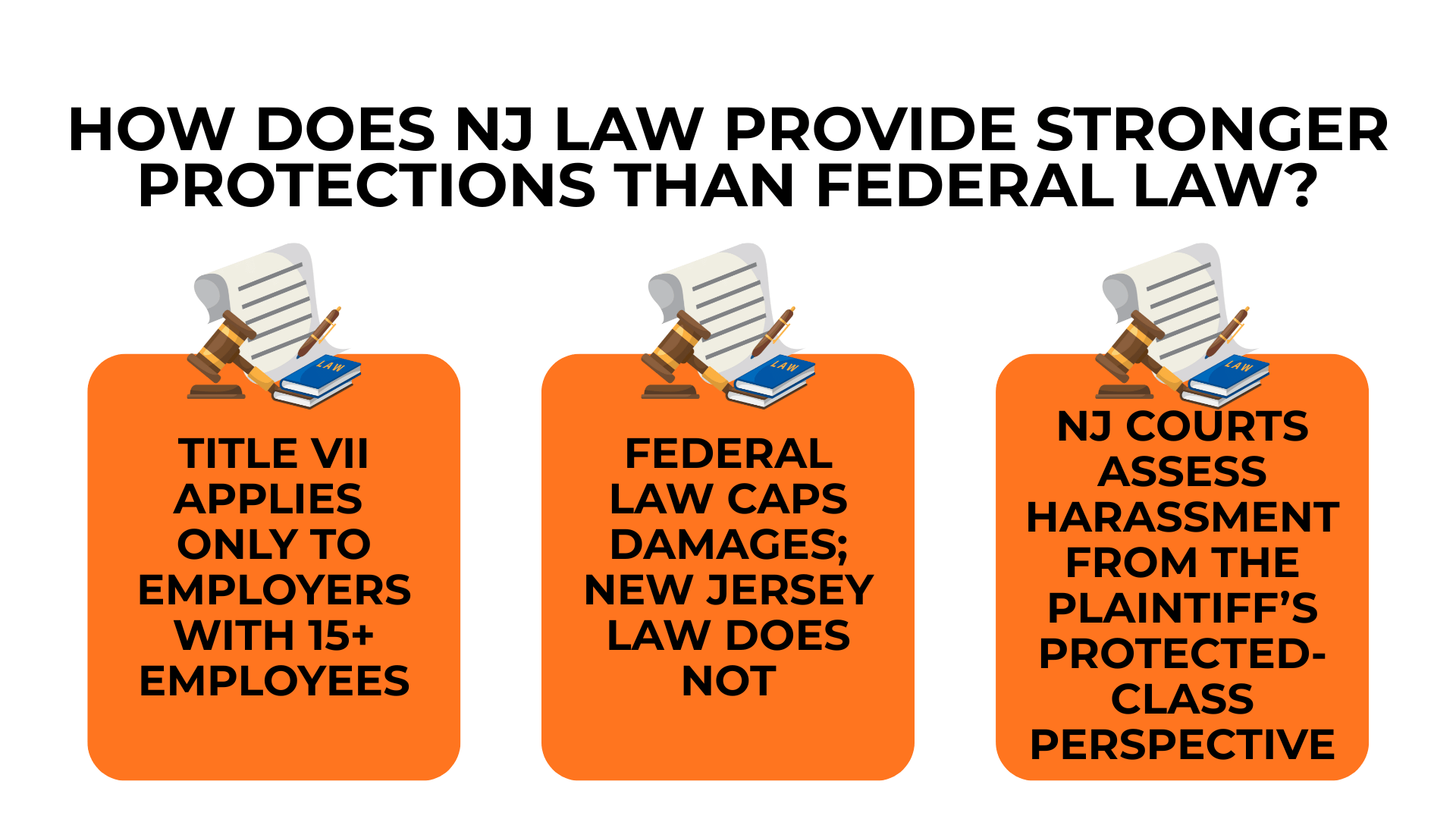
Federal Title VII applies only to employers with 15 or more employees. This threshold excludes workers at small businesses from federal protection entirely.
NJLAD has no such limitation. The law applies to all employers regardless of size, including those with only one employee. If you work for a small business that federal law does not cover, you retain full protection under New Jersey law.
Uncapped damages and individual liability
The differences in available damages are substantial:
- Federal law caps combined compensatory and punitive damages between $50,000 and $300,000 depending on employer size
- New Jersey places no statutory cap on compensatory damages, including emotional distress
- NJLAD allows individual liability against supervisors and harassers under the aiding-and-abetting provision at N.J.S.A. 10:5-12(e)
- Federal law permits suits only against the employer entity, not individual harassers
- New Jersey courts have upheld substantial awards, including a $3.6 million front pay award in Quinlan v. Curtiss-Wright Corp., 204 N.J. 239 (2010)
More plaintiff-friendly legal standards
New Jersey courts apply legal standards that favor employees in several important ways. The state uses a “reasonable person of the same protected class” standard rather than a generic reasonable person test, ensuring that harassment is evaluated from the perspective of someone similarly situated to the plaintiff.
Recent New Jersey decisions have reinforced that single severe incidents can create actionable claims. In Rios v. Meda Pharmaceutical, Inc., 247 N.J. 1 (2021), the court held that two demeaning slurs were sufficiently severe to support a hostile work environment claim. This reflects New Jersey’s mandate that the LAD be construed liberally to accomplish its remedial purpose.
Frequently Asked Questions
Can I file a harassment claim if my manager only harassed me once?
In New Jersey, yes. Under Taylor v. Metzger, 152 N.J. 490 (1998), and Rios v. Meda Pharmaceutical, Inc., 247 N.J. 1 (2021), a single severe incident can create an actionable hostile work environment, particularly when committed by a supervisor. The law recognizes that supervisor conduct “greatly magnifies the gravity” of harassment. Federal courts typically require a pattern, but one extreme incident may still qualify.
What if my company has fewer than 15 employees?
The New Jersey Law Against Discrimination covers all employers regardless of size, including those with only one employee. While federal Title VII requires 15 or more employees, NJLAD fills this gap completely. You have full legal protection under state law even if federal law does not apply to your employer.
Can my manager personally be held liable for harassment?
Under NJLAD, yes. New Jersey’s aiding-and-abetting provision at N.J.S.A. 10:5-12(e) allows individual liability against supervisors and harassers. Federal Title VII does not permit individual liability—only the employer entity can be sued. This is a significant advantage of pursuing claims under New Jersey law.
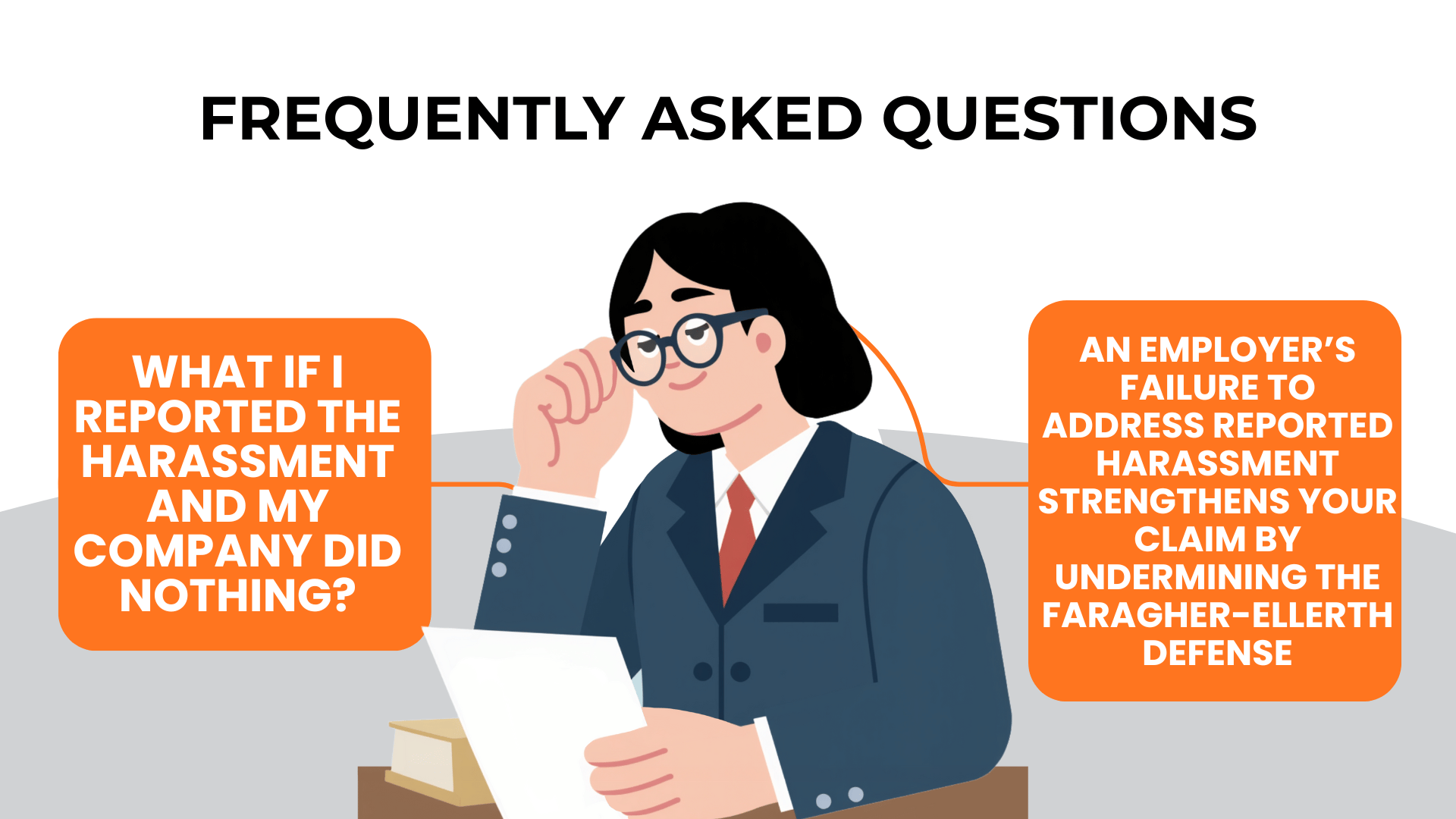
What if I reported the harassment and my company did nothing?
When an employer fails to investigate or address reported harassment, this strengthens your claim. Under the Faragher-Ellerth framework, employers can defend against liability by showing they took reasonable care to prevent and correct harassment. An inadequate response undermines that defense and may support additional damages.
How long do I have to file a claim against my manager?
For federal claims, you must file an EEOC charge within 300 days of the harassment. For NJLAD claims filed directly in New Jersey Superior Court, you have two years. Filing under both statutes preserves maximum options, but the federal deadline is the more urgent concern.
Taking the Next Step
Sexual harassment by a manager creates a uniquely difficult situation because the person responsible for the misconduct also holds power over your employment. The law recognizes this dynamic and provides heightened protections when supervisors abuse their authority.
New Jersey employees benefit from some of the strongest anti-harassment protections in the country: coverage regardless of employer size, uncapped damages, individual harasser liability, and courts that take single severe incidents seriously. Understanding these protections is the first step toward addressing harassment effectively.
Filing deadlines make timing important. The 300-day federal deadline and two-year state deadline provide windows that close permanently once passed. Documenting incidents, preserving evidence, and understanding your options positions you to make informed decisions about how to proceed.
If you have questions about sexual harassment by a manager, contact The Lacy Employment Law Firm to discuss your situation.