
When your manager starts mentioning retirement during every performance review, or when the company replaces you with someone twenty years younger after calling your position “eliminated,” you may be experiencing age discrimination. Recognizing these patterns is the first step toward understanding your rights. Workers over 40 in Pennsylvania and New Jersey have legal protections against age-based workplace discrimination, but many don’t realize when their treatment crosses the line from unfair to illegal.
According to AARP Research (2025), 64% of workers age 50 and older have seen or experienced age discrimination in the workplace. This article examines the most common forms this discrimination takes—from outright termination to subtle exclusion—so you can identify whether your experience may be actionable under federal, Pennsylvania, or New Jersey law.
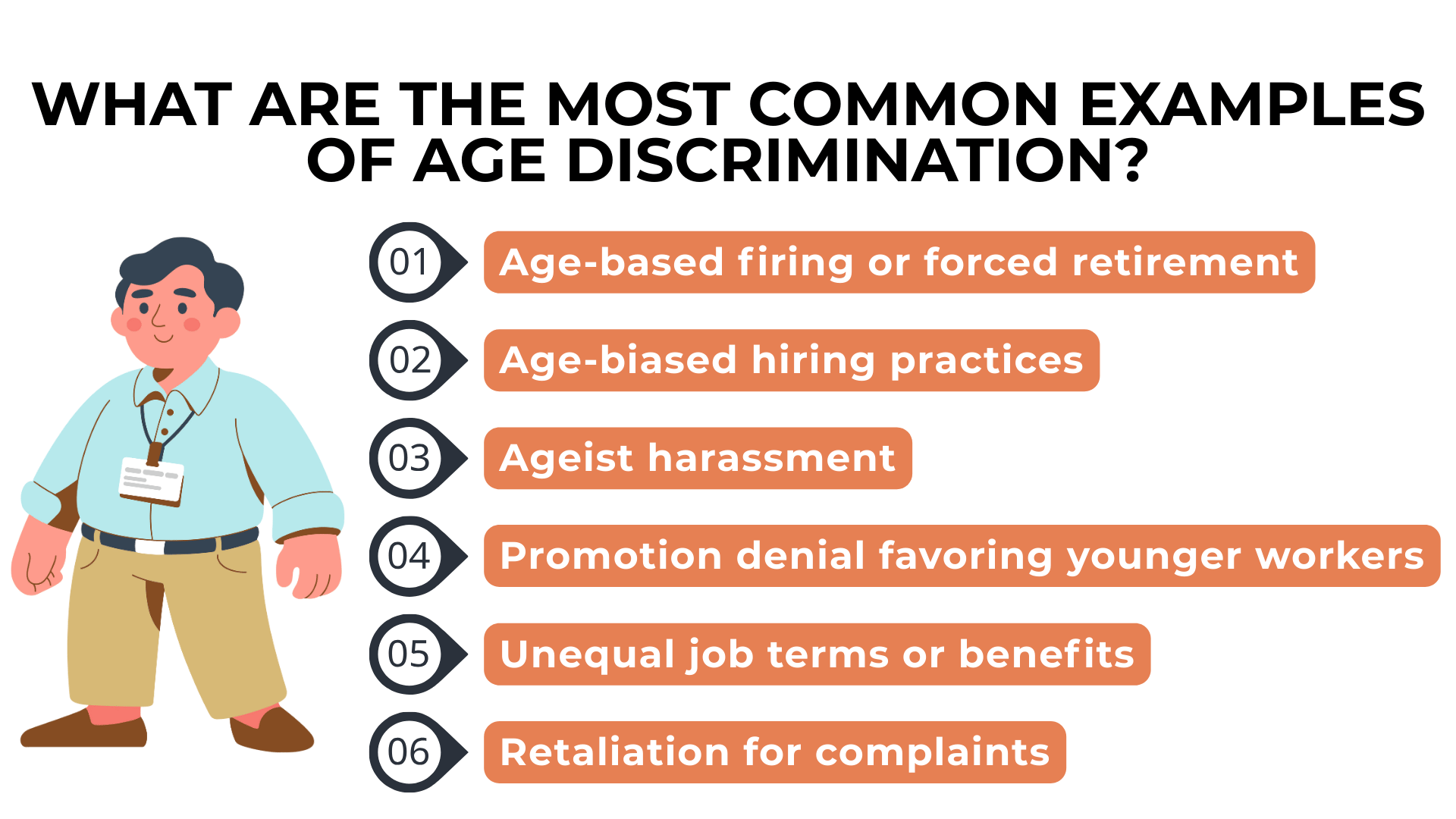
What Are the Most Common Examples of Age Discrimination?
Age discrimination takes many forms, and understanding the categories helps workers recognize patterns in their own experience. The EEOC’s 2018 report on age discrimination documented how allegation types have shifted over decades, revealing which forms of discrimination workers encounter most frequently.
Termination and Discharge Patterns
Discriminatory termination remains the dominant form of age discrimination complaints. According to the EEOC (2018), 55% of all age discrimination charges allege wrongful discharge—up from 45% in 1992. This includes outright firing, forced retirement, and layoffs that disproportionately target older workers.
Hiring and Promotion Barriers
Older job seekers face significant barriers that younger applicants don’t encounter. The EEOC Office of General Counsel FY 2024 Annual Report shows that 28.6% of the agency’s age discrimination lawsuits in fiscal year 2024 involved hiring discrimination. Failure to promote based on age falls into the broader category of discriminatory terms and conditions, which the EEOC (2018) reports now comprises 25% of charges—nearly double the rate from 1992.
Harassment and Hostile Treatment
Age-based harassment has grown dramatically as a complaint category. The EEOC (2018) found that 21% of age discrimination charges alleged harassment—more than triple the 6% rate in 1992. This includes ageist comments, exclusion from workplace activities, and creating an environment hostile to older workers.
The main categories of age discrimination include:
- Termination or discharge based on age, including forced retirement and pretextual layoffs
- Failure to hire qualified older applicants or using screening methods that disadvantage them
- Harassment through ageist comments, jokes, or treatment that creates a hostile work environment
- Failure to promote when younger, less qualified employees advance instead
- Discriminatory terms and conditions, including reduced training, lesser assignments, or benefit disparities
- Retaliation against workers who complain about age discrimination
What Does Age Discrimination in Firing Look Like?
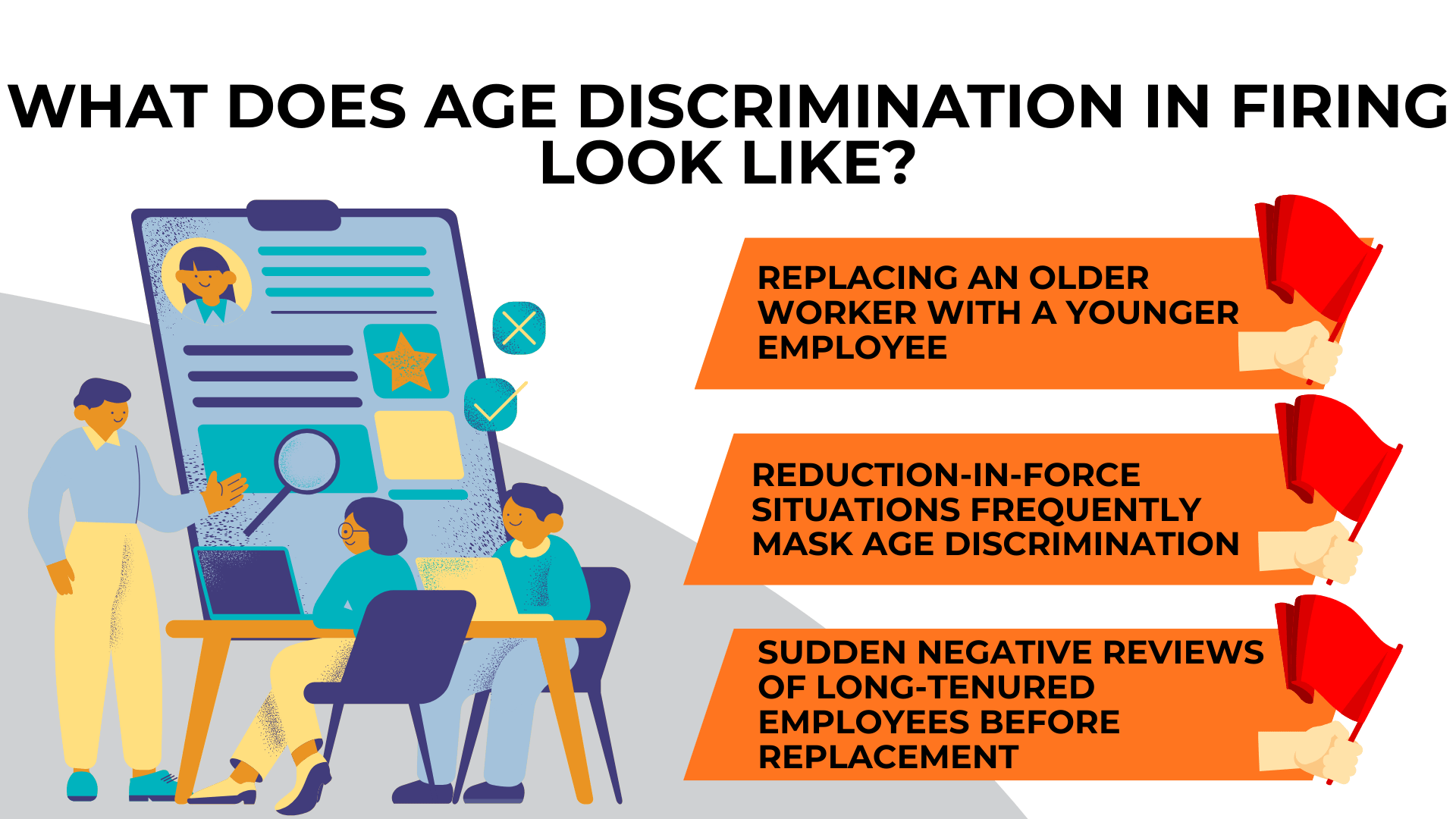
Termination-based discrimination often involves patterns that become clear only when examining the circumstances surrounding the firing. Courts look at whether age was the “but-for” cause of termination—meaning it wouldn’t have happened if the employee had been younger.
Replacement by Substantially Younger Employees
One of the clearest indicators of age discrimination occurs when an employer terminates an older worker and fills the position with someone substantially younger. Under federal law established in O’Connor v. Consolidated Coin Caterers Corp., 517 U.S. 308 (1996), the replacement doesn’t need to be under 40—courts focus on whether there’s a significant age gap suggesting discriminatory intent.
A worker in their late 50s terminated for “restructuring” whose position is filled weeks later by someone in their early 30s presents a textbook example. The employer’s stated reason doesn’t match the reality, suggesting age was the actual motivation.
Layoffs That Target Older Workers
Reduction-in-force situations frequently mask age discrimination. According to ProPublica and the Urban Institute (2018), 56% of workers in their 50s with stable, long-term employment are pushed out or laid off at least once before they’re ready to retire. When layoffs disproportionately affect older employees while younger workers in similar roles are retained, it may indicate discriminatory selection criteria.
The economic impact of these terminations is severe. The Urban Institute (2018) found that only 10% of displaced older workers ever again earn as much as they did before their job loss.
Sudden Performance Problems After Years of Good Reviews
A pattern worth examining is when long-tenured employees with positive performance histories suddenly receive negative evaluations shortly before termination. This sequence—years of satisfactory reviews followed by abrupt criticism—can suggest the employer is building a paper trail to justify a predetermined termination.
Settlement examples illustrate these patterns. The NJ Attorney General’s Division on Civil Rights (2023) announced a $175,487 settlement with the Camden City School District resolving allegations of age discrimination in hiring. In another case, a New Jersey nurse received a $115,000 settlement after alleging her termination during a reduction-in-force was actually pretext for age discrimination.
How Does Age Discrimination Appear in Hiring?
Age discrimination in hiring is difficult to prove because applicants rarely know why they weren’t selected. However, research has documented clear patterns showing older applicants receive different treatment.
Lower Callback Rates for Older Applicants
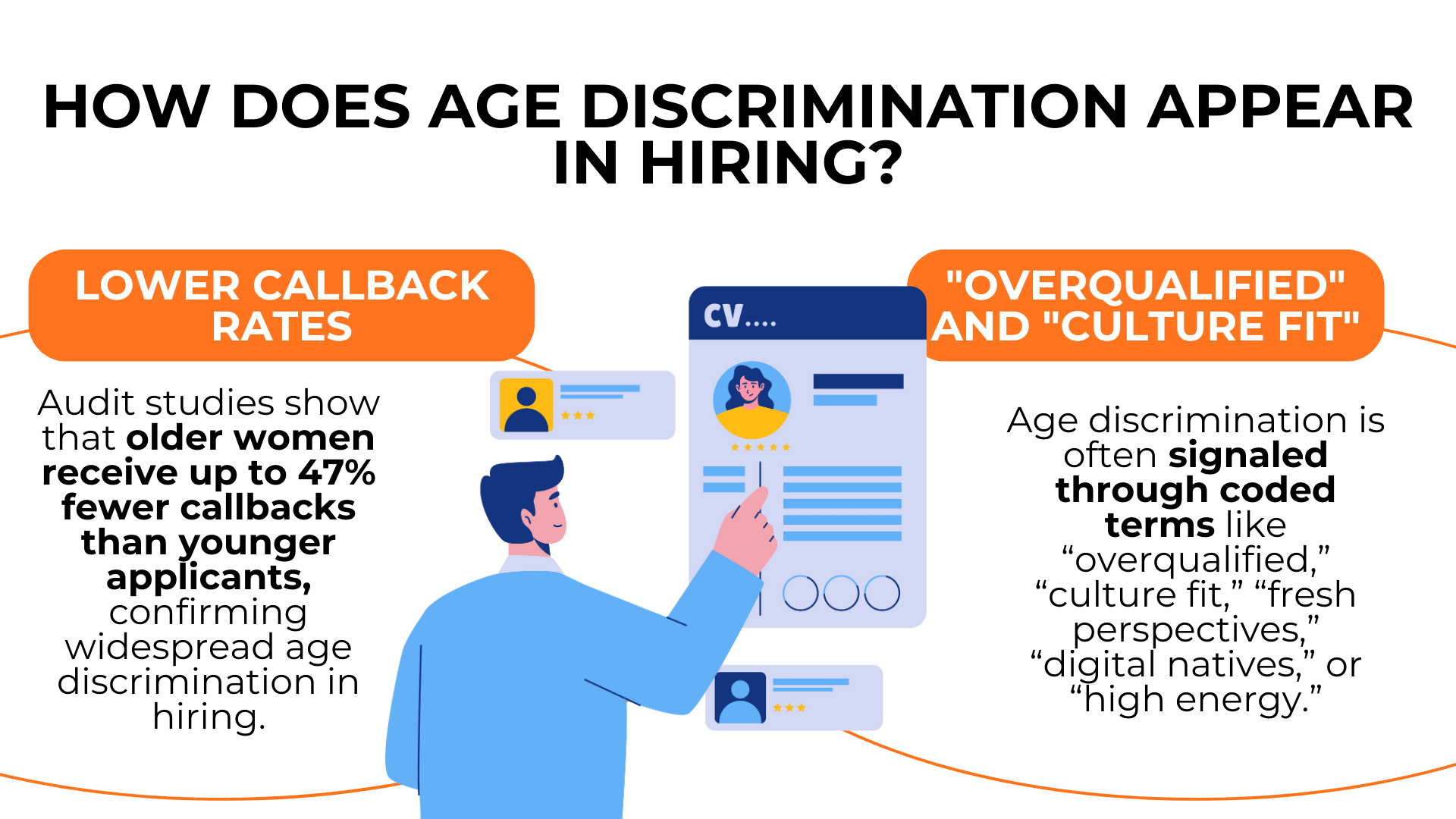
The most compelling evidence of hiring discrimination comes from audit studies that submit identical resumes with only age-related details changed. According to the Federal Reserve Bank of San Francisco (2017), older female applicants ages 64-66 received 47% fewer callbacks than younger applicants ages 29-31 for administrative positions. The same study found a 36% callback gap for older women in retail sales positions compared to younger applicants.
These disparities persist despite equivalent qualifications on paper. AARP Research (2024-2025) found that 74% of older job seekers believe their age will be considered a barrier by hiring managers—a perception well-supported by the data.
“Overqualified” and “Culture Fit” Rejections
Employers sometimes use neutral-sounding language that masks age bias. Telling an experienced applicant they’re “overqualified” can be a proxy for “too old.” Similarly, rejections based on “culture fit” or seeking someone with “fresh perspectives” may indicate age-based decision-making when the company’s culture skews young.
Job postings seeking “digital natives,” “recent graduates,” or employees with “high energy” can signal age discrimination in the hiring process, even when they don’t explicitly mention age.
What Are Examples of Age-Based Harassment at Work?
Hostile work environment claims based on age require showing harassment that was severe or pervasive enough to alter working conditions. Under the standard established in Lehmann v. Toys ‘R’ Us, Inc., 132 N.J. 587 (1993), courts examine whether the conduct would not have occurred but for the employee’s age and whether it created conditions a reasonable person would find hostile.
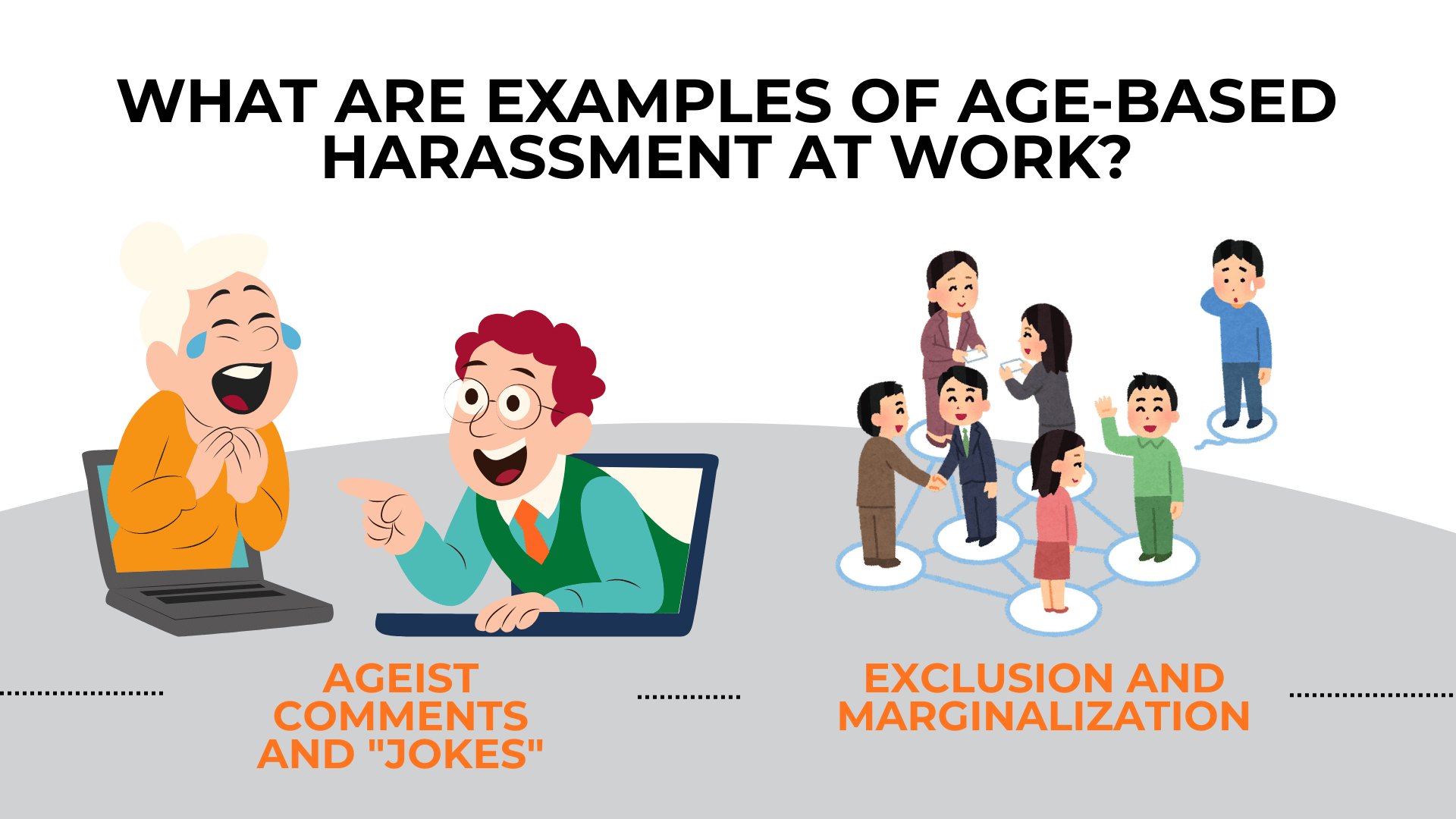
Ageist Comments and “Jokes”
The AARP (2024-2025) found that 60% of workers age 50 and older have experienced subtle forms of age discrimination, including comments and assumptions. Common examples of ageist language include:
- Being called a “dinosaur,” “old-timer,” or told you’re “over the hill”
- Hearing you’re “too old to learn new tricks” or lack “fresh ideas”
- Receiving constant comments about when you plan to retire
- Being told the company needs “new blood” or “younger energy”
- Jokes about memory loss, physical limitations, or being out of touch
- Comments suggesting you can’t keep up or should “make way” for younger workers
- References to your age during meetings or in emails, even when framed as humor
Exclusion and Marginalization
Beyond verbal harassment, discrimination often manifests through exclusion. Older workers may find themselves left out of important meetings, removed from email chains, or excluded from social events that include younger colleagues. Being passed over for visible projects or client interactions while younger employees receive these opportunities can contribute to a hostile environment.
When Harassment Becomes Legally Actionable
Not every offensive comment creates a legal claim. Courts assess the totality of circumstances, including the frequency and severity of conduct, whether it’s physically threatening or humiliating, and whether it interferes with work performance. A single isolated comment rarely suffices, but New Jersey courts have recognized that an extremely severe incident—particularly from a high-ranking official—can sometimes be actionable on its own, as established in Taylor v. Metzger, 152 N.J. 490 (1998).
What Are Subtle Forms of Age Discrimination?
Much age discrimination operates below the surface through assumptions and differential treatment that accumulates over time. These subtle forms affect career trajectory and workplace experience even when they don’t involve explicit age-based statements.
Assumptions About Abilities
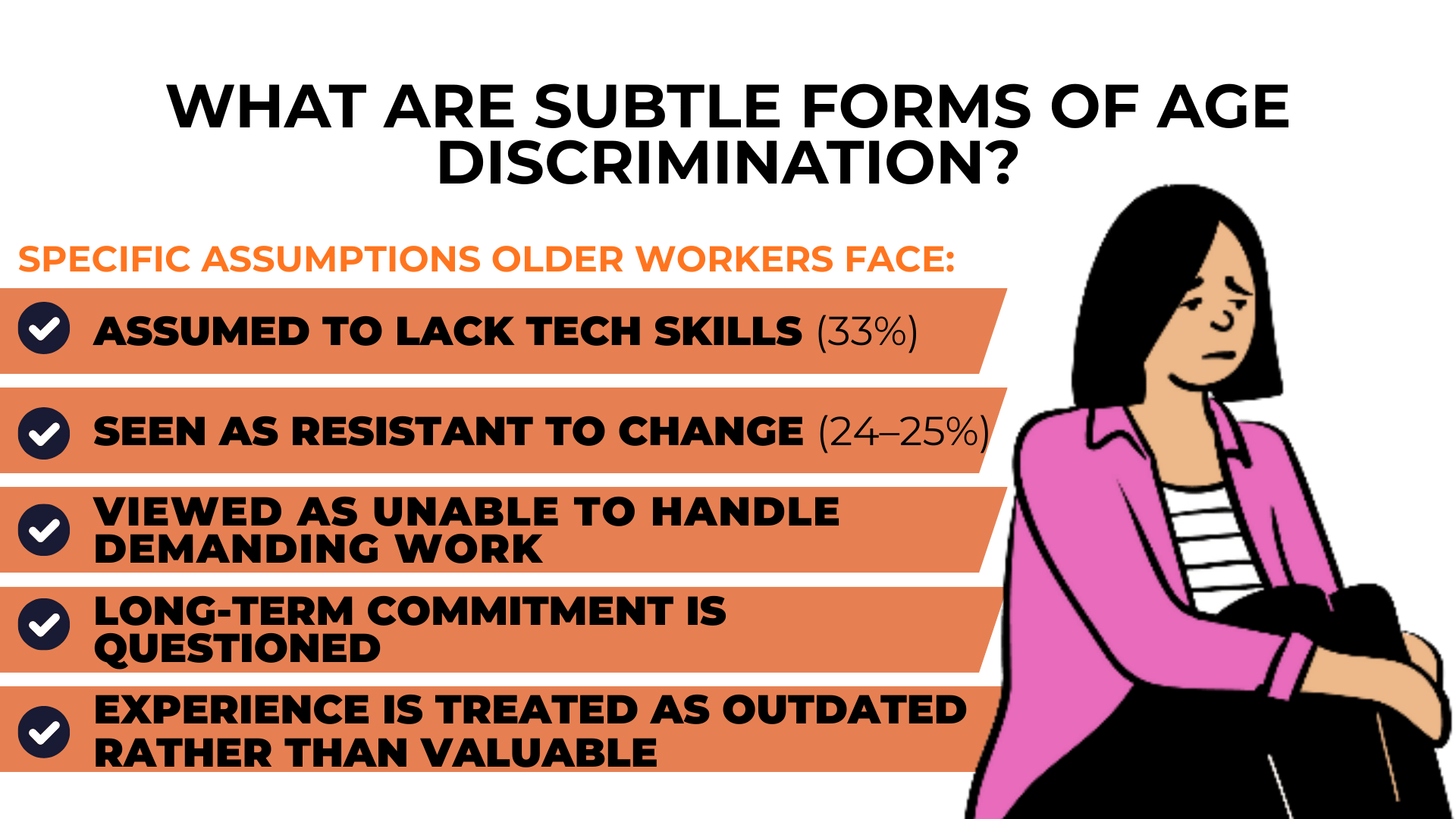
Survey data from AARP (2024-2025) documents specific assumptions older workers face:
- 33% experience assumptions that they lack technology skills
- 24-25% encounter beliefs that they’re resistant to change
- Colleagues assume they can’t handle demanding projects or tight deadlines
- Supervisors question whether they’re committed long-term to the organization
- Coworkers treat their knowledge and experience as outdated rather than valuable
These assumptions often operate unconsciously but produce measurable disparities in how older workers are treated compared to younger colleagues with similar qualifications.
Differential Treatment in Development Opportunities
The AARP (2024-2025) found that 20% of workers 50 and older receive less training than their younger counterparts. When employers invest in developing younger employees while excluding older workers from training programs, conferences, or advancement opportunities, it can constitute discrimination in terms and conditions of employment—even without an explicit termination or demotion.
Who Is Protected from Age Discrimination?
Understanding whether you fall within the protected class is essential to evaluating any potential claim. Coverage varies significantly between federal law and state laws in Pennsylvania and New Jersey.
Federal and Pennsylvania Protection
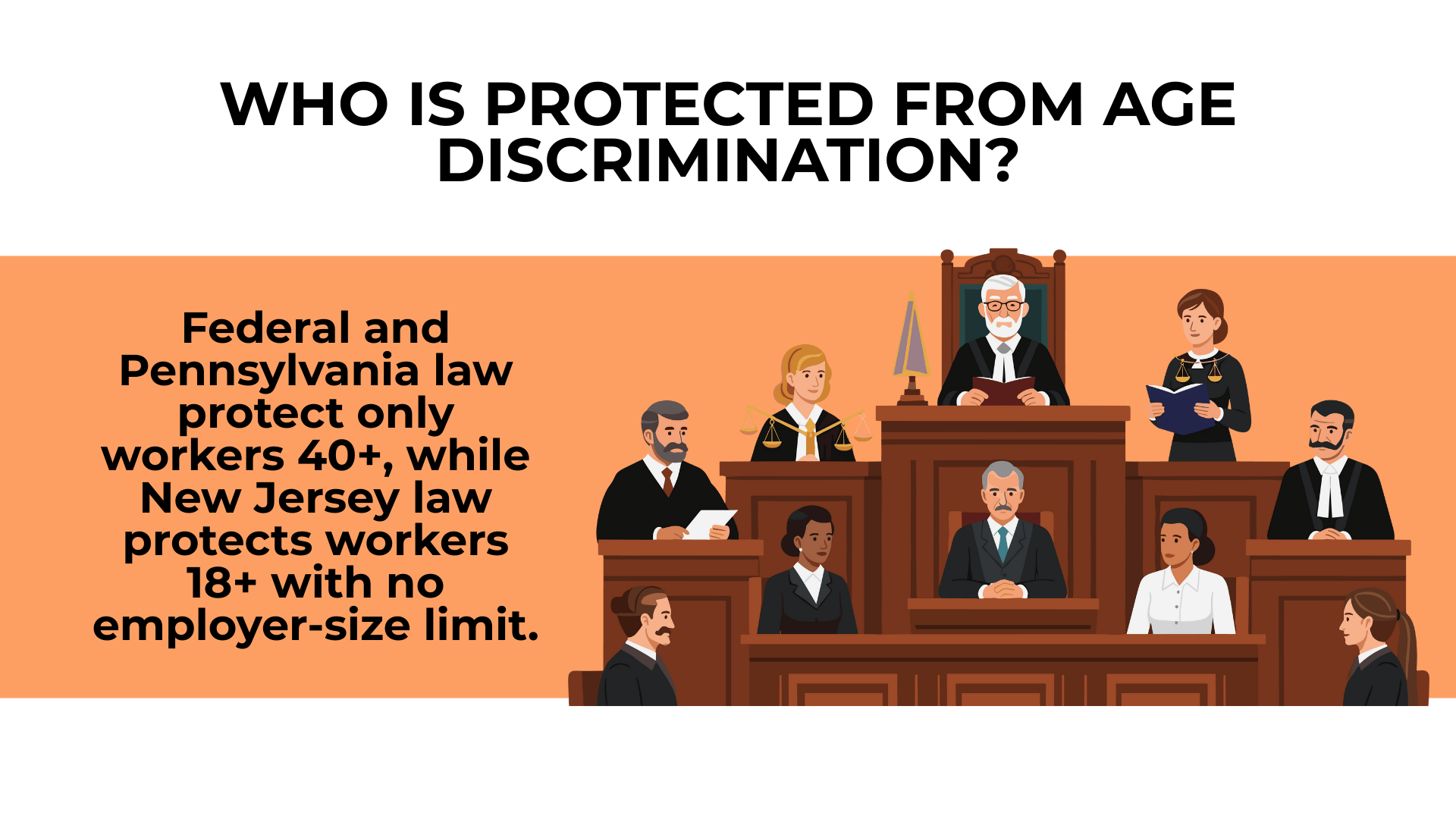
Under the Age Discrimination in Employment Act (ADEA), 29 U.S.C. § 631(a), workers age 40 and older are protected from age discrimination. Federal law applies to employers with 20 or more employees, per 29 U.S.C. § 630(b). Pennsylvania’s Human Relations Act (PHRA), 43 P.S. § 954(b), similarly protects workers 40 and older but applies to smaller employers—those with four or more employees.
New Jersey’s Broader Coverage
New Jersey’s Law Against Discrimination (LAD), N.J.S.A. 10:5-12(a), provides the most expansive protection. The LAD covers workers age 18 and older, as established in Bergen Commercial Bank v. Sisler, 157 N.J. 188 (1999), meaning even younger workers can bring claims if discriminated against because of their age. The LAD also has no minimum employer size, covering all New Jersey employers regardless of how many people they employ.
This means a 25-year-old passed over for promotion in favor of a 22-year-old could potentially have a claim in New Jersey, while the same situation would not be covered under federal or Pennsylvania law.
How Widespread Is Age Discrimination Today?
Understanding the scope of age discrimination validates individual experiences and demonstrates that enforcement agencies take these claims seriously.
Survey Data on Worker Experiences
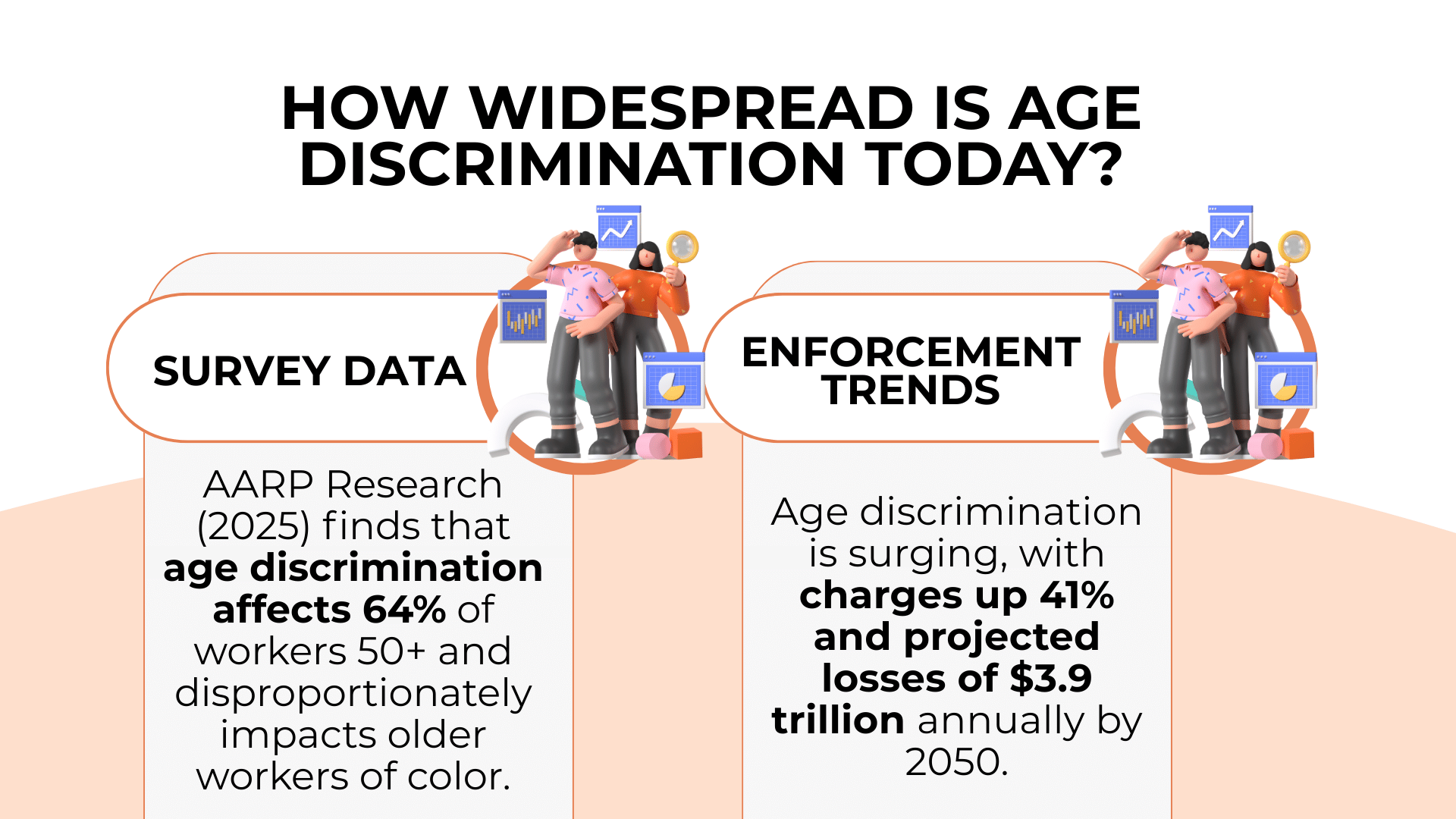
The prevalence of age discrimination is documented across multiple research sources. According to AARP Research (2025), 64% of workers age 50 and older have seen or experienced age discrimination. The same research found that 22% feel they are actively being pushed out of their current job because of their age.
Racial disparities compound the problem. AARP Research (2025) found that 74% of African American/Black workers over 50, 67% of Asian American/Pacific Islander workers, and 62% of Hispanic/Latino workers have experienced age discrimination—rates exceeding those of workers overall.
Enforcement Trends and Charge Filings
Age discrimination complaints are increasing substantially. According to the EEOC Enforcement and Litigation Statistics (2025), 16,223 age discrimination charges were filed in fiscal year 2024—a 41% increase from the 11,500 charges filed in fiscal year 2022. This upward trend signals that workers are increasingly willing to come forward.
The economic toll is staggering. AARP and The Economist Intelligence Unit (2020) estimated that age discrimination cost the U.S. economy $850 billion in lost GDP in 2018, with projected losses reaching $3.9 trillion annually by 2050 if current patterns continue.
Frequently Asked Questions
Is being called “overqualified” a form of age discrimination?
When employers use “overqualified” to reject experienced applicants, it can mask age bias. Courts have recognized this term as potential evidence of discrimination when used disproportionately against older candidates or combined with other age-related factors in the hiring process.
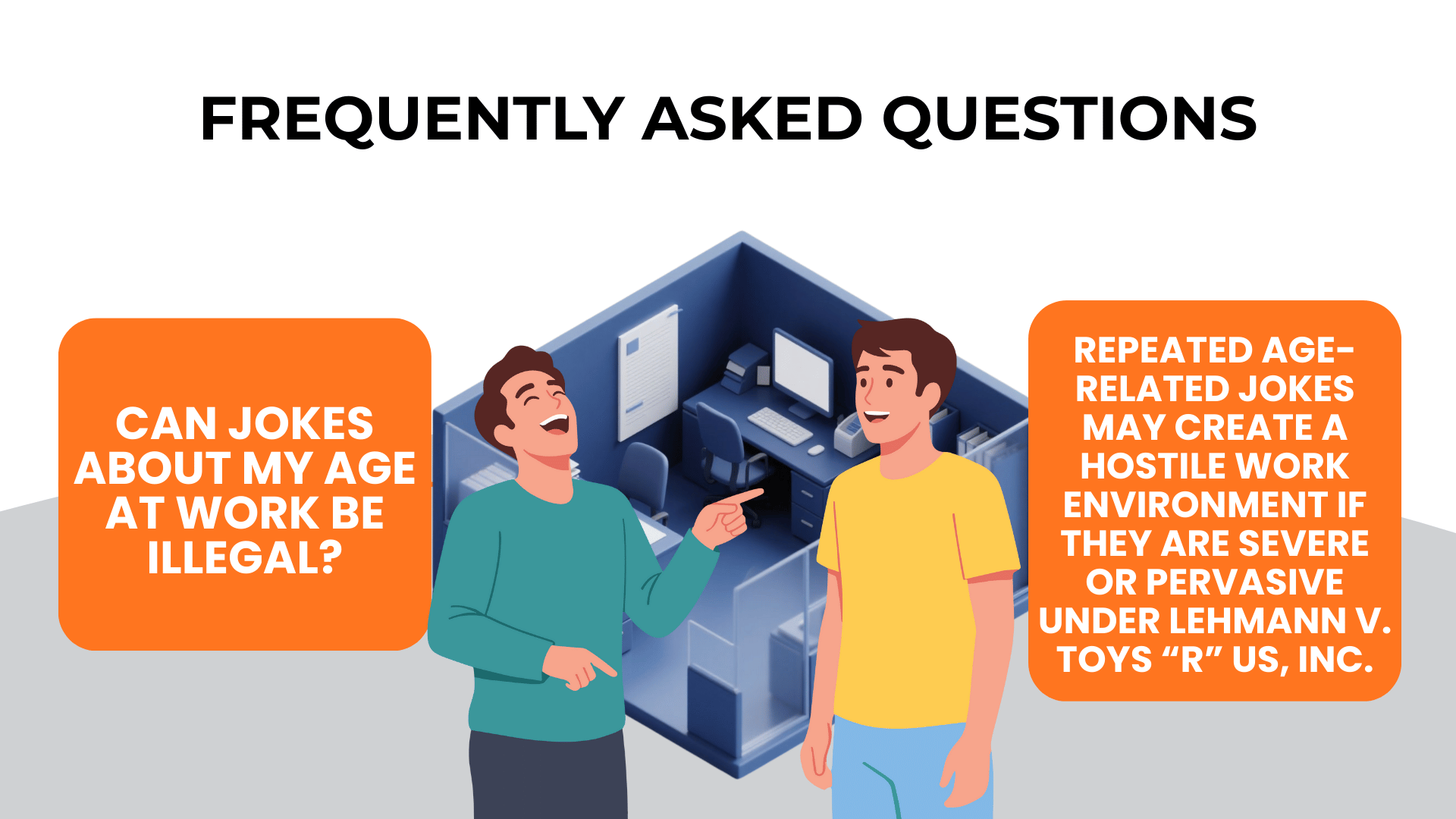
Can jokes about my age at work be illegal?
Age-related jokes can contribute to a hostile work environment claim when they are severe or pervasive enough to alter working conditions. A single comment rarely qualifies, but ongoing comments about retirement, being a “dinosaur,” or struggles with technology may collectively create an actionable hostile environment under the standard established in Lehmann v. Toys ‘R’ Us, Inc., 132 N.J. 587 (1993).
Does my employer need to say “you’re too old” for it to be discrimination?
No. Direct statements about age are rare. Most age discrimination is proven through circumstantial evidence—patterns like replacing older workers with younger ones, excluding older employees from opportunities, or applying policies that disproportionately affect workers over 40.
What if my company laid off mostly older workers during a restructuring?
When layoffs disproportionately affect older workers, it may indicate age discrimination even without explicit age-based statements. Statistical patterns showing older workers were selected at higher rates, combined with other evidence of discriminatory intent, can support a reduction-in-force discrimination claim.
I’m under 40—can I still face age discrimination?
In New Jersey, yes. The NJ Law Against Discrimination protects workers age 18 and older from age-based discrimination. Federal law under the ADEA and Pennsylvania law under the PHRA only protect workers 40 and older.
Taking the Next Step
Recognizing age discrimination is often the hardest part. The examples discussed here—from termination patterns and hiring callbacks to ageist harassment and subtle exclusion—represent the documented experiences of millions of workers. The 41% increase in EEOC age discrimination charges between 2022 and 2024 reflects growing awareness that this treatment is not just unfair but illegal.
If you recognize these patterns in your own workplace experience, documenting specific incidents with dates, witnesses, and context creates a foundation for evaluating your options. Both Pennsylvania and New Jersey have time limits for filing complaints, so understanding whether your situation may be actionable sooner rather than later preserves your ability to act.
If you have questions about age discrimination in your workplace, contact The Lacy Employment Law Firm to discuss your situation.