Sexual harassment at work takes many forms, and recognizing illegal conduct is the first step toward protecting yourself. You might wonder whether the comments your supervisor makes cross a line, whether that unwanted touch was serious enough to matter, or whether the images a coworker keeps showing you constitute harassment. These questions are common, and the answers depend on understanding what behaviors the law actually prohibits.
Both federal law and the New Jersey Law Against Discrimination make sexual harassment illegal. According to the EEOC Select Task Force on the Study of Harassment in the Workplace (2016), between 25% and 85% of women report experiencing workplace sexual harassment, depending on how surveys define the conduct. That wide range reflects how many people struggle to identify whether what happened to them qualifies. This article provides concrete examples to help you recognize harassment and understand your options.
What Behaviors Qualify as Sexual Harassment at Work?
Sexual harassment includes unwelcome sexual advances, requests for sexual favors, and other verbal or physical conduct of a sexual nature that affects your employment or creates a hostile environment. The key word is “unwelcome.” Conduct you did not invite, did not want, and found offensive or intimidating may qualify as harassment under the law.
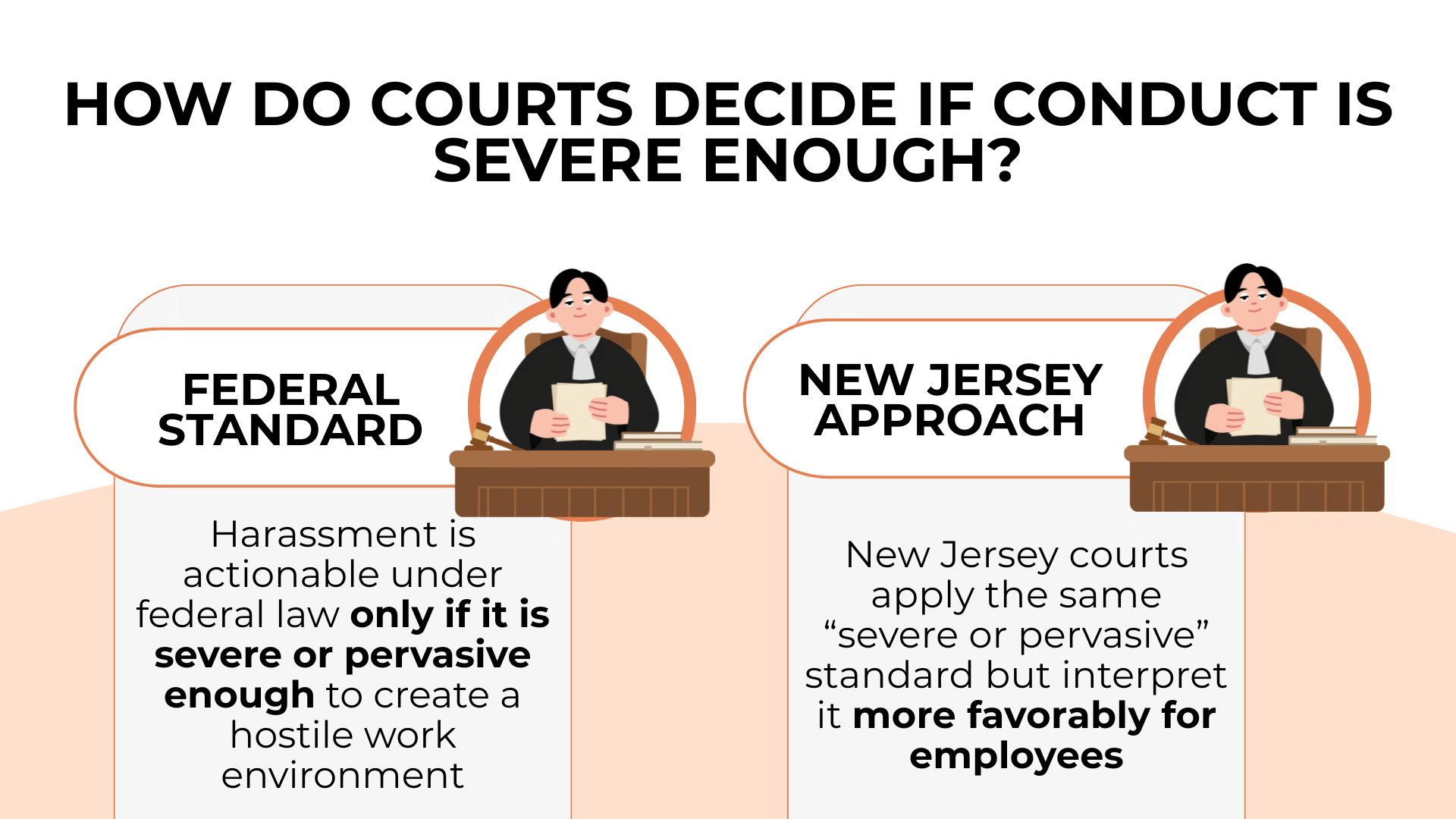
Courts and enforcement agencies recognize several categories of harassing conduct. Understanding these categories helps you identify whether your experience fits within the legal definition.
Physical conduct examples
Physical harassment involves unwanted bodily contact or invasion of personal space. The following behaviors may constitute sexual harassment:
- Touching, rubbing, or brushing against someone’s body without consent
- Hugging, kissing, or patting someone in ways that feel uncomfortable or inappropriate
- Cornering someone or blocking their path to create physical intimidation
- Massaging someone’s shoulders, neck, or back without permission
- Grabbing, groping, or pinching any part of someone’s body
- Sexual assault or attempted sexual assault
Physical conduct often carries significant weight in harassment claims because it involves direct bodily violation. However, harassment does not need to be physical to be illegal.
Verbal harassment examples
Verbal harassment includes spoken or written comments of a sexual nature. These behaviors may create a hostile work environment:
- Making sexual jokes, comments, or innuendos about someone’s body or appearance
- Asking repeated questions about someone’s sex life or dating status
- Requesting sexual favors or propositioning someone for dates after they have declined
- Making crude or offensive remarks about sex or gender
- Spreading sexual rumors about a coworker
- Using sexually degrading words to describe someone
Verbal harassment can be just as damaging as physical conduct. Repeated comments that demean, objectify, or sexualize an employee can make the workplace intolerable.
Visual and digital harassment examples
Visual harassment involves images, gestures, or electronic communications. The following conduct may qualify:
- Displaying sexually explicit pictures, posters, or screensavers in the workplace
- Sending emails, texts, or social media messages with sexual content
- Sharing pornographic images or videos with coworkers
- Making sexual gestures or suggestive facial expressions
- Staring, leering, or making prolonged inappropriate eye contact
- Showing someone explicit content on a phone or computer
Digital harassment has become increasingly common. Text messages, emails, and social media communications are evaluated the same way as in-person conduct.
How Do Courts Decide If Conduct Is Severe Enough?
Not every offensive comment or awkward interaction rises to the level of illegal harassment. Courts apply a legal standard to determine whether conduct crosses the line from merely unpleasant to unlawful.
The federal standard
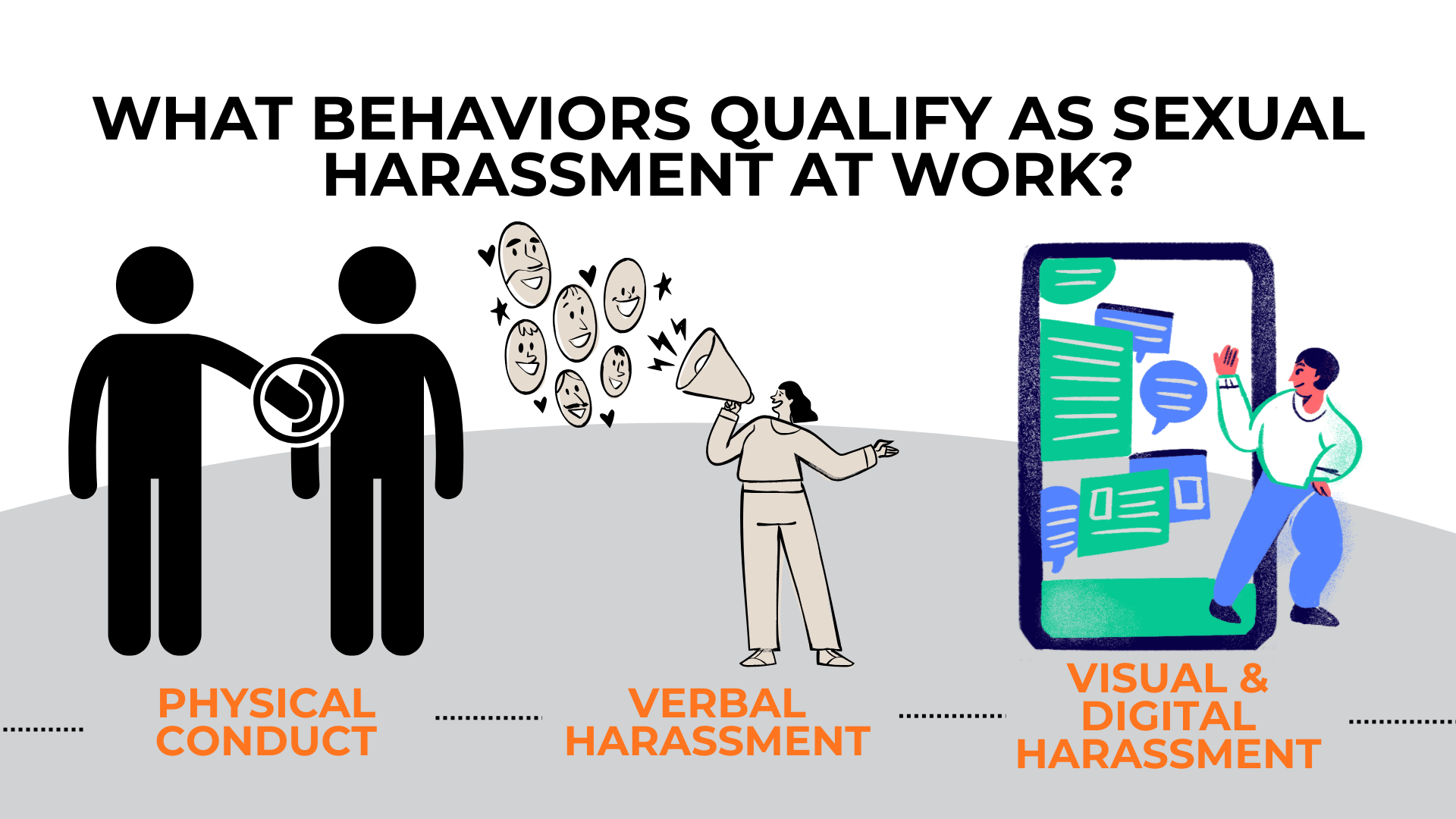
Under federal law, harassment must be “severe or pervasive” enough to alter the conditions of employment and create a hostile or abusive work environment. Courts established this standard in Harris v. Forklift Systems, Inc., 510 U.S. 17 (1993), and evaluate the totality of circumstances, including:
- How frequently the conduct occurred
- How severe each incident was
- Whether the conduct was physically threatening or humiliating
- Whether it unreasonably interfered with work performance
New Jersey’s more protective approach
New Jersey courts apply the same “severe or pervasive” language but interpret it more favorably for employees. In Taylor v. Metzger, 152 N.J. 490 (1998), the New Jersey Supreme Court held that a single racial slur by a supervisor created an actionable hostile environment. The court emphasized that supervisor conduct “greatly magnifies the gravity of the comment.”
More recently, in Rios v. Meda Pharmaceutical, Inc., 247 N.J. 1 (2021), the New Jersey Supreme Court confirmed that two demeaning slurs can be “sufficiently severe or pervasive” to support a harassment claim. This means New Jersey employees may have viable claims even when federal courts might require additional incidents.
What Are Examples of Hostile Work Environment Harassment?
Hostile work environment harassment typically involves a pattern of conduct that makes the workplace intimidating, offensive, or abusive. The cumulative effect matters as much as any single incident.
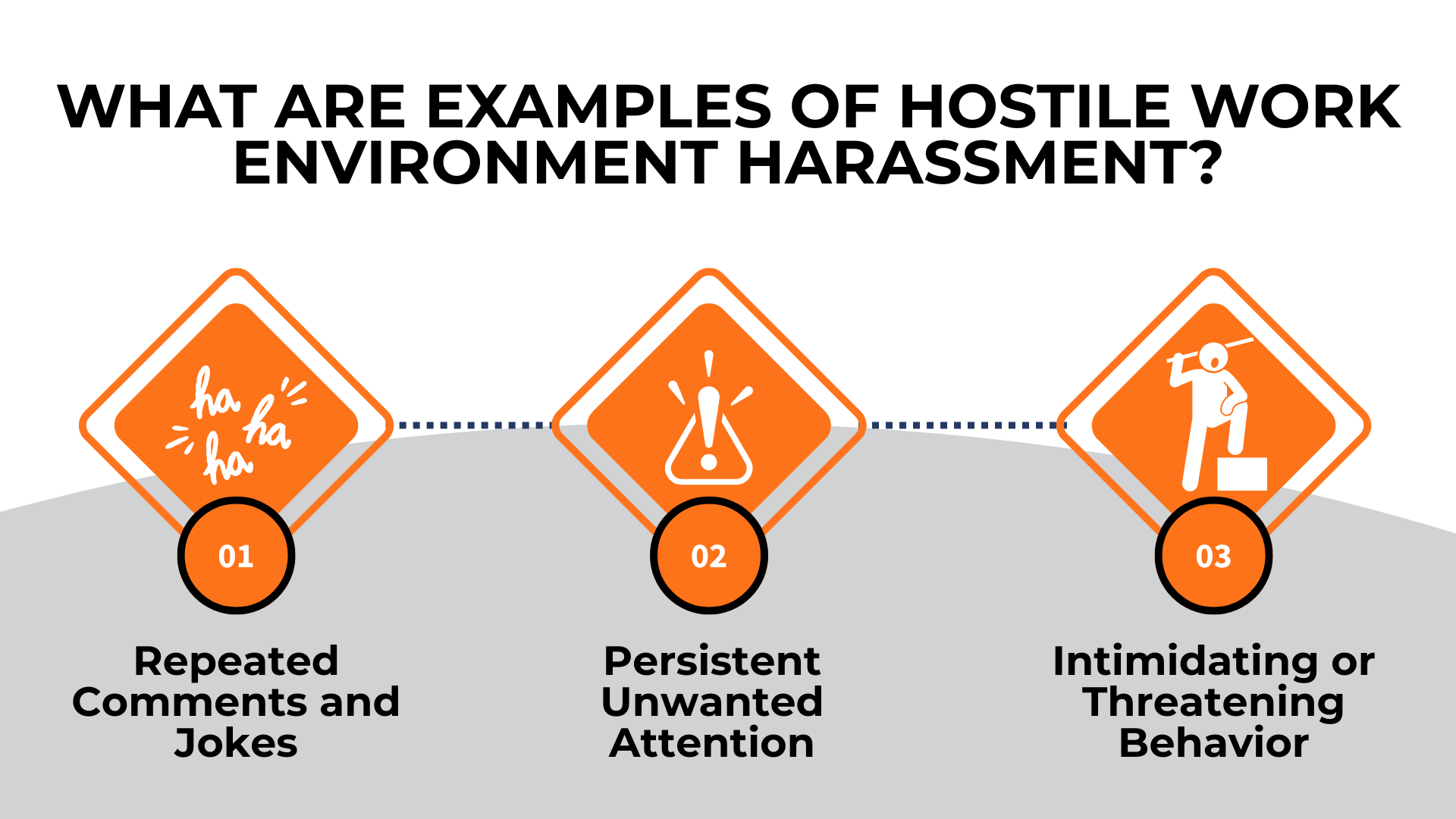
Repeated comments and jokes
Ongoing sexual remarks can poison a workplace even when each individual comment seems minor. Examples include a supervisor who regularly comments on employees’ bodies during meetings, coworkers who share sexual jokes despite being asked to stop, or a manager who makes daily remarks about an employee’s attractiveness.
Persistent unwanted attention
Some harassers focus their conduct on a specific target through unwanted romantic or sexual pursuit. This includes asking someone out repeatedly after they have said no, following someone around the workplace or to their car, sending flowers or gifts after being told the attention is unwelcome, or monitoring someone’s schedule and showing up wherever they go.
Intimidating or threatening behavior
Harassment can involve conduct designed to frighten or coerce. Examples include threatening job consequences if someone reports harassment, using physical size or position to intimidate, or creating an atmosphere where employees fear speaking up.
The following behaviors commonly appear in hostile work environment claims:
- Supervisors rating employees’ bodies or making comments about their sexual desirability
- Coworkers displaying sexual images despite complaints
- Managers telling sexual jokes at meetings or in common areas
- Employees receiving sexually explicit emails or texts from colleagues
- Workers being subjected to ongoing comments about their gender or sexuality
- Staff being touched inappropriately during work interactions
- Employees facing retaliation threats when they object to conduct
- Workers being excluded from opportunities because they rejected advances
What Are Examples of Quid Pro Quo Harassment?
Quid pro quo harassment occurs when someone in authority conditions job benefits on sexual submission or punishes an employee for rejecting sexual advances. This type of harassment requires a supervisor or someone with power over employment decisions.
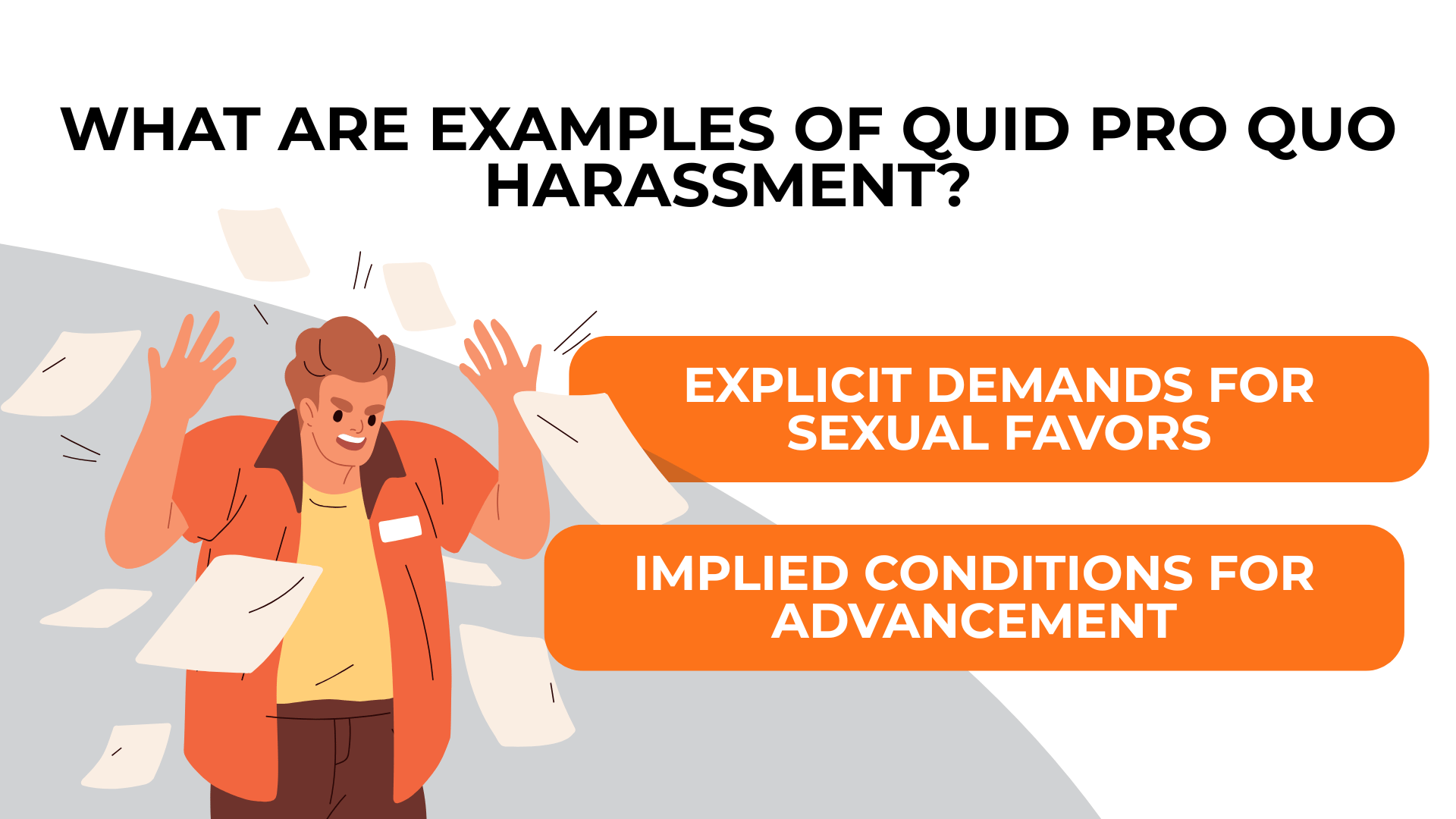
Explicit demands for sexual favors
Direct quid pro quo harassment involves clear propositions tied to employment. Examples include a manager telling an employee they will receive a promotion if they go on a date, a supervisor demanding sexual acts in exchange for not being fired, or a hiring manager offering a job in return for sexual favors.
When this type of harassment results in a tangible employment action—such as termination, demotion, or denial of a promotion—the employer is strictly liable under Burlington Industries, Inc. v. Ellerth, 524 U.S. 742 (1998). The employer cannot escape responsibility by claiming it had a harassment policy or that the employee failed to complain.
Implied conditions for advancement
Not all quid pro quo harassment involves explicit demands. Sometimes the message is communicated through implication. A supervisor might consistently promote employees who accept their romantic advances while passing over those who decline. A manager might give favorable assignments to employees who tolerate inappropriate touching. A boss might hint that career success depends on being “friendly” in ways that suggest sexual availability.
According to the EEOC Data Highlight on Sexual Harassment (2022), $299.8 million was recovered for sexual harassment claims between FY 2018 and FY 2021, with $48 million coming from litigation. These recoveries demonstrate that quid pro quo and hostile environment claims can result in substantial compensation.
Why Do Most Harassment Victims Stay Silent?
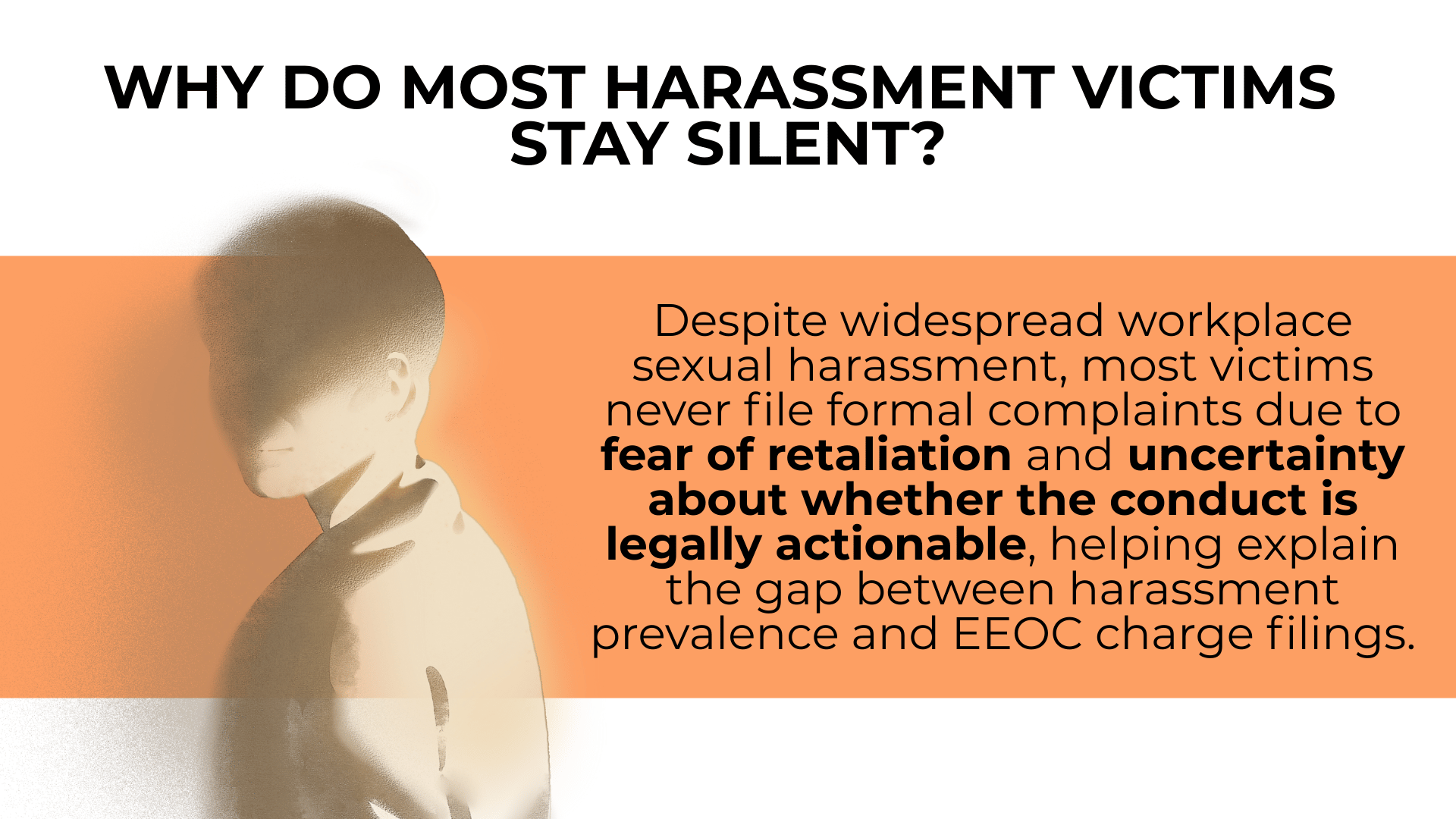
Despite the prevalence of workplace sexual harassment, the vast majority of those who experience it never take formal action. Understanding why helps explain the gap between harassment rates and charge filings.
Fear of retaliation
According to the EEOC Data Highlight on Sexual Harassment (2022), 43.5% of sexual harassment charges filed between FY 2018 and FY 2021 included concurrent retaliation claims. This statistic reveals how commonly harassment victims face adverse consequences for speaking up. Employees worry about being fired, demoted, given unfavorable assignments, or subjected to a hostile response from coworkers.
The fear is rational. Retaliation happens frequently enough that nearly half of those who file harassment charges also report retaliatory conduct. However, retaliation itself is illegal, and employees have legal protections when they report harassment in good faith.
Uncertainty about whether conduct qualifies
According to the EEOC Select Task Force on the Study of Harassment in the Workplace (2016), approximately 90% of individuals who experience harassment never file a formal charge. Many question whether their experience was “bad enough” to warrant action. They may minimize what happened, compare their situation to more extreme cases, or worry they will not be believed.
This self-doubt keeps many valid claims from ever being pursued. The examples throughout this article demonstrate that harassment takes many forms, and conduct does not need to be extreme to be illegal.
What Evidence Should You Document?
If you believe you are experiencing sexual harassment, documentation strengthens your position whether you decide to file an internal complaint, pursue an agency charge, or consult with an attorney.
Types of evidence to preserve
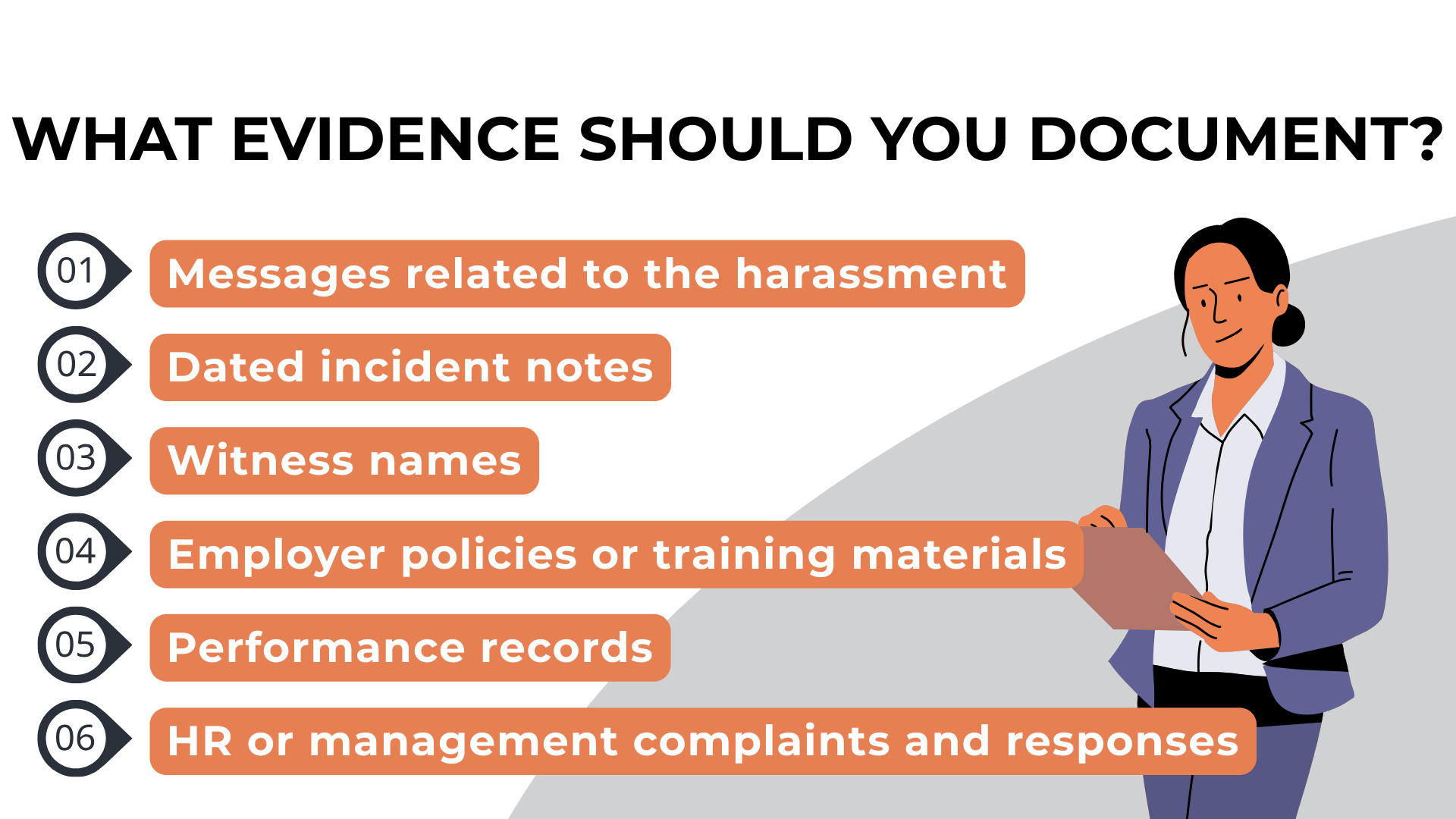
Building a record requires saving communications and identifying potential witnesses. Consider preserving the following:
- Emails, text messages, voicemails, and social media messages related to the harassment
- Written notes describing each incident with dates, times, locations, and specific language used
- Names of witnesses who observed the conduct or heard about it
- Copies of your employer’s anti-harassment policy and any training materials you received
- Performance reviews and other employment documents showing your work history
- Any written complaints you submitted to HR or management and their responses
Creating a timeline of incidents
A detailed timeline helps establish the pattern and frequency of harassment. Record what happened as close to each incident as possible, while details remain fresh. Note the specific words used, any witnesses present, and how the conduct affected your work or well-being.
Speaking with an attorney can help you understand what evidence matters most for your situation and what steps to take next.
What Protections Does New Jersey Law Provide?
New Jersey employees have stronger protections than federal law alone provides. The New Jersey Law Against Discrimination offers several advantages that can significantly affect your claim.
Coverage for all employers
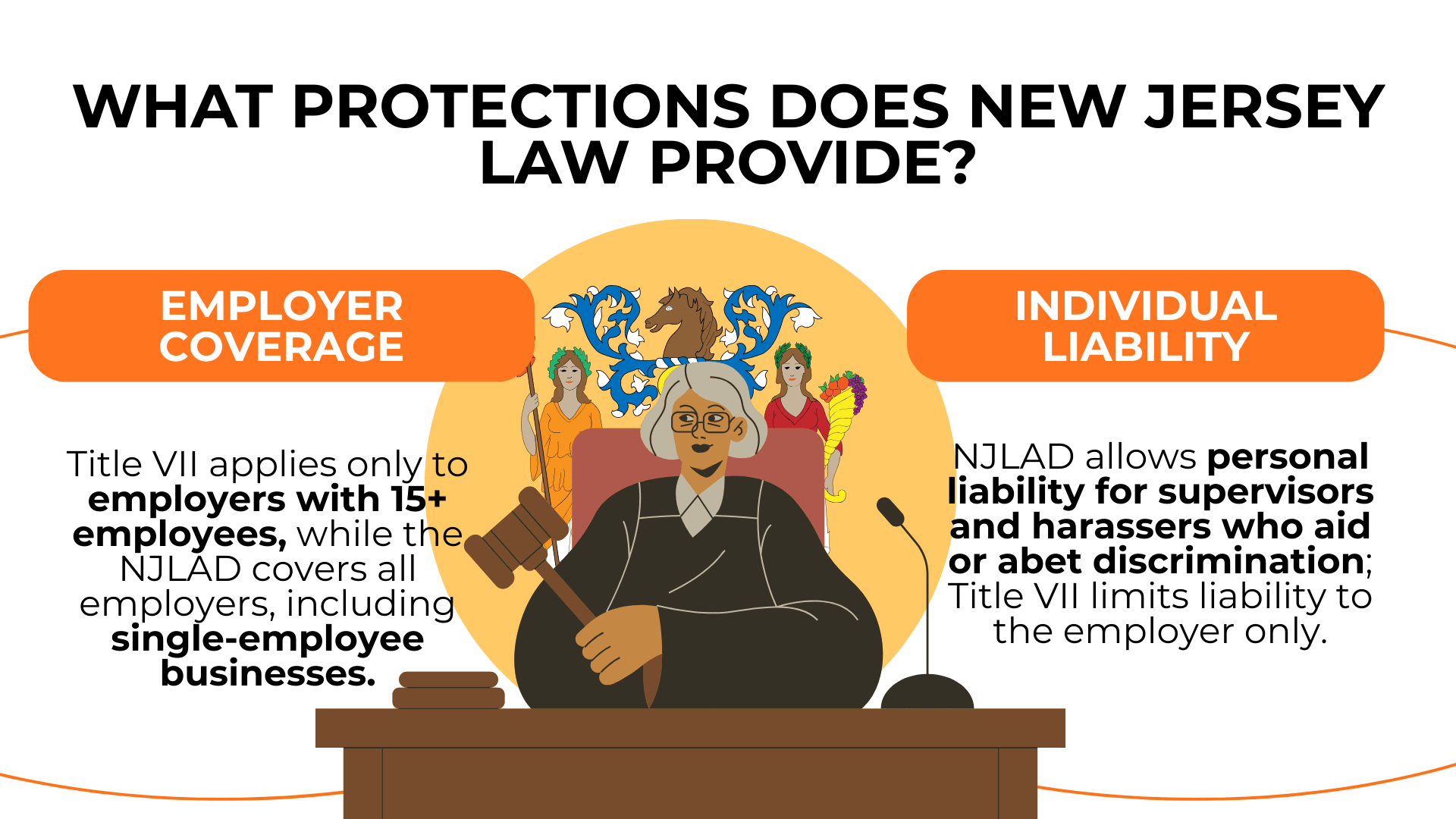
Title VII only applies to employers with 15 or more employees. The NJLAD applies to all employers regardless of size, including those with only one employee. This means workers at small businesses have state-law protections even when federal law does not cover them.
Additionally, under N.J.S.A. 10:5-12(e), individual supervisors and harassers can be held personally liable for aiding and abetting discriminatory conduct. Title VII does not allow individual liability—only the employer entity can be sued. This creates additional accountability and potential recovery under New Jersey law.
Filing deadlines you must know
Timing matters in harassment cases. Different filing options have different deadlines:
For federal claims, you must file a charge with the EEOC within 300 days of the discriminatory act when filing in New Jersey. After the EEOC issues a right-to-sue letter, you have 90 days to file in federal court.
For New Jersey state claims, you can file directly in Superior Court within two years of the harassment without first filing an administrative complaint. This is a significant advantage because it provides more time and preserves your right to a jury trial with full discovery.
According to EEOC Charge Statistics by State (FY 2022), 1,270 total EEOC charges were filed from New Jersey, with 281 involving sex-based discrimination. These numbers represent only a fraction of actual harassment given the high underreporting rate.
Frequently Asked Questions
Can a single incident qualify as sexual harassment?
Yes, particularly under New Jersey law. While federal courts often require a pattern of conduct, New Jersey courts have held that a single sufficiently severe incident can create an actionable hostile environment. In Taylor v. Metzger, 152 N.J. 490 (1998), the New Jersey Supreme Court found that one racial slur by a supervisor was enough. The Rios v. Meda Pharmaceutical decision confirmed that even two demeaning comments can suffice when severe enough.
Does sexual harassment have to be physical?
No. Verbal comments, visual displays, and digital communications can all create a hostile work environment. Courts evaluate the totality of circumstances, and verbal harassment that is sufficiently severe or pervasive is just as actionable as physical conduct. Many successful claims involve no physical contact at all.
Can harassment happen through text messages or emails?
Yes. Digital communications are evaluated the same way as in-person conduct. Sexually explicit texts, inappropriate emails, offensive social media messages, and similar electronic communications can contribute to or independently establish a hostile work environment claim.
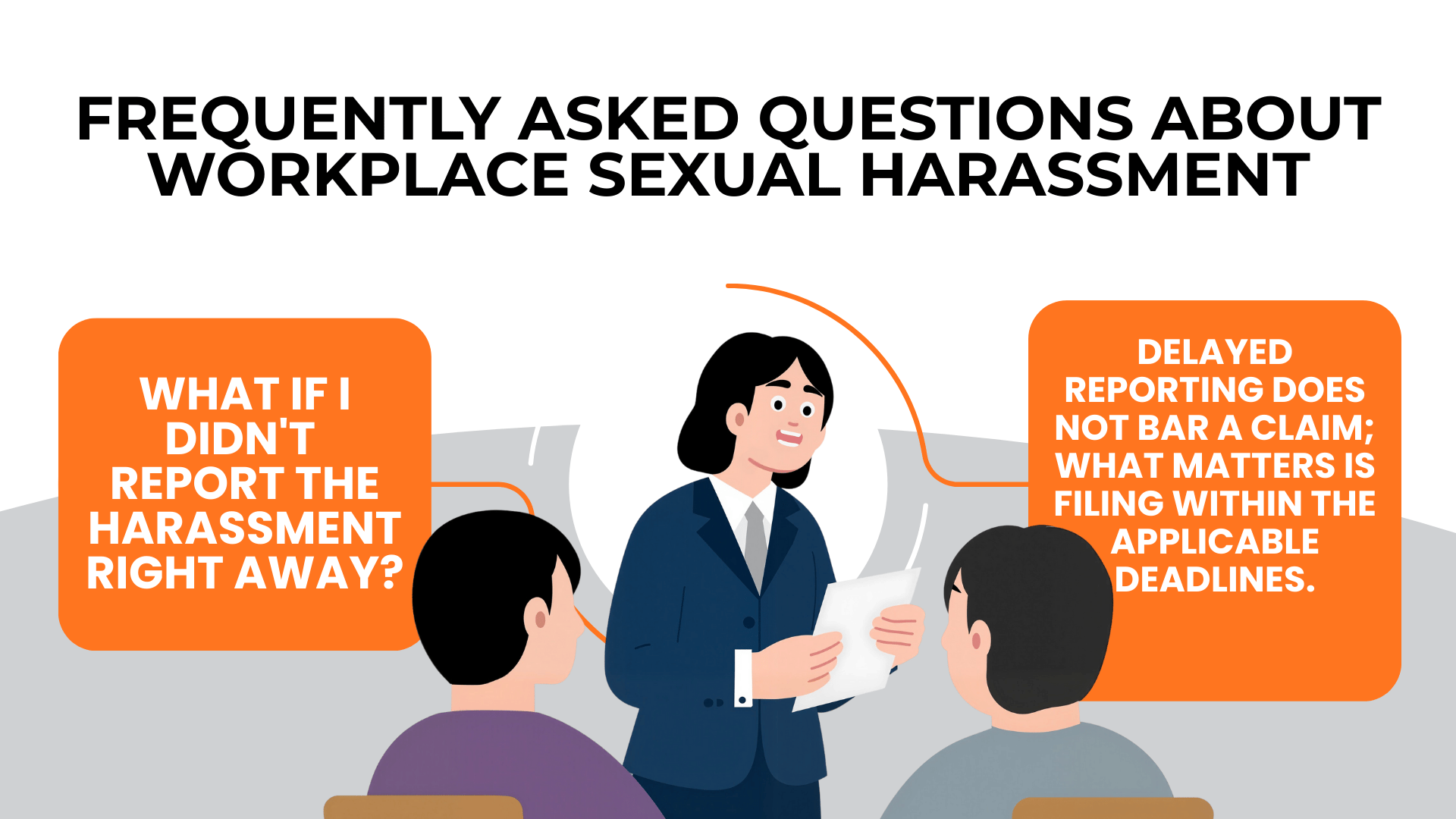
What if I didn’t report the harassment right away?
Delayed reporting does not automatically bar your claim. Many employees wait to report for valid reasons, including fear of retaliation and uncertainty about whether the conduct qualifies. According to the EEOC, 90% of those who experience harassment never file formal charges. What matters most is filing within the applicable deadlines: 300 days for an EEOC charge or two years for a New Jersey Superior Court filing.
Can men be victims of sexual harassment?
Yes. According to the EEOC Data Highlight on Sexual Harassment (2022), men filed 21.8% of sexual harassment charges between FY 2018 and FY 2021. Sexual harassment laws protect all employees regardless of gender, and men face the same protections as women when subjected to unwelcome sexual conduct.
Taking Action on What You’ve Learned
Recognizing sexual harassment is essential, but understanding your options matters equally. The behaviors described throughout this article—from unwanted touching to persistent sexual comments to job threats tied to sexual demands—can all form the basis of legal claims under federal and New Jersey law.
According to the EEOC Office of General Counsel Fiscal Year 2024 Annual Report, the agency achieved a 97% favorable resolution rate in district court litigation during FY 2024. When meritorious cases move forward, outcomes strongly favor employees.
New Jersey’s protections are particularly strong. No employer is too small to be covered, damages are uncapped, and courts have shown willingness to find single incidents actionable when sufficiently severe. Filing deadlines create urgency, but you have options for pursuing claims under both federal and state law.
If you have questions about sexual harassment at work, contact The Lacy Employment Law Firm to discuss your situation.